BY SAL GRECO
The criminal prosecution of Los Angeles Police Department Officer Daniel Flores has become much more than a dispute over California’s recording laws.
It has become a test of how a major American police department handles an officer who documents alleged misconduct inside his own workplace—and what happens when the internal affairs process, administrative discipline and criminal prosecution begin colliding with one another.
On Monday, August 10, Flores pleaded not guilty to 16 felony counts of eavesdropping stemming from recordings he made of fellow LAPD employees. CBS Los Angeles reports prosecutors allege Flores secretly recorded coworkers 122 times while assigned to the LAPD Recruitment and Employment Division in 2024. If convicted, he potentially faces up to 13 years in prison.
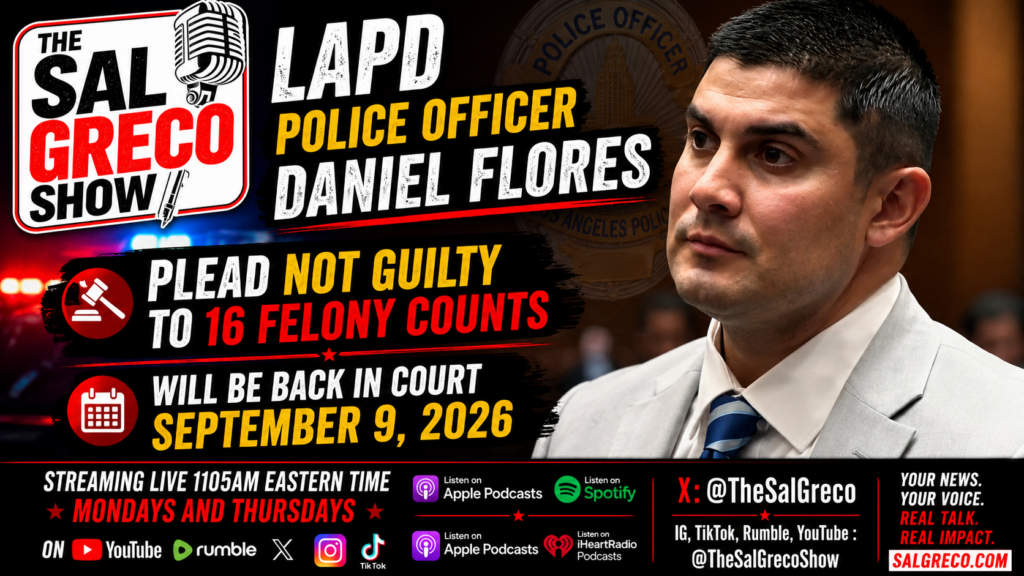
But before Flores ever walked into a Los Angeles courtroom for his arraignment, The Sal Greco Show examined many of these questions in Episode 218 with retired LAPD Sergeant Marlon Marrache, whose perspective was particularly important because Marrache did not approach this simply as another commentator looking at a controversial police story.
He spent 24 years with the LAPD and has worked in the world of internal affairs since 2008. Marrache explained that he has taught internal-affairs investigations in California and elsewhere and has worked as a consultant and expert in IA-related matters.
That background matters because Episode 218 was not merely about whether people personally approved or disapproved of Flores secretly recording his coworkers.
Marrache broke down what should happen inside a law-enforcement agency when allegations this serious surface—and why the sequence of events surrounding Flores raises difficult questions for the LAPD.
What Daniel Flores Says He Exposed
The underlying allegations are disturbing.
Flores has alleged that employees inside an LAPD unit responsible for recruitment and employment made racist, sexist and homophobic remarks. Atlanta Black Star reported that Flores collected roughly 90 recordings and ultimately turned recordings over in hopes that officers responsible for the comments would be disciplined.
CBS subsequently reported that Flores said he submitted complaints and more than 120 recordings to LAPD Internal Affairs and the Los Angeles Police Commission in January 2025.
The alleged comments reportedly included derogatory statements about Black people, women, gay people, Asians and Latinos. These allegations become even more troubling considering the employees involved worked in an area connected with determining who gets hired into the LAPD.
That distinction should not be lost.
This wasn’t allegedly happening at some private gathering completely disconnected from police business. According to the reporting and Flores’s lawsuit, the conversations involved employees working inside an LAPD recruitment operation.
Marrache made one point absolutely clear during Episode 218: whatever questions exist about Flores’s conduct, the underlying comments themselves should not be minimized.
He described the alleged remarks as completely unacceptable and inappropriate and said the employees accused of making them should go through the internal-affairs process.
That is an important distinction.
Condemning the alleged comments and questioning Flores’s recording methods are not mutually exclusive positions.
Marrache Explained How LAPD’s Internal Affairs System Actually Works
One of the most valuable portions of Episode 218 was Marrache’s explanation of what happens when serious misconduct allegations are sustained inside the LAPD.
He described a process in which serious accusations can eventually lead to a hearing resembling a tribunal or arbitration. The department presents evidence and witnesses, the accused employee presents a defense, and a panel determines whether allegations are proven. If an allegation is sustained, the matter proceeds into a penalty phase where employment history and character evidence can become relevant.
Then Marrache applied that process directly to Flores.
According to Marrache’s analysis, Flores effectively “rang the bell” by bringing forward extensive recordings documenting what he believed was serious misconduct. LAPD therefore had potentially serious allegations against the employees who were recorded.
But another investigation existed involving Flores himself.
Marrache noted reporting that command staff had recommended a 22-day suspension for Flores. Importantly, he repeatedly cautioned that the public did not yet know whether those administrative allegations were directly connected to the recordings or represented a separate matter.
That distinction remains important today.
Atlanta Black Star similarly reported that an LAPD administrative investigation found Flores responsible for policy violations and recommended a 22-day unpaid suspension, although that administrative decision had not been finalized as of its August 9 report.
Marrache’s Biggest Procedural Question: Why Didn’t LAPD Slow Everything Down?
This may have been the most consequential part of the Episode 218 discussion.
Marrache explained that when allegations potentially involve criminal conduct, agencies frequently allow the criminal process to proceed before completing a compelled administrative investigation.
He discussed California’s peace-officer procedural protections and the concept of “tolling,” explaining that pending criminal allegations can provide a reason to delay an administrative investigation.
His question was therefore straightforward:
If LAPD officials believed Flores’s recording activity potentially constituted a crime, when did they reach that conclusion?
And if they believed criminal exposure existed, why wasn’t the process structured accordingly from the beginning?
Marrache argued that LAPD should have conducted a substantial preliminary inquiry before rushing forward. In his assessment, once the case became public, political statements were made and competing processes were underway, the department had created a situation that became increasingly difficult to unwind.
That observation looks even more significant following Flores’s arraignment.
Flores Is Now Officially Fighting the Charges
Flores appeared in court Monday and pleaded not guilty to all 16 felony counts.
The Los Angeles Times reported that Flores said little during the hearing beyond acknowledging his speedy-hearing rights and entering his plea. His next court date was set for September 9.
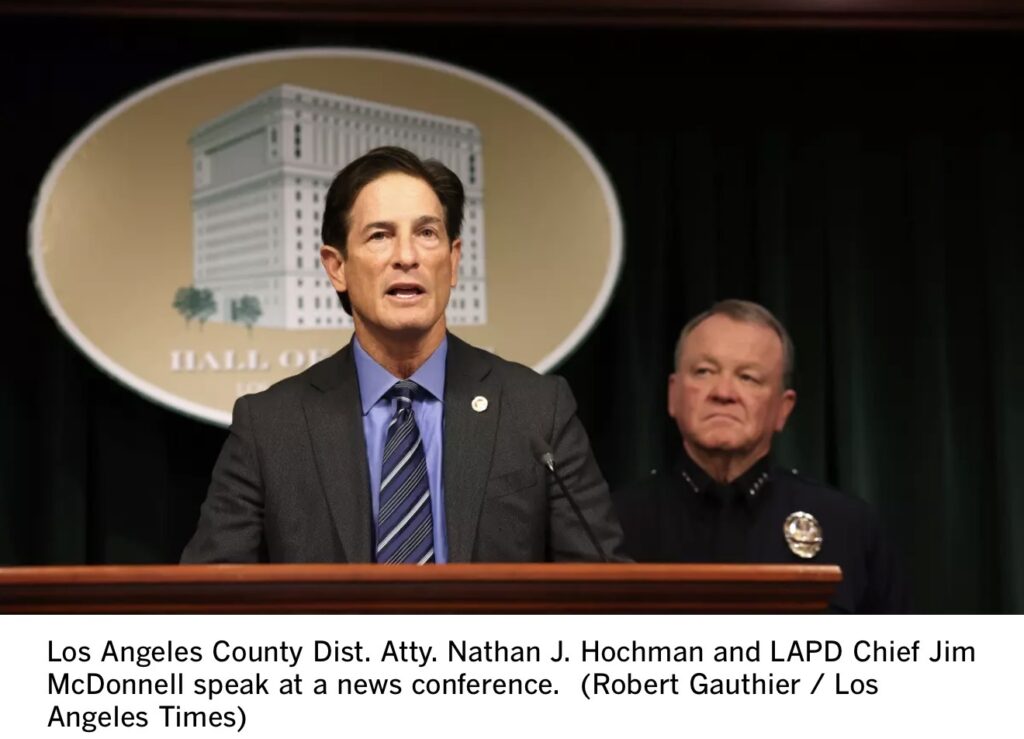
His attorney, Alan Jackson, has accused Los Angeles County District Attorney Nathan Hochman’s office of prosecutorial overreach.
CBS reported Jackson calling the prosecution “abusive” and arguing that Flores is being targeted after reporting racism within the department.
The defense’s basic argument creates an extraordinary image:
An LAPD officer says he encountered serious misconduct.
He recorded it.
He didn’t sell the recordings.
He didn’t publish them on social media.
According to his attorneys, he brought the evidence into the department.
And now he is the one standing in criminal court.
That does not automatically make the recordings legal. It does, however, explain why the prosecution has generated such intense controversy.
The Prosecution Says There Is Another Side
Any serious analysis must also examine what prosecutors are alleging about Flores himself.
Hochman’s office argues this wasn’t simply an altruistic whistleblower documenting misconduct.
According to CBS, prosecutors allege Flores sometimes participated in offensive conversations, altered recordings to remove portions reflecting his own participation, and was motivated at least partly by avoiding a transfer and potentially obtaining money through litigation against Los Angeles.
This issue was actually discussed during Episode 218.
On episode 218, Marrache asked what Flores’s motives and intentions were and whether the recordings could have been self-serving. But Marrache’s larger point was that those were precisely the kinds of questions investigators should be asking during a legitimate investigation.
In other words, questioning Flores’s motives doesn’t automatically invalidate what he recorded.
Likewise, proving that coworkers made abhorrent remarks would not automatically resolve whether Flores violated California law.
Both questions can exist simultaneously.
That nuance is getting lost in much of the public debate.
California’s Recording Law Is at the Center of the Criminal Case
California generally requires all parties to consent before a confidential conversation may legally be recorded.
Hochman’s position is that Flores crossed that line.
Atlanta Black Star reported Hochman’s warning that privacy protections apply regardless of whether the person making the recording is a neighbor, coworker or police officer.
Flores’s defense, however, is expected to argue that his circumstances fall within legal protections or exceptions because he was acting within the scope of his law-enforcement duties. His attorneys have also challenged whether some conversations had the required expectation of confidentiality.
Those aren’t questions for social media to decide.
They are legal questions that will ultimately have to be litigated.
And Flores is presumed innocent unless and until the prosecution proves its case.
Karen Bass Raises the Whistleblower Question
Perhaps one of the most unusual developments is that Los Angeles Mayor Karen Bass has publicly expressed concern about the prosecution.
Bass condemned the alleged racist, sexist and homophobic statements but warned that prosecuting Flores could send the wrong message and discourage future whistleblowers from exposing serious misconduct.
Episode 218 specifically discussed Bass’s position.
Marrache attempted to examine both sides rather than simply assuming political motives. He suggested it was possible LAPD command personnel had information about potential criminal implications that caused officials to reconsider how the case should proceed.
But he ultimately returned to his criticism of the process, saying LAPD had “dropped the ball” in how internal discussions and decision-making surrounding the case were handled.
That is an important point because the controversy isn’t simply about Flores anymore.
It is about institutional decision-making.
Even Prosecutors Are Reportedly Questioning Hochman’s Approach
The controversy intensified immediately before Flores’s arraignment.
The Los Angeles Times reported that Hochman’s office filed a lengthy document providing extensive details about the prosecution’s theory, including allegations concerning Flores’s motives and editing of recordings.
Flores’s attorneys accused Hochman of attempting to influence public perception before trial.
More remarkably, two anonymous Los Angeles County prosecutors told the Times that the filing was unusual, with one describing the approach as something prosecutors in the office normally do not file. Hochman defended his decision, saying detailed briefs promote due process and that he personally signed the filing because he stands behind the prosecution.
That dispute adds another layer to the case.
The battle is no longer simply:
LAPD versus Daniel Flores.
It now involves Flores’s attorneys challenging the district attorney’s handling of the prosecution, the mayor questioning the message the charges send to whistleblowers, the police chief supporting the legal process, and critics questioning whether the person who documented alleged misconduct is being treated more aggressively than those whose alleged conduct triggered the controversy.
Marrache’s Broader Warning About Internal Affairs
Episode 218 also went beyond Flores.
Marrache made a broader observation about internal-affairs systems that deserves attention.
He said large departments such as LAPD and NYPD need internal affairs and described it as a “necessary evil.” Major departments have enough personnel that investigators frequently can examine employees they have no personal relationship with.
But internal complaints involving harassment, discrimination and hostile-work-environment allegations can create different problems.
Marrache argued that certain internal cases may be better handled by independent third parties because personal relationships, favoritism, bias and nepotism can compromise confidence in an investigation.
His objective, he explained, should be gathering all relevant evidence so whoever ultimately adjudicates the case receives a fair and complete record.
That principle reaches far beyond Los Angeles.
A Familiar Question for SalGreco.com: What Happens to the Officer Who Speaks Up?
Readers of SalGreco.com should recognize the larger issue.
This website has repeatedly examined allegations involving internal affairs, whistleblowers, retaliation, selective discipline and the enormous power police departments possess when investigating their own employees.
Those cases aren’t identical to Flores’s, and they shouldn’t be treated as identical.
But the institutional question is remarkably familiar:
Can an internal-affairs system objectively investigate allegations that potentially embarrass the institution operating that very system?
That is why Marrache’s Episode 218 appearance was so important.
He isn’t arguing that Flores automatically gets a pass because the recordings allegedly exposed disgusting behavior.
He acknowledged the seriousness of the recording issue.
He acknowledged that investigators should examine Flores’s motives.
He acknowledged that there may be facts unavailable to the public.
But he also explained how the process is supposed to work from the perspective of someone who actually conducted LAPD internal-affairs investigations.
That experience makes his criticism of the process difficult to dismiss as mere anti-LAPD commentary.
The Question Isn’t Whether Two Things Can Be True
The Flores case should not be reduced to choosing between two simplistic narratives.
It is possible that LAPD employees made reprehensible comments deserving serious administrative consequences.
It is also possible that Flores violated California law in the manner in which he recorded them.
It is possible Flores had personal motives.
It is also possible that the recordings exposed genuine misconduct the department needed to know about.
And it is possible to believe in enforcing recording laws while simultaneously asking whether prosecuting an officer with 16 felonies and potential exposure of up to 13 years in prison creates a chilling effect for the next officer contemplating whether to document misconduct.
Those questions aren’t mutually exclusive.
They are exactly why this case deserves scrutiny.
Now the Courts Take Over
Daniel Flores has pleaded not guilty.
The allegations against him remain allegations.
The accusations against the employees captured on his recordings must likewise be evaluated through appropriate investigative and disciplinary processes.
But the public should continue watching what happens to everyone involved, not simply Flores.
What disciplinary action results from the underlying comments?
What becomes of Flores’s administrative case?
Will prosecutors establish that the conversations legally qualified as confidential communications?
Will the defense establish that Flores’s conduct was protected because of his law-enforcement duties?
How will the court evaluate prosecutors’ allegations about Flores’s motives and editing?
And perhaps most importantly for every police officer watching this case:
If you discover serious misconduct inside your department, what exactly are you supposed to do with the evidence?
That question existed before Daniel Flores walked into court Monday.
Episode 218 of The Sal Greco Show put it directly under the microscope.
His arraignment has only made the question harder to ignore.
Because law-enforcement accountability cannot simply mean aggressively investigating the employee who exposes misconduct.
Real accountability requires examining the misconduct, the whistleblower, the investigators, the disciplinary process and the institution itself—with the same standard applied to everyone.