
Koran Irvine was not a criminal suspect. He was a Con Edison worker, husband and father on his way home. The complaint against Victor Romero raises serious questions about the fatal shooting, the first-degree manslaughter charge, the PAPD–NYPD investigation, and the accused man’s employment by a Wall Street CEO.
By Sal Greco | October 25, 2026
On Tuesday evening, October 20, 2026, Koran Irvine, 46, was crossing the George Washington Bridge after working at Con Edison. He had a family waiting for him. He was not wanted for a crime, was not accused of threatening anyone with a weapon, and was not identified as a suspect in any offense. According to the prosecutors’ account, a near-miss during a lane change turned into an alleged pursuit, a gunshot and a fatal crash. Irvine was the person killed—not the person charged.
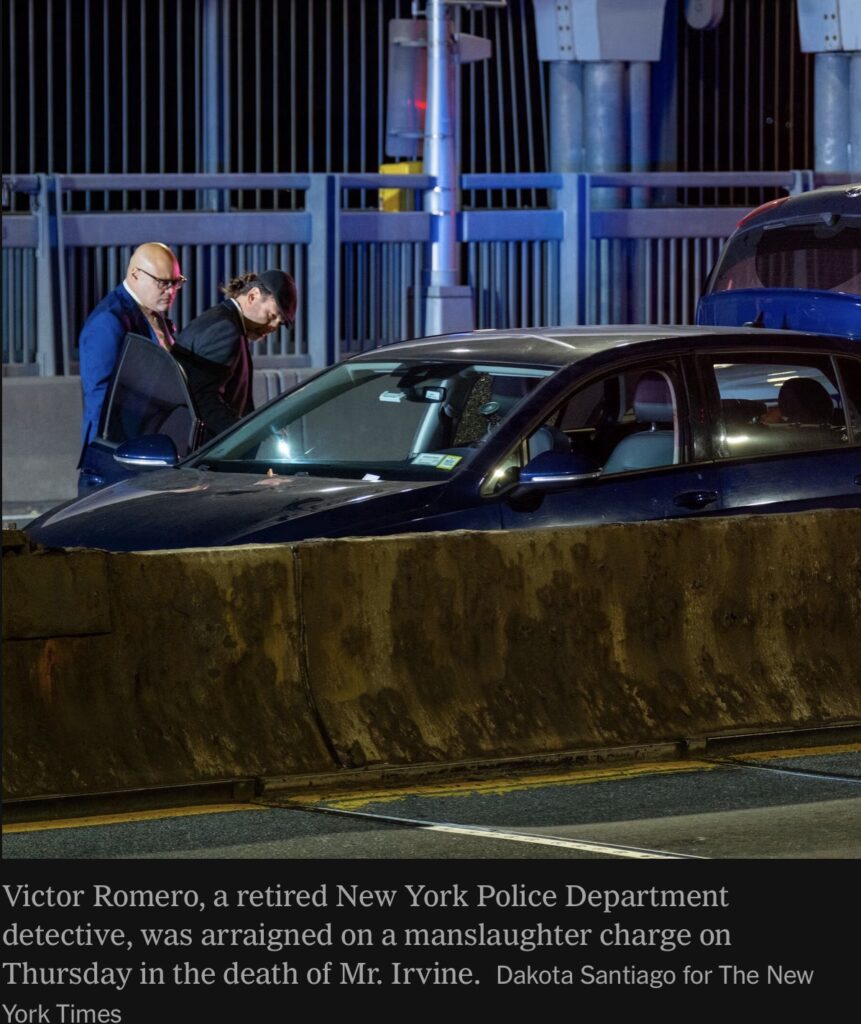
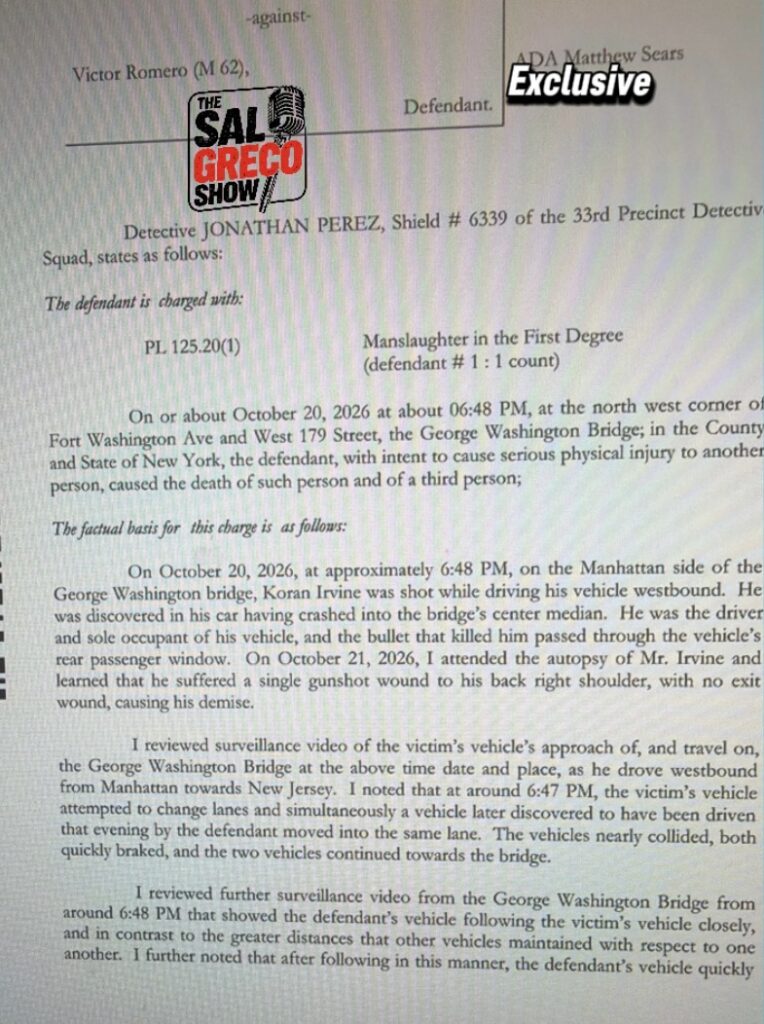
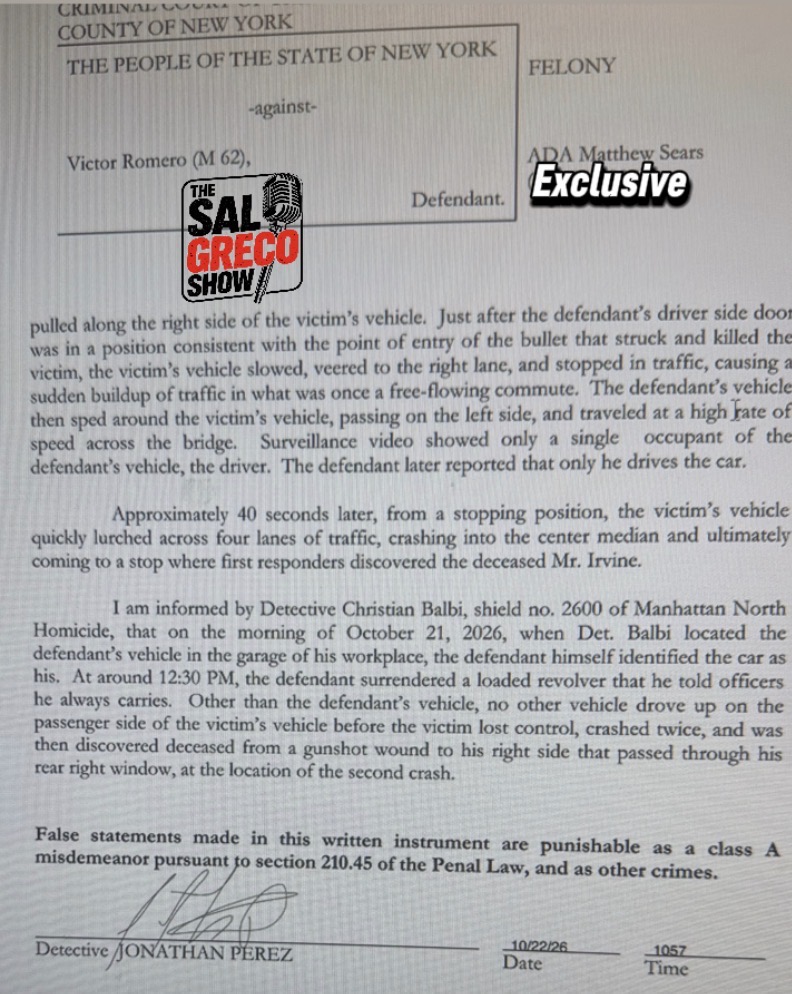
Police arrested Victor Romero, 62, a retired NYPD detective who worked as a driver and private-security employee for QVT Financial CEO Dan Gold. Early police accounts called the arrest a murder case. Yet the actual October 22 New York County felony complaint—the two court document photographs accompanying this article—charges Romero with one count of first-degree manslaughter under Penal Law §125.20(1). He pleaded not guilty. A judge set $1 million bail. By Friday, October 23, Romero had posted it and left jail.
What happened on that bridge? Why did an investigation initially described as being led by Port Authority police produce an NYPD detective’s criminal complaint? How was the decision to charge manslaughter rather than murder reached? And can police, prosecutors and elected leadership demonstrate that the former officer received the same scrutiny as anyone else would?
There are more questions than answers. There is also a crucial distinction between publicly documented facts, allegations made by named sources and unanswered suspicions. This report keeps that distinction in view.
Start with Koran Irvine—not with the accused’s résumé

Irvine was a Valley Cottage, Rockland County resident, a longtime Con Edison worker, a husband and father of two. His family describes a hard-working man who brought warmth and humor to the people around him. Con Edison publicly mourned the killing of its employee. According to ABC7, Irvine had recently completed 20 years of service and was leading work on a transformer project. His family said he had worked overtime and was heading home.
His wife Patricia described monitoring his shared phone location as he drove toward the bridge, then seeing it stop moving. The family’s grief was compounded by the criminal case. His sister Zeria Irvine and aunt Gale Forde have publicly questioned why the accused former detective was not facing a murder charge. Their lawyer, Keith White, has questioned whether Romero received preferential treatment. Those are the family’s concerns, not findings by any court.
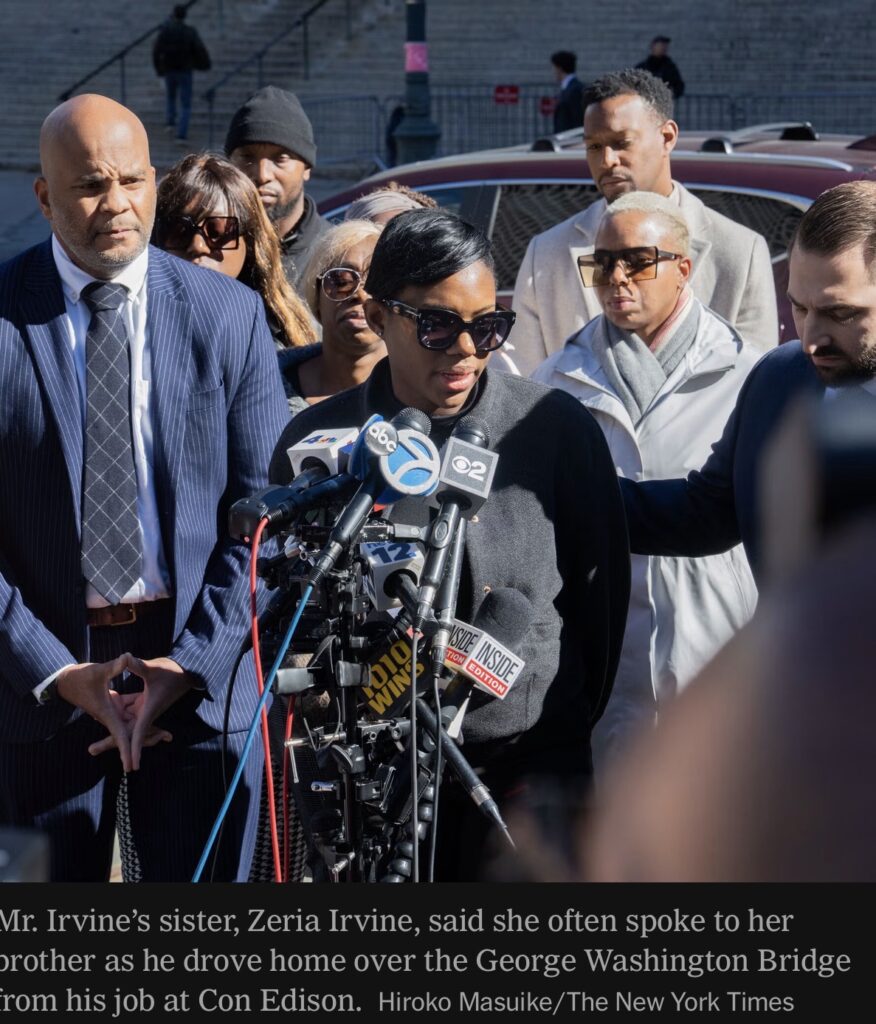
Nothing in the felony complaint alleges that Irvine committed a crime. A near-collision in traffic—even if a driver changes lanes imperfectly—would not justify shooting him. The focus should remain on the conduct alleged against the armed driver and on the work of investigators entrusted with finding the truth.
What the actual criminal complaint says
The complaint is sworn by NYPD Det. Jonathan Perez, shield 6339, 33rd Precinct Detective Squad, dated October 22, 2026. It lists Assistant District Attorney Matthew Sears and one count of first-degree manslaughter.
According to that complaint, about 6:48 p.m. October 20, Irvine and a vehicle later associated with Romero nearly collided as both tried to enter the same lane on the Manhattan approach to the upper bridge. Surveillance footage allegedly shows both drivers brake, then continue toward New Jersey. The defendant’s vehicle is described as following Irvine closely, eventually coming alongside his passenger side. The complaint says the defendant’s driver’s door was positioned consistently with the shot’s entry path through Irvine’s rear passenger window.
Irvine sustained one fatal gunshot wound to the back of his right shoulder, the complaint says. The defendant’s vehicle allegedly accelerated away across the bridge. Approximately 40 seconds later, Irvine’s car lurched across four lanes and crashed into the center divider. Irvine, the only person inside, was subsequently pronounced dead at Englewood Hospital.
The complaint states that NYPD Manhattan North Homicide Det. Christian Balbi, shield 2600, located Romero’s vehicle in a garage at his workplace the next morning, October 21. Romero allegedly identified the vehicle and, around 12:30 p.m., surrendered a loaded revolver that he said he regularly carried. Public reports say police recovered additional guns. The complaint does not by itself establish ballistics conclusions, intent to kill, or the final outcome of the prosecution. Those are matters for evidence and the courts.
These are allegations made by prosecutors, not proof of guilt. Romero has pleaded not guilty and is presumed innocent unless convicted.
Murder arrest—or manslaughter prosecution? What changed?
The distinction is not semantic. The public first heard that police had arrested Romero on a murder allegation. The filed court instrument instead invokes §125.20(1), which concerns intending to inflict serious physical injury and thereby causing death. One central theory of second-degree intentional murder, §125.25(1), instead requires intent to cause death. Proving intent is a legal and evidentiary issue; neither the seriousness of the loss nor the number of shots by itself decides the appropriate charge.
Still, this case cries out for a transparent explanation. What did the Manhattan District Attorney’s Office know between arrest and arraignment that informed its charging choice? Was the choice based on video, a statement, forensic evidence, legal analysis or some combination? Was a murder count rejected outright, reserved for further grand-jury review, or never supported by prosecutors’ interpretation of the evidence? The DA has said the investigation continues; a manslaughter complaint does not necessarily freeze the eventual indictment.
The family is entitled to ask those questions publicly. So is everyone who travels across this bridge.
$1 million bail, posted—and a family demanding answers
At his October 22 arraignment, Romero was granted bail of $1 million. Reporting from the courtroom says the judge rejected a prosecution request that Romero surrender his passport. City jail records cited by Gothamist and other outlets show that he posted bail October 23 and was released while the case proceeds. His next appearance was reported as scheduled for October 27.
Bail is not an acquittal, and release while awaiting trial is not inherently evidence of favoritism. Yet a case in which the prosecution alleges a driver fired a gun into another moving vehicle, left the scene and then went to work the following day is one where the public can reasonably ask how the court assessed appearance risk and safety. Patricia Irvine’s statements and her family’s public outrage show why confidence in the process matters.
PAPD first on scene. Why did the NYPD make the arrest and sign the complaint?
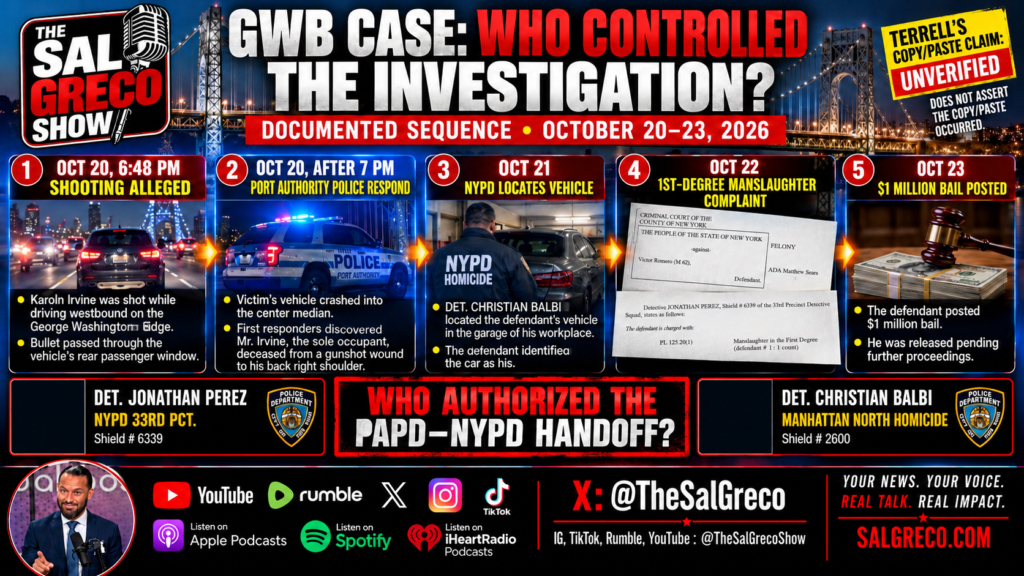
Port Authority police were not bystanders. They police the bridge, answered reports of a vehicle crash just after 7 p.m., and found Irvine in his crashed Volkswagen. CBS New York’s October 21 initial account expressly described the Port Authority Police Department as heading up the investigation. FOX 5 also reports that PAPD officers were the responding officers. The Port Authority’s own description of its bridge-incident response includes PAPD officers taking statements and filing reports.
Yet the documents now before the public identify NYPD personnel in central investigative roles: Manhattan North Homicide found the suspect vehicle, and a 33rd Precinct detective signed the complaint. The Manhattan DA’s Office is prosecuting a case alleging conduct on the New York side of the bridge. NYPD participation in a case involving New York County is not inherently unauthorized or proof of wrongdoing. Agencies can work jointly and share evidence. But the paperwork should show how that happened here.
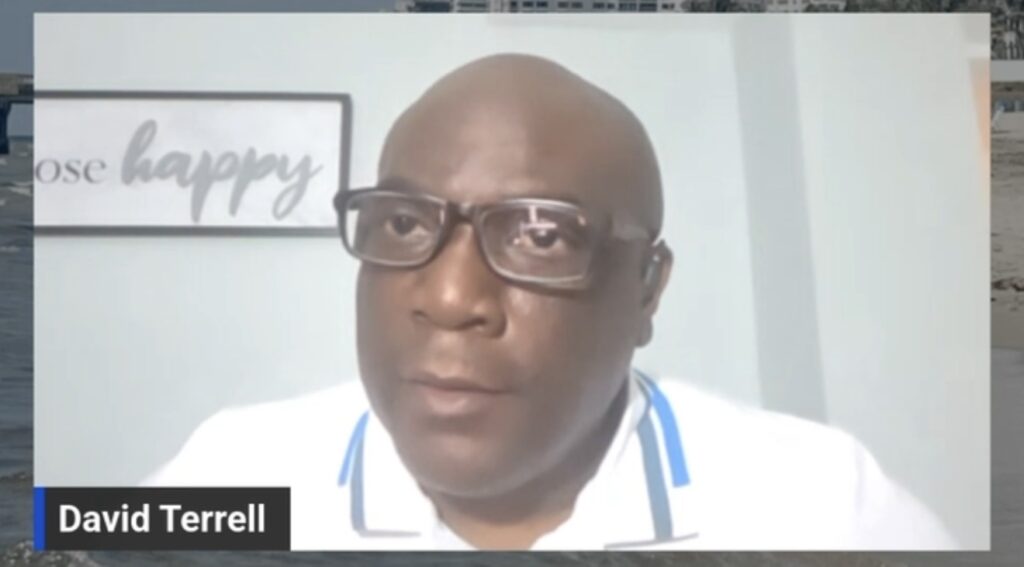
Here is the specific, serious allegation: Retired NYPD Detective Dave Terrell says that, according to sources he considers reliable, Port Authority police initially took the complaint report, after which NYPD personnel allegedly copied and pasted portions of that report and moved quickly to arrest Romero without advance notice to PAPD. Terrell’s account has not been independently verified through the original reports, dispatch logs or interagency communications. We do not present it as established misconduct.
Nevertheless, it raises documentable questions:
1. What are the PAPD’s original incident, complaint and evidence reports—and when were they created and approved?
2. What are the NYPD’s first written reports and their electronic creation, revision and approval timestamps?
3. Did both departments jointly investigate, or did one formally become lead agency? Who made that determination, when and on what authority?
4. Were PAPD supervisors and the Port Authority command notified before NYPD made the arrest? If not, why not?
5. Do the two narratives share language because facts were properly exchanged, or because one report was copied without attribution? The original electronic audit trails could help answer that.
6. Who collected surveillance video, recovered ballistic evidence and maintained the chain of custody?
An unannounced arrest, if proved, would still need context: investigators sometimes act quickly to preserve evidence or secure a suspect. The point is accountability through records, not announcing a conclusion before records exist.
No mugshot, no conventional perp walk: transparency or double standard?
Irvine’s attorney Keith White publicly complained about the accused’s low visibility before court and called the courthouse presentation a modified perp walk. Those observations deserve to be heard, especially when the defendant once wore the NYPD badge. But there is a legal distinction the public should know: New York’s Public Officers Law §89(2)(b)(viii) treats arrest and booking photographs as a category protected from ordinary public disclosure, subject to exceptions such as a law-enforcement purpose. The NYC Department of Correction says it does not supply mugshots. A public perp walk is not a statutory requirement.
Therefore, the absence of an official booking photograph or staged walk is not itself proof of a cover-up. What is fair to demand is consistent public information about the arrest, charge, appearance and case status, and an explanation of any genuinely different treatment once the relevant records are reviewed. Why did the public initially receive a murder description but later encounter a manslaughter complaint? Which agency controlled press information, and why did those accounts evolve?
Victor Romero’s NYPD career—and the QVT Financial connection
Romero reportedly served approximately seven years in the NYPD, including assignment to Brooklyn North Narcotics, and retired in July 2001. In June 2000, while off duty at a family laundromat/dry-cleaning business in Brooklyn, he intervened during an attempted robbery, was shot in the hand and chest, and shot two assailants. Contemporary reporting called him heroic. That prior conduct is part of his career, but does not determine whether he committed the alleged 2026 offense or merits different treatment today.
An attorney for the Irvine family has also claimed that an oversight investigation connected with the 2000 shooting ended when Romero retired. We have not independently confirmed the underlying CCRB records or that account; any assertion about the reason for his retirement or firearm status warrants obtaining them.
The New York Post, citing law-enforcement sources, reported that Romero worked as a driver and private-security employee for QVT Financial CEO Dan Gold, and was driving a Range Rover associated with the firm during the alleged incident. QVT said it was aware of press coverage and was cooperating with authorities. No public evidence reviewed here says Dan Gold or QVT directed, knew about, approved or participated in the alleged shooting. But it is fair to ask: Was Romero on duty? What were his security responsibilities? Who owned and insured the vehicle? Was his daily carry of a loaded revolver authorized under the correct license and employment arrangements? Have QVT’s contemporaneous schedules, vehicle records and security policies been preserved?
Dan Gold, Jessica Tisch, Harvard—and a narrowly documented SEC overlap
Yes, both Dan Gold and NYPD Commissioner Jessica Tisch are Harvard alumni. QVT’s corporate website says Gold earned an A.B. in Physics from Harvard College. The NYPD’s official biography says Tisch graduated from Harvard in Government and also earned a Harvard Law degree and Harvard Business School MBA. Attending the same institution is not evidence that they know each other, let alone evidence of involvement in this case.
The public corporate record contains one more narrow but verifiable item. A June 2007 SEC registration statement for Vion Pharmaceuticals lists QVT Fund LP and Baker Tisch Investments LP separately among securities holders. The filing identifies QVT Financial as QVT Fund LP’s investment manager and Daniel Gold among QVT Financial GP’s managing members. Earlier SEC filings identify Baker/Tisch Investments among vehicles included in reporting associated with the Baker brothers and named members of the broader Tisch family.
What does that prove? Only an old securities-holding overlap in one issuer’s filings. It does not establish a business partnership between Gold and Jessica Tisch, a personal relationship, political alignment or influence over an NYPD investigation. Publishing the archival detail with that limitation is more responsible than suggesting the surname alone proves a connection. If a closer historical relationship exists, actual contracts, correspondence or financial disclosures—not innuendo—would be required to substantiate it.
Political donations: what the public records actually show
Campaign records matching Daniel Gold by name, Briarcliff Manor location and QVT/earlier financial-employer information show both Democratic and Republican contributions. The examples below are selected, identifiable federal transactions, not a complete accounting of every possible New York state, city, independent-expenditure or charitable payment. Contributions transmitted through ActBlue are counted once, not counted again as a separate donation when passed to the ultimate campaign.
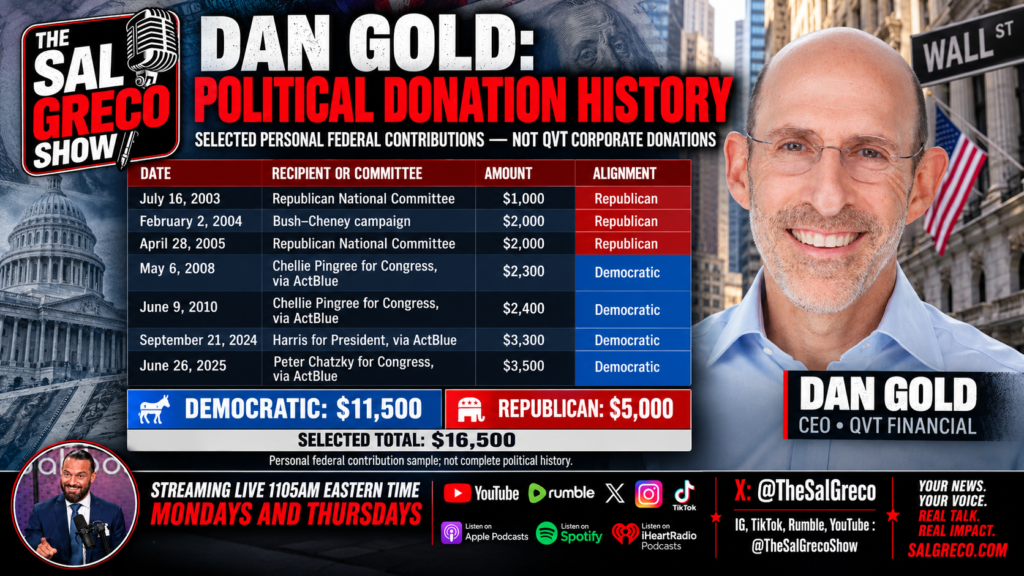
This record does not establish Gold’s voter registration or party affiliation. More importantly, this review did not verify a donation by Gold personally to Zohran Mamdani, Eric Adams, Letitia James, Kathy Hochul, Alvin Bragg, Jessica Tisch or a Tisch-family political committee. That is a finding about what has been verified so far, not an assertion that a complete search of every state and municipal filing proves none exists. Nor did we verify that QVT Financial itself made the listed contributions: these are individual contributions. Public disclosures of other employees’ donations must not be attributed to Gold or treated as corporate gifts.
Some members of the wider Tisch family reportedly financed the anti-Mamdani Fix the City independent-expenditure committee in 2025. Those are separate people’s donations, not Daniel Gold’s. It would be irresponsible to place their sums on a chart labeled as Gold’s giving.

The questions the public officials should answer—on the record
● Manhattan District Attorney Alvin Bragg’s office: Why was first-degree manslaughter filed rather than an intentional-murder charge? What remains before the grand jury? What evidence governs any later charging decision? What was the prosecution’s bail and passport position?
● NYPD Commissioner Jessica Tisch and the NYPD: Who requested NYPD investigative control or joint participation, and when? Were the PAPD and Manhattan DA notified at every step? Will the originating report and the electronic audit history be preserved? What explains the discrepancies in early public charging statements?
● Port Authority Police Department: What records did PAPD generate first? What is the documented role of PAPD detectives after NYPD entered the case? Did anyone object to, delay or approve investigative steps?
● QVT Financial and CEO Dan Gold: What was Romero’s employment and security role, his schedule, the vehicle’s registered owner, and company policy on armed driving or private-security work? Have these records been provided to investigators?
● The court and prosecution: How was the risk posed by the alleged conduct assessed at bail? What conditions now govern Romero’s release? Will the public receive timely updates as the case progresses?
There are already sufficient facts for urgent scrutiny without assigning guilt to Gold, QVT, Tisch, PAPD, NYPD or prosecutors. Koran Irvine deserves a fair and thorough investigation, his family deserves candid explanations, and Victor Romero is entitled to due process and the presumption of innocence. What neither side deserves is selective secrecy or an investigation driven by reputation instead of evidence.
The George Washington Bridge carries the public across a jurisdictional boundary every day. When a man is killed there, the agencies policing that crossing must show the public exactly who did what, when, and why. The paper trail—not connections, uniforms or rumors—should answer the questions.