
BY SAL GRECO
A 28-year NYPD veteran was allegedly unaccounted for after becoming ill. Now questions about AWOL procedures, conflicting explanations, supervisory accountability and the treatment of his funeral are drawing scrutiny.
The death of NYPD Police Officer Jeffrey Lamont Struggs, a 28-year veteran assigned to Brooklyn’s 79th Precinct, is raising serious questions about what his command knew, when it knew it, and whether established NYPD procedures designed to account for an absent officer were followed.
Struggs, 57, died in August after nearly three decades of service. His obituary confirms that he joined the NYPD after becoming a father and ultimately devoted 28 years to the department, including service at the 79th Precinct. His funeral was held September 3 on Staten Island.
But behind the tributes is a troubling question being raised publicly by former NYPD officer Sal Greco and attorney and former NYPD Police Officer Eric Sanders:
How could a veteran police officer apparently stop reporting for duty and remain unaccounted for without the NYPD’s established absence procedures resulting in someone locating him?
The allegations aired by Greco and Sanders are serious. They remain allegations unless and until substantiated by NYPD records, an official investigation, sworn testimony or other independently verifiable evidence. But the publicly available Patrol Guide makes the underlying procedural questions difficult to dismiss.
The Timeline That Needs Answers
According to information presented during a segment on the Sal Greco Show episode 224, Struggs allegedly became ill while working overtime at MetroTech on August 15 and received permission to leave.
Sal Greco stated that according to sources, Struggs subsequently failed to report for a scheduled tour beginning at 7:05 a.m. on August 16 and was recorded as a no-show at the shooting range on August 17.
What happened afterward is at the center of the controversy.
According to the show’s sources, 79th Precinct Commanding Officer Deputy Inspector Arsenio Camillo initially said Struggs was on vacation. The transcript then attributes a different account to Brooklyn North Chief Mark Vasquez: that Camillo acknowledged Struggs was unaccounted for and considered AWOL.
Still another explanation allegedly emerged later: Struggs had supposedly called in for lost time for August 16 and 17 but failed to submit vacation paperwork.
Those competing versions are precisely why documentation matters.
If Struggs had properly requested time off, there should be records capable of establishing that fact. If he had not, the question becomes when supervisors recognized that an officer scheduled to work was missing and what they did about it.
The transcript says Struggs was ultimately discovered after a resident reportedly complained to 311 about an odor.
That allegation, if confirmed, raises an obvious question:
Why did a civilian complaint allegedly lead to the discovery of Struggs rather than the NYPD’s own personnel-accountability procedures?
What NYPD Patrol Guide 205-18 Actually Requires
This is where the issue moves beyond opinion.
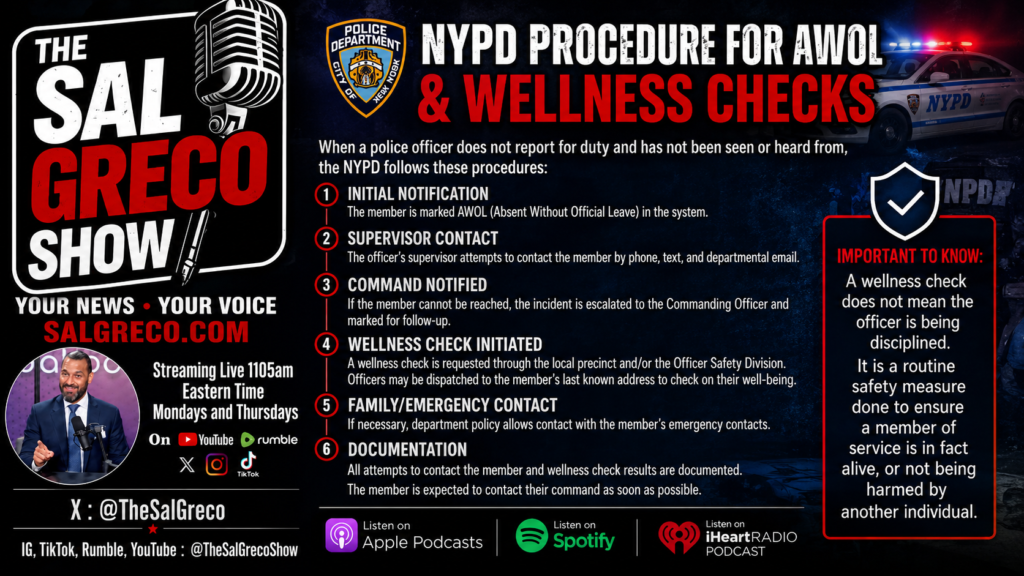
A publicly available version of NYPD Patrol Guide Procedure 205-18, “Absent Without Leave,” establishes specific steps when a uniformed member is absent without leave for two hours at the beginning of a scheduled tour.
The desk officer is instructed to make telephone inquiries, including checking command roll call, the Sick Desk, court sign-in rooms and the member’s residence. Department records and roll-call change sheets are to be checked, and inquiries are to be made of command personnel.
Significantly, the procedure also directs the desk officer to request that a supervisor from the precinct covering the member’s residence respond to the member’s home.
If the member still has not been contacted four hours after the beginning of the tour, the procedure calls for notifications to the commanding officer or duty captain, borough command, Operations Unit and Internal Affairs Bureau Command Center.
A Command Log entry is supposed to document the inquiries and notifications.
The commanding officer or duty captain is then directed to conduct an immediate investigation, report the results and document them.
Those provisions create a straightforward set of factual questions for the 79th Precinct:
Were the calls made? Were Struggs’ records checked? Was his residence checked? Was a supervisor dispatched? Were emergency contacts reached? Was the Operations Unit notified? Was Internal Affairs notified? What was entered in the Command Log? Who conducted the required investigation?
The answers should not depend upon competing recollections. If the procedure was triggered and followed, documentation should help establish what occurred.
The Procedure Is More Than Discipline
Greco repeatedly emphasized during the broadcast that AWOL procedures should not be viewed merely as a mechanism for punishing officers.
They can also function as a welfare safeguard.
“If they don’t see them, they’re not coming to work, or something is wrong,” Greco said in substance while explaining why an unexplained absence should prompt immediate concern. He stressed that supervisors first need to determine whether an absent member is safe.
That interpretation is significant in the Struggs case because the allegation is that his last interaction with NYPD personnel may itself have involved illness.
The show described another incident in which an absent civilian NYPD employee was checked at home after failing to report for work. According to the account, officers discovered the employee in cardiac arrest and were able to save her.
That anecdote illustrates the larger point: an unexplained absence can be more than an attendance problem.
It can be an emergency.
Eric Sanders: Establish the Chronology
Attorney Eric Sanders has taken a more explicitly investigative approach.
According to a statement reproduced during the program, Sanders said that after speaking directly with a member of Struggs’ family, he was highly likely to become involved in examining the circumstances of the officer’s death.
Sanders focused particularly on establishing Struggs’ last confirmed contact with NYPD personnel and determining what happened afterward.
Among the questions Sanders raised were when Struggs last actually worked, when somebody from his command last physically saw him, what occurred after a sergeant allegedly assisted him when he became ill, when the department realized he had stopped reporting, whether anyone attempted to contact him, whether an emergency contact was notified and whether a welfare check occurred.
Sanders was also careful not to make an unsupported causal accusation.
“I’m not assigning responsibility for this man’s death,” his statement says, while arguing that avoiding speculation does not eliminate the need to investigate the apparent gap in accountability.
That distinction matters.
At this point, publicly available information does not establish that any particular supervisor caused Struggs’ death or that earlier intervention necessarily would have saved him.
What can legitimately be investigated is whether required procedures were followed and whether compliance—or noncompliance—affected how long Struggs remained unaccounted for.
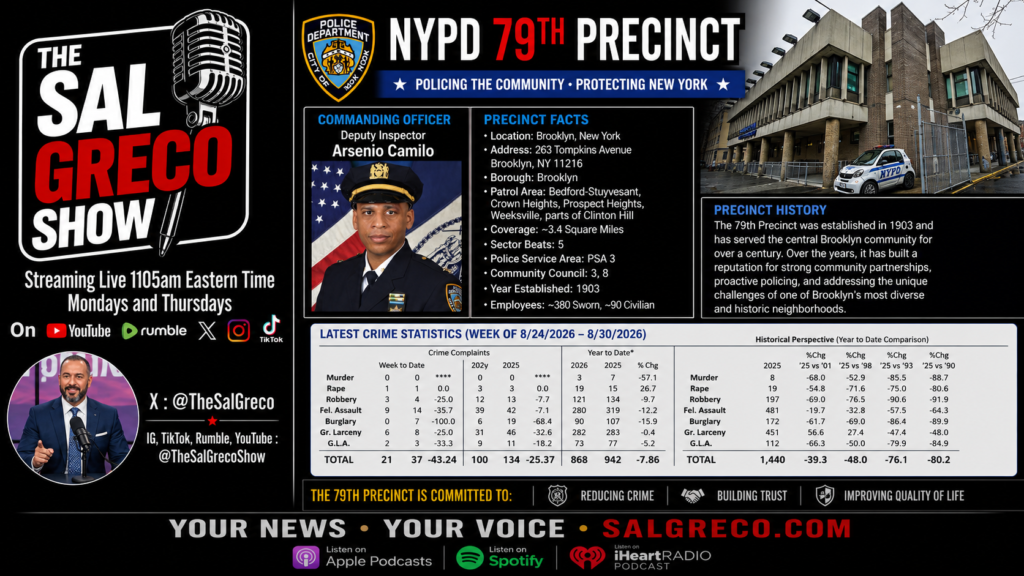
Deputy Inspector Camillo Has Questions to Answer
The allegations involving Deputy Inspector Camillo center principally on the apparently conflicting explanations regarding Struggs’ status.
Greco alleged during the broadcast that information from his sources shifted between explanations involving lost time and Struggs simply not being accounted for.
That allegation needs documentary verification.
Roll calls, command logs, telephone records, duty charts, lost-time documentation, vacation requests, shooting-range records, emails, text messages and other department records could potentially establish a reliable chronology.
The key issue is not whether someone can now produce an explanation.
It is whether records created at the time Struggs disappeared from duty support that explanation.
New Allegations Surrounding Sergeant Angelo
Questions did not end with the circumstances preceding Struggs’ discovery.
A subsequent one-page transcript supplied to this publication raises allegations concerning Sergeant Angelo, who was reportedly involved with a detour assignment connected to the September 3 funeral.
According to that transcript, Angelo had been serving as the detour sergeant responsible for checking personnel working the event. Greco alleged that Angelo moved from a 4-to-12 tour to the detour assignment because he wanted to fraternize with a particular female officer.
Greco further alleged that Angelo was subsequently returned to 4-to-12 tours as some form of punishment.
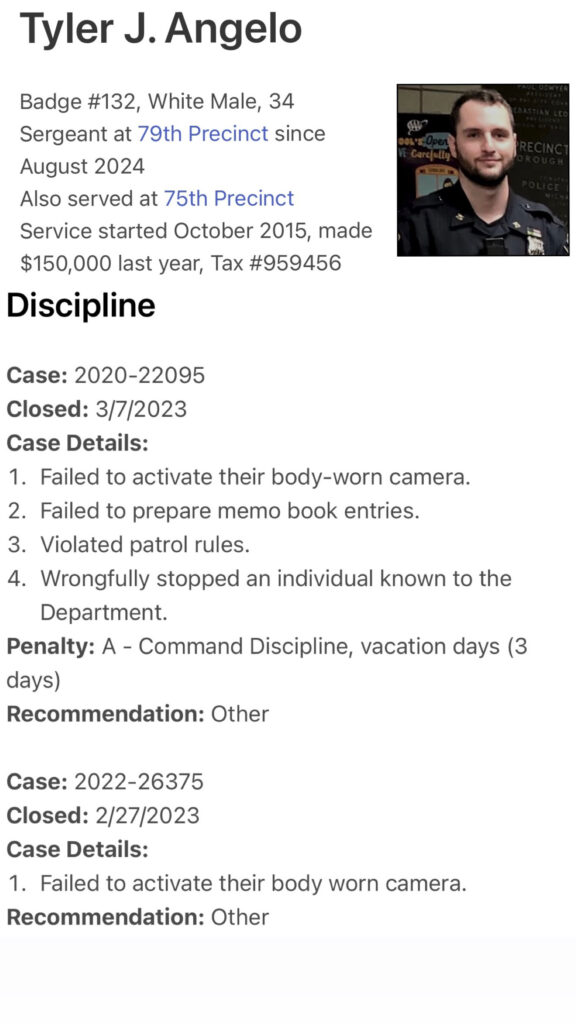
Those claims are presently allegations, and the transcript does not provide documentary evidence establishing either Angelo’s motivation for taking the assignment or that a subsequent scheduling decision constituted discipline.
They nevertheless raise another question requiring a straightforward answer from the department:
Was the staffing and supervision of Officer Struggs’ funeral handled professionally and according to normal NYPD procedures?
For Greco, the allegation was particularly offensive because this was not an ordinary detail.
It was the funeral of a fallen brother officer.
“NYPD needs to treat this with the utmost respect,” Greco said, describing Struggs as “one of their own” and arguing that he deserved better.
A 28-Year Career Should Not End With Unanswered Questions
Whatever an investigation ultimately establishes, Struggs was far more than a name on a roll call.
Former colleagues have publicly remembered him as funny, kind and helpful. One former 79th Precinct colleague recalled working patrol with him and remembered how frequently Struggs spoke about his family and children. Another remembered seeing him regularly while working MetroTech details.
That makes the central issue remarkably simple.
If Officer Jeffrey Struggs stopped reporting to work, what happened next?
If Patrol Guide 205-18 was triggered, produce the records showing it was followed.
If Struggs was legitimately on lost time or vacation, produce the contemporaneous documentation.
If supervisors called him, identify when.
If somebody went looking for him, document where and when.
If emergency contacts were notified, establish who made those notifications.
If no welfare check occurred, explain why.
And if established NYPD procedures were not followed, determine who was responsible and why.
The answers should come from records and verified evidence—not rumor, retrospective explanations or finger-pointing.
Officer Jeffrey Struggs gave the New York City Police Department 28 years of service.
His family is entitled to know what happened during his final days.
His fellow officers are entitled to know whether the procedures designed to protect them actually function when one of them disappears.
And if those procedures failed, Deputy Inspector Camillo, Sergeant Angelo and every supervisor who had responsibility during the relevant period have questions to answer—not because their culpability has been established, but because accountability requires establishing exactly what each person knew, did and documented.
The family deserves a complete chronology.
Officer Struggs deserves nothing less.