
BY SAL GRECO
The New York City Police Department once again finds itself defending another high-profile lawsuit—one that reaches directly into the Office of the Police Commissioner and raises significant questions about leadership, disciplinary consistency, and accountability.
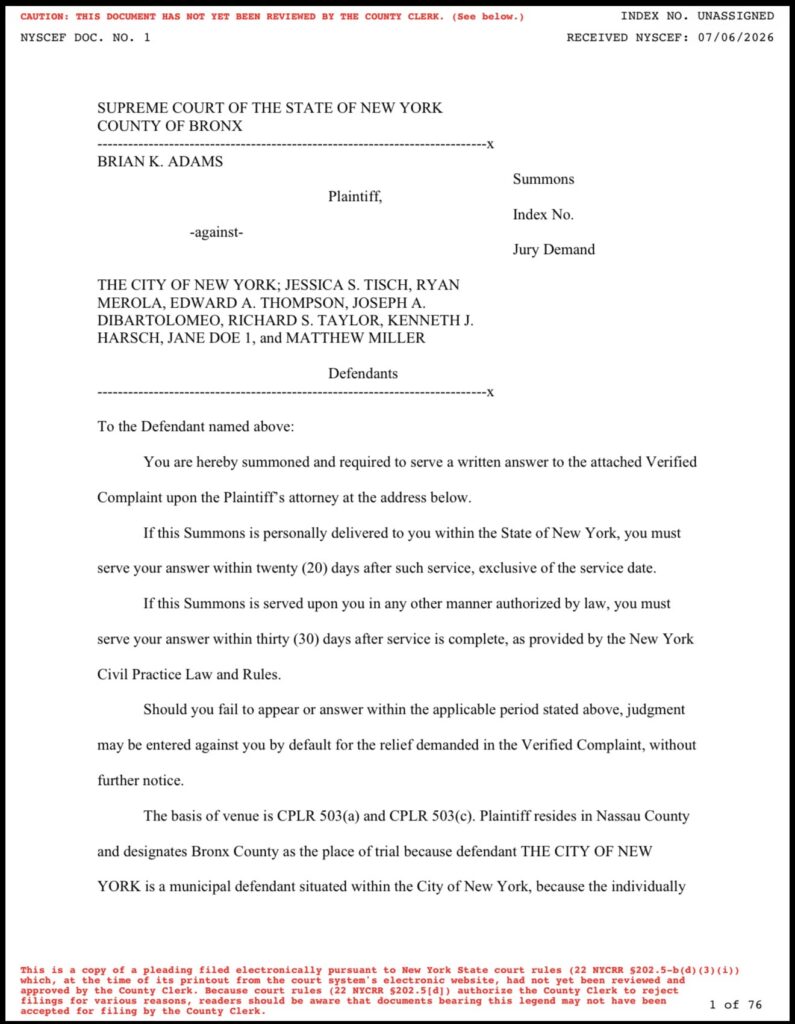
Former NYPD civilian executive Brian K. Adams has filed a 76-page complaint in New York Supreme Court against the City of New York, Police Commissioner Jessica S. Tisch, Chief of Staff Ryan Merola, Richard S. Taylor and several other current or former NYPD officials. The lawsuit alleges discrimination, retaliation, selective discipline, aiding and abetting discrimination, and violations of both the New York State and New York City Human Rights Laws. The allegations remain unproven, and the defendants will have an opportunity to respond through the judicial process.
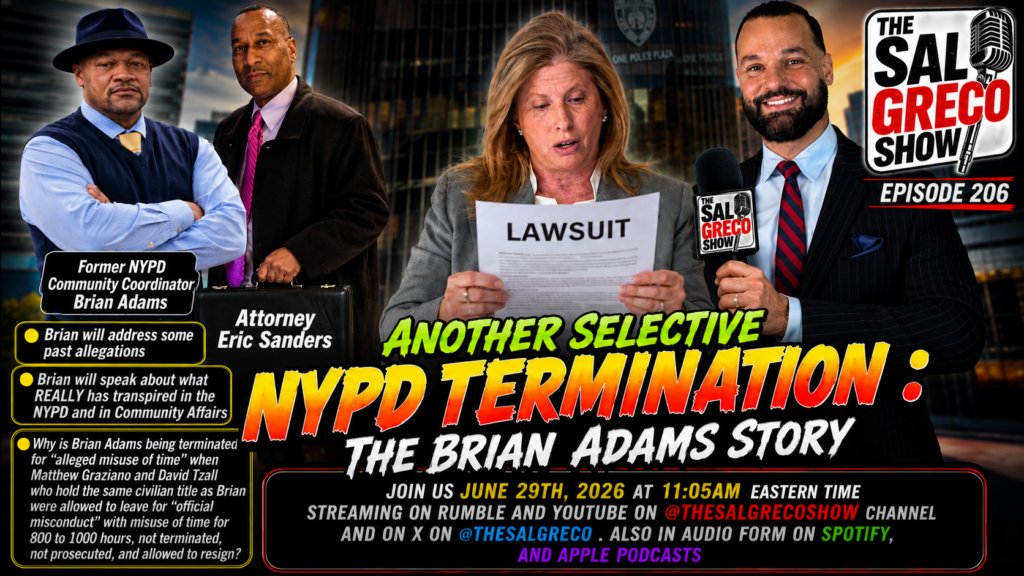
Before filing suit, Adams appeared on The Sal Greco Show alongside his attorney, Eric Sanders, for an extensive interview with hosts Sal Greco and Jack Stern. During the discussion, Adams addressed the allegations surrounding his termination, responded to media coverage, described his years inside the NYPD, and explained why he believes his dismissal represented something far greater than the end of one employee’s career.
For Sanders, the lawsuit is about far more than one personnel decision.
According to Sanders, the complaint alleges a pattern of selective discipline, retaliation, and disparate treatment that, if proven, demonstrates inconsistent standards being applied within the NYPD. He emphasized throughout the interview that the complaint marks only the beginning of the legal process and that discovery could ultimately determine what internal communications, documents, and testimony become part of the public record.
A Career Built on Community Relationships
According to the complaint, Adams joined the NYPD in 2018 as the Citywide Community Coordinator after previously working in both the private sector and with charitable organizations. Over the next several years, he worked under multiple police commissioners, including James O’Neill, Dermot Shea, Keechant Sewell, Edward Caban, and Thomas Donlon. The lawsuit alleges that during those administrations he developed numerous programs intended to improve relationships between the NYPD and communities throughout New York City.
Among the programs discussed during both the interview and the complaint were youth outreach initiatives, Explorer and Cadet partnerships, violence-interruption efforts, partnerships with community organizations, annual New Year’s Eve programs recognizing students, Thanksgiving events honoring crime victims’ families, and relationships with community leaders during some of the city’s most difficult moments.
The complaint further alleges that Adams eventually became the executive responsible for the Community Ambassador Unit, serving in what he describes as a civilian executive position equivalent in responsibility to a deputy chief. According to the lawsuit, his duties required extensive interaction with elected officials, youth organizations, advocacy groups, violence-interruption organizations, and neighborhoods where police-community relations were often strained.
During the interview, Adams described those years as some of the most rewarding of his career, stating that he believed relationship-building—not simply enforcement—was an essential component of effective policing.
Adams Says Everything Changed
According to the lawsuit, Adams contends that the environment inside the NYPD changed after Jessica Tisch became Police Commissioner.
The complaint alleges that longstanding community programs were reduced or discontinued, operational resources were restricted, executive responsibilities were diminished, and Adams ultimately became the subject of increased scrutiny before being terminated following an Internal Affairs interview in June 2026. Adams alleges he was not informed why he was being terminated before media reports concerning his dismissal appeared publicly the following day.
During his appearance on The Sal Greco Show, Adams disputed the narrative surrounding his termination and argued that many of the practices now being questioned had existed during prior administrations without objection. He maintained that context surrounding his responsibilities and the manner in which his position operated had largely been absent from public reporting.
Responding to the New York Post
A substantial portion of the interview focused on a June 25, 2026 NewYork Post article that reported on Adams’ termination.
Adams stated during the interview that he believed the article omitted important context regarding his responsibilities, his years of service, and the operational realities of his position. He disputed several aspects of the public narrative surrounding his dismissal and maintained that his perspective deserved to be heard alongside the allegations that had already entered the public domain.
Sanders similarly argued that media reports often rely upon incomplete information available before litigation begins. He stressed that lawsuits permit parties to obtain evidence through discovery and cautioned against reaching conclusions before all relevant documents and testimony become available.
The Legal Claims
The complaint alleges that Adams was subjected to discrimination and retaliation while similarly situated employees were allegedly treated differently. Among other things, the lawsuit claims that adverse employment decisions were motivated by unlawful considerations and that disciplinary standards were not applied consistently.
Those allegations are vigorously denied by implication at this stage simply by virtue of the litigation process, and no court has yet determined whether any of the claims have merit. The defendants have not yet filed answers to the complaint.
Questions That May Be Addressed Through Discovery
During his appearance on The Sal Greco Show, Adams also discussed what he described as internal communications among senior NYPD personnel. Adams asserted that certain communications and messaging practices, if fully disclosed through discovery or other official legal processes, would provide additional context for the claims raised in his lawsuit. He argued that those communications deserve further public scrutiny and maintained that they would support his broader allegations of selective discipline, inconsistent treatment, and internal decision-making within the department. Those statements reflected Adams’ account during the interview and have not been adjudicated by any court.
Adams further stated that, in his view, additional internal records and communications exist that could become relevant as the litigation progresses. According to Adams, those materials would help explain how employment decisions were made, why certain disciplinary actions were pursued against him, and whether similar standards were consistently applied throughout the department.
Attorney Eric Sanders echoed that position, emphasizing that discovery is designed to allow both parties to obtain documents, communications, and testimony that may be relevant to the claims and defenses in the case. He argued that the evidence ultimately produced—not speculation or public narratives—should determine whether Adams’ allegations are substantiated.
Beyond One Lawsuit
Whether Brian Adams ultimately prevails or not will be determined in court.
What cannot be disputed is that the NYPD continues to face substantial employment litigation involving current and former employees. Each lawsuit requires significant public resources, including attorneys, investigators, court personnel, and taxpayer-funded legal defense.
For critics of the department’s leadership, the volume of litigation has prompted questions about management practices, disciplinary consistency, and organizational culture. Supporters of the administration argue that lawsuits are an inevitable part of overseeing a department of the NYPD’s size and that allegations contained in complaints should not be mistaken for established facts.
As this litigation moves forward, discovery, motion practice, and ultimately the courts—not public opinion—will determine whether the allegations made by Brian Adams are supported by the evidence.
Regardless of the outcome, the case represents another closely watched legal challenge involving the NYPD and is likely to receive continued attention as additional filings become public.