
Mayor Zohran Mamdani and Police Commissioner Jessica Tisch are touting historic crime reductions. NYPD’s preliminary numbers support much of that story — but the department’s own history of crime reclassification, suppression and undisclosed audit results leaves an important question unanswered.
By Sal Greco
NEW YORK — If you listen to Mayor Zohran Mamdani and NYPD Commissioner Jessica Tisch, New York City is experiencing an extraordinary public-safety success story.
And on paper, there is significant evidence supporting that claim.
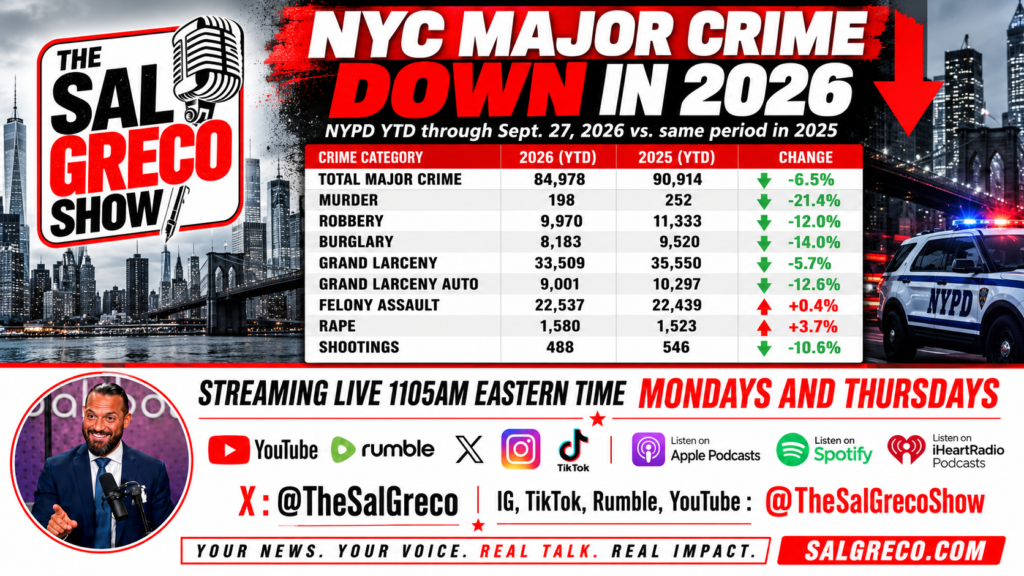
Through September 27, 2026, the NYPD’s preliminary CompStat statistics show 84,978 major crimes compared with 90,914 during the same period in 2025 — a decline of 6.5%, or 5,936 fewer reported major crimes. Murder is down 21.4%, robbery 12%, burglary 14%, grand larceny 5.7% and grand larceny auto 12.6%. Rape reports are up 3.7%, while felony assault is virtually flat, increasing 0.4%.
| Major Crime | 2026 YTD | 2025 YTD | Change |
| Murder | 198 | 252 | -21.4% |
| Rape | 1,580 | 1,523 | +3.7% |
| Robbery | 9,970 | 11,333 | -12.0% |
| Felony Assault | 22,537 | 22,439 | +0.4% |
| Burglary | 8,183 | 9,520 | -14.0% |
| Grand Larceny | 33,509 | 35,550 | -5.7% |
| Grand Larceny Auto | 9,001 | 10,297 | -12.6% |
| Total | 84,978 | 90,914 | -6.5% |
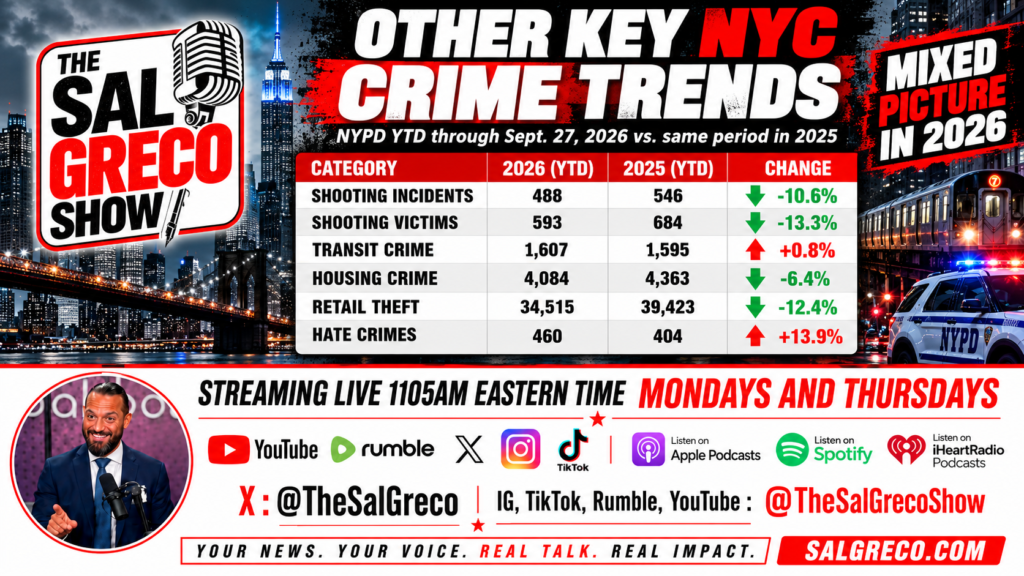
Shootings provide another significant data point. Shooting incidents stand at 488 compared with 546 last year, down 10.6%, while shooting victims are down 13.3%, from 684 to 593. Those are meaningful decreases, particularly because shootings and homicides are substantially harder to conceal through ordinary complaint-classification changes than offenses such as larceny, robbery or burglary.
Mamdani has not been timid about interpreting the numbers. At an April 2 press conference alongside Tisch, the mayor said the statistics told a “clear, indisputable story” that the administration’s public-safety approach was working. Tisch attributed the decline largely to the NYPD’s “precision policing strategy,” gun arrests, targeted deployments and investigations of violent groups.
By September, NYPD was announcing what it described as the safest summer in recorded history for murders, shooting incidents and shooting victims. In August alone, major crime fell 6.6% from the same month in 2025.
But there is another set of numbers New Yorkers still have not been shown alongside those press conferences:
The results of the NYPD’s own crime-classification audits.
NYPD admits the audits exist
At a September 16 City Council Public Safety Committee hearing devoted specifically to NYPD crime statistics, department officials described a substantial internal auditing apparatus.
The NYPD said its Data Integrity Unit continuously samples reports; its Crime Audit Team specifically examines categories outside the seven major crimes looking for cases that may have been misclassified; commands undergo quarterly reviews; and auditors compare 911 and radio runs with complaint reports to determine whether reports were taken and whether crimes were classified correctly.
That is precisely the system that should give the public confidence in CompStat.
Except when Council Member Phil Wong asked the obvious question — what percentage of 2025 reports were incorrect or misclassified? — NYPD did not provide the number.
Wong said his predecessor had previously requested the audit reports without receiving them. NYPD officials promised at the hearing to provide the requested information. The Council also requested statistics on officers disciplined for refusing complaints or downgrading crimes and audit information concerning Transit District 20.
As of September 29, those requested audit error rates do not appear in the public material I reviewed.
That doesn’t prove the current CompStat statistics are false.
But it does create a straightforward transparency problem: if NYPD is confident enough in its preliminary crime numbers to hold press conferences celebrating them, why shouldn’t the public simultaneously see the audits testing the accuracy of those numbers?
NYPD itself warns at the bottom of its weekly CompStat report that its figures are “preliminary and subject to further analysis and revision.”
History gives New Yorkers a reason to ask
Questions about crime classification are not theoretical in the NYPD.
A major 2013 NYPD Crime Reporting Review Committee report examined Quality Assurance Division audits and documented repeated patterns in which crimes were incorrectly classified into less serious categories.
Investigators found larcenies classified as lost property, robberies classified as larcenies and burglaries classified as larcenies. The committee warned that even apparently small error rates could produce meaningful changes in major-crime totals because enormous numbers of lower-level and lost-property reports were involved.
Its estimates were significant.
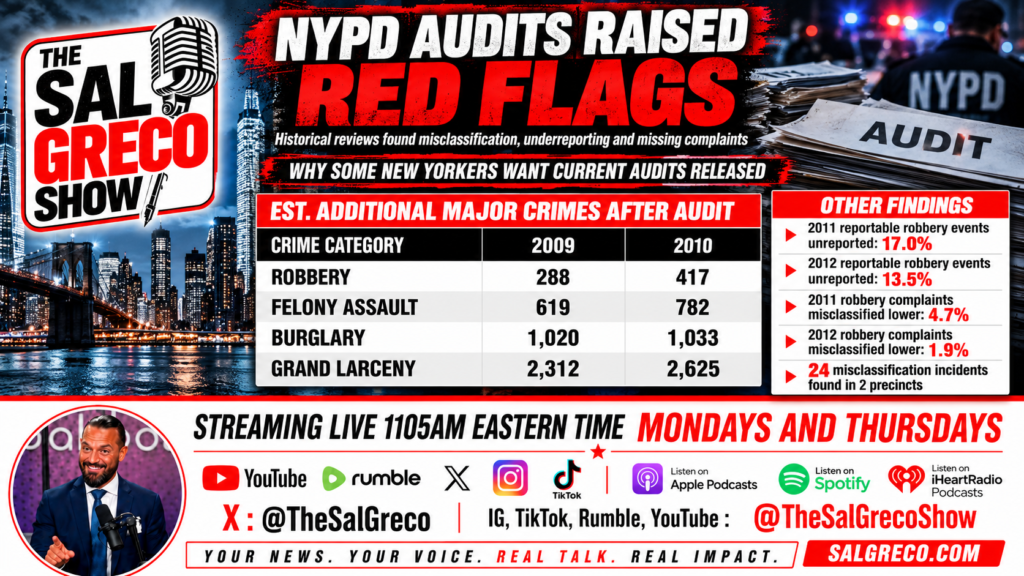
For 2009, the committee calculated that correcting the audit error rates could have produced approximately 288 additional robberies, 619 additional felony assaults, 1,020 additional burglaries and 2,312 additional grand larcenies.
For 2010, it estimated 417 additional robberies, 782 additional felony assaults, 1,033 additional burglaries and 2,625 additional grand larcenies.
Those figures were statistical extrapolations from samples, not a finding that thousands of individual reports were deliberately falsified. The committee itself cautioned about those limitations.
But its conclusion deserves attention today: misclassification could have an “appreciable effect” on some reported crime rates, and audit error rates alone could be misleading if the public was not shown where crimes were being moved from and where they should have been counted.
The same report examined NYPD audits matching robbery-related 911 calls against complaint reports. In 2011, it found an estimated 17% of reportable robbery events went unreported, improving to 13.5% in 2012. Of robbery complaint reports that were actually prepared, 4.7% reviewed in 2011 had been classified as lesser offenses.
That is not ancient folklore. It is NYPD’s own documented auditing history.
Supervisors have been disciplined over crime reporting
The former New York City Commission to Combat Police Corruption likewise reported disciplinary cases involving intentional misclassification of crime. It said felony complaints had been downgraded to misdemeanors or classified as no crime at all, with at least 24 misclassification incidents uncovered in two precincts. Penalties generally involved losing vacation days.
In another documented case, a captain was accused of instructing a sergeant to falsify memo-book entries so that it appeared a robbery complainant had recanted. According to the commission, that prevented the robbery paperwork from entering NYPD’s computer system. The captain forfeited 40 vacation days; the commission said a more serious penalty was warranted.
A later NYPD disciplinary decision involving Lieutenant Andrew Hatki is even more explicit. A departmental trial commissioner found Hatki guilty after an audit of 1,558 complaints in the 40th Precinct discovered 35 non-clerical misclassifications. The decision concluded that Hatki ordered three separate subordinates to be inaccurate in crime reporting and described the conduct as a troubling pattern of serious misconduct.
And this isn’t solely a historical issue.
In March 2025, NYPD removed the commander of Transit District 20, Captain Steve Hyland, after an audit found what the department publicly described as a “handful” of intentionally misclassified complaint reports. NYPD said those reports did not significantly alter the district’s overall statistics. At the September 2026 Council hearing, officials confirmed that the captain’s disciplinary matter was still pending, while Council members requested the underlying audit data and error rates.
That audit should be public.
So should the citywide audit numbers.

Misclassification can be more than an administrative matter
Not every classification mistake is misconduct, much less a crime.
Investigations change. Facts emerge. A felony assault victim can later die, turning an assault into a homicide. Property initially believed lost can later be shown to have been stolen. NYPD officials emphasized exactly that point at the September Council hearing, and they are correct.
But knowingly falsifying an official police record is an entirely different matter.
Depending on the specific facts and intent, knowingly submitting false information into government records can implicate New York’s statutes covering offering a false instrument for filing and official misconduct. Offering a false instrument for filing in the first degree can be a class E felony when the statutory elements, including intent to defraud, are satisfied. Official misconduct is a class A misdemeanor.
That is why an intentional crime downgrade cannot simply be dismissed as paperwork.
Then came the federal monitor’s newest report
The timing could hardly be more relevant.
On September 28 — one day before this article — the federal monitor overseeing NYPD stop-and-frisk reforms released another disturbing set of statistics.
The monitor estimates that more than one-quarter of Terry stops were not properly documented in 2025, with reporting compliance at approximately 73%. The monitor says underreporting causes the NYPD’s stop database to undercount actual police activity and makes unlawful conduct harder to identify.
Even more strikingly, the monitor stated that officers who misclassify stops as lower-level encounters or fail to file required stop reports are rarely disciplined, and that supervisors and command executives have not been held adequately accountable.
The monitorship exists because a federal court found in 2013 that NYPD’s stop-and-frisk policies and practices violated constitutional requirements. The court also found evidence that officers had been subjected to substantial pressure to increase stop numbers without corresponding pressure to ensure those stops were legally justified.
More than a decade later, the federal monitor is still there.
That fact alone should make transparency over any police-generated statistics a priority rather than an afterthought.
Taxpayers continue paying the price for police misconduct
The financial consequences extend beyond CompStat.
According to the Legal Aid Society’s September 2026 analysis of city data, $53.5 million had already been paid in 2026 to resolve NYPD misconduct claims, while the organization says payments since 2018 are approaching $1 billion. Those totals cover police misconduct broadly and should not be described as exclusively stop-and-frisk payouts.
Historically, however, taxpayers also paid $11.3 million in attorneys’ fees in the Floyd stop-and-frisk litigation, according to the City Comptroller.
The Floyd, Ligon and Davis cases remain the foundation of the federal monitoring structure that continues today.
So is crime actually down?
Based on the information currently available, the official data say yes.
Murders are substantially lower. Shootings are lower. Robberies, burglaries, auto thefts and grand larcenies are all lower than at this point last year. It would be inaccurate to simply declare those reductions fictitious without evidence.
But that is not the end of the inquiry.
The real issue is whether the public is being given all of the information necessary to independently assess the size and reliability of those decreases.
When the mayor says the crime statistics tell an “indisputable story,” while NYPD’s own audit results and misclassification error rates remain unavailable to the public after City Council members specifically requested them, the obvious response is:
Release the audits.
Show New Yorkers how many complaints were examined.
Show how many were incorrectly classified.
Show how many crimes were upgraded.
Show how many were downgraded.
Show how many 911 calls that should have produced complaint reports produced none.
Show what discipline resulted when intentional manipulation was found.
And publish those figures at the same time the mayor and police commissioner announce the next historic crime reduction.
Maybe those audits will confirm exactly what Mamdani and Tisch are telling the public.
If so, they would strengthen their argument.
But after decades of documented misclassification cases, previous audits showing thousands of potentially undercounted major crimes, a current disciplinary investigation over intentionally misclassified transit complaints, and a federal monitor reporting significant underdocumentation of police stops, asking New Yorkers to accept preliminary numbers without the corresponding audit trail leaves an unnecessary question mark hanging over otherwise encouraging crime statistics.
Crime may indeed be down.
The audits should tell New Yorkers how much confidence they can place in the numbers used to prove it.