
Florida Governor Ron DeSantis’s unconventional, yet widely popular decision to redraw the state’s congressional lines mid-decade elicited a strong emotional reaction from both those who approved of the decision and the vocal minority who opposed it.
While constitutional by the letter of the law, altering the demographics of several crucial districts was labeled as manipulation by Florida House Democrats and a sliver of Republicans who felt that the move was fundamentally unfair. The move gives Republicans a distinct advantage in four districts where registration from their party now outnumbers Democrats. Regardless of how people feel about DeSantis’s decision, it’s likely to be upheld in court, meaning that Republicans now have a competitive advantage in Florida for the upcoming midterms.
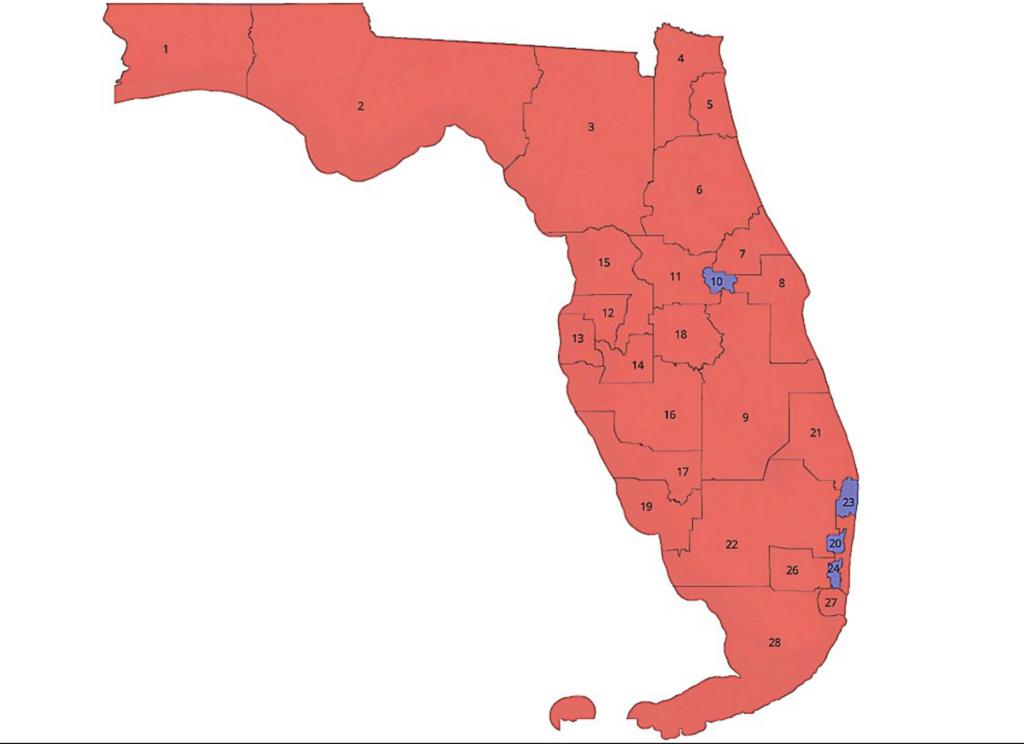
Is this the home plate umpire adjusting the strike zone in the top of the 9th inning with the home team up by a run (pre ABS of course)? Maybe, depending on one’s biases and viewpoints, but the bottom line is that the districts are being permanently made over, and there’s no going back. While some are quick to complain, don’t be surprised if other lawmakers try to take a page out of DeSantis’s playbook. Especially given what’s at stake in November, with Democrats looking to reclaim majority control in the House and Senate while Republicans try to hang on to their advantage.
Politicians looking to tilt the scales in their party’s favor are likely to publicly lobby for or take part in redistricting efforts that give their party a leg up come election day. If done legally, it’s also a way for them to earn brownie points amongst constituents with strong partisan ties. Case in point – DeSantis is now being lauded by local Republicans after receiving criticism from those who felt he was running out the clock on his governorship. Even if the remainder of his term is underwhelming, DeSantis’s redistricting efforts will be ingrained into an overwhelmingly positive legacy.
With many states providing significant wiggle room on laws surrounding political redistricting, lawmakers are likely to coalesce in cases where they can help candidates from their party get elected. Perhaps they’ll be more discreet and secretive about their intentions than the Governor was, but expect them to take his idea and run with it.
This may involve expanding districts to include more registered voters from their party, as DeSantis did, or shrinking districts to exclude areas that feature voters with opposing viewpoints. Some could get creative in trying to actively sway voter registration in specific regions while simultaneously employing the aforementioned strategy. Either way, expect district doctoring/manipulation to become the new norm as opposed to a one-off anomaly.
Traditional swing states like Michigan, Pennsylvania, and Ohio will be particularly interesting to observe under the microscope as partisan-motivated redistricting could permanently push the momentum pendulum in one direction or another. Using the rules to one’s advantage will be key when evaluating paths to move forward. However, one thing is certain: DeSantis’s decision now looks more like it’ll do more to inspire motivation than serve as a deterrent.