BY SAL GRECO
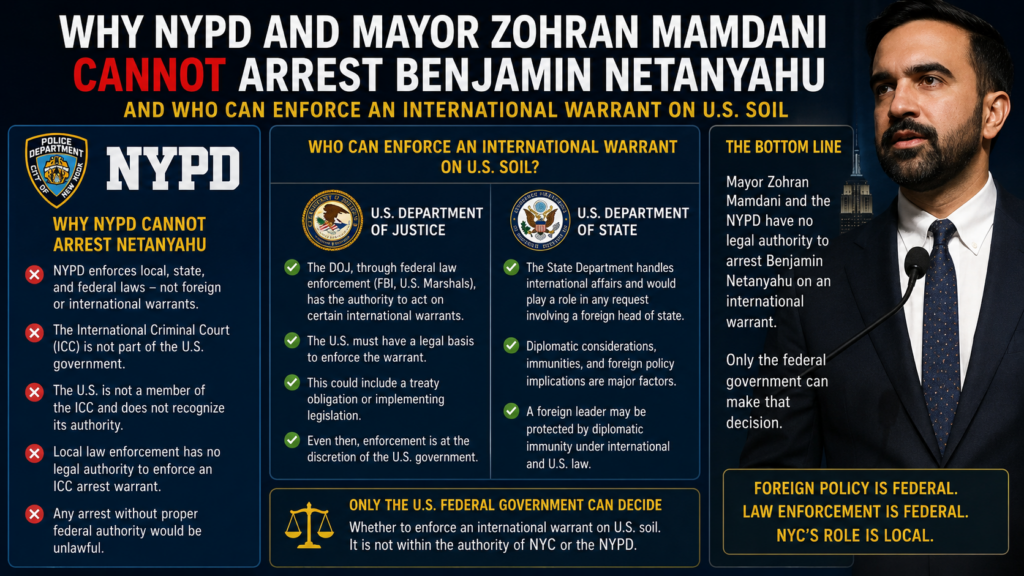
As torrential rain flooded New York City streets, submerged highways, and sent water pouring into subway stations, Mayor Zohran Mamdani found himself answering questions once again about whether Israeli Prime Minister Benjamin Netanyahu would be arrested if he came to New York. Rather than pivoting to the immediate crisis unfolding across the city, the mayor doubled down on the issue during an interview—a matter that, regardless of one’s views on international politics, is largely outside the authority of New York City’s municipal government.
The timing could not have been worse.
New Yorkers weren’t watching water cascade through subway stations wondering about international arrest warrants. They were wondering why, decade after decade, the nation’s largest city continues to struggle with flooding, aging infrastructure, and transportation systems that appear increasingly unable to handle severe weather.
The mayor’s comments created a political distraction at precisely the moment many residents wanted to hear about storm response, infrastructure resilience, and a long-term plan to modernize New York City’s aging public works.
This is particularly unfortunate because Mayor Mamdani inherited infrastructure challenges that did not begin with his administration. Years of deferred maintenance, aging water and sewer systems, and major capital needs accumulated under multiple mayors, including Eric Adams and those before him. No single administration created these problems, and no single administration will solve them overnight.
Yet leadership is often defined by priorities.
Just weeks ago, New York City was forced to respond to a serious structural emergency when a Midtown high-rise showed signs of potential collapse, prompting evacuations and an emergency response led by the Department of Buildings and other city agencies. Combined with the latest flooding, it served as another reminder that New York’s infrastructure requires sustained attention and investment.
Whether discussing deteriorating roads, century-old water mains, vulnerable subway infrastructure, bridges, tunnels, or public buildings, New Yorkers expect City Hall to remain relentlessly focused on the issues that affect their daily lives.
The debate over international warrants is, at its core, a federal and international matter. Foreign policy is conducted by the President of the United States and the federal government. Whatever one’s position on the International Criminal Court or Prime Minister Netanyahu, New York City’s mayor has limited authority over those questions, while local law enforcement’s responsibilities are governed by federal, state, and local law—not by political rhetoric alone.
That reality makes repeated comments on the subject politically risky. Every minute spent discussing issues beyond City Hall’s practical authority is a minute not spent communicating a vision for improving the city residents elected the mayor to govern.
This does not mean Mayor Mamdani should ignore international events or moral questions. Public officials are entitled to express their views. But governing requires balancing those views with the everyday responsibilities of running America’s largest city.
New Yorkers want to know how the next flood will be mitigated. They want assurances that aging infrastructure will be modernized. They want confidence that another structural emergency will be prevented whenever possible. They want a city government focused on making their neighborhoods safer, stronger, and more resilient.
There is still an opportunity for Mayor Mamdani to redirect the conversation.
If his administration, working alongside Governor Kathy Hochul and state and federal partners, makes rebuilding New York City’s aging infrastructure a defining priority, he could become the first mayor in decades remembered not simply for talking about the city’s problems—but for finally beginning to solve them.
Politics often rewards leaders who focus relentlessly on what they can control. New York City’s infrastructure is one of those things. That is where the attention should be.