
By Sal Greco | The Sal Greco Show | October 25, 2026 | SALGRECO.COM

Florida voters are being told that county sheriffs need more money to keep people safe. Some of those same agencies are locked in increasingly bitter fights with the county governments that fund them. In Miami-Dade, the debate now involves $132,500 in cowboy hats and the planned withdrawal of the mayor’s security detail. In Broward, a fight over an expensive training complex has county officials demanding records and access. In Palm Beach, executive salaries and supplemental retirement contributions have raised uncomfortable questions about priorities.
The question is not whether law enforcement deserves adequate funding. It does. The question is whether independent elected sheriffs should be able to demand additional taxpayer dollars without equally convincing disclosure of how the money they already receive is spent.
And with statewide Amendment 3 approaching on November 3, Florida taxpayers must decide how much pressure to put on the property-tax system. The amendment could force difficult budget choices. It is not, however, a sheriff-spending audit or an automatic ban on questionable purchases. That distinction matters.
Miami-Dade: Cowboy hats are funded; the mayor’s security detail is on the chopping block
Miami-Dade Sheriff Rosie Cordero-Stutz’s office purchased approximately 1,000 cowboy hats at $132.50 apiece, totaling $132,500. The agency describes the hats as optional uniform equipment paid for through an existing allocation. Supporters point out that wide brims can protect deputies working in the Florida sun, and the sheriff has said keeping existing uniform colors avoided the cost of a broader rebranding. Those explanations belong in the record.
But so does the timing. Miami-Dade has adopted a record $1.234 billion sheriff’s budget for fiscal year 2026-27, including funding for 200 additional positions and historically high overtime appropriations. County leaders say that is $186.3 million above the sheriff’s certified request, yet Cordero-Stutz contends the office remains approximately $42 million short and has pursued a state budget appeal.
Then came a move far more consequential than a uniform accessory: the sheriff notified Mayor Daniella Levine Cava and county commissioners that the Sergeant-at-Arms program, which provides security and transportation for the mayor and 13 commissioners, would be discontinued on November 9, 2026. Cordero-Stutz describes the program as costing roughly $4.1 million annually and says those resources should be directed to public safety. The mayor disputes the budget-shortfall narrative and has called for a safe transition.
Let’s be clear: nobody has proved that the security decision is retaliation. But a sheriff who publicly claims a financial emergency while also defending a sizable discretionary-looking purchase invites obvious questions. What threat assessment supports eliminating the detail? Which patrol shifts will receive the redeployed personnel? How much will actually be saved? And who takes responsibility if a security gap emerges?
The elected sheriff does not outrank the elected mayor. Nor is the sheriff simply the mayor’s employee. Florida’s constitutional structure grants these offices separate responsibilities. Independence is not superiority, and it certainly is not immunity from scrutiny.
Broward: A $74 million training complex and a fight over who may look inside
Broward Sheriff Gregory Tony is in his own public confrontation with Broward Mayor Mark Bogen and the county commission. The commission approved a roughly $885 million sheriff’s budget for the 2026-27 fiscal year, approximately $50 million below Tony’s request. Tony says he needs additional funding to keep public-safety salaries competitive.
But the county has questioned earlier spending decisions. Relying on its auditor’s findings, Broward officials alleged that the agency shifted approximately $4.8 million from salary accounts toward its training-center project. County filings cited an approximately $18 million project overrun, $552,905 in branding, and $7.5 million in wellness-center change orders that included a sauna and cold-plunge tub. These are audit findings and county allegations, not criminal convictions or a final adjudication of wrongdoing. The sheriff’s office has disputed the county’s accusations and has said additional salary funding is needed.
The confrontation escalated when county officials sought to inspect the training complex and were denied access. Commissioners authorized legal action to establish their right to enter county-owned or leased facilities. Tony said an active state investigation complicated access and accused the county of political interference.
An independent sheriff needs operational authority to fight crime. But if a county helps finance a facility, taxpayers should not need a courthouse battle to determine what was built, what it cost and who approved the spending.
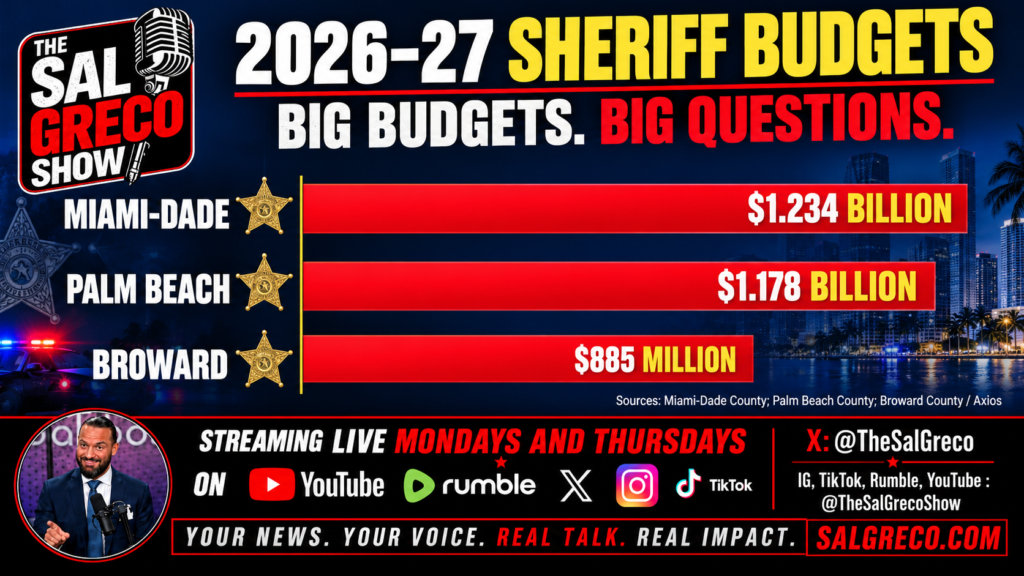
The budget numbers show why transparency matters
The three sheriff budgets under debate are enormous: approximately $1.234 billion for Miami-Dade, $1.178 billion for Palm Beach, and $885 million for Broward.
These totals are not perfectly interchangeable. The Palm Beach Sheriff’s Office operates detention facilities, while Miami-Dade corrections is organized separately; Broward’s agency has additional regional service responsibilities and contract arrangements. Simply ranking totals is not evidence of inefficiency. It is a reason to demand comparably detailed budgets with clear service-level explanations.
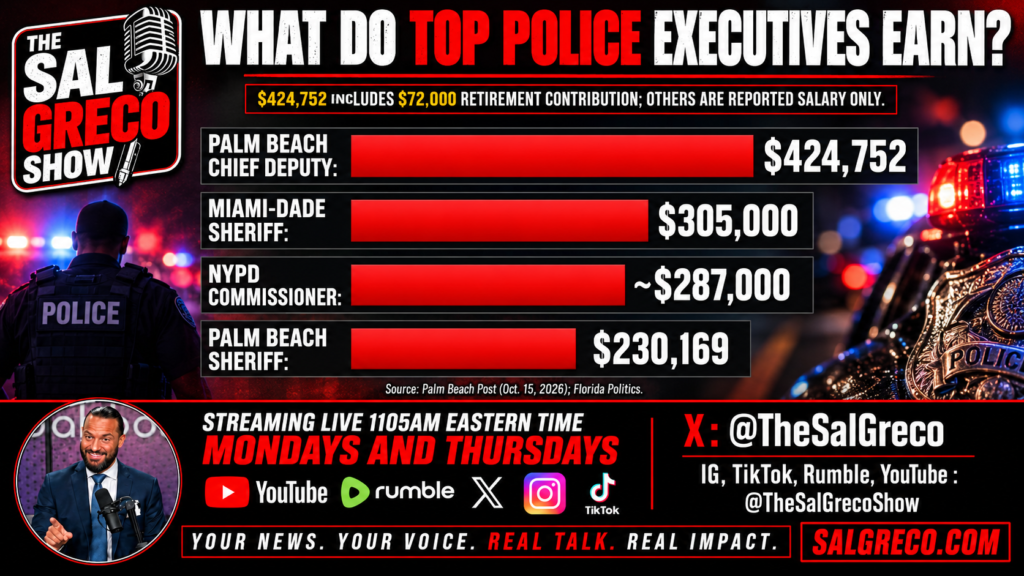
Palm Beach: When the top brass earn more than leaders of the NYPD
An October 15 Palm Beach Post investigation found that the six highest-ranking Palm Beach Sheriff’s Office law-enforcement executives received approximately $2.009 million in combined compensation, compared with roughly $1.5 million for comparable NYPD leaders. The totals were compiled using different mixes of salary and benefits, so they cannot be treated as a strictly salary-only comparison.
Still, individual packages stand out. PBSO Chief Deputy Robert Allen receives a reported $352,752 salary plus a $72,000 taxpayer-financed supplemental retirement contribution, totaling $424,752 for that year. Civilian Chief Operating Officer George Forman reportedly receives the same salary and supplemental contribution. By comparison, Palm Beach Sheriff Ric Bradshaw’s reported salary is $230,169, the NYPD commissioner’s about $287,000, and Miami-Dade Sheriff Cordero-Stutz was reported to have a $305,000 salary upon entering office; that last figure is not independently verified as her current 2026 payroll rate.
The Palm Beach Post also found that more than $6.3 million in taxpayer money had been contributed since 2021 to additional retirement accounts for 41 PBSO executives. Eleven executives received $72,000 each in 2026 on top of their ordinary salary and other retirement benefits. These arrangements may be authorized benefits; legality is a separate question from whether they are prudent, necessary or competitively justified.
A much bigger city, and far more homes
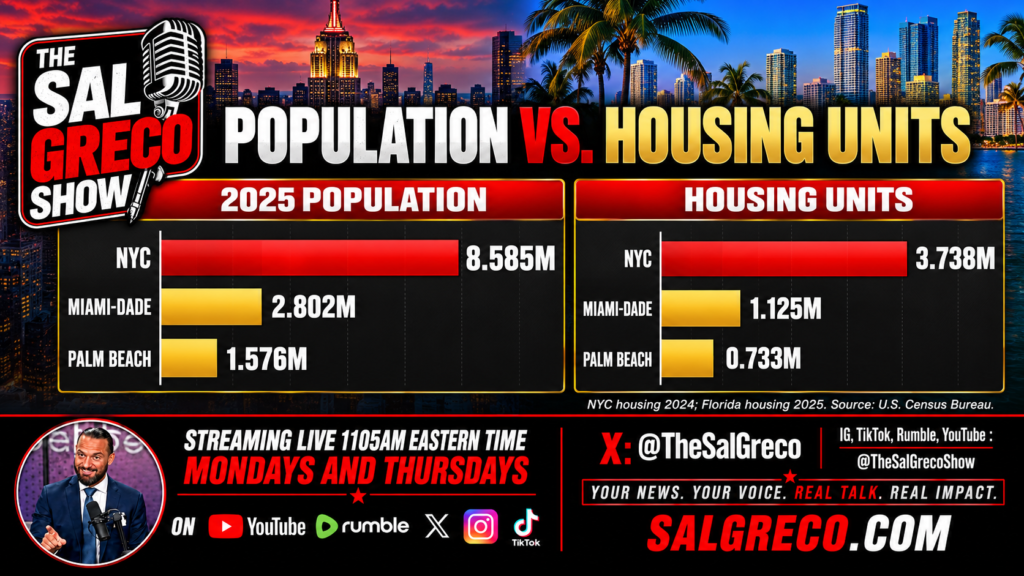
The latest Census estimates put New York City at approximately 8.585 million people, Miami-Dade at 2.802 million, and Palm Beach County at 1.576 million. Housing-unit figures are approximately 3.738 million for New York City, 1.125 million for Miami-Dade, and 733,000 for Palm Beach. Florida housing counts are 2025 estimates; the NYC figure is from the 2024 American Community Survey.
New York City has more than five times Palm Beach County’s population, yet some Palm Beach executives receive more compensation than the NYPD commissioner. That contrast deserves examination, but it does not alone prove a salary is excessive: job duties, cost of living, staffing, correctional responsibilities, and employer-paid benefits also matter.
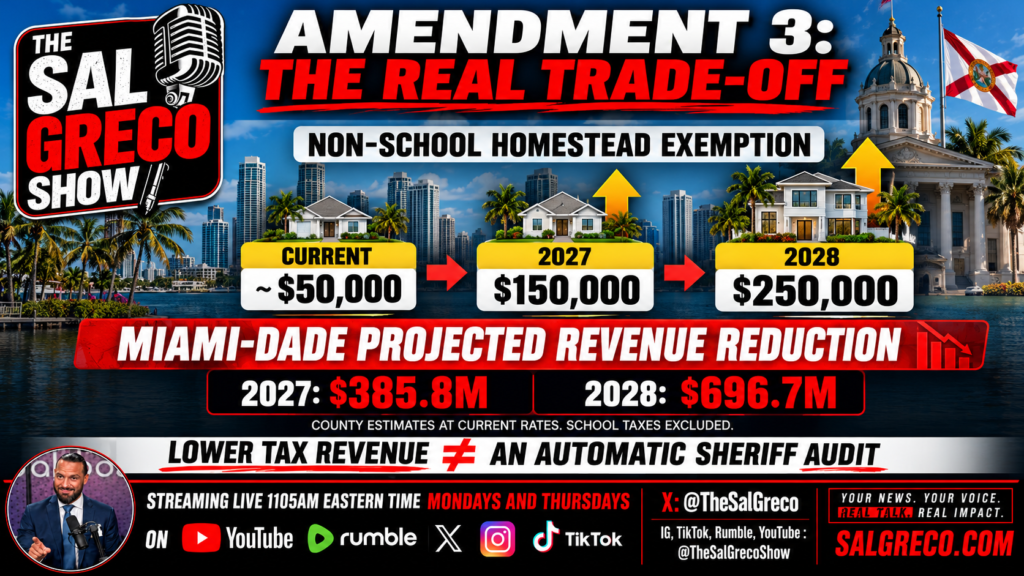
Amendment 3: A way to squeeze budgets, not a substitute for accountability
On November 3, voters statewide will decide Florida’s Amendment 3, which would expand the homestead exemption for non-school property taxes from roughly $50,000 today to $150,000 in 2027 and $250,000 in 2028, followed by inflation adjustments. It would also lower the annual assessment-increase cap on non-homestead properties from 10% to 5%. It requires 60% approval to pass. This is the statewide property-tax Amendment 3, not Miami-Dade’s unrelated County Referendum 3 concerning vacancy elections.
For eligible existing homeowners, it could mean meaningful property-tax relief. It could also force local officials to make spending choices they have deferred. Miami-Dade projects about $385.8 million in reduced property-tax revenue in the budget year beginning October 2027 and $696.7 million in the following budget year, assuming current rates.
There is a limit to the austerity argument: Amendment 3 does not require an independent sheriff audit, cap executive compensation, cancel cowboy-hat orders, or prevent public money from going to a disputed training center. It expressly lists public safety and government administration among the permissible uses of remaining property-tax revenue, while allowing other uses to be approved. Localities may raise other fees or taxes or reduce services; cuts could hit patrols, emergency response, libraries, roads or programs taxpayers actually want.
Tax relief is a legitimate policy choice. So is protecting basic public safety. Voters deserve to know both the promised savings and who may bear the cost. It is misleading to promise that an exemption itself will pinpoint extravagance in a sheriff’s purchasing office.
The accountability test that sheriffs should have to pass
There is a direct way to confront waste: publish itemized purchases, make training-center change orders public, disclose executive salary and benefits together, require independent performance and financial audits, and attach measurable staffing and response-time outcomes to additional funding requests. Florida law already empowers county budget authorities to request detailed expenditure information from sheriffs, although it also grants elected sheriffs substantial authority to transfer funds after approval. Policymakers can debate strengthening those safeguards.
Miami-Dade should publish the operational savings and risk assessment behind ending the mayor’s detail. Broward should release the complete training-center accounting and resolve county access on a lawful basis. Palm Beach should justify its executive retirement arrangements against comparable agencies with transparent, like-for-like compensation figures.
No sheriff is above the taxpayer. No mayor is above the taxpayer. And no public official should mistake an independent office for a personal kingdom. Amendment 3 may reduce the money flowing to local government, but the more durable answer is a culture of disclosure, enforceable oversight and consequences when public spending cannot be justified.
The Sal Greco Show – Your News. Your Voice. Real Talk. Real Impact.