
BY SAL GRECO
The latest lawsuit filed by NYPD Officer Shatorra J. Foster may ultimately become about far more than a single hair test. At its core, the case raises broader questions about retaliation inside the NYPD, the use of Psychemedics hair testing as an employment tool, and whether officers who challenge the Department are subjected to heightened scrutiny after engaging in protected activity.
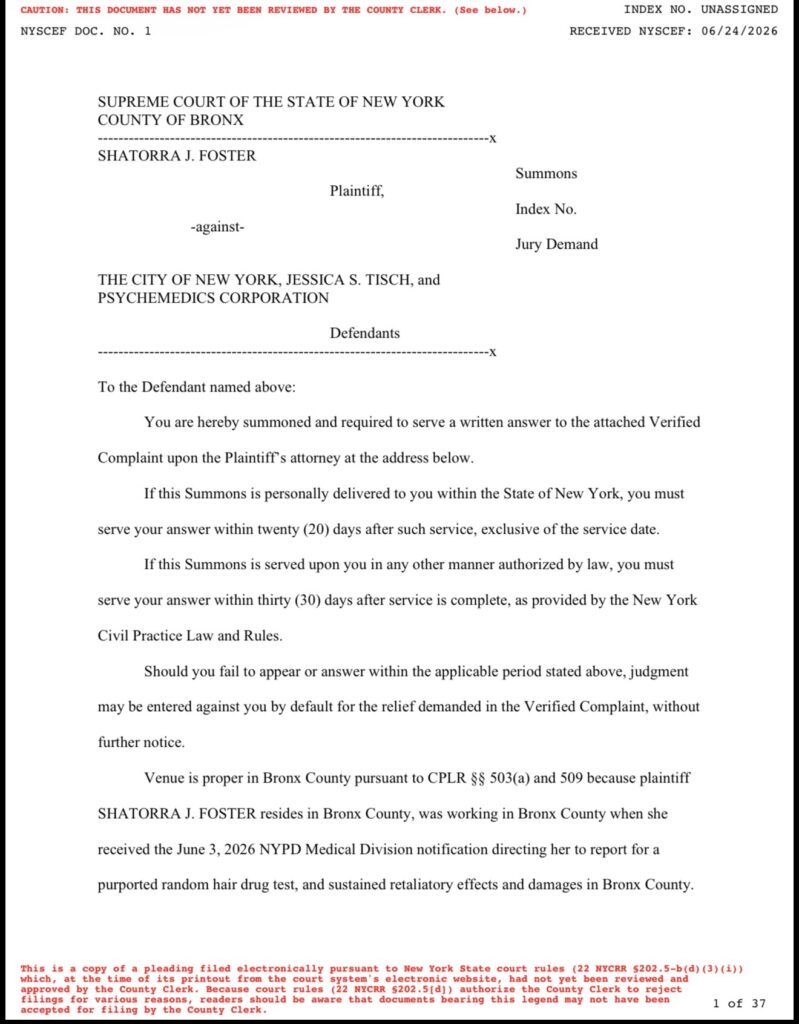
According to the complaint filed in Bronx Supreme Court, Foster alleges that she was ordered to submit to what the NYPD described as a “random” hair drug test on June 3, 2026—just one day after the City and NYPD officials were served with a separate lawsuit she had filed alleging retaliation and misconduct. The lawsuit names the City of New York, Police Commissioner Jessica Tisch, and Psychemedics Corporation as defendants.
The Timing Is the Story
The most significant allegation in the complaint is not that Foster failed a drug test. In fact, the lawsuit alleges she independently obtained a hair test later that same day that returned negative results and further alleges that the NYPD’s own test was likely negative because no discipline, suspension, or modification followed.
Instead, Foster argues that the act of compelling her to report for testing itself constituted retaliation. The complaint notes that she had recently engaged in extensive protected activity, including litigation, complaints, and allegations involving sexual harassment, retaliation, and investigative misconduct. The lawsuit alleges that the testing order arrived less than twenty-four hours after defendants were served with her Bronx County action.
If those allegations are proven, the case could become a significant examination of how the NYPD deploys internal administrative tools against members who challenge Department leadership or ongoing disciplinary proceedings.
The Psychemedics Question
The lawsuit also directly attacks the scientific reliability of the hair-testing program itself.
Foster alleges that the NYPD relies upon a testing regime that is “scientifically disputed,” inadequately validated, and insufficiently transparent. The complaint specifically argues that the testing program fails to satisfy accepted standards of scientific reliability and meaningful review.
Those allegations are particularly noteworthy because this is not the first time Psychemedics testing has become the focus of litigation involving NYPD personnel.
Former NYPD officer Frank Palaguachi has also challenged disciplinary actions connected to Psychemedics hair testing. Critics of hair testing have long argued that environmental contamination, external exposure, and variations in hair characteristics can create concerns that differ from traditional urine or blood testing methods. Supporters of hair testing, meanwhile, argue that it provides a longer detection window and has been accepted by many employers and law enforcement agencies across the country.

What makes the Foster lawsuit different is that the challenge is not merely directed at an individual result. The complaint questions the entire framework under which the testing is ordered, administered, reviewed, and used in personnel decisions.
A Retaliation Theory That Extends Beyond One Officer
For years, current and former NYPD members have alleged that retaliation remains one of the Department’s most persistent internal problems.
The significance of the Foster lawsuit is that it attempts to connect that broader allegation to a specific event occurring immediately after protected legal activity. The complaint repeatedly emphasizes that defendants allegedly failed to provide documentation showing how the selection was made, who authorized the test, or what process established that the selection was truly random.
Those allegations echo concerns frequently raised by officers who claim administrative processes can be weaponized against members who become whistleblowers, file lawsuits, challenge disciplinary actions, or publicly criticize Department leadership.
The issue of retaliation has also surfaced in public discussions surrounding the so-called Paul Saraceno files, which were previously examined by The Sal Greco Show and SalGreco.com. In those discussions, participants described retaliation within the NYPD as a real and ongoing concern. While those discussions are separate from Foster’s lawsuit and are not evidence of the claims in this case, they provide context for why allegations of retaliatory conduct continue to resonate among many current and former members of the Department.
Why This Case Could Be Embarrassing for NYPD Leadership
The lawsuit arrives at a time when the NYPD is already facing scrutiny over internal disciplinary processes, morale concerns, and a growing number of lawsuits naming senior leadership.
Foster’s complaint places Police Commissioner Jessica Tisch directly into the litigation and alleges that the testing occurred within a structure operating under her authority. The lawsuit further claims that the Department was already aware of Foster’s protected activity before the testing directive was issued.

Whether those allegations can ultimately be proven remains to be seen. Filing a lawsuit does not establish liability, and the City and other defendants will have an opportunity to contest every allegation.
Nevertheless, the optics are difficult to ignore. A police officer files a lawsuit against the NYPD. The next day she is ordered to report for what is described as a random drug test. Even if the Department ultimately demonstrates that the selection was entirely legitimate, the timing alone is likely to become a central issue in discovery and future court proceedings.
The Bigger Picture
The Foster lawsuit may ultimately become one of the most consequential challenges yet to the NYPD’s reliance on Psychemedics hair testing.
If the court allows broad discovery, plaintiffs could seek records concerning how officers are selected for testing, who authorizes those selections, what safeguards exist against retaliation, and whether the testing methodology meets the standards claimed by its defenders.
Combined with the separate litigation involving Frank Palaguachi, the case has the potential to place the NYPD’s hair-testing program under an unprecedented microscope.
At stake is not merely one officer’s test result. The larger question is whether a system intended to promote integrity can itself be manipulated—or perceived as being manipulated—against officers who choose to challenge the Department through protected legal activity.
That question may ultimately prove more important than the test itself.