
BY SAL GRECO
Gasoline has again become a major economic issue for American households. But comparing prices under Donald Trump’s first presidency, Joe Biden’s presidency and Trump’s second term requires separating presidential policy from events that presidents do not directly control—COVID, Russia’s invasion of Ukraine, global oil production, refinery capacity and, most recently, the continuing conflict with Iran.
The numbers reveal something particularly important about 2026: the United States is producing more crude oil than ever, yet American motorists are simultaneously paying some of the highest gasoline prices in years.
That apparent contradiction tells us a lot about how gasoline prices actually work.
Where gas stands right now
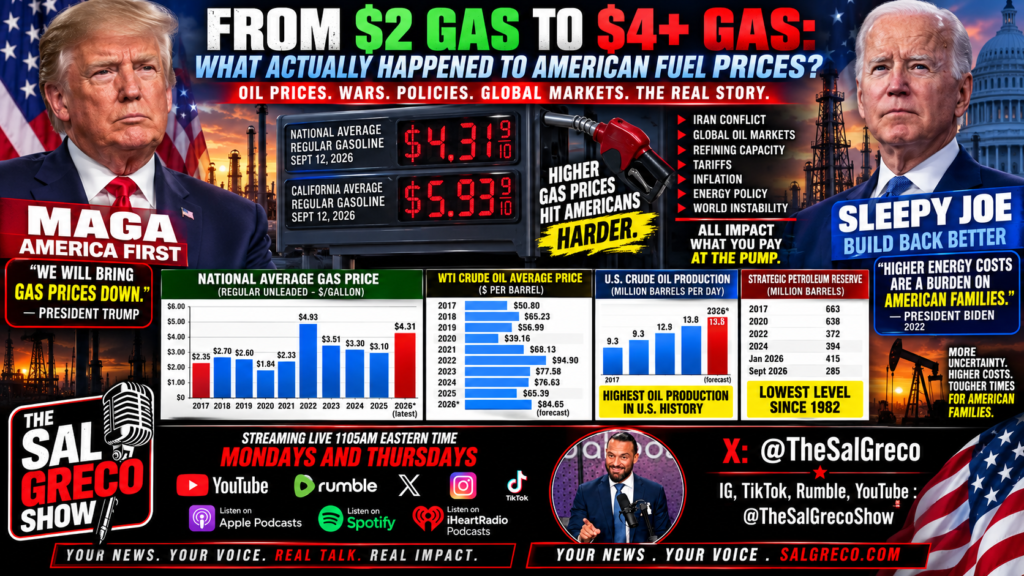
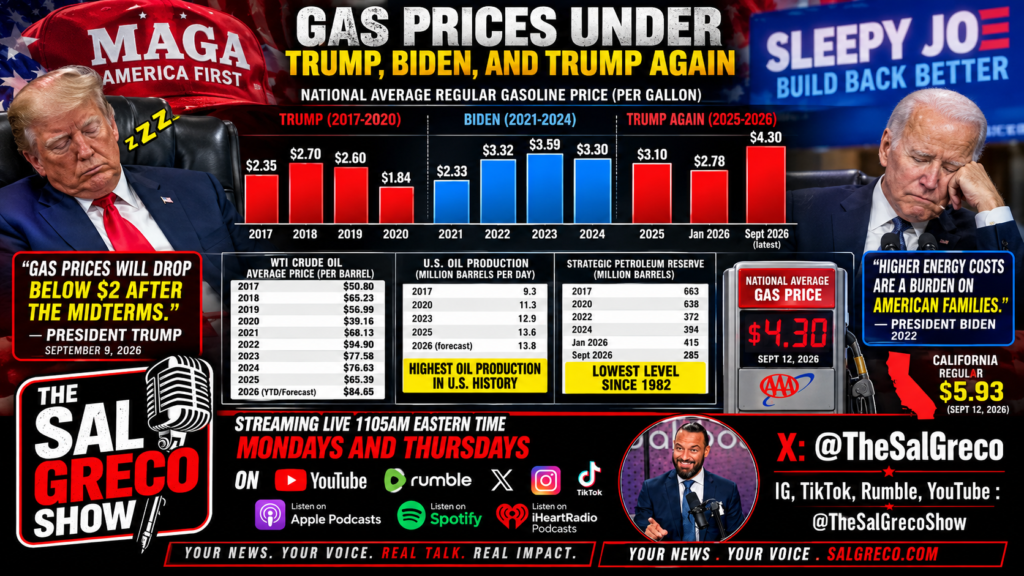
As of the latest AAA reading available, September 12, 2026, the national average for regular gasoline is $4.310 per gallon. One year earlier it was about $3.19. AAA reported on September 10 that prices had jumped approximately 13 cents in only one week, specifically pointing to rising crude prices and continued volatility surrounding the Strait of Hormuz.
That’s roughly a 35% increase from a year ago.
The government’s EIA measurement is slightly different because of methodology and publication timing: its September 7 weekly national average was $4.157. That was 97 cents above a year earlier.
And the movement during Trump’s second term is dramatic. EIA’s monthly conventional regular-gas series went from about $2.70 in January 2026 → $3.48 in March → $3.94 in April → $4.33 in May before easing and then climbing again amid renewed Middle East turmoil.
Oil prices from Trump I through Trump II
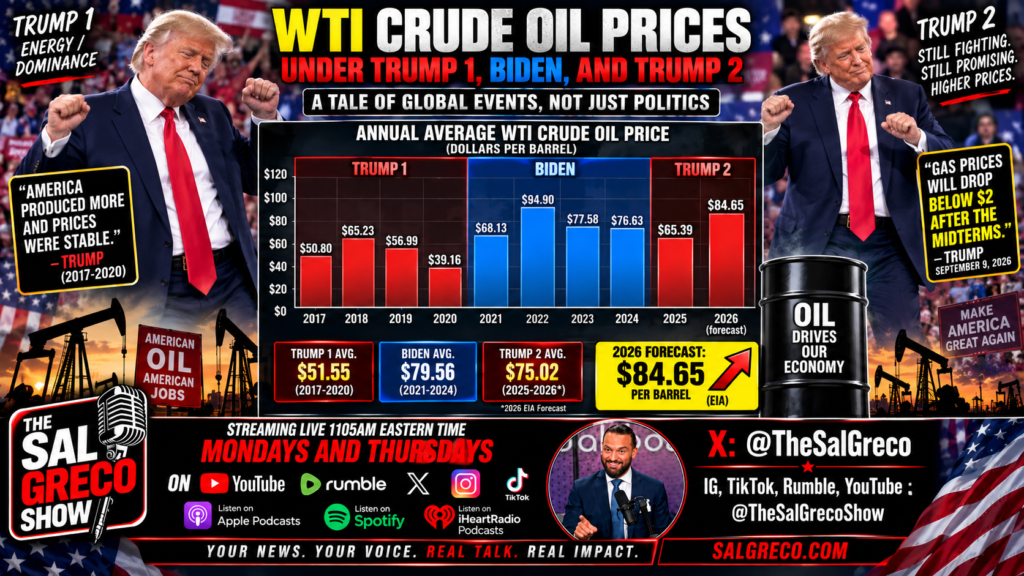
For an apples-to-apples comparison, West Texas Intermediate (WTI) is the best U.S. benchmark. These are the annual average WTI crude prices per barrel, not the highest price reached during each year:
| Year | President | Avg. WTI crude |
| 2017 | Trump | $50.80 |
| 2018 | Trump | $65.23 |
| 2019 | Trump | $56.99 |
| 2020 | Trump | $39.16 |
| 2021 | Biden | $68.13 |
| 2022 | Biden | $94.90 |
| 2023 | Biden | $77.58 |
| 2024 | Biden | $76.63 |
| 2025 | Trump | $65.39 |
| 2026 | Trump | $84.65 forecast full-year avg. |
The historical numbers through 2025 come directly from EIA’s WTI series. Because 2026 isn’t over, there cannot yet be a final 2026 annual average; EIA currently forecasts about $84.65 for the year.
But that annual forecast hides what’s happening right now. Brent moved back above $100 last week, while WTI also returned to roughly $100 territory as fighting involving the U.S. and Iran intensified.
That’s substantially different from 2025, when WTI averaged only about $65.
The presidential comparison needs context
During Trump’s first term, oil averaged approximately $51 in 2017, $65 in 2018 and $57 in 2019.
Then came 2020.
WTI’s annual average collapsed to about $39 because COVID-19 crushed worldwide transportation and petroleum demand. Therefore, extremely inexpensive gasoline in spring 2020 cannot reasonably be attributed entirely to Trump administration energy policy. An unprecedented collapse in global demand was a major cause.
The reverse happened under Biden in 2022. WTI averaged nearly $95, while gasoline surged after Russia’s full-scale invasion of Ukraine disrupted global energy markets. EIA says petroleum prices rose sharply following the invasion.
Then prices came down substantially. Regular gasoline averaged approximately $3.30 in 2024 and $3.10 in 2025, with 2025 becoming the third consecutive year of declining annual gasoline prices.
That matters because it means neither statement—“Biden caused $5 gas” or “Trump caused today’s $4.31 gas”—adequately describes how the petroleum market works.
Presidential decisions matter, but oil is a globally traded commodity.
Then came the Iran shock
This is arguably the biggest part of the 2026 story.
Reuters reported this week that escalating U.S.-Iran fighting pushed oil back above $100. It estimates roughly 10 million barrels per day of oil exports are currently missing from the global market because of the Iran war, while disruptions through the Strait of Hormuz continue.
The Strait matters enormously because it is one of the world’s most important petroleum chokepoints.
AAA explicitly connects the latest gasoline increase with this situation:
One month ago: $4.01
One week earlier: $4.14
September 10: $4.28
September 12: $4.31
AAA said that Strait of Hormuz volatility had pushed crude back toward $100/barrel.
“Is today’s gasoline spike principally Trump’s tariffs or the Iran conflict?”
The available evidence points much more strongly toward the Iran conflict, disruption of global petroleum flows, higher crude prices and extremely tight refining/product markets as the immediate drivers.
That doesn’t mean administration policies are irrelevant. Tariffs, sanctions, environmental rules, drilling/leasing policy, SPR decisions, permitting and foreign policy can all affect costs or supply. But tariffs alone don’t adequately explain why oil and gasoline moved so violently alongside changes in the Iran/Hormuz situation.
Here’s the extraordinary part: America is producing record amounts of oil
The idea that America simply “isn’t drilling” doesn’t fit the current numbers.
The United States was the largest crude-oil producer in the world in 2025, producing a record 13.6 million barrels per day.
And EIA reported just three days ago that America is on course to break the record again in 2026:
2024: ~13.2 million b/d
2025: ~13.6–13.7 million b/d
2026 forecast: 13.8 million b/d
EIA expects the Permian Basin alone to produce approximately 6.8 million barrels every day this year.
So we have the seemingly bizarre situation:
Record American oil production + $100 global crude + $4.31 American gasoline.
Those facts aren’t contradictory.
“Then why don’t we just use American oil?”
This is one of the most important questions to explain on air.
We already do.
Millions of barrels of domestically produced crude enter American refineries every day. But producing crude oil isn’t the same thing as producing gasoline, and American crude isn’t isolated from the international market.
There’s another wrinkle: not all crude oil is interchangeable.
A great deal of America’s shale production is relatively light, sweet crude. Many sophisticated U.S. refineries—particularly Gulf Coast and Midwest facilities—were designed and economically optimized to process heavier, sour crude.
Consequently, the U.S. can simultaneously:
produce American crude → export some of it → import different grades of foreign crude → refine that crude → consume and export gasoline/diesel.
EIA specifically says this mismatch is one reason the United States continues importing crude despite enormous domestic production.
That isn’t necessarily irrational. A refinery designed to efficiently process discounted heavy Canadian crude may make gasoline more economically from that barrel than from a barrel of light Permian crude.
America’s refinery problem
This is becoming increasingly important.
You can’t put crude oil into your Ford or Chevy.
It must become gasoline or diesel first.
Reuters reported Friday that the Trump administration is considering using the Defense Production Act to increase U.S. refining capacity as the Iran conflict exposes vulnerabilities in American fuel supplies.
Why?
U.S. refineries are already running around 98% utilization.
That leaves very little slack.
If crude costs rise while refineries are already running close to their limits—and gasoline or diesel inventories are tight—the price of finished fuel can increase dramatically.
“What about America’s oil reserves?”
There are actually three different things people mean when they say “oil reserves.”
America has approximately 46 billion barrels of proved crude-oil and lease-condensate reserves, based on the latest comprehensive EIA reserve estimate, for year-end 2024. “Proved reserves” means oil that geological and engineering evidence indicates can be economically recovered under existing conditions.
That’s oil underground.
Then America has ordinary commercial crude inventories—oil already extracted and stored by companies.
And finally there’s the government’s emergency stockpile:
The Strategic Petroleum Reserve.
This is where the current numbers become remarkable.
The SPR contained roughly:
2017: 663 million barrels at year-end
2020: 638 million
2021: 594 million
2022: 372 million
2023: 355 million
2024: 394 million
2025: 413 million
Jan. 2026: 415 million
EIA provides the historical inventory series.
But the Iran conflict led to another enormous drawdown.
By late August, EIA showed only 286.6 million barrels remaining.
And Reuters reported on September 8 that the SPR had fallen further to approximately:
285.4 MILLION BARRELS
That’s the lowest level since November 1982.
So America absolutely has been using its emergency oil to try to cushion the market.
The SPR isn’t an untouched reservoir sitting there while Americans pay $4 gas.
Why not dump all 285 million barrels onto the market?
Because it isn’t remotely enough to permanently overpower the world petroleum market.
At U.S. production of roughly 13.8 million barrels/day, the remaining SPR is equivalent to only about 21 days of current U.S. crude production.
And Reuters reports the Iran conflict has removed approximately 10 million barrels per day of exports from the global market. At that disruption rate, 285 million barrels represents less than 29 days of the missing global supply.
Of course, that isn’t literally how the reserve would be deployed; there are physical withdrawal rates, refinery logistics and international coordination to consider. But it illustrates the scale problem.
The SPR can bridge an emergency and soften a supply shock.
It cannot manufacture unlimited cheap oil.
And draining it aggressively today means having fewer emergency barrels available if the conflict gets worse tomorrow.
And California DID just break a record—but there’s an important correction
California’s regular gasoline has not reached its all-time statewide record today.
AAA’s latest available California average is:
Regular:
$5.927/gallon
That’s extraordinarily high, but California’s record statewide regular-gas average remains:
$6.4375 — June 14, 2022.
So California regular is still about 51 cents below its all-time record.
However, something has just hit a record:
California diesel:
$7.9827/gallon
AAA identifies that as California’s highest recorded average diesel price.
And nationally, Reuters reported another milestone this week: GasBuddy’s U.S. average diesel price crossed $6 per gallon for the first time. Reuters attributed the squeeze to several factors, including the Iran conflict, attacks on Russian refining infrastructure and restrictions on fuel exports from Russia and China.
That’s arguably an even bigger economic story than $4 gasoline because diesel feeds into the cost of trucking, agriculture, construction and supply chains, meaning businesses can ultimately pass some of those costs through to consumers.
So who or what is responsible?
The fairest conclusion from the numbers is that there isn’t one culprit.
Trump administration energy and foreign policies can influence domestic production, sanctions, tariffs, the SPR, refinery regulation and geopolitical risk. Biden administration policies likewise influenced those areas during his presidency.
But the immediate 2026 explosion in fuel prices is occurring despite record U.S. oil production and coincides with a huge international petroleum supply disruption.
The current chain looks much more like:
Iran conflict → Hormuz disruption → millions of barrels removed from global supply → global crude jumps → $100+ oil → U.S. refineries operating near capacity → gasoline/diesel wholesale costs rise → motorists pay more at the pump.
That’s why simply saying “drill more” doesn’t fully solve the immediate problem. America is already producing more crude than at any point in its history.
And simply saying “release the reserve” isn’t a permanent solution either. America has already drawn the SPR down from about 415 million barrels in January to approximately 285 million now.
The deeper issue exposed by 2026 is that being the world’s largest oil producer does not make the United States immune to a global oil shock.
American gasoline is still produced by refineries operating inside a global petroleum market. When a major portion of world supply becomes inaccessible, the price of the remaining barrels rises—including barrels produced in Texas.
The Political Price of $4 Gas
President Trump has now acknowledged that Americans may not see meaningful relief at the pump before the November midterm elections. On September 9, Trump said he believes gasoline will eventually fall below $2 per gallon, but added, “not until after the midterms.” Days later, he again predicted gasoline would “drop like a rock” once the Iran war ends. Those are predictions, however—not guarantees—and Trump has not demonstrated how or why gasoline would fall below $2 after Election Day.
That distinction matters. The Iran conflict is now in its seventh month even though Trump initially described a much shorter timetable, and the disruption to oil traffic through the Strait of Hormuz has helped push crude prices above $100 and gasoline above $4 nationally. Trump now says he expects the war to end sometime around or after the November election.
For a political movement built around “America First,” that creates an unavoidable debate within Trump’s own coalition: How long should the United States remain involved in another Middle Eastern conflict, and how much economic pain should Americans absorb as a consequence? Trump has defended the Iran war as necessary to prevent Iran from acquiring a nuclear weapon; critics contend that a prolonged conflict conflicts with the noninterventionist expectations that attracted some voters to his MAGA coalition. At the Republican midterm convention, Trump continued defending the war and urged supporters to vote as though he himself were on the ballot.
And the economic consequences are no longer abstract. Gasoline averaged $4.192 per gallon in August, up from $4.064 in July, while higher energy costs are contributing to renewed inflation pressure. Reuters reported that frustration over gasoline and other living costs has eroded Trump’s approval and become a political vulnerability for Republicans.
That puts the issue squarely into the 2026 midterm debate, with Republicans defending their congressional majorities. For working- and middle-income families already struggling with housing, food, insurance and other expenses, another $60, $80 or $100 at the pump every month can matter far more than political slogans. Recent polling has found widespread household strain from gasoline prices, while cost of living remains a major voter concern.
Whether frustrated Trump voters ultimately stay home, vote Republican anyway, choose independent candidates or vote Democratic cannot yet be known. But that uncertainty itself should concern Republicans. A voter does not necessarily have to switch parties for dissatisfaction to matter; declining enthusiasm and turnout among previously reliable supporters can also influence close congressional races.
And that may become one of the defining tests of Trump’s second presidency. Americans who voted for him in 2024 will ultimately judge whether the administration delivered the lower costs and “America First” priorities it promised—or whether another prolonged overseas conflict and the resulting energy shock left them paying substantially more simply to drive to work. Trump’s prediction that gasoline will fall below $2 after the midterms is now measurable: either prices eventually move dramatically in that direction, or they don’t. Until then, Americans are paying today’s price, not tomorrow’s promise—and on November 3, they will decide for themselves how much that matters.