
BY SAL GRECO
Donald Trump returned to the White House with something few presidents in modern American history have ever possessed: a political movement built almost entirely around him.
He wasn’t simply another Republican president.
To millions of Americans, Trump represented disruption.
He was bold. Dynamic. Unpredictable. And, to his supporters, brave enough to say things politicians had spent decades refusing to say.
He promised to secure the border, confront Washington’s political establishment, put America first, avoid unnecessary foreign wars, bring manufacturing home and—perhaps most importantly—fight for the forgotten American worker.
But as the 2026 midterm elections approach, the polling raises an uncomfortable question for the president and the Republican Party:
Has the political disruption that once made Donald Trump extraordinary started becoming ordinary?
Worse, has what once appeared bold, dynamic and brave increasingly begun to look routine, impulsive and disconnected from what the common American man and woman actually expected from their once-heralded political hero?
The latest numbers suggest something has changed.
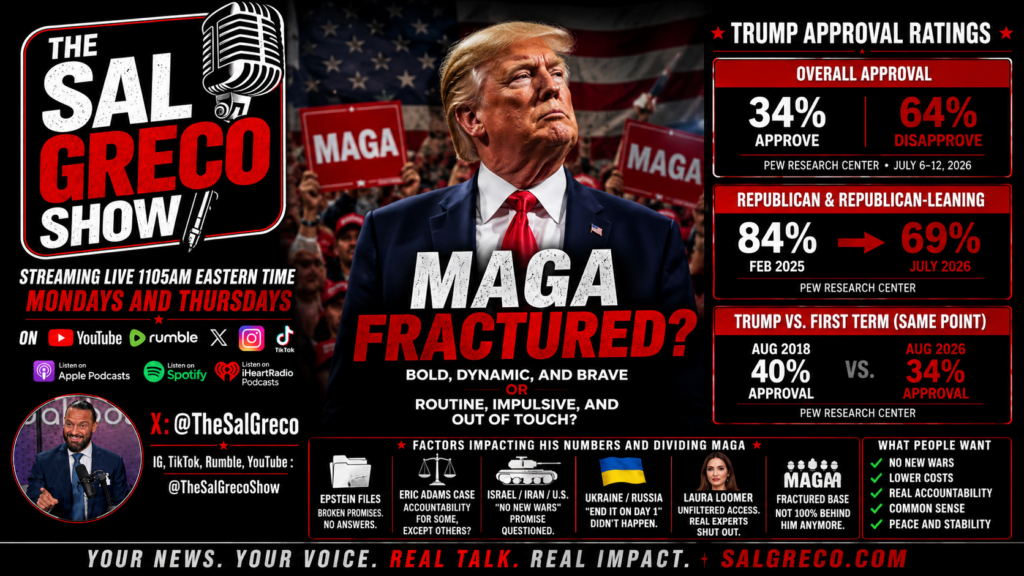
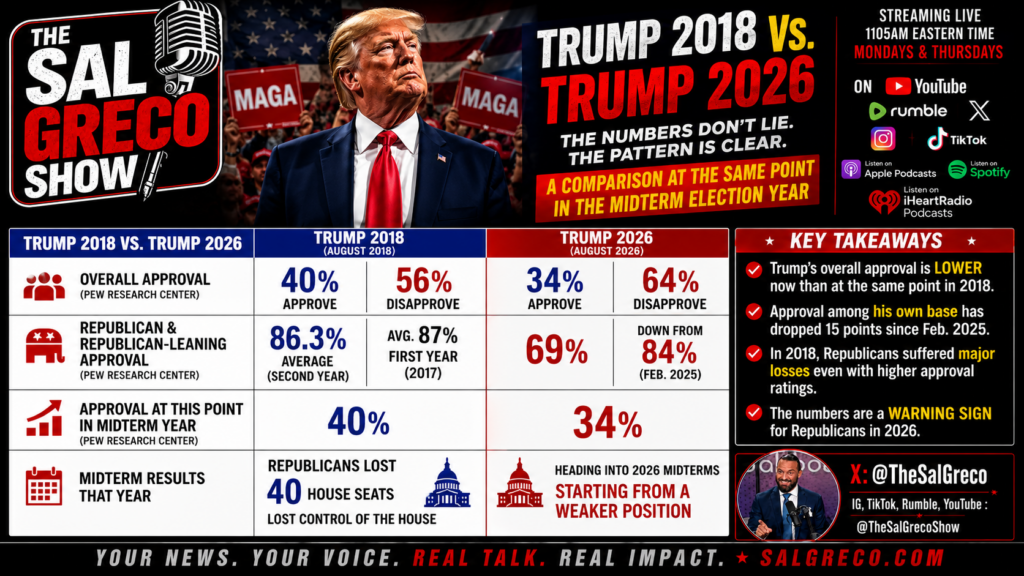
According to Pew Research Center’s July 6–12 survey, only 34% of Americans approve of Trump’s job performance. That is significantly below the 40% approval Trump had at approximately the same point in August 2018 during his first administration.
And this isn’t merely Democrats rejecting Donald Trump.
That has been happening for nearly a decade.
The more important development is occurring among Trump’s own voters.
THE REPUBLICAN DROP
Pew found that Trump’s approval among Republicans and Republican-leaning independents has fallen from 84% in February 2025 to 69% today.
That’s a 15-point decline within his own political coalition.
Among Republicans alone, Trump’s approval has averaged 81% during the February-July 2026 period, compared with an average 87% during his first year back in office in 2025.
Compare that with Trump’s first presidency.
During Trump’s second year in office in 2018, his approval among Republicans averaged 86.3%. During his third year it climbed to 88.8%. Even during the tumultuous final portion of 2020, Republican approval averaged 83.2%.
Trump’s political superpower has always been the extraordinary loyalty of Republican voters.
That loyalty hasn’t disappeared.
But it has unquestionably weakened.
And heading toward a midterm election, that matters.
THE “FAKE NEWS” RESPONSE IS WEARING THIN
There is another Trump routine that is approaching a decade old.
When the stock market is soaring, Trump points to it as evidence of his economic leadership.
When polls show him winning, they are great polls.
When television ratings demonstrate his popularity, he talks about them.
When election results favor him, the voters have spoken.
But when polls turn against him, suddenly the polls are fake.
When economic indicators become inconvenient, somebody else is responsible.
When reporting contradicts the preferred narrative, it becomes “fake news.”
That act worked politically for years because Trump’s supporters had legitimate reasons to distrust portions of America’s political and media establishment.
But distrust of institutions cannot become an excuse for dismissing every piece of information that delivers bad news.
At some point, leadership requires listening to information you don’t want to hear.
And after nearly a decade of watching the same cycle, the American public appears increasingly familiar with the routine.
You cannot celebrate the scoreboard when you’re winning and declare the scoreboard fraudulent every time you’re losing.
Eventually, people notice.
TRUMP 2026 VS. TRUMP 2018
The comparison is especially important because America has already seen what happened when Trump entered a midterm election with mediocre national approval.
In October 2018, Gallup measured Trump’s overall approval at 44%, including approximately 90% among Republicans.
Republicans nevertheless suffered major losses that November, losing 40 House seats and control of the House of Representatives.
Today Trump is starting from an even weaker national position.
Pew has him at 34%.
At the comparable point in 2018, Pew had him at approximately 40%.
That doesn’t mean 2026 automatically becomes another 2018. Congressional districts, individual candidates, turnout and the Senate map matter enormously.
But anyone inside the Republican Party looking at these numbers and simply screaming “fake polls” is ignoring a warning light flashing directly in front of them.
THE BIDEN COMPARISON
There is an extraordinary irony developing.
Trump’s current political position increasingly resembles the environment Republicans spent years criticizing under President Joe Biden.
In July 2022, Gallup had Biden at 38% overall approval, with only 31% of independents approving of his performance.
Even Democrats had begun showing frustration. Biden’s approval among Democrats had fallen to 78%, down dramatically from the 98% Democratic approval he enjoyed when his presidency began.
By October 2022, immediately before Biden’s midterm election, his overall approval stood at 40%.
Trump now confronts a version of the same political problem:
Your opponents were never going to support you. The danger begins when your own people stop enthusiastically supporting you.
THE COMMON MAN AND WOMAN
Perhaps that is where the Trump White House should be paying the closest attention.
Donald Trump’s original political appeal wasn’t primarily built around Washington.
It was built around the people outside Washington.
The construction worker.
The police officer.
The small-business owner.
The truck driver.
The waitress.
The mother staring at a grocery bill.
The father wondering why filling his gas tank suddenly costs so much.
The young couple wondering whether owning a home has become a fantasy.
These were the people who transformed “Make America Great Again” from a campaign slogan into a political movement.
Trump convinced millions of Americans that while Washington’s political class obsessed over ideology, international institutions and endless political warfare, somebody finally understood them.
Today, some of those same Americans appear to be asking a different question:
Does he still?
EPSTEIN AND THE ACCOUNTABILITY PROBLEM
The handling of the Epstein files became another source of frustration, particularly among portions of Trump’s own base.
For years, many Trump supporters demanded transparency and accountability surrounding Jeffrey Epstein and the powerful people potentially connected to him.
Whatever one believes ultimately exists in those files, the political problem for Trump was largely self-created.
Expectations were raised.
Supporters expected disclosure.
They expected answers.
Instead, the administration’s handling of the issue generated confusion, competing explanations and anger among some of the same people who had spent years demanding transparency.
For a movement that built much of its identity around exposing powerful institutions and holding elites accountable, that frustration shouldn’t be casually dismissed.
ERIC ADAMS AND SELECTIVE ACCOUNTABILITY
Then there was New York City Mayor Eric Adams.
Trump campaigned as the man who would restore accountability and end politically motivated justice.
Yet his Justice Department’s handling of the federal corruption prosecution against Adams created its own serious ethical controversy.
The administration sought dismissal of the charges without prejudice, and multiple federal prosecutors resigned amid the dispute. A federal judge ultimately dismissed the case with prejudice, preventing prosecutors from resurrecting the charges later.
Regardless of whether someone believes Adams was guilty, innocent or politically targeted, the episode created terrible optics for an administration promising impartial justice.
Accountability cannot mean aggressively pursuing the people you dislike while finding convenient exits for people who become politically useful.
The standard has to apply regardless of political relationship.
Otherwise “accountability” becomes another Washington slogan.
“NO NEW WARS”
Foreign policy may represent an even deeper fracture.
Trump’s appeal was never simply traditional Republican foreign policy.
A substantial portion of MAGA specifically rejected America’s post-9/11 cycle of military intervention.
Trump understood that.
He repeatedly criticized endless wars.
He promised peace through strength.
He presented himself as the president who could project American power without repeatedly sending America into new conflicts.
That makes the handling of the Israel-Iran-U.S. conflict particularly consequential.
Whether one supports or opposes the administration’s decisions, the political contradiction is impossible to ignore:
A president whose movement included millions of Americans exhausted by foreign intervention now finds himself trying to maintain their confidence while America is involved in another major Middle Eastern conflict.
For some MAGA voters, that wasn’t what they signed up for.
WHAT HAPPENED TO “DAY ONE”?
Then there is Russia and Ukraine.
Trump repeatedly promised during the campaign that he could rapidly end the Russia-Ukraine war, at times saying he could resolve it within 24 hours or before even formally taking office.
That obviously did not happen.
Perhaps that promise was always campaign hyperbole.
Perhaps resolving a massive international conflict was considerably more complicated than a campaign rally made it sound.
But voters are allowed to remember promises.
And eventually the accumulation of promises matters.
No new wars.
End Ukraine quickly.
Expose corruption.
Hold bad actors accountable.
Bring costs down.
Put ordinary Americans first.
Each individual failure or controversy can be explained.
Eventually voters stop evaluating them individually and start evaluating the pattern.
THE LAURA LOOMER PROBLEM
Another growing source of criticism involves activist and social engineer Laura Loomer’s extraordinary access and apparent influence around Trump’s political orbit.
The problem isn’t simply Loomer’s ideology or personality.
The deeper issue is what her prominence symbolizes.
When activists and online personalities appear capable of obtaining extraordinary access to the president while experienced scholars, policy experts, longtime conservative intellectuals and even lifelong Trump supporters complain about being ignored or shut out, something has gone wrong with the information pipeline surrounding the president.
Political loyalty is not expertise.
Social-media engagement is not scholarship.
Virality is not evidence.
And allegations repeated loudly enough online do not magically become established facts.
Trump once benefited from hearing voices Washington ignored.
But there is an enormous difference between rejecting establishment groupthink and replacing expertise with another form of groupthink generated by social media.
If a president increasingly hears from the people who tell him what he wants to hear while those offering uncomfortable information lose access, that isn’t disruption.
It’s an echo chamber.
And echo chambers eventually produce bad decisions.
MAGA IS NOT ONE PERSON
Perhaps Trump’s biggest political miscalculation is believing MAGA remains a monolithic group standing 100% behind his every word.
It isn’t.
Maybe it never was.
There are America First economic populists.
There are traditional conservatives.
There are libertarians.
There are working-class former Democrats.
There are anti-war voters.
There are religious conservatives.
There are immigration hawks.
There are police officers, veterans, union workers and small-business owners.
There are voters who love Trump personally.
There are others who don’t particularly like him but believed his policies were better than the alternative.
And increasingly there appear to be voters who still want Trump to succeed while no longer automatically agreeing with everything he does.
That distinction matters.
Criticizing Donald Trump does not automatically make someone anti-Trump.
Questioning an administration doesn’t make somebody a Democrat.
Disagreeing with the president on Iran doesn’t mean someone suddenly supports the political left.
Demanding answers about Epstein doesn’t make someone disloyal.
Wanting qualified people advising the president instead of social-media personalities doesn’t mean someone abandoned America First.
In fact, holding elected officials accountable—even elected officials you voted for—should be one of the most American things a citizen can do.
A FRACTURED MAGA BASE
The MAGA coalition isn’t necessarily collapsing.
But the evidence suggests it is fractured.
And Trump’s response to that fracture cannot simply be insisting that everyone still loves him, every negative poll is fake and every critic is suddenly an enemy.
The Pew numbers make that increasingly difficult to argue.
Approval among Republicans and Republican-leaning independents falling from 84% to 69% isn’t nothing.
It is a warning.
Some of these voters aren’t becoming Democrats.
They aren’t putting Biden bumper stickers on their cars.
They haven’t suddenly embraced progressive politics.
Many still hope Donald Trump succeeds.
But hoping someone succeeds and believing that person can do no wrong are two entirely different things.
That distinction may define Trump’s second term.
BOLD CAN EVENTUALLY BECOME IMPULSIVE
Trump’s unpredictability was once one of his greatest political weapons.
Nobody knew what he was going to say.
Nobody knew what he was going to do.
The political establishment couldn’t control him.
The media couldn’t anticipate him.
Foreign leaders couldn’t easily calculate him.
And his supporters loved it.
But there is a thin line between unpredictability and impulsiveness.
There is a difference between disrupting a broken system and creating disruption simply because disruption itself has become routine.
There is a difference between ignoring conventional wisdom and refusing to listen to anybody delivering unwelcome information.
What once appeared bold can eventually appear impulsive.
What once appeared dynamic can become routine.
What once appeared fearless can eventually look unaware of what the very people who elected you actually want.
And that may be the greatest danger facing Trump politically.
THE HERO PROBLEM
Donald Trump became something unusual in American politics.
To a significant portion of his supporters, he wasn’t simply their preferred politician.
He became a symbol.
He survived investigations, impeachments, criminal prosecutions, an assassination attempt and completed one of the most extraordinary political comebacks in American history.
To those supporters, Trump wasn’t merely fighting Democrats.
He was fighting an entire political establishment on their behalf.
That created an almost heroic image around him.
But heroes eventually face expectations.
And the higher someone is elevated, the greater the disappointment when supporters begin believing that person has stopped listening to them.
A voter who never liked Donald Trump is unlikely to determine his political future.
A voter who loved Donald Trump and becomes disappointed in him very well might.
They don’t have to become Democrats.
They simply have to stay home.
That is how midterm elections change.
PEOPLE WANT PEACE AND THE ABILITY TO LIVE
At this point, millions of Americans aren’t asking for political miracles.
They hope for the best.
They hope their president succeeds because when an American president succeeds, America should benefit.
But many ordinary Americans also want something considerably simpler.
They don’t want another war.
They don’t want another son or daughter potentially sent into another overseas conflict that seems to have no ending.
They don’t want to continue being economically crushed.
They want groceries they can afford.
Housing they can afford.
Insurance they can afford.
Energy they can afford.
They want wages that actually mean something after the bills are paid.
They want stability.
And at minimum, many hope America can avoid entering another major conflict or watching their household finances deteriorate further before Trump’s term is finished.
Those aren’t unreasonable expectations.
They’re precisely the kinds of expectations that helped create MAGA in the first place.
THE WARNING LIGHTS ARE FLASHING
None of this means Donald Trump’s political movement is finished.
Far from it.
American politics can change dramatically between August and November.
Wars can end.
Markets can move.
Prices can fall.
Candidates can implode.
Political scandals can erupt.
And polls are not elections.
But polls are information.
Trump understood that perfectly well when those polls showed him winning.
He should understand it now.
The message isn’t necessarily that MAGA has abandoned Donald Trump.
The message is that a meaningful portion of MAGA appears increasingly willing to question Donald Trump.
And maybe that’s healthy.
No elected official should have a political base that believes questioning him constitutes betrayal.
No president should be surrounded exclusively by people afraid to tell him he’s wrong.
And no politician—Donald Trump included—is entitled to permanent loyalty from the American voter.
THE QUESTION TRUMP MUST ANSWER
Joe Biden learned a brutal political lesson:
Eventually voters stop caring about explanations.
They care about results.
Trump risks learning exactly the same lesson.
Donald Trump built one of the most extraordinary political movements in modern American history because millions of forgotten Americans believed he heard them when Washington didn’t.
They believed he understood their anger.
Their economic anxiety.
Their exhaustion with foreign wars.
Their distrust of institutions.
Their desire for accountability.
Their frustration with a government seemingly more interested in itself than the citizens paying for it.
Those people haven’t necessarily abandoned Donald Trump.
Many still desperately want him to succeed.
But wanting someone to succeed doesn’t require pretending everything is going well.
And Donald Trump would be making an enormous mistake if he interpreted continued support as unconditional obedience.
The question heading toward the 2026 midterms isn’t whether these voters suddenly love Democrats.
Most probably don’t.
It isn’t whether MAGA still exists.
It unquestionably does.
The real question is much more important:
Does Donald Trump still understand the people who created MAGA—or has he started believing that MAGA exists simply to support Donald Trump?
Because those are two very different things.
The movement was built around Americans who believed their government had forgotten them.
Trump became their champion because he convinced them somebody finally remembered.
If those same Americans begin feeling forgotten again, dismissing their concerns as fake news, disloyalty or bad polling won’t solve the problem.
It will prove their point.
Donald Trump’s greatest political threat may therefore not be Democrats, the media or another investigation.
It may be something much harder for any politician to defeat:
Disappointment among the people who once believed in him the most.