BY SAL GRECO
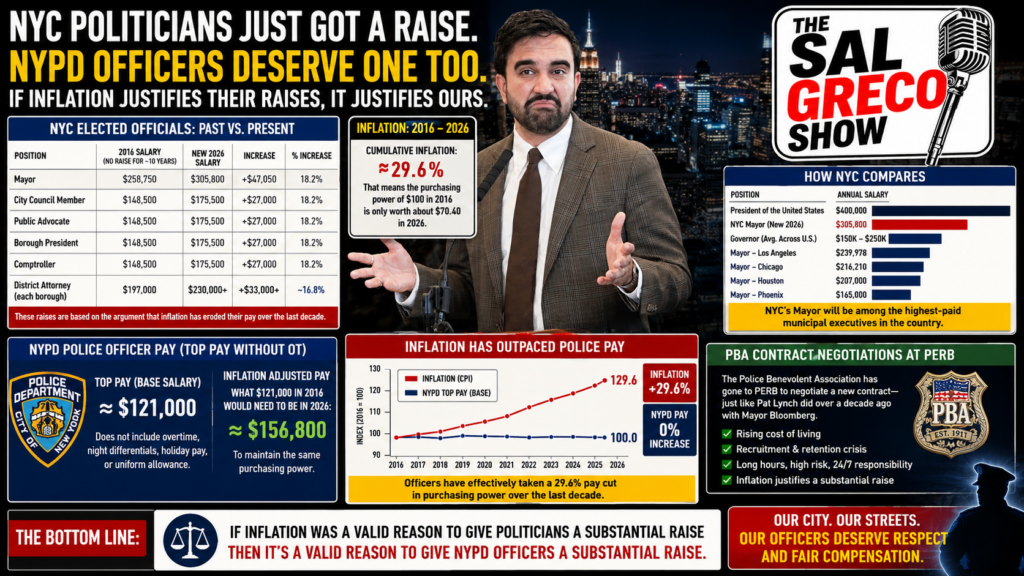
The New York City Council has approved significant salary increases for the city’s elected officials, arguing that their compensation had failed to keep pace with inflation after approximately a decade without raises. Under the legislation, City Council members would see their salaries increase from $148,500 to $175,500, while the mayor’s salary would rise from $258,750 to approximately $305,800. Similar increases would also apply to the public advocate, borough presidents, comptroller, district attorneys, and several other elected officials. Supporters of the increases argued that salaries had remained unchanged since 2016 and that inflation had substantially eroded their purchasing power.
Whether New Yorkers support or oppose those raises, the underlying argument is straightforward: inflation matters.
If inflation is a legitimate reason to substantially increase the salaries of politicians, then the same logic should apply to the thousands of police officers who patrol New York City’s streets every day.
Inflation Doesn’t Discriminate
Since 2016, cumulative inflation has significantly reduced the purchasing power of every New Yorker—not just elected officials.
Police officers have experienced the same increases in housing costs, food prices, insurance premiums, transportation expenses, childcare costs, and everyday necessities as everyone else.
Unlike many elected officials, however, police officers cannot supplement their salaries through outside employment while serving full-time in one of the country’s most demanding professions.
The question therefore becomes simple:
If inflation justifies raises for politicians, shouldn’t it justify raises for the police officers who protect the city?
Comparing Political Salaries
Even before the proposed raises, New York City’s elected officials ranked among the highest-paid public officials in America.
For comparison:
- The President of the United States earns $400,000 annually (plus an expense allowance and use of the White House).
- State governors across the country generally earn between approximately $150,000 and $250,000, depending on the state.
- Many large-city mayors earn considerably less than New York City’s mayor.
Following the proposed increase, New York City’s mayor would earn over $300,000 annually, placing the office among the highest-paid municipal executive positions in the nation.
Meanwhile, the NYPD PBA Awaits a New Contract
At the very same time elected officials are receiving raises based largely on inflation, the Police Benevolent Association—the union representing New York City police officers—is seeking a new collective bargaining agreement through the Public Employment Relations Board (PERB).
The move to PERB echoes prior contract disputes during the Bloomberg administration, when former PBA President Patrick Lynch likewise pursued arbitration after negotiations failed to produce an agreement.
Today’s officers face many of the same challenges, only amplified by inflation and an increasingly expensive cost of living.
Current top-pay NYPD police officers earn roughly $121,000 in base salary before overtime and other contractual pay differentials. While that figure may sound substantial on paper, it has not kept pace with the dramatic increase in New York City’s cost of living over the past decade.
Adjusted for inflation, maintaining the same purchasing power as officers enjoyed ten years ago would require materially higher compensation today.
Recruitment and Retention Matter
The NYPD continues to compete with surrounding police departments, federal agencies, and suburban departments that often offer comparable—or higher—pay, different retirement structures, and significantly improved quality of life.
Recruiting and retaining experienced officers has become increasingly challenging.
When experienced officers leave, taxpayers lose years of training and institutional knowledge while the department spends millions recruiting and training replacements.
Competitive salaries are not simply an employee benefit—they are a public safety investment.
Applying the City’s Own Logic
City leaders have effectively made the argument themselves:
After approximately ten years without raises, inflation reduced the value of elected officials’ salaries enough to warrant meaningful increases.
If that reasoning is sound for politicians, consistency suggests it should also apply to the men and women responding to shootings, violent crimes, domestic violence calls, terrorism threats, protests, major events, and emergencies every day.
No one disputes that inflation affects elected officials.
The question is whether City Hall will acknowledge that inflation affects police officers just as much.
The Bottom Line
Reasonable people can disagree over whether politicians deserved raises.
But if inflation is the standard used to justify higher compensation for elected officials after a decade without increases, then it becomes difficult to argue that the NYPD’s rank-and-file should be treated differently.
As the PBA negotiates its next contract through PERB, City Hall now faces an obvious question:
Should the same inflation argument that benefited politicians also result in a substantial raise for the police officers who protect New York City?
If inflation justified raising the salaries of the city’s elected leaders, many officers and taxpayers will argue that the same principle should apply to those wearing the uniform.