
BY SAL GRECO
Representative Thomas Massie is raising a serious question about Republican leadership’s priorities after highlighting the House of Representatives’ surprisingly limited legislative schedule before the November midterm elections.
The calendar Massie posted is authentic. It comes from the official 2026 legislative calendar released by House Majority Leader Steve Scalise. The calendar shows the House leaving Washington for its summer recess after its July session, returning in September, and then remaining out of regular legislative session for virtually all of October.
Massie wrote:
“Waiting for y’all to discover Republican leaders in DC have also scheduled an October recess.”
He claimed that only eight full legislative days and eight partial days remain before voters go to the polls, concluding:
“It looks like we’re intent on squandering a majority, until you understand Uniparty IS always the majority.”
Massie’s post and wording have been independently confirmed through his official social-media account.
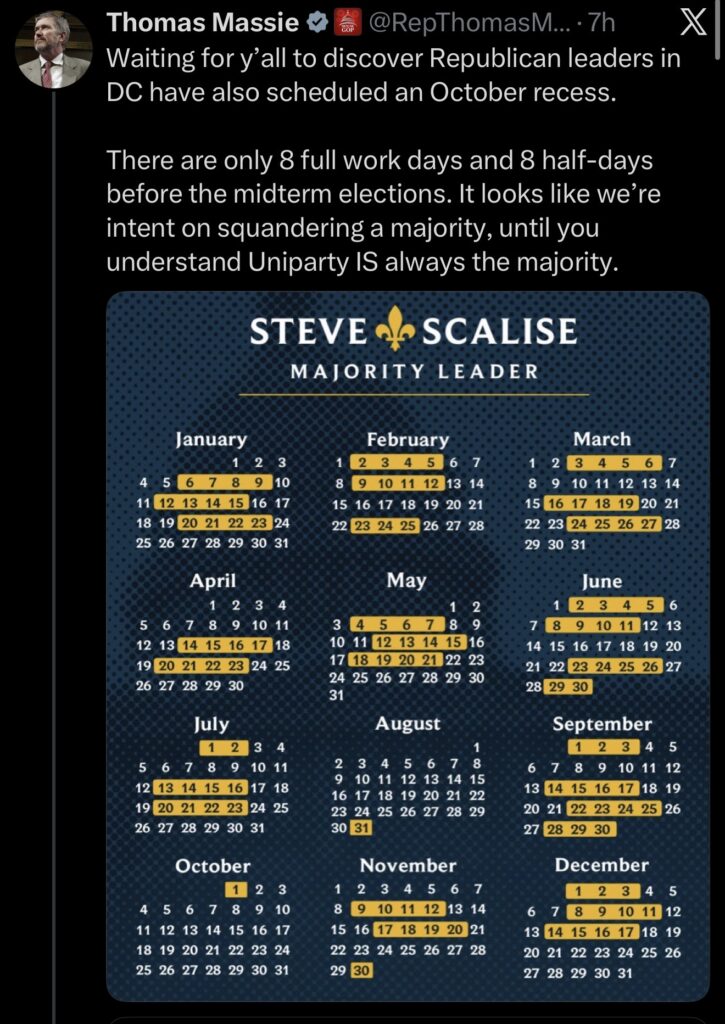
His broader point is substantially accurate: the House calendar currently provides only a few working weeks between the summer recess and the election. However, “half-days” is Massie’s characterization of days on which lawmakers typically arrive for evening votes or leave after morning votes. The official calendar identifies legislative days but does not formally label them “full” and “half” days.
The calendar can also be changed. Speaker Mike Johnson and Majority Leader Scalise could add voting days, cancel district work periods or recall members during an emergency. As currently published, however, Massie is correct that Republicans have given themselves an extremely narrow window to pass legislation before the election.
A Majority With Almost No Margin for Error
The criticism carries additional weight because Republicans do not possess a comfortable House majority.
An official House Clerk membership list dated July 1 showed:
- 218 Republicans
- 212 Democrats
- One independent
- Four vacancies
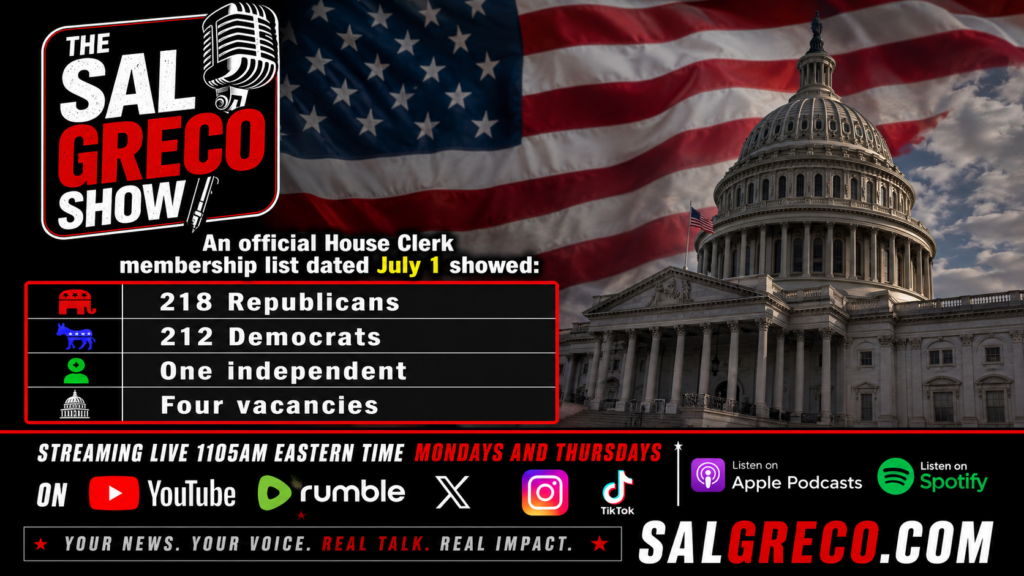
That means Republican leadership can afford only a small number of defections on party-line legislation, particularly when members are absent. A handful of Republican “no” votes can defeat a bill or force leadership to seek Democratic support.
That mathematical reality has already been visible during procedural and legislative votes. One July rule governing several Republican bills passed only 215–211. Such votes demonstrate how quickly leadership can lose control when even a few members object or fail to attend.
Republicans therefore face two separate dangers.
First, they could enter the election without delivering enough concrete accomplishments to energize their voters.
Second, they could reinforce the perception that congressional leaders from both parties prefer campaigning, fundraising and managed legislative stalemate over confronting controversial issues.
That second concern is the foundation of Massie’s “uniparty” argument.
Why the Schedule Feeds the “Uniparty” Belief
“Uniparty” is not an official organization. It is a political term used primarily by populist and anti-establishment voters who believe Democratic and Republican leaders publicly fight while privately protecting the same institutions, spending arrangements and governing practices.
The House calendar does not prove that such coordination exists. There are legitimate reasons lawmakers spend extended periods outside Washington, including district meetings, constituent services, hearings away from the Capitol and campaigning in competitive districts.
Nevertheless, the optics are damaging.
Republicans control the House, the Senate and the White House. Their voters therefore expect them to use every available legislative day to pursue the agenda on which they campaigned.
When Congress schedules extended recesses while major Republican priorities remain unfinished, voters may reasonably ask why leadership is not keeping members in Washington.
The appearance becomes particularly problematic when lawmakers later claim there was insufficient time to pass legislation.
Massie’s criticism essentially asks: How can Republicans say Democrats or Senate rules prevented action when Republican leaders voluntarily limited the number of days available for debate and voting?
Even voters who reject the “uniparty” label may see the schedule as evidence of complacency, poor planning or fear of forcing politically difficult votes.
What Has President Trump Said?
As of July 31, President Donald Trump does not appear to have publicly addressed Massie’s specific criticism of the House’s October recess.
Trump has, however, taken the opposite position regarding the Senate’s summer break.
He has demanded that Senate Majority Leader John Thune cancel or postpone the Senate’s August recess until lawmakers act on the SAVE America Act, Trump’s election-policy legislation involving voter identification and proof-of-citizenship requirements.
Trump has also pressured Senate Republicans to reconsider the legislative filibuster because the party’s 53-seat Senate majority is not enough to overcome the ordinary 60-vote threshold without Democratic support. Senate leadership has resisted abolishing the rule and has argued that there is currently no clear path to passing the measure.
That creates an obvious political contrast.
Trump is publicly telling senators to stay in Washington and pass his agenda, while the House calendar contains a summer recess followed by only several weeks of voting before an October break.
It remains possible that Trump will pressure Speaker Johnson and Scalise to revise the House calendar as well. But no verified statement from Trump specifically demanding cancellation of the October House recess had surfaced by the time of publication.
Trump and Massie have frequently disagreed, particularly regarding spending, debt and foreign policy. But on the narrower question of whether Congress should remain in session to advance major legislation, Trump’s recent comments concerning the Senate lend at least indirect support to Massie’s underlying complaint.
What Legislation Is Awaiting Action?
There is an important distinction between legislation awaiting action somewhere in Congress and bills formally scheduled for a future House floor vote.
House Republican leadership has not yet released a detailed September weekly floor schedule identifying every bill that will receive a vote. Therefore, claims that particular legislation is guaranteed to reach the House floor would be premature.
Several major matters nevertheless remain unresolved or could require additional House action.
Government funding
Government funding remains one of Congress’s most important responsibilities.
The House passed H.R. 9770, the Continuing Appropriations Act, 2027, intended to prevent a September 30 funding lapse and continue funding for programs including SNAP, WIC, TANF and disaster relief through the end of 2026.
However, the Senate may amend the legislation. Any different Senate version would have to return to the House for another vote or be reconciled through negotiations.
Congress could therefore return in September facing another government-funding confrontation immediately before the October recess.
Annual appropriations bills
Congress has also been considering the individual appropriations measures that finance federal departments and agencies.
Among the measures that moved through the House process were:
- The National Security, Department of State and Related Programs appropriations bill
- The Energy and Water Development appropriations bill
- Veterans-related legislation
- Other departmental funding measures
House leadership’s own floor notices show that several appropriations and policy bills were considered during June and July.
Even where the House passes its version, disagreements with the Senate can produce negotiations, amendments and return votes.
The SAVE America Act
Trump’s SAVE America Act is one of his most heavily promoted pre-election priorities.
Its central provisions involve national voter-identification standards and documentary proof of citizenship for federal voter registration. Supporters characterize the legislation as an election-integrity safeguard. Opponents argue that it could prevent eligible citizens who lack readily available documentation from registering or voting.
The immediate obstacle is primarily in the Senate, where Republican leaders lack 60 votes under existing filibuster rules. Trump has demanded that the Senate remain in Washington until the bill is addressed.
Should the Senate amend or combine the proposal with another legislative package, the House could be required to vote again.
Defense and national-security legislation
Defense authorization, military funding and war-powers disputes remain active issues.
Congress has recently confronted disagreements involving military spending, overseas operations and restrictions on presidential war powers. Several Republicans have joined Democrats on particular resolutions, demonstrating that foreign policy can divide the GOP conference.
Any Senate amendments to defense or national-security packages could force further House action during the limited September window or after the election.
A possible Republican budget package
The Trump administration has also been pressing Senate Republicans to advance another major budget framework before the election, described by supporters as a pre-election package focused on farmers, defense, traditional Republican constituencies and MAGA priorities.
The proposal remains politically and procedurally uncertain. But if the Senate advances a budget resolution or reconciliation-related package, House Republicans may be required to consider it.
The Political Risk for Republicans
The October recess will not, by itself, determine control of Congress. Elections turn on candidate quality, district boundaries, fundraising, presidential approval, economic conditions and local issues.
But the schedule could become a symbol of a larger Republican problem.
The party currently has unified control of Washington yet continues to face internal disputes involving spending, foreign policy, Senate procedure and the scope of Trump’s agenda.
If Republicans return home without passing high-profile priorities, Democratic candidates can argue that GOP control produced dysfunction rather than results.
At the same time, Republican voters could conclude that leadership failed to use its power aggressively enough. That frustration could reduce turnout among the very voters Republicans need in close House races.
Massie’s warning is therefore not merely about the number of days lawmakers sit in the Capitol. It is about political urgency.
A governing party with a narrow majority cannot afford to appear comfortable, especially when that majority could disappear after a shift of only a few seats.

Is Massie Correct?
Massie is correct about the central factual issue: the official House calendar currently contains very few legislative days between the summer recess and the November election, with no regular October voting session shown.
His count of “eight full work days and eight half-days” reflects how congressional arrival and departure days normally operate rather than formal terminology contained in the calendar.
His conclusion that leadership is deliberately protecting a “uniparty” is a political interpretation, not a provable fact.
But Republican leadership’s schedule undeniably gives that argument oxygen.
When voters see lawmakers leaving Washington despite unresolved spending bills, election legislation, defense matters and other promised priorities, it becomes easier to believe that congressional urgency is largely theatrical.
Republicans may still add days, recall the House or produce significant legislation during September. But unless that happens, they will enter the final weeks of the campaign vulnerable to criticism from both directions: Democrats accusing them of failing to govern and conservative voters accusing them of refusing to fight.
Thomas Massie may not be able to prove the existence of a uniparty. But by scheduling so little time to legislate before a potentially decisive election, Republican leaders are making his argument considerably easier to sell.