
BY SAL GRECO
Former NYPD Chief of Department Jeffrey Maddrey has now surfaced on New York State’s police decertification list. But beyond Maddrey himself, his case raises a much larger question: How much power should a police department have to permanently damage an officer’s post-NYPD life through an administrative determination — particularly when there has been no criminal conviction?
For more than a year and a half, questions have followed former NYPD Chief of Department Jeffrey B. Maddrey out the door of One Police Plaza.
Did he retire in good standing? Did he receive the coveted NYPD “Good Guy Letter”? Does he have a retired NYPD identification card? Could he ever work in law enforcement again?
Now, at least part of that picture has become clearer.
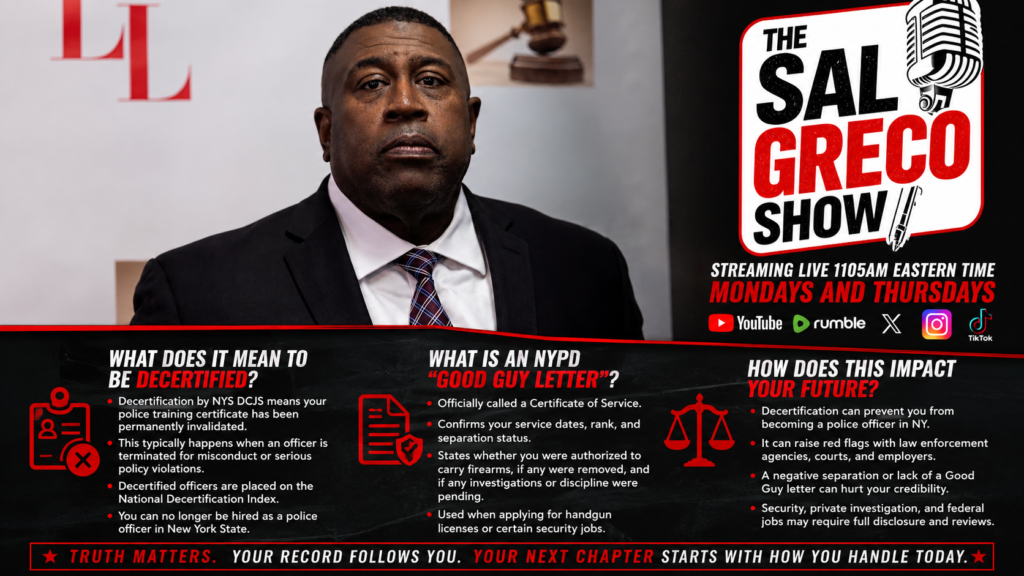
The New York State Division of Criminal Justice Services’ Police and Peace Officer Decertification system states that a police officer’s basic training certificate is invalidated when an officer is reported as having been removed for cause for misconduct, or resigned or retired subsequent to or in connection with allegations of misconduct. DCJS says police officers removed for cause under regulations effective since October 2021 have their basic training permanently invalidated. The state also sends decertification information to the National Decertification Index, which police employers are required to check before hiring.
According to the August 14, 2026 DCJS list discussed on Episode 223 of The Sal Greco Show, Maddrey is listed as a “removal for cause,” effective January 22, 2025.
That is significant. But it also raises a much more uncomfortable question about what “decertification” actually proves — and whether the administrative machinery surrounding decertification and “Good Guy Letters” has become far too subjective.
What Does Decertification Actually Mean?
First, decertification should not be confused with a criminal conviction.
DCJS itself explains that the information on its public decertification list is derived from information reported by police and peace-officer employers. The agency expressly warns that the information may later be changed, corrected or updated. DCJS also provides a procedure to address materially inaccurate employer reporting.
That distinction matters enormously.
When a New York police officer is decertified under the current system, the consequence can be devastating to any future law-enforcement career. For police officers removed for cause under the post-October 2021 regulations, DCJS says the basic training certificate is permanently invalidated, without the former option of simply retaking the state-mandated basic course.
In other words, the certificate that once established that the officer met New York’s basic police training requirements is gone.
That does not, standing alone, mean that a court found the former officer guilty of a crime.
And that distinction sits at the center of the Maddrey debate.
The “Good Guy Letter” — And the Power Behind It
Then there is the infamous “Good Guy Letter.”
The term sounds informal, but the consequences can be anything but.
A federal court recently described these documents in remarkable detail in Perros v. County of Nassau, litigation brought by former Nassau County law-enforcement personnel who had been denied recommendations following disability retirements.
The September 2025 decision explained that the recommendation forms became commonly known as “good guy letters” and observed that such recommendations historically were so routinely granted that there was essentially no corresponding police term for being denied one.
Even more important, the court described the Good Guy Letter as a retirement benefit upon which other benefits turned. In the Nassau County system involved in Perros, the letter affected the retirees’ ability to obtain retired law-enforcement pistol permits, retain service weapons and receive credentials reflecting their ability to carry a firearm.
And this is where the Maddrey story becomes bigger than Jeffrey Maddrey.
What Perros Really Says
There is an important legal distinction that needs to be made.
It would go too far to say that Perros created a universal rule that every officer in New York who has not been criminally convicted must receive a Good Guy Letter. The case does not say that.
What it does demonstrate, however, is how constitutionally problematic a subjective or discriminatory system for withholding these recommendations can become.
The plaintiffs in Perros were former corrections officers and deputy sheriffs who alleged that Sheriff Michael Sposato denied them Good Guy Letters because they retired on disability after suffering job-related injuries. In 2017, the federal court allowed their Equal Protection and municipal-liability claims to continue.
The litigation ultimately became far more damaging to Nassau County.
By the September 2025 damages decision, the defendants had conceded liability. U.S. District Judge Gary R. Brown described former Sheriff Sposato’s conduct in extraordinary terms and found that his actions had serious consequences for the retirees. The court awarded a combined $283,000, including $150,000 in punitive damages against Sposato.
That case should be required reading whenever a police agency decides who is — or isn’t — a “good guy.”
Because the fundamental issue is subjectivity.
Who decides?
Under what objective standard?
What evidence is required?
Does an allegation count?
Does an unfinished departmental investigation count?
Does merely leaving while an investigation remains open count?
And what happens when the police department making that determination has an adversarial relationship with the departing officer?
Those questions cannot simply disappear because somebody inside Police Headquarters checks a box.
Maddrey May Be the Hardest Test Case
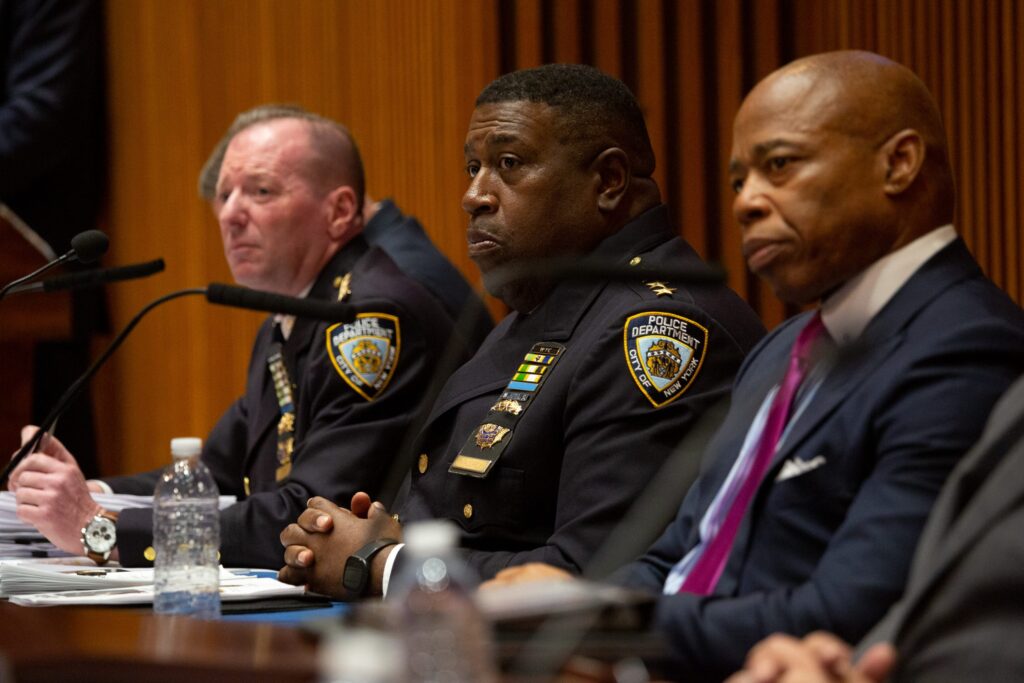
Maddrey presents an unusually complicated example.
As Sal Greco and Jack Stern discussed during Episode 223, Maddrey’s departure came amid serious allegations and enormous public scrutiny. There remain unanswered questions concerning the circumstances surrounding his departure and the investigations that followed.
Those allegations should not be minimized.
But neither should an administrative designation be transformed into a criminal conviction that does not exist.
That was one of the tensions explored during the show.
Greco argued that Maddrey’s circumstances potentially make him a special case because of the seriousness of the allegations and investigations surrounding his departure. Jack Stern countered that the broader principle cannot change depending upon whether the former officer is popular, unpopular or someone the public believes deserves punishment.
That is precisely the point.
You cannot build due process around whether you like the person receiving it.
Maddrey may be the least sympathetic person through whom to challenge the system — but difficult cases are exactly where legal principles matter most.
Maddrey Is Also Already a Lawyer
One statement from the Episode 223 discussion also requires an important update.
Maddrey does, in fact, appear to have obtained his New York law license.
Public attorney-directory information lists Jeffrey Brian Maddrey as admitted in New York in 2024 and currently registered.
That means decertification from police service and authorization to practice law are two separate issues.
New York’s attorney-disciplinary system can, of course, impose discipline based upon qualifying misconduct; a criminal conviction is not the only conceivable basis for attorney discipline. But there is a major difference between saying Maddrey’s conduct could potentially draw scrutiny and claiming that his police decertification automatically disbars him.
It does not.
As of this writing, I have found no public indication that Maddrey has been disbarred, and his publicly available attorney information continues to identify him as registered.
So the question raised during Episode 223 has evolved: it isn’t whether Maddrey will become an attorney.
He already is one.
The question is whether anything arising from his NYPD departure or subsequent investigations will ultimately affect that license.
No Criminal Conviction? Then Explain the Standard
This is where I believe NYPD’s Good Guy Letter system deserves far more scrutiny.
The Department should not possess unchecked discretion to effectively brand somebody as having left in bad standing and impose potentially lifelong collateral consequences without transparent standards and meaningful due process.
That is not a defense of Jeffrey Maddrey.
It is a defense of a rule that must apply to everybody.
If NYPD has evidence establishing grounds for denying retired credentials or reporting somebody to DCJS, then disclose the applicable basis and provide the process required by law.
But “we decided he’s not a good guy” cannot become the standard.
That is subjective bullshit masquerading as due process.
And Perros demonstrates just how badly such discretion can be abused. There, the federal litigation concerned retirees who had not been denied because a jury convicted them of crimes, but because of a policy tied to their disability retirements. Years later, the litigation ended with conceded liability and substantial damages.
The lesson should be obvious: administrative discretion is not unlimited merely because the person exercising it wears stars, bars or a commissioner’s shield.
This Isn’t Just About Maddrey
Episode 223 also put Maddrey’s situation alongside other former NYPD members who have faced decertification or adverse post-employment consequences.
That includes former Deputy Chief Paul Saraceno, retired Detective David Terrell and me.
And that is precisely why I cannot support a different constitutional standard simply because Jeffrey Maddrey is now on the receiving end.
In my case, I was not criminally convicted. I was not under criminal investigation. Yet the consequences of an administrative separation extend well beyond the final day somebody walks out of an NYPD facility.
That is what outsiders frequently fail to understand.
A Good Guy Letter, retired identification credentials and state police certification can affect firearm licensing, employment opportunities and whether another law-enforcement agency will even consider an applicant. In the case of state decertification, New York specifically makes that information available to prospective police employers and reports it to the National Decertification Index.
So these are not ceremonial pieces of paper.
They can follow somebody for the rest of his or her professional life.
The Irony of Jeffrey Maddrey
There is admittedly an extraordinary irony here.
For years Maddrey occupied the highest uniformed position in the largest police department in America. As Chief of Department, he was responsible for overseeing NYPD operations and the officers beneath him; when he was appointed in 2022, NYPD itself described him as the Department’s “highest-ranking uniformed officer.”
Now his own police certification has been invalidated.
But irony is not a legal standard.
Neither is outrage.
Neither are newspaper headlines.
And neither are allegations, regardless of how disturbing those allegations may be.
If Maddrey ultimately committed crimes, the criminal-justice system exists to address them. If evidence establishes professional misconduct warranting consequences to his law license, New York’s attorney-disciplinary process exists for that purpose.
But those systems have procedures for a reason.
The Bigger Question NYPD Needs to Answer
The real story here therefore isn’t simply:
JEFFREY MADDREY DECERTIFIED.
The bigger story is what happens when an employer possesses the ability to report a departing police officer in a manner capable of effectively destroying that officer’s ability to work as a police officer again.
DCJS acknowledges the central role employers play in this process: employers report removals for cause or departures connected with misconduct allegations, while DCJS maintains the registry and invalidates certification under the governing law and regulations. DCJS also acknowledges a mechanism for correcting materially inaccurate employer reports.
That makes transparency indispensable.
If the NYPD reported Maddrey as removed for cause, the public deserves to know precisely what finding supported that classification.
Was there a completed disciplinary proceeding?
Were charges pending when he departed?
Was there a formal departmental finding?
Was the determination based upon an open investigation?
What opportunity did Maddrey have to contest it?
And what standards does NYPD apply when deciding whether any former member receives a Good Guy Letter and retired credentials?
Those questions should be answered not merely for Jeffrey Maddrey, but for every former cop subjected to the same process.
Because Perros v. County of Nassau stands as a warning of what can happen when an agency turns something traditionally associated with retirement into a subjective reward-and-punishment system. The case does not establish that every unconvicted officer automatically has an absolute federal right to a Good Guy Letter, but it absolutely undermines the idea that administrators can arbitrarily hand these benefits out to favored retirees and deny them to others without legal consequence.
And that distinction matters.
Jeffrey Maddrey may ultimately prove to be a special case. The investigations surrounding his departure may eventually produce facts that dramatically alter this discussion.
But until those facts are established through an appropriate process, the principle should remain the same:
An allegation is not a conviction. An administrative designation is not a guilty verdict. And an agency’s subjective opinion about whether somebody is a “good guy” should never substitute for due process.
Irrespective of how anyone feels about Jeffrey Maddrey, the law cannot depend upon whose name happens to be on the paperwork.
Because today it’s Jeffrey Maddrey.
Yesterday it was Paul Saraceno, David Terrell and me.
Tomorrow, it will be somebody else.