
Mayor Mamdani Praises NYPD Commissioner Jessica Tisch for Lower Crime and Fighting Corruption. But What About the Conflict-of-Interest Questions, Lawsuits, Unreleased Crime Audits, Departmental Scandals and Rank-and-File Morale Crisis Under Her Leadership?
BY SAL GRECO | SALGRECO.COM
New York City Mayor Zohran Mamdani says he has no plans to remove NYPD Commissioner Jessica Tisch. Despite pressure from the Democratic Socialists of America (DSA), progressive activists and elected officials following a federal immigration-enforcement shooting, Mamdani continues to defend the commissioner he inherited from former Mayor Eric Adams.
His justification is straightforward: crime is down, and Tisch has supposedly cleaned up corruption within the NYPD’s upper ranks.
But those claims do not resolve the larger questions surrounding her leadership.
The issues include potential conflicts of interest involving businesses connected to Tisch’s family, multiple lawsuits naming her personally, allegations of retaliation and discrimination, continuing questions about senior-official misconduct, strained rank-and-file morale, and the department’s failure to publicly provide requested crime-classification audit results.
Some matters are documented facts. Others are allegations or unanswered ethics questions. They must not be confused. But together they raise a fundamental issue:
Has Jessica Tisch earned the extraordinary confidence Mayor Mamdani continues placing in her?
THE DSA IS TARGETING THE WRONG ISSUE
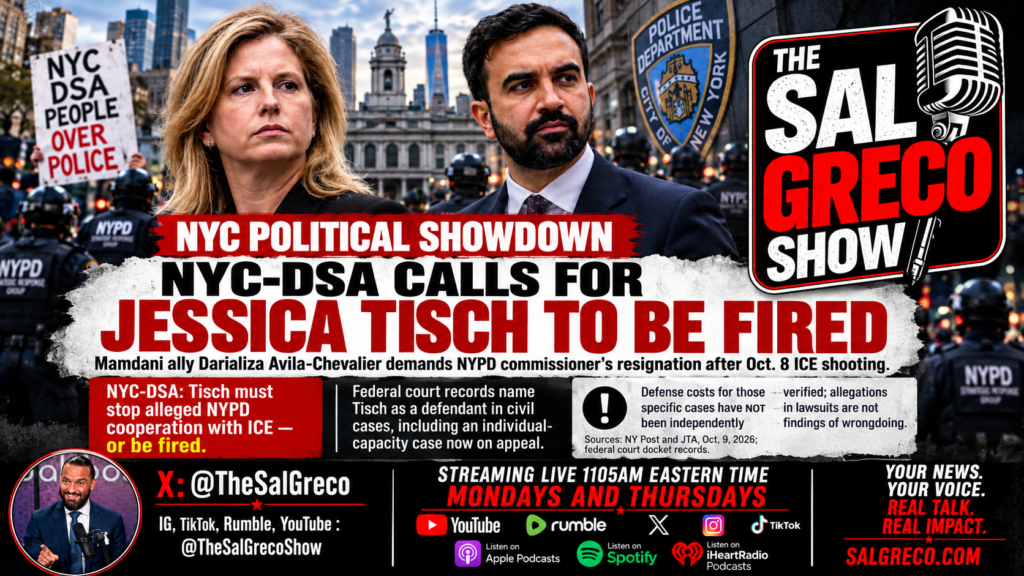
On October 8, 2026, federal immigration agents shot and wounded Oscar Bergal during an enforcement operation in Marble Hill. A five-year-old child was reportedly inside the vehicle and was unharmed.
The incident generated understandable outrage and questions about federal enforcement tactics. But the basic fact remains:
The NYPD did not carry out the shooting. Federal immigration agents did.
The DSA and other critics have also raised separate complaints about the NYPD’s response to protests, including the actions of the Strategic Response Group. Those allegations deserve independent investigation. But the federal shooting and the NYPD’s protest response involve different actors and responsibilities.
Demanding Tisch’s removal simply because a federal agent shot someone in New York City is not a persuasive accountability argument. If critics want to examine Tisch’s performance, they should focus on what she actually controls.
DID TISCH REALLY ROOT OUT CORRUPTION?
At an October 13 press conference, Mamdani cited Tisch’s record of reducing crime and removing corruption from the department’s upper ranks.
Tisch has taken action against senior officials, and the NYPD endured serious scandals under former Mayor Adams. But removing executives or reorganizing leadership does not prove that corruption has been eliminated, nor does it answer whether continuing allegations are being investigated impartially.
Since Tisch became commissioner, lawsuits involving NYPD personnel have continued, allegations of favoritism and retaliation have persisted, and questions about senior-level oversight remain. The New York City Department of Investigation has also confirmed an ongoing investigation involving a request for NYPD records under Charter Section 821 concerning exempt-class appointments. DOI did not establish wrongdoing by Tisch or the individuals referenced in an unverified records-request document.
The point is not that every allegation amounts to corruption. It is that Mamdani’s sweeping claim that Tisch rooted out corruption requires evidence, not political applause.
How many allegations were independently investigated? How many were substantiated? How many resulted in meaningful discipline? How many remain unresolved?
Those questions should be answered before Tisch is presented as the commissioner who solved the NYPD’s integrity problems.
THREE CONFLICT-OF-INTEREST QUESTIONS
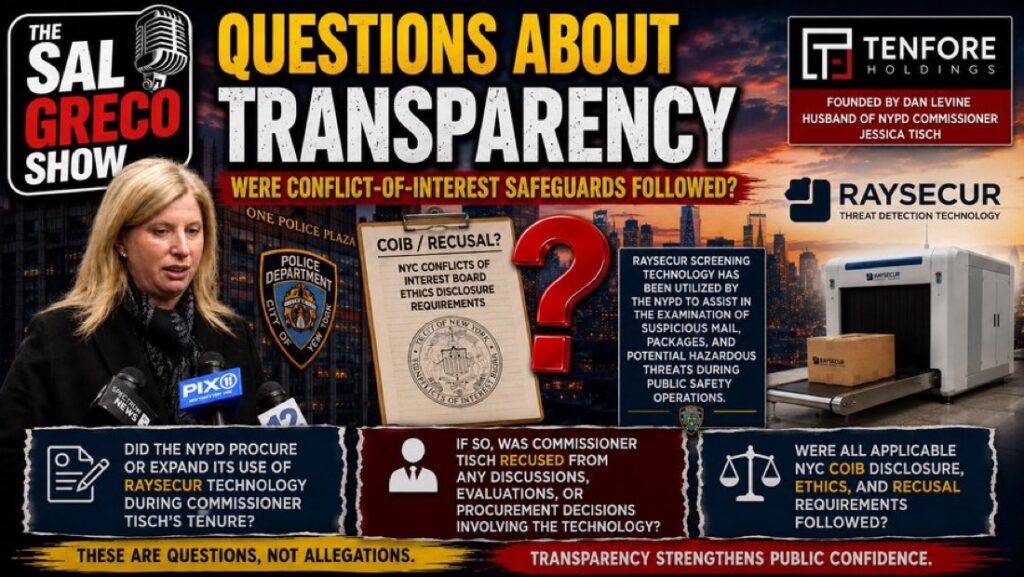
Tisch’s husband, investor Dan Levine, founded Tenfore Holdings, which has interests in technology and security businesses. One Tenfore-backed company is RaySecur, whose screening systems have reportedly been used in connection with NYPD Bomb Squad operations.
In 2026, philanthropist Craig Newmark donated $1 million through the New York City Police Foundation to support the Bomb Squad. The foundation publicly connected the initiative to Tisch’s emphasis on Bomb Squad technology. Two of Tisch’s cousins have also served as Police Foundation trustees, according to reporting examined by SalGreco.com.
None of this proves wrongdoing. It does, however, justify basic questions: Did the NYPD acquire RaySecur products during Tisch’s tenure? Were Levine’s investment connections disclosed? Did the Conflicts of Interest Board review the matter? Did Tisch recuse herself from any relevant decision?
If the process was proper, City Hall should release the records showing that.
The Official NYC Bin Contract
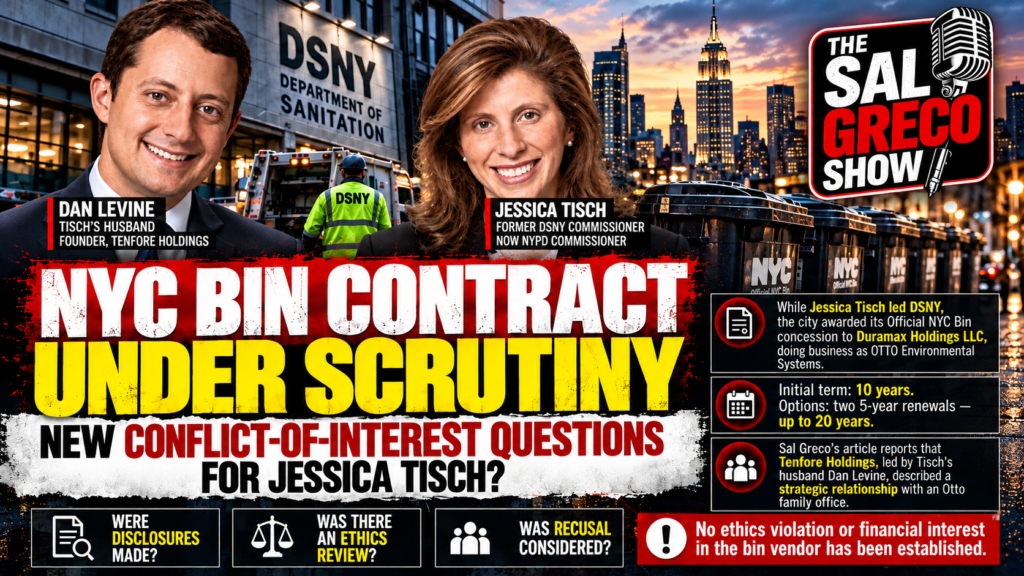
Before becoming police commissioner, Tisch ran the Department of Sanitation, which pursued the official NYC trash-bin program. Public procurement documents identify Duramax Holdings LLC, doing business as OTTO Environmental Systems, as the selected company.
Tenfore Holdings had publicly described a strategic relationship involving the Otto family office. Available reporting has not established that Levine or Tenfore owned the awarded company or financially benefited from the contract. A shared name or business association is not proof of common ownership or an ethics violation.
But the city should still explain whether Tisch made the required disclosures, obtained an ethics opinion, considered recusal and underwent an independent conflict review.
The manufacturer later faced bankruptcy proceedings, according to The New York Times. That is separate from any potential conflict involving Tisch, but it raises legitimate questions about how the exclusive supplier was vetted and monitored when residents were required to purchase the containers.
The Fulton Fish Market
The City Council allocated $25 million over two years to modernize the Fulton Fish Market Cooperative in the Bronx. Levine has been publicly identified as the market’s chairman, while Council Speaker Julie Menin has a longstanding public relationship with Tisch.
The available reporting does not establish that Menin directed money to Levine, that Levine personally received the funds or that Tisch participated in the budget decision. But the public should know Levine’s financial interest, whether his chairmanship is compensated, whether connected companies could benefit, whether relationships were disclosed and whether any conflict review occurred.
These three matters do not establish three ethics violations. They do establish three situations in which public activity intersects with the professional interests or affiliations of the commissioner’s household.
The public should not be asked to dismiss those questions without documentation.

THE LAWSUITS AND INTERNAL ACCOUNTABILITY QUESTIONS
SalGreco.com has documented lawsuits involving discrimination, retaliation, hostile working conditions, selective discipline, executive oversight and alleged abuse of authority inside the NYPD. Several name Tisch as a defendant, including in her individual capacity.
The allegations remain unproven, and a commissioner is not personally responsible for every alleged act of a subordinate. But repeated litigation involving senior leadership is relevant to evaluating whether the department’s internal problems have actually been solved.
Among the cases reported are:
● Retired Inspector Danielle Raia’s 118-page lawsuit alleging gender discrimination, denial of resources, retaliation, selective treatment and failures of executive oversight.
● A veteran female captain’s 75-page complaint alleging harassment, domestic abuse, discrimination and retaliation, including challenges to decisions made during Tisch’s administration.
● Lieutenant Karolina Ostrowska-Tuznik’s federal civil-rights complaint naming Tisch individually and alleging retaliation connected to her assignment and the NYPD’s K9 Wellness Outreach and Support Unit.
● Officer Delinda Giraldo’s verified complaint alleging sexual harassment, retaliation, inappropriate supervisory conduct and failures of internal accountability.
● Police Academy lawsuits involving former recruits Slims Florentino and Emilio Andino, raising allegations of unequal discipline, hostility, retaliation and supervisory failures.
These complaints do not establish liability. But they raise a broader institutional question:
How many allegations of harassment, retaliation and selective treatment must emerge before the leadership structure itself receives independent review?
HEALTH AND WELLNESS: WHO IS LOOKING AFTER THE COPS?
The NYPD Health & Wellness Section is supposed to help officers manage psychological stress and the burdens of police work. Instead, SalGreco.com has examined controversies involving former executive director Matthew Graziano, psychologist David Tzall, alleged timekeeping and outside-employment irregularities, disputed access to confidential information, retaliatory conduct and the deterioration of specialized wellness programs.
Those allegations should not be treated as proven theft or misconduct without investigative findings. But they matter because officers must trust the systems designed to help them.
Ostrowska-Tuznik’s lawsuit also alleges retaliation and damage to the K9 wellness program. If officers believe complaints invite retaliation, confidential information is insecure or favored executives receive different treatment, institutional trust erodes.
A department cannot credibly claim to prioritize officer wellness while leaving serious questions about its own wellness operation unanswered.
CRIME IS DOWN — BUT WHERE ARE THE AUDITS?
Mamdani’s strongest defense of Tisch is the reported decline in crime.
Preliminary NYPD CompStat data examined by SalGreco.com showed 84,978 incidents in the seven major crime categories through September 27, 2026, compared with 90,914 during the same period in 2025 — a decline of approximately 6.5%. Murder was down 21.4%, robbery 12%, burglary 14% and shootings approximately 10.6%.
Those figures should not be dismissed. But neither should they be treated as unquestionable proof of successful leadership.
At a September 16 City Council hearing, the NYPD acknowledged that it maintains systems to identify misclassified complaints and other data-integrity problems, including the Data Integrity Unit, Crime Audit Team and command reviews. Council Member Phil Wong asked for the percentage of incorrectly classified reports in 2025. Department officials did not provide the error rate at the hearing and indicated the information would be furnished. As of SalGreco.com’s September 29 review, the requested figures had not been publicly identified.
The absence of public audit data does not prove that the crime reductions are fictitious. But it leaves the public without important information about the reliability of the measurements. The NYPD has a documented history of misclassification issues, including a 2025 case in which a transit commander was removed following findings involving intentionally misclassified complaints.
So Mamdani should answer:
If the crime numbers are reliable enough to justify retaining the commissioner, why shouldn’t the public see the audits that test their reliability?
Release the number of complaints reviewed, the number misclassified, the corrections made, whether deliberate downgrading was substantiated and what discipline followed.
Crime reduction matters. So does the accuracy of the numbers used to claim it.
MISCONDUCT, TAXPAYER COSTS AND MORALE
Taxpayers also continue to bear the cost of alleged police misconduct. A September 2026 Legal Aid Society analysis cited by SalGreco.com reported approximately $53.5 million paid during 2026 to resolve NYPD misconduct claims. Those payments span different periods and should not be attributed entirely to Tisch, but they remain relevant to evaluating departmental accountability.
A September 2026 monitoring report also estimated that more than one-quarter of Terry stops during 2025 were not properly documented, with reporting compliance around 73%. If required police activity is not consistently documented, the public cannot confidently evaluate constitutional policing, supervision or discipline.
Meanwhile, the Police Benevolent Association warned in August 2025 that resignations and retirements continued to outpace hiring, reporting an average of approximately 316 officers leaving or filing for retirement each month. PBA President Patrick Hendry described members as overworked and burned out.
These staffing problems predate Tisch and involve compensation, contracts, working conditions and city policy. Nor is there sufficient evidence to claim that morale is at an all-time low. But lawsuits alleging favoritism and retaliation, unresolved questions about senior officials and concerns about unequal accountability all affect officer confidence.
City Hall should commission an independent, confidential morale assessment covering retention, supervisory fairness, complaint procedures and confidence in leadership.
TRANSPARENCY IS PART OF LEADERSHIP
The Sal Greco Show has also taken legal action seeking access to NYPD disciplinary-outcome records. In July 2026, SalGreco.com reported that an Article 78 proceeding had been commenced against the city and the NYPD following disputed records requests.
That litigation must proceed on its merits. But it illustrates the larger problem: why should disciplinary outcomes, ethics explanations and crime-audit results require adversarial legal action before the public can examine them?
The NYPD’s extraordinary powers make transparency more important, not less.
THE CASE FOR TISCH’S RESIGNATION OR REMOVAL
Jessica Tisch should resign, or Mayor Mamdani should replace her — not because the DSA demands punishment over a federal immigration shooting, but because the cumulative questions surrounding NYPD leadership, internal accountability and public transparency have become too serious to dismiss with political talking points.
This is an argument about executive leadership and public confidence, not a claim that Tisch has been convicted of corruption, committed an ethics violation or been found liable in the lawsuits discussed here.
New York City should not have to wait for a criminal conviction before determining whether its police commissioner remains the right person to lead the department. Leadership is judged by results, integrity, transparency and the condition of the institution — not solely by press releases.
Before defending Tisch again, Mamdani should require:
1. An independent review of potential conflicts involving RaySecur, Tenfore Holdings, the official bin procurement and the Fulton Fish Market, including disclosures, ethics determinations and recusals.
2. A public accounting of significant employment lawsuits and allegations involving the NYPD’s executive and supervisory structure, while respecting due process and ongoing proceedings.
3. Release of crime-classification audit results and error rates, with independent review where appropriate.
4. An accounting of substantiated executive misconduct, disciplinary decisions, unresolved investigations and remedial actions during Tisch’s tenure.
5. An independent assessment of officer morale, retention, supervisory fairness and confidence in internal complaint procedures.
6. Meaningful access to disciplinary-outcome records consistent with applicable law.
Until those issues are meaningfully examined, describing Tisch as the commissioner who cleaned up corruption is premature.
THE BOTTOM LINE
The DSA is focusing on federal immigration enforcement and the NYPD’s response to protests. Mamdani is pointing to lower crime and anti-corruption efforts. Neither approach addresses the full record.
The public still needs answers about conflicts of interest, lawsuits, senior-official misconduct, crime-data reliability, disciplinary transparency and officer morale.
Jessica Tisch should not lose her job because the DSA is angry about an ICE agent’s actions.
She should leave because, in my assessment, the unresolved governance and transparency questions surrounding her leadership have undermined the case for retaining her.
New York City needs a commissioner whose performance and integrity can withstand independent scrutiny — not one whose continued employment rests primarily on the mayor’s confidence.
The NYPD does not belong to Jessica Tisch, Zohran Mamdani, the DSA or any political establishment.
It belongs to the people of New York City.
And they deserve answers.
SAL GRECO
The Sal Greco Show | SalGreco.com