BY SAL GRECO
When a police officer risks his career to document what he believes is serious misconduct inside his own department, who should become the focus of the justice system?
That question now sits at the center of one of the most controversial law enforcement prosecutions in America.
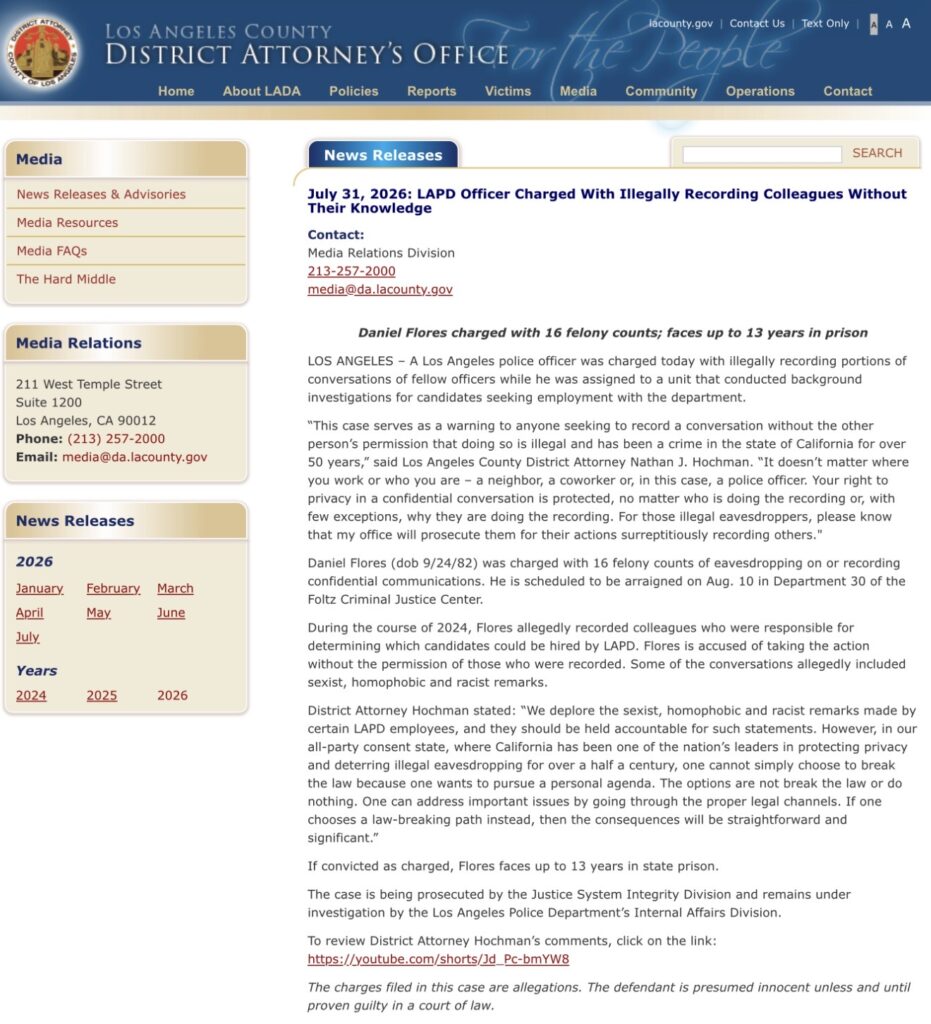
Los Angeles Police Department Officer Daniel Flores has been charged with 16 felony counts of illegally recording confidential communications after prosecutors allege he secretly recorded fellow officers without their consent while assigned to the LAPD’s Recruitment and Employment Division. According to prosecutors, some of those recordings allegedly captured racist, sexist, and homophobic remarks made by officers responsible for evaluating future LAPD recruits. If convicted, Flores faces up to 13 years in prison under California’s strict all-party consent recording law.
Flores’ attorney paints a dramatically different picture.
According to his defense, Flores wasn’t secretly recording coworkers for personal gain, blackmail, or public embarrassment. Instead, he allegedly documented misconduct and delivered approximately 90 recordings directly to LAPD Internal Affairs because he believed the department needed to know what was occurring inside one of its most important divisions.
If those facts are ultimately proven, one cannot help but ask a difficult question:
Has the system turned the script completely upside down?
Instead of the headlines focusing on officers allegedly making racist, sexist, and homophobic comments while helping determine who gets hired as LAPD officers, the man now facing years in prison is the officer who reported the conduct.
That reality has understandably generated significant public debate.
Was This Simply Enforcement of California Law?
California’s recording statute is among the toughest in America.
Generally speaking, confidential conversations cannot legally be recorded without everyone’s consent.
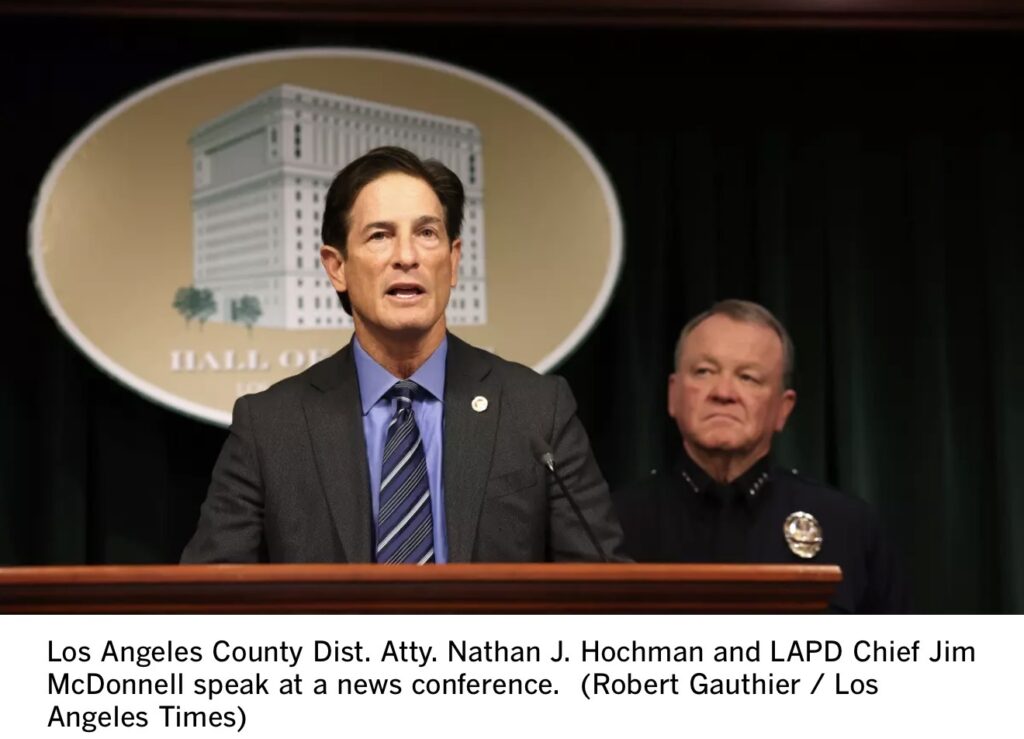
District Attorney Nathan Hochman has emphasized that California’s privacy laws apply equally to everyone and that motive alone does not excuse violating the statute. He also publicly stated that the alleged racist, sexist, and homophobic comments were deplorable and that those responsible should be held accountable.
The legal issue for the courts is straightforward.
Did Flores violate California law?
The public policy issue, however, is much larger.
The Chilling Effect
Every police department tells officers to report misconduct.
But what happens when an officer believes misconduct is occurring behind closed doors and the only way to prove it is to document it?
If documenting alleged misconduct results in felony charges against the reporting officer, future whistleblowers across the country may reasonably wonder whether speaking up is worth the personal risk.
That concern deserves serious discussion regardless of where someone stands on the underlying criminal case.
A Familiar Pattern?
As someone who has spent years reporting on policing issues, I cannot ignore what I view as similarities between this case and controversies that have surrounded the NYPD.
Under NYPD Police Commissioner Jessica Tisch, critics have argued that internal critics, whistleblowers, and employees challenging department leadership have sometimes become the subjects of investigations or disciplinary action themselves. Those matters involve different facts and allegations than the Flores case, and each should be judged on its own merits.
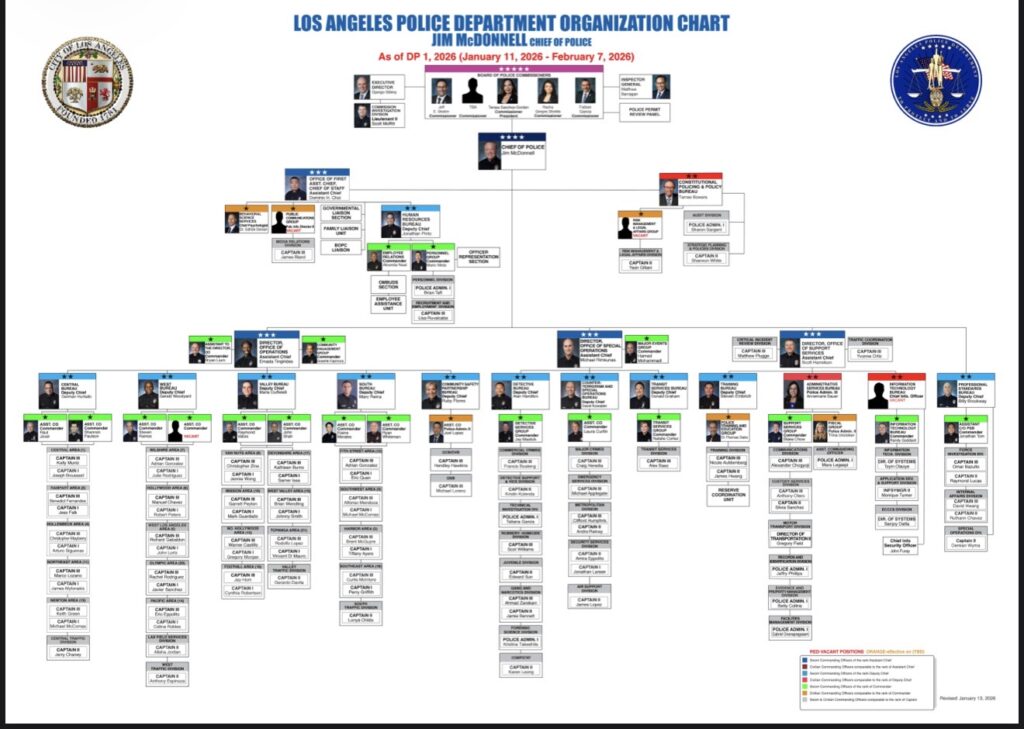
Likewise, Los Angeles is led by LAPD Chief Jim McDonnell, who became Chief in late 2024. Since taking office, McDonnell has inherited a department that has continued to grapple with allegations involving officer misconduct, discrimination, internal culture, and accountability—issues that predate his administration but remain active during his tenure.
The Flores case is now another test of how that commitment to accountability will be measured.
The Question That Must Be Asked
At this stage, there is no public evidence proving that the prosecution of Daniel Flores was initiated to shield corruption or retaliate against him for exposing misconduct.
However, given the sequence of events, it is reasonable to ask whether this prosecution could create the appearance that the whistleblower became the primary target while the alleged misconduct he reported received comparatively less public attention.
That perception matters.
Public confidence in law enforcement depends not only on enforcing the law fairly but also on ensuring that those who report misconduct are treated with fairness and transparency.
History Matters
The LAPD has experienced numerous documented corruption and misconduct scandals over the decades, including the Rodney King incident, the Rampart scandal, federal oversight through a Department of Justice consent decree, the falsified gang-database cases, and more recent misconduct investigations involving officer behavior and internal culture. Those events are part of the department’s documented history and demonstrate why public confidence depends on accountability at every level.
No one should assume today’s leadership is responsible for every historical scandal. At the same time, today’s leadership is responsible for how the department responds when new allegations emerge.
The Bottom Line
Daniel Flores will have his day in court, and the criminal charges against him deserve to be decided based on the evidence and California law—not politics or public opinion.
But another question deserves an answer outside the courtroom.
If an officer believes he is exposing misconduct inside one of America’s largest police departments, should he expect protection as a whistleblower—or prosecution as a criminal?
That question extends far beyond Los Angeles.
It reaches every police department in America.
And until agencies demonstrate that exposing misconduct is welcomed rather than feared, officers may continue wondering whether reporting corruption could end their careers instead of correcting the institution they swore to serve.