BY SAL GRECO
The controversial prosecution of Los Angeles Police Department Officer Daniel Flores has taken a significant new turn.
Last week, SalGreco.Com wrote about the troubling questions surrounding Flores, an LAPD officer charged with 16 felony counts after secretly recording fellow officers who allegedly made racist, sexist and homophobic remarks while working in the department’s Recruitment and Employment Division.
At the time, the central question was relatively straightforward:
Was Daniel Flores a whistleblower attempting to expose misconduct—or an officer who crossed the line into criminal conduct while doing it?
Now prosecutors are offering a much different and considerably more complicated version of the story.
According to a new 26-page preliminary-hearing brief filed by the Los Angeles County District Attorney’s Office, prosecutors allege Flores did considerably more than quietly record offensive conversations and hand the evidence over to Internal Affairs.
They contend he sometimes helped create the very conversations he later recorded.
Prosecutors: Flores Initiated and Participated in Conversations
According to prosecutors, Flores made more than 100 recordings involving fellow officers during 2024. The District Attorney’s filing specifically alleges there were 122 recordings capturing racist, sexist or homophobic remarks by coworkers.
But prosecutors claim Flores wasn’t always merely a silent observer.
They allege that Flores sometimes initiated or participated in discussions about particular subjects before turning on his recording device. Once recording began, according to the prosecution, he would reduce or stop his own participation.
Prosecutors further allege that Flores edited out many of his own comments and reactions and never protested the offensive remarks captured across those 122 recordings. They claim that, in several conversations, Flores himself participated in insensitive banter.
Those allegations—if prosecutors can prove them—add an entirely new dimension to a case that has already generated national controversy.
They also deserve to be scrutinized just as closely as the original decision to prosecute Flores.
The District Attorney Challenges the Whistleblower Narrative
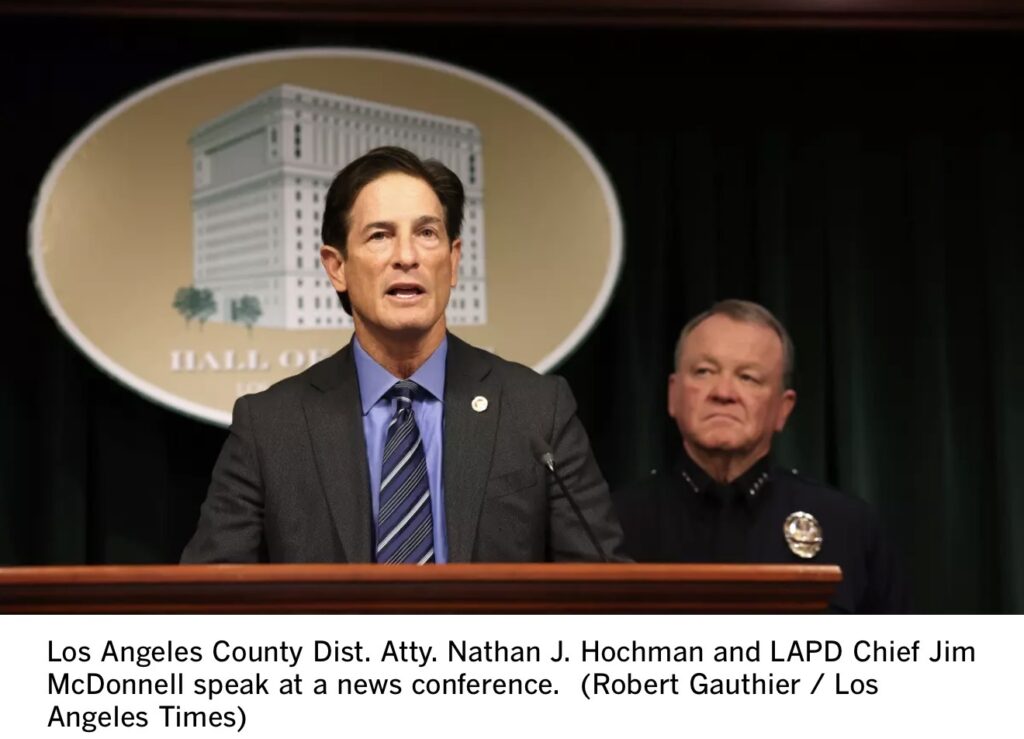
Los Angeles County District Attorney Nathan Hochman is also directly challenging the portrayal of Flores as a traditional whistleblower.
The prosecution argues Flores was not conducting an official criminal investigation because the offensive statements allegedly made by his coworkers did not themselves constitute criminal activity.
Hochman’s position is essentially that even if Flores wanted to expose bigotry, he could not violate California law to accomplish that objective.
Prosecutors say Flores had lawful alternatives available to him, including reporting his concerns through LAPD Internal Affairs or the independent Office of Inspector General.
That presents an interesting question, however.
Flores ultimately did take recordings to Internal Affairs.
As previously reported, Flores turned approximately 90 recordings over to his superiors as part of an Internal Affairs complaint because, according to his side, he wanted the department to investigate and discipline those responsible.
So the dispute is becoming increasingly complicated.
It isn’t simply about whether Flores reported misconduct.
It’s about how he obtained the evidence, what his actual motivations were, and what occurred before and during those recordings.
Prosecutors Allege a Financial Motivation
Perhaps the most damaging new allegation involves Flores’ purported comments about suing the LAPD.
According to prosecutors, three colleagues recalled Flores referring to civil lawsuits against the department as the “LAPD lottery.”
They further allege he discussed the LAPD having “deep pockets” and talked about making money through litigation.
Flores has since filed a lawsuit against the City of Los Angeles seeking monetary damages.
The District Attorney’s Office therefore contends Flores’ motivations weren’t entirely altruistic. Prosecutors suggest his actions were connected, at least partly, to avoiding a transfer and potentially positioning himself for a lucrative lawsuit against the city.
Again, these are allegations made by prosecutors—not established facts.
Flores has not been convicted of anything, and his defense will have an opportunity to challenge the government’s characterization of the recordings, his statements and his motives.
But these allegations materially change the public debate surrounding this case.
Yet Another Question Remains: What About the Other Officers?
Even with these new allegations, one issue from my original reporting hasn’t disappeared.
What happened to the officers whose alleged comments started this controversy in the first place?
The District Attorney’s Office acknowledges that the recordings captured alleged racist, sexist and homophobic statements.
Prosecutors say administrative investigations were conducted against the 16 coworkers and that potential departmental penalties could range from reprimands and suspensions all the way to termination.
That deserves transparency to whatever extent California law permits.
Because two things can potentially be true simultaneously.
Flores could have violated California’s recording laws.
And LAPD employees could have engaged in behavior completely inconsistent with the standards expected from police officers—particularly employees entrusted with helping determine who gets hired into one of America’s largest police departments.
One allegation doesn’t erase the other.
This Is Exactly Why Due Process Matters
The new information also demonstrates why rushing to declare either side completely right or completely wrong is dangerous.
My original article asked whether Flores was a whistleblower or a criminal.
The prosecution’s new filing makes that question even more complicated.
If Flores merely documented workplace misconduct and delivered the recordings to Internal Affairs, prosecuting him with 16 felonies carrying the possibility of up to 13 years in prison raises legitimate concerns about the chilling effect on future police whistleblowers.
But if prosecutors can prove Flores deliberately manufactured conversations, selectively recorded coworkers after encouraging offensive discussions, removed his own participation and did so while contemplating a financial payday, the factual picture becomes dramatically different.
That’s why evidence matters.
That’s why context matters.
And that’s why both sides need to be heard.
The Broader Problem for LAPD Hasn’t Gone Away
Regardless of what ultimately happens to Daniel Flores, LAPD leadership still has a problem.
These recordings apparently exist.
Offensive conversations involving members of a division responsible for evaluating prospective police officers apparently occurred.
The prosecution itself acknowledges allegations involving racist, sexist and homophobic statements.
So while Flores’ conduct is now under a microscope, LAPD Chief Jim McDonnell and department leadership should still have to answer a separate question:
What has been done about the conduct Flores allegedly captured?
If Flores broke the law, let a court determine that based on admissible evidence and California law.
But accountability cannot end with Flores.
The public deserves to know whether employees entrusted with determining who is qualified to wear an LAPD badge engaged in discriminatory or degrading behavior—and whether meaningful administrative action followed.
Flores Heads to Court
Flores, 43, faces 16 felony counts of eavesdropping on or recording confidential communications. Prosecutors say he faces as much as 13 years in state prison if convicted as charged.
His arraignment is scheduled for August 10 at the Foltz Criminal Justice Center.
The case is being prosecuted by the Los Angeles County District Attorney’s Justice System Integrity Division and remains under investigation by LAPD Internal Affairs.
And like every criminal defendant in America, Flores is presumed innocent unless and until prosecutors prove the charges against him.
The next phase of this case may finally begin answering the question raised in my original article.
But the question may no longer simply be:
Whistleblower or criminal?
It may now be:
Did Daniel Flores legitimately expose an ugly culture inside an LAPD unit, manipulate that culture for his own purposes—or is the truth somewhere between those two competing narratives?
Whatever the answer, the investigation shouldn’t stop with the man holding the recorder.
It should also examine what was being said on the other side of it.