
BY SAL GRECO
There is a difference between reporting on a politician and engineering a narrative about one.
That distinction was at the center of a discussion between Sal Greco and Jack Stern during Episode 219 of The Sal Greco Show, as the conversation turned to New York City Mayor Zohran Mamdani, the media coverage surrounding his administration, and the increasingly powerful role that political influencers play in shaping public opinion.
The larger point wasn’t that Mamdani should be protected from criticism. It was exactly the opposite: criticize him when the facts warrant criticism. Praise him when the facts warrant praise. And when the evidence is mixed, tell people that too.
What shouldn’t happen is starting with a predetermined conclusion and then selecting only the information necessary to make the audience arrive there.
That is where journalism can begin crossing the line into social engineering.
Mamdani’s Numbers Complicate the Narrative
Whatever someone’s personal opinion of Mamdani may be, his polling numbers need to be part of any fair discussion about his mayoralty.
And the numbers presented during Episode 219 show why.
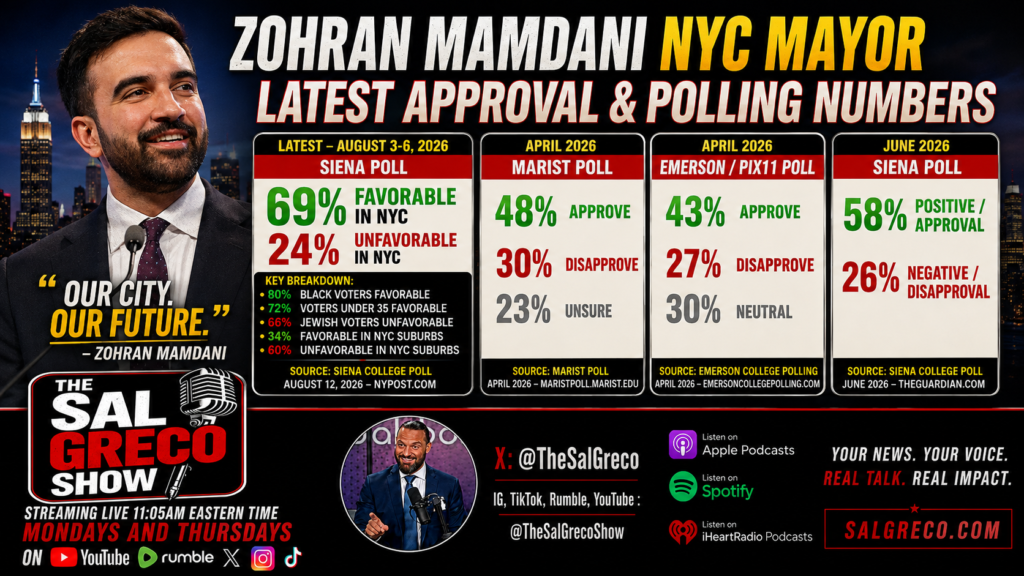
In the first 100 days of his administration, a Marist Poll conducted March 26–31 found 48% of New York City residents approved of Mamdani’s job performance, 30% disapproved and 23% were unsure. The survey included 1,454 NYC adults and carried a margin of error of ±3.3 percentage points.
A separate Emerson College Polling/PIX11 survey released in April produced somewhat different numbers but the same basic picture: 43% approved, 27% disapproved and 30% were neutral.
Then came the latest Siena polling featured on the show.
According to the Siena College survey reported August 12, Mamdani had a 69% favorable rating among New York City voters compared with 24% unfavorable. That is not an approval rating in the strict sense—it measures favorability—but it is nevertheless an important indication of how city voters currently view their mayor.
The same poll revealed significant differences depending upon where and among whom the question was asked.
Mamdani was viewed favorably by 80% of Black voters statewide and 72% of voters ages 18–34. At the same time, 66% of Jewish voters viewed him unfavorably. Geography produced another dramatic divide: in the New York City suburbs, only 34% viewed Mamdani favorably while 60% viewed him unfavorably.
Those numbers tell a far more interesting story than either “Mamdani is a disaster” or “Mamdani is universally loved.”
Neither description adequately explains what is happening.
He is a highly polarizing political figure whose support varies dramatically depending upon geography and demographic group—and whose standing within New York City itself is currently strong.
That is the story the numbers tell.
Report the Numbers—Even When They Don’t Fit Your Politics
This is where mainstream media organizations, independent outlets and political commentators all have a responsibility.
If Mamdani does something wrong, report it.
If one of his policies fails, investigate it.
If taxes increase, examine who is paying them and what New Yorkers are receiving in return.
If crime rises or falls, show the statistics.
If his administration contradicts itself, ask questions.
But the same standard has to work in the other direction.
If 69% of NYC voters tell a pollster they have a favorable opinion of Mamdani, that shouldn’t disappear simply because it interferes with a preferred political narrative.
Likewise, the 69% figure shouldn’t be presented without mentioning that the same Siena survey found dramatically different attitudes toward him outside the five boroughs.
Context matters.
And context is one of the first casualties of social engineering.
Social Engineering Doesn’t Belong Exclusively to the Left or Right

One of the central arguments of the Episode 219 discussion was that social engineering isn’t exclusively a left-wing or right-wing phenomenon.
Both sides can do it.
The personalities change. The ideology changes. The audience changes.
The mechanics frequently don’t.
People are presented with an emotionally powerful narrative. Anger or fear gets attached to it. Information supporting the narrative gets amplified. Information complicating it gets minimized. Eventually, members of the audience aren’t merely consuming information—they’re joining a side.
That dynamic has become particularly powerful in the age of social media.
Algorithms reward engagement, and outrage generates engagement extremely well.
The result is an environment where the most extreme interpretation of an event can travel farther than the most accurate one.
Political content increasingly becomes entertainment.
And entertainment requires conflict.
Hassan Piker, Nick Fuentes and Opposite Ends of the Same Media Ecosystem
That led to another controversial portion of the Episode 219 conversation: Hassan Piker and Nick Fuentes.
Politically, the two occupy radically different worlds.
But the comparison made on the show wasn’t that their political beliefs are identical. Clearly, they aren’t.
The comparison concerned the function of highly ideological political influencers inside the modern information ecosystem.
Personalities can build audiences around anger, ideological identity, controversy and a constant sense that something enormous is at stake.
One audience gets pushed from the left.
Another gets pushed from the right.
Each audience becomes convinced that the other side represents the fundamental problem.
Meanwhile, both sides are competing for the same scarce resource:
Your attention.
That should make audiences more cautious about accepting conclusions simply because they come from someone whose politics they already share.
Guilt by Association Is Not Evidence
The conversation also raised another important issue surrounding Mamdani: guilt by association.
A politician appearing with someone, being photographed with someone, participating in an interview or receiving support from a controversial personality doesn’t automatically establish agreement with everything that individual has ever said.
Association can absolutely be relevant.
But association should lead to questions, not automatically to conclusions.
What was said?
What does the politician actually believe?
Did he endorse the controversial statement?
Did he reject it?
Is there evidence demonstrating a deeper relationship?
Those questions matter.
Otherwise, virtually anyone in public life can eventually be condemned through photographs, interviews, acquaintances and appearances.
That isn’t investigative journalism.
It’s narrative construction.
The Audience Has a Responsibility Too
Media organizations aren’t solely responsible for this problem.
Audiences have changed as well.
People increasingly seek information that confirms what they already believe. Algorithms learn those preferences and deliver more of it.
Someone watches one political clip.
Then another.
Then another.
Soon the person’s entire information environment reinforces the same worldview.
That’s an extraordinarily powerful form of influence because it frequently doesn’t feel like influence at all.
It feels like confirmation.
That is why one of the most important defenses against social engineering is surprisingly simple:
Read people you disagree with.
Look at the original polling.
Read the underlying documents.
Watch the entire interview rather than the viral 30-second clip.
Separate reporting from commentary.
And most importantly, be willing to change your mind when the evidence changes.
Mamdani Should Be Judged on His Record
Mamdani is the mayor of New York City.
That means his administration should face aggressive scrutiny.
His policies involving taxation, housing, policing, public safety, transportation and government spending deserve serious examination. His political philosophy deserves debate. His decisions deserve criticism when warranted.
But New Yorkers also have an enormous interest in the mayor succeeding.
Wanting a politician to fail simply because you dislike him ultimately means hoping the government overseeing millions of people’s daily lives fails along with him.
You don’t have to support Mamdani.
You don’t have to agree with democratic socialism.
You don’t have to like his policies.
You don’t even have to like him.
But criticism should be based upon what his administration actually does, not what someone wants the public to believe he might do.
Journalism Should Inform People, Not Program Them
The job of journalism should not be telling the public what conclusion to reach.
Give people the information.
Give them the evidence.
Give them the competing arguments.
Give them the numbers.
Then allow them to decide.
The Mamdani polling featured during Episode 219 provides a perfect example.
The April Marist numbers showed 48% approval.
The April Emerson/PIX11 numbers showed 43% approval.
The latest Siena numbers show 69% favorability among NYC voters and 24% unfavorability, while simultaneously revealing considerable opposition in the suburbs and among certain demographic groups.
None of those numbers prove Mamdani is a great mayor.
None prove he’s a bad mayor.
They tell us what people thought when those surveys were conducted.
That information belongs to the public—not to one political side.
The Most Dangerous Social Engineering Is the Kind You Agree With
People usually recognize manipulation when the other side is doing it.
Recognizing it from your own side is much harder.
That’s the challenge.
If you immediately question every story attacking your preferred politician but accept every story attacking the politician you despise, you’re not evaluating information consistently.
You’re evaluating it emotionally.
That is exactly the environment in which social engineering thrives.
Left versus right makes for great television.
It generates clicks.
It creates viral clips.
It builds enormous audiences.
But reality isn’t obligated to fit neatly into either team’s narrative.
Sometimes Mamdani will be right.
Sometimes he’ll be wrong.
Sometimes Republicans will have a legitimate criticism.
Sometimes Democrats will.
And sometimes both sides will be selling their audiences a narrative designed primarily to keep them angry.
The answer isn’t censorship.
It’s better information, more context and a public willing to think critically.
Mainstream media has a responsibility to provide that information fairly.
Independent media has the same responsibility.
And ultimately, audiences have a responsibility to demand it.
Because once journalism stops helping people make informed decisions and begins deciding what people are supposed to think, it isn’t simply reporting the story anymore.
It’s engineering the audience.
The Sal Greco Show — Your News. Your Voice. Real Talk. Real Impact.