
November 28, 2026 | BY SAL GRECO
Whatever happened to draining the swamp?
President Donald Trump’s family finds itself at the center of another financial controversy after its cryptocurrency venture, World Liberty Financial (WLFI), suffered a catastrophic collapse overnight, renewing questions about conflicts of interest, insider financial arrangements, foreign influence and the commercialization of the American presidency.
The latest cryptocurrency meltdown comes just weeks after Republicans lost control of both chambers of Congress and less than a week after Trump hosted another exclusive dinner for investors in his personal cryptocurrency.
While Americans continue to struggle with affordability, housing, employment and mounting financial pressures, the financial interests of the president and his family deserve greater public scrutiny.

THE TRUMP FAMILY’S CRYPTOCURRENCY COLLAPSES
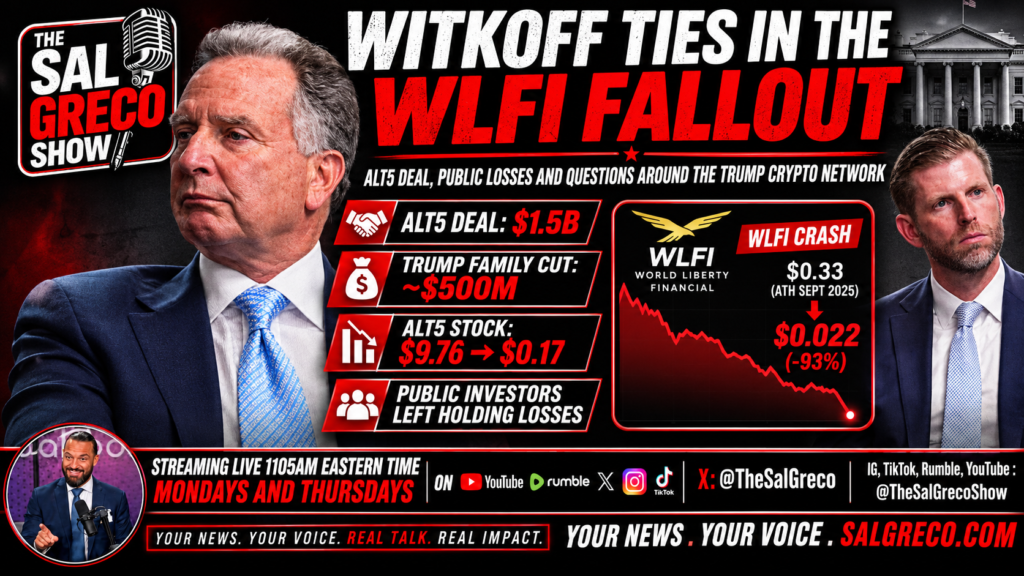
World Liberty Financial’s WLFI token lost approximately 50% of its value overnight, reaching a record low of $0.0158 — approximately 95% below its September 2025 peak of 33 cents.
Cryptocurrency news account Chain INK highlighted the collapse on X, reporting that the token experienced a dramatic decline within 15 minutes, wiping out millions of dollars in leveraged trading positions and hundreds of millions in market capitalization.
According to blockchain data examined by The Block, a World Liberty-linked strategic reserve wallet sold approximately $20 million in Ethereum, realizing an estimated $19.3 million loss while attempting to protect an outstanding cryptocurrency loan.
The details surrounding that loan are particularly noteworthy.
In April 2026, World Liberty Financial borrowed approximately $75 million in stablecoins using billions of its own WLFI tokens as collateral through a cryptocurrency lending platform called Dolomite.
Who co-founded Dolomite?
Corey Caplan, World Liberty Financial’s own chief technology officer.
As WLFI collapsed, additional collateral was deposited and portions of the debt were repaid. Meanwhile, World Liberty’s USD1 stablecoin briefly traded as low as 94 cents on Binance, despite being designed to maintain a value of one dollar.
World Liberty subsequently defended its transactions as responsible treasury management, denied selling WLFI tokens during the restructuring and maintained that USD1’s reserves were not endangered. Binance announced it was reviewing the trading activity.
The precise cause of the sudden sell-off remains unclear.
THE $1.5 BILLION DEAL THAT ENRICHED THE TRUMP FAMILY
Perhaps even more significant is the financial arrangement between World Liberty Financial and ALT5 Sigma, a Nasdaq-listed company now known as AI Financial Corporation.
In August 2025, ALT5 announced a $1.5 billion financing arrangement centered on acquiring World Liberty Financial’s cryptocurrency.
Under World Liberty’s revenue-sharing structure, the Trump family was entitled to a substantial portion of eligible token-sale proceeds.
Reuters subsequently calculated that approximately $538 million flowed to the Trump family through the ALT5 transaction alone.
World Liberty co-founder Zach Witkoff, the son of Trump administration envoy Steve Witkoff, became ALT5’s chairman. Eric Trump was initially announced as a prospective board member before being designated a board observer, according to SEC filings.
Now consider what happened to the investment:
- ALT5 shares traded above $9 in August 2025.
- The company’s stock closed at approximately 17 cents on November 27, 2026.
- SEC filings disclosed that approximately 7.28 billion WLFI tokens originally valued at nearly $1.46 billion were worth approximately $417 million as of September 26.
- At a subsequent market price of $0.019 per token, those same holdings would have a theoretical value of approximately $138 million, assuming the quantity remained unchanged.
The company’s November SEC filing also disclosed a margin call that resulted in the transfer of 343.4 million WLFI tokens into jointly controlled wallets.
Social media commentator Ronald Carter highlighted additional alleged transfers involving hundreds of millions of tokens during the latest collapse. Those particular transactions require further independent verification.
Nevertheless, the documented financial disparity is substantial: the Trump family received hundreds of millions of dollars through the arrangement while public shareholders experienced enormous losses.
BILLIONAIRE INVESTOR ACCUSES WORLD LIBERTY OF FRAUD
Justin Sun, the billionaire founder of the Tron cryptocurrency network and an early investor in World Liberty Financial, publicly accused the venture of misconduct following the collapse.
Sun alleged improper insider lending arrangements and called upon cryptocurrency exchanges, regulators and courts to intervene.
Earlier this year, Sun filed a federal lawsuit against World Liberty Financial after the company froze his cryptocurrency holdings.
World Liberty countersued, accusing Sun of attempting to undermine the value of WLFI.
The allegations remain disputed and have not been established in court. However, the litigation raises further questions about the financial arrangements surrounding a business associated with the sitting president of the United States.
A PATTERN OF FINANCIAL CONTROVERSIES
Cryptocurrency commentator Jeremy, posting under the handle @Jeremybtc on X, highlighted numerous controversies extending well beyond this weekend’s cryptocurrency collapse.
Many of the transactions and events he referenced are independently documented.
Consider the following:
- January 17, 2025: Donald Trump launched his personal $TRUMP meme coin three days before returning to the White House. Approximately 80% of its supply was allocated to affiliated entities.
- January 19, 2025: Melania Trump’s cryptocurrency launched. A subsequent Financial Times investigation found that traders who acquired tokens before the public announcement generated approximately $99.6 million in profits. The identities of those traders and whether they received improper advance information remain unresolved.
- January 2025: According to The Wall Street Journal, UAE-linked investors agreed to purchase a 49% stake in World Liberty Financial for $500 million just four days before Trump’s inauguration.
- March 2025: Trump publicly identified cryptocurrencies, including XRP, Solana and Cardano, for inclusion in a proposed government cryptocurrency reserve, sending their market prices higher.
- April 9, 2025: Trump encouraged Americans to purchase stocks hours before announcing a 90-day pause on most of his tariffs, triggering a massive market rally and prompting congressional calls for an investigation into potential insider trading.
- May 2025: Abu Dhabi investment firm MGX used World Liberty Financial’s USD1 stablecoin to complete a $2 billion investment in Binance.
- May 2025: Trump hosted an exclusive dinner for leading holders of his personal meme coin, linking cryptocurrency ownership to access to the president.
- October 23, 2025: Trump pardoned Binance founder Changpeng Zhao, who had previously pleaded guilty to an offense involving failures in anti-money-laundering compliance.
- 2026: Trump publicly praised individual publicly traded companies, including Intel and Palantir, triggering additional questions about presidential statements that can influence financial markets.
These events do not automatically establish criminal conduct or a quid pro quo. They do, however, illustrate the extent to which the president’s official responsibilities intersect with private financial interests.
PAYING FOR FASTER ACCESS TO PRESIDENTIAL ANNOUNCEMENTS?
The financial controversies extend beyond cryptocurrency.
On October 29, 2026, Reuters reported that Trump’s Truth Social platform had secured agreements with Bloomberg, Jump Trading and Susquehanna for faster access to the president’s social media posts.
The service reportedly costs as much as $100,000 per month.
Presidential announcements concerning tariffs, military operations, economic policies and individual companies can move financial markets within seconds.
The arrangement therefore raises a fundamental question: Should certain private corporations be able to purchase faster access to market-moving presidential announcements than the American public?
Democratic senators Elizabeth Warren and Adam Schiff previously requested that federal securities regulators examine the arrangement.
The issue is not simply whether selling faster access to social media data is legal. It is whether the commercialization of official presidential communications creates an unfair financial advantage or a conflict between public duties and private revenue.
BILLIONS FOR THE TRUMP FAMILY — BILLIONS IN LOSSES FOR INVESTORS
According to a Reuters investigation published in June 2026, the Trump family generated at least $2.3 billion from cryptocurrency ventures following Trump’s return to the presidency.
Trump’s subsequent financial disclosure revealed more than $1.4 billion in cryptocurrency-related income during 2025, according to Reuters’ analysis, including approximately $635 million associated with his personal meme coin.
By November 22, Reuters estimated that outside investors across five major Trump-linked cryptocurrency and cryptocurrency-related ventures had suffered more than $5 billion in losses, including declines in the value of investments still held.
Meanwhile, Reuters reported in July that Trump’s financial managers had placed substantial portions of his wealth into traditional stocks and bonds.
Trump has maintained that his children manage his private finances. The White House has also previously denied that the president or his family engage in conflicts of interest.
Those explanations do not eliminate the legitimate questions surrounding presidential influence, financial incentives and the protection of ordinary investors.

WHAT HAPPENED TO DRAINING THE SWAMP?
The original MAGA movement promised to challenge political corruption, confront entrenched Washington interests and restore accountability to the federal government.
The current controversies invite comparisons between those promises and the financial activities now surrounding the presidency.
The question Republicans face is whether they will apply the same standards of scrutiny to a Republican administration that they have demanded of Democratic administrations.
Would these financial arrangements receive the same reception if they involved Joe Biden and his family?
Would foreign investments, cryptocurrency dinners, billion-dollar business arrangements and paid access to presidential communications receive less scrutiny under a Democratic president?
Political accountability should not depend on who occupies the White House.
The November 3 midterm elections resulted in Republicans losing both the House and Senate. According to the Associated Press, Democrats have secured at least 259 House seats, representing their largest House majority since 1990.
Although this weekend’s cryptocurrency collapse occurred after the election and cannot explain those results, the broader controversies raise questions about public confidence, political priorities and the direction of the Republican Party.
MR. PRESIDENT, WHAT ABOUT RUNNING THE COUNTRY?
The presidency carries responsibilities far greater than the success of cryptocurrency ventures, private investments or the financial interests of any president’s family.
Americans are concerned about paying their bills, securing employment, purchasing homes, supporting their families and maintaining a stable country.
Those issues deserve the full attention of the federal government.
Congressional oversight should examine these financial arrangements, determine whether existing safeguards are sufficient and establish whether public authority has ever been used improperly for private financial benefit.
The same standards should apply to every administration, Republican or Democrat.
Ultimately, the American people deserve transparency about where public service ends and private business begins.
America first should mean the American people first.
© 2026 SalGreco.com | The Sal Greco Show — Independent Journalism. Your News. Your Voice.