
BY SAL GRECO
Mayor Zohran Mamdani’s controversial pied-à-terre tax is moving forward again—for now—after an appellate development temporarily lifted the court order that had stopped its rollout. But the legal battle is far from finished, and the controversy surrounding how New York City identified potential taxpayers raises another intriguing question: Could some property owners attempting to establish that their New York City property is their primary residence inadvertently raise questions about their New York State and City income-tax residency?
That issue could ultimately become one of the more interesting unintended consequences surrounding the new law.
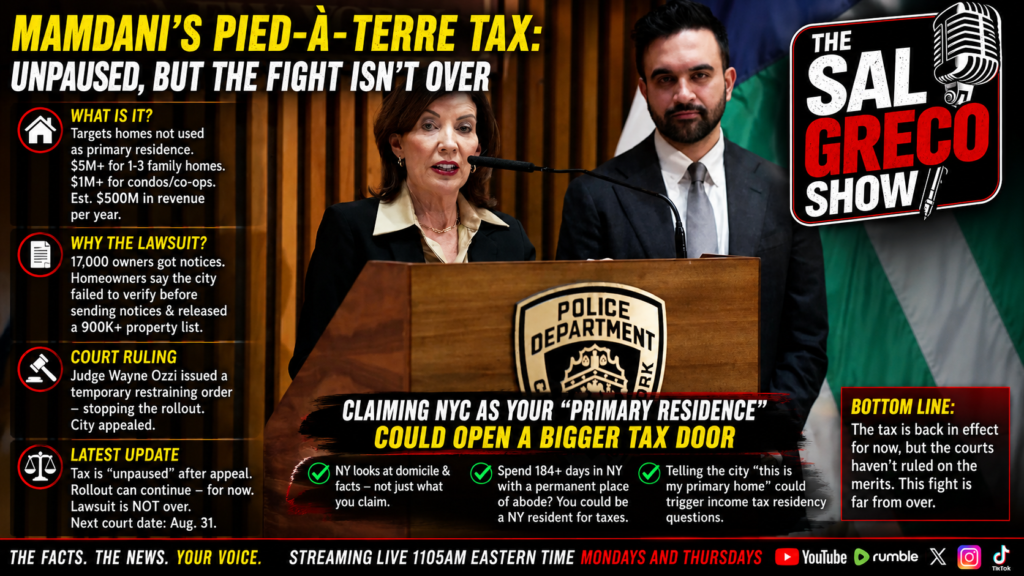
The surcharge targets high-value New York City residential properties that are not used as an owner’s primary residence. It generally applies to one-to-three-family homes valued at $5 million or more and condominiums and cooperative apartments valued at $1 million or more. The administration has projected that the tax could generate approximately $500 million annually.
The policy itself, however, isn’t the only thing being challenged.
Thousands of New Yorkers Received Notices
The city’s Department of Finance sent notices to approximately 17,000 property owners potentially subject to the surcharge. The preliminary tax roll was considerably larger, encompassing roughly 960,000 properties.
Three homeowners subsequently sued the Mamdani administration, arguing that the city failed to properly determine whether properties were actually secondary residences before putting the burden on homeowners to establish that they qualified for an exemption.
Significantly, the plaintiffs’ present challenge focuses on how the tax was implemented, rather than simply arguing that no pied-à-terre tax can legally exist. Some people receiving notices maintain that the properties flagged by the city have actually been their primary residences for years.
Attorney Randy Mastro, the former New York City First Deputy Mayor, is representing the homeowners.
The controversy became even greater when the city made publicly available a massive property database containing names, addresses and property information. The lawsuit challenged that aspect of the rollout as well.
Judge Wayne Ozzi Steps In
Earlier this week, Richmond County Supreme Court Justice Wayne Ozzi issued a temporary restraining order against portions of the city’s rollout.
Ozzi raised concerns about the city’s procedures and temporarily prevented the administration from proceeding while the dispute was litigated. The ruling also addressed the controversial publicly available property list.
For a brief period, that represented a significant victory for the homeowners.
Then City Hall appealed.
Latest Ruling: The Tax Is Back in Effect—for Now
That brings us to the latest development Thursday.
The city’s appeal effectively stayed Ozzi’s temporary order, allowing the Mamdani administration to resume implementation of the pied-à-terre surcharge while the litigation continues.
That distinction is extremely important.
The latest development is not a final ruling declaring Mamdani’s tax—or the city’s implementation of it—lawful.
Instead, the temporary restraint against the administration has been put on hold while the appellate process moves forward. The underlying legal challenge remains alive.
In other words, City Hall can proceed for the moment, but the courts have not resolved the central questions raised by the homeowners.
And buried inside this entire controversy is another potentially significant issue.
What Happens When Someone Suddenly Says NYC Is Their “Primary Residence”?
The entire premise of a pied-à-terre tax depends upon distinguishing a person’s primary residence from a secondary residence.
That raises an obvious question.
Suppose a wealthy individual has historically maintained that Florida—or another state—is home while also owning an expensive Manhattan apartment.
The individual receives a NYC pied-à-terre notice and responds:
“This isn’t my second home. This is my primary residence.”
That statement could save the property owner from the pied-à-terre surcharge if the person actually satisfies the applicable exemption requirements.
But could it also raise another question?
If NYC is now your primary residence, are you also a New York resident for income-tax purposes?
The answer isn’t automatically yes—but the declaration could potentially become relevant.
New York Doesn’t Determine Income-Tax Residency From One Checkbox
New York State’s residency rules are considerably more complicated than simply asking which property someone calls their “primary residence.”
For income-tax purposes, New York examines domicile—essentially the place a person intends to maintain as his or her permanent home. New York’s Department of Taxation and Finance specifically explains that merely filing documents or registering to vote somewhere is not necessarily enough to establish domicile. The person’s overall circumstances matter.
That means declaring a Manhattan apartment a primary residence for purposes of avoiding this surcharge would not, standing alone, automatically transform someone into a New York income-tax resident.
But it could become a relevant piece of evidence if New York ever examined that person’s residency.
And that’s where this becomes interesting.
New York Has Another Residency Test
Even someone whose actual domicile remains Florida, Texas or another state can potentially become a New York resident for income-tax purposes under New York’s statutory residency rules.
Generally, an individual domiciled outside New York can nevertheless be treated as a New York resident if the person:
Maintains a permanent place of abode in New York for substantially all of the taxable year AND spends 184 days or more in New York during that year.
New York says that even part of a day generally counts as a New York day for purposes of that calculation.
That can have consequences considerably larger than a property surcharge because New York residents generally face taxation based upon resident income-tax rules rather than merely taxation of New York-source income applicable to nonresidents.
Could New York Look Back?
Here’s where property owners should be careful about what they’re claiming.
There is an enormous difference between saying:
“I moved to New York this year and this property is now my primary residence.”
and saying:
“The city made a mistake because this has always been my primary residence.”
The first statement could simply reflect a legitimate change in someone’s circumstances.
The second could potentially raise questions if the same individual has spent years filing New York returns as a nonresident while representing to another New York governmental agency that the NYC property has actually been his or her primary home throughout that same period.
That would not automatically establish past tax liability. Residency determinations depend upon the applicable law and the person’s actual facts, including domicile, time spent in New York and maintenance of a permanent place of abode.
But such contradictory representations could certainly be something tax authorities might examine.
New York’s own guidance makes clear that taxpayers claiming nonresident status while maintaining a permanent New York abode need adequate records demonstrating that they did not exceed the state’s day-count threshold.
An Unintended Consequence of Mamdani’s Tax?
That creates a fascinating potential dilemma.
The Mamdani administration wants owners of expensive secondary residences to pay an additional property surcharge because they maintain valuable NYC homes without making those properties their primary residences.
But in challenging their inclusion, some owners may have to affirmatively demonstrate:
“I actually live here. This is my primary home.”
For legitimate full-time New Yorkers who were mistakenly swept into the city’s enormous database, that may simply establish that the Department of Finance got it wrong.
For someone who has deliberately maintained another state’s domicile for tax purposes, however, the analysis could become considerably more complicated.
If a taxpayer has spent years saying “Florida is home” for income-tax purposes and then tells New York City “Manhattan is actually my primary residence” when a new surcharge arrives, that inconsistency could at least invite additional questions.
It doesn’t automatically mean taxes are owed. It doesn’t automatically establish New York domicile. And it certainly doesn’t establish tax fraud.
But it could create evidence relevant to a future residency examination.
The Legal Battle Is Just Beginning
For now, Mamdani’s administration has won the ability to continue implementing the surcharge while the litigation proceeds.
It has not won a final judgment on the merits.
Justice Ozzi’s concerns about the rollout remain part of the ongoing controversy, the homeowners’ lawsuit continues, and appellate courts will ultimately have much more to say about what the city did and whether it complied with the law.
But beyond the courtroom battle lies an issue that deserves considerably more attention.
In attempting to determine who owns a “second home,” New York City is effectively asking thousands of property owners to establish where they actually live.
For some people, that’s easy.
For others, the answer to that question could potentially be worth considerably more than the pied-à-terre tax they’re trying to avoid.