
BY SAL GRECO
Nearly 400 improperly registered noncitizens reportedly cast ballots—but New Jersey has not yet publicly shown which elections, districts or candidates were affected
New Jersey officials have acknowledged an election-system failure serious enough to require a full independent investigation, public disclosure of its findings and a ballot-by-ballot accounting of its potential effect on elections across the state.
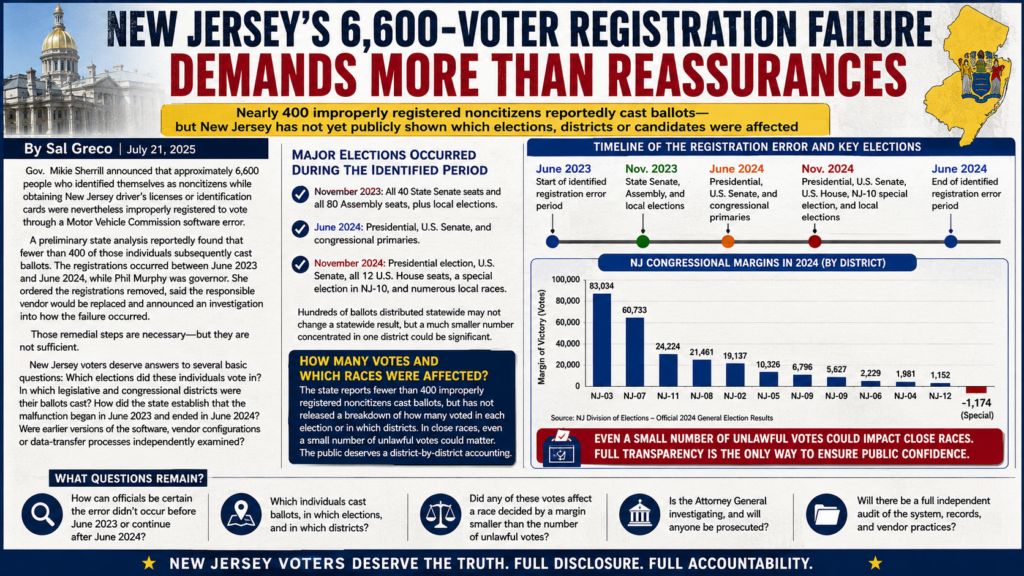
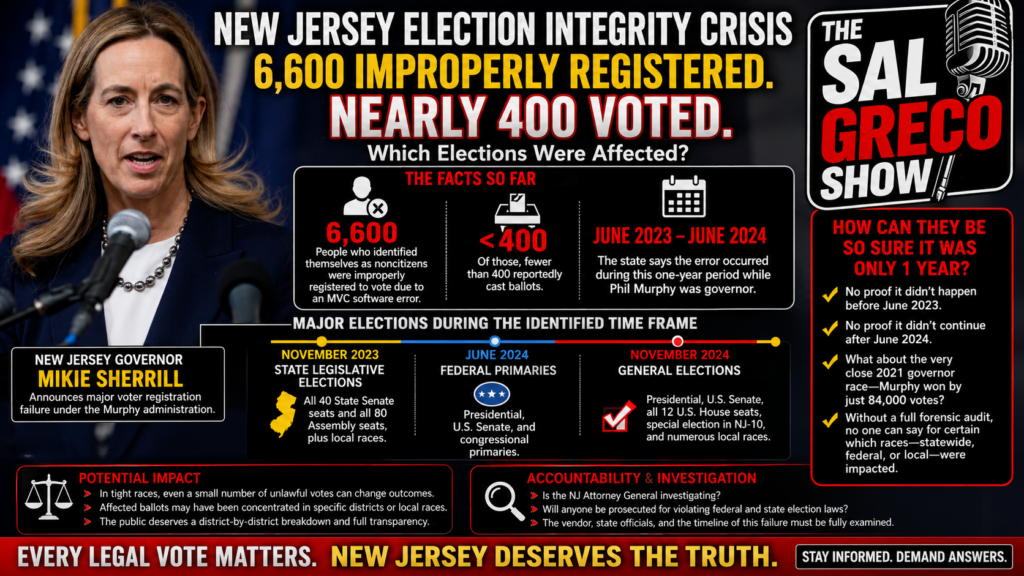
Gov. Mikie Sherrill announced that approximately 6,600 people who identified themselves as noncitizens while obtaining New Jersey driver’s licenses or identification cards were nevertheless improperly registered to vote through a Motor Vehicle Commission software error.
A preliminary state analysis reportedly found that fewer than 400 of those individuals subsequently cast ballots. Sherrill said the registrations occurred between June 2023 and June 2024, while Phil Murphy was governor. She ordered the registrations removed, said the responsible vendor would be replaced and announced an investigation into how the failure occurred.
Those remedial steps are necessary—but they are not sufficient.
New Jersey voters deserve answers to several basic questions: Which elections did these individuals vote in? In which legislative and congressional districts were their ballots cast? How did the state establish that the malfunction began in June 2023 and ended in June 2024? Were earlier versions of the software, vendor configurations or data-transfer processes independently examined? And has the state ruled out similar errors before June 2023 based on verifiable system records—or merely on the currently identified software defect?
Until those questions are answered with supporting evidence, officials cannot reasonably expect the public to accept a general assurance that no election was affected.
What New Jersey has admitted
According to the governor and published reports, the affected applicants had indicated that they were not United States citizens. Despite that information, the MVC system transmitted or processed them as voter registrants.
That distinction matters. This was not merely a case in which applicants allegedly lied about citizenship and intentionally completed fraudulent applications. Based on the state’s description, the government’s own system improperly registered people who had disclosed their noncitizen status.
The governor has also said that the affected registrations included people listed as Democrats, Republicans and independents. That fact may help show that the error was not confined to one political party, but it does not resolve the central election-integrity question. Party registration does not prove how someone voted, particularly in a general election where ballots are secret. (AP News)
The public also needs a precise number—not simply “fewer than 400”—and a breakdown identifying how many ballots were cast in each election.
Major elections occurred during the identified period
The dates identified by the governor overlap with major state and federal electoral activity.
In November 2023, New Jersey held elections for all 40 seats in the State Senate and all 80 seats in the General Assembly, along with county, municipal and school-board contests. The results determined control and representation throughout the Legislature. The state maintains official certifications and archived results for those elections.
In June 2024, New Jersey held presidential, U.S. Senate and congressional primaries. Those contests determined which candidates advanced to the November general election.
The registration period identified by the governor ended in June 2024, but that does not necessarily mean the consequences ended then. Unless the improperly created registrations were removed immediately, people registered through the defect could have remained eligible in the system for the November 5, 2024 general election.
That election included:
- The presidential race;
- New Jersey’s U.S. Senate election;
- All 12 New Jersey seats in the U.S. House;
- A special election in the 10th Congressional District; and
- Numerous county and municipal contests.
Democrats won nine of New Jersey’s 12 congressional seats in 2024, while Republicans won three. Nationally, Republicans—not Democrats—retained control of the U.S. House, 220 seats to 215. Therefore, it would be inaccurate to state that New Jersey’s 2024 results kept Democrats in control of Congress. However, New Jersey’s results did preserve a nine-seat Democratic delegation and contributed to the extremely narrow national balance of power.
Even when a statewide or congressional margin exceeded 400 votes, that does not dispose of the issue. The ballots may have been concentrated in particular counties, municipalities, legislative districts, party primaries or local races. Hundreds of ballots distributed statewide may not change a statewide result, but a much smaller number concentrated in one district could become significant.
That is why the state must disclose where the ballots were cast—not merely the statewide total.
Could particular races have been changed?
At this point, there is no publicly established evidence that the improperly cast ballots changed the winner of any identified election. That fact must be stated clearly.
But the absence of currently public evidence is not the same as proof that no race was affected.
To make that determination responsibly, investigators would need to compare the number of confirmed ineligible ballots cast in each contest with the certified margin in that contest. They would also need to determine which ballot styles those voters received and which elections they participated in, while protecting the secrecy of individual candidate selections.
An investigation should examine every election in which the affected registrations were active, including:
- The November 2023 legislative and local elections;
- Any 2023 special, municipal, school-board or runoff elections;
- The June 2024 federal primaries;
- The November 2024 presidential, Senate, House and local elections, if those registrations remained active;
- Any later elections in which an improperly registered individual remained on the rolls.
The state should publish a district-by-district table showing the number of affected registrations, ballots cast and certified victory margin for every relevant race.
Without that analysis, the statement that no election outcome was affected is premature.
How does New Jersey know it happened only from June 2023 through June 2024?
This is perhaps the most important unanswered question.
The governor has identified a one-year window, but the public has not yet been shown the technical evidence establishing those boundaries.
A credible forensic investigation must determine:
- The precise software update, configuration change or coding defect that created the problem;
- The date the defective software entered production;
- The date it was repaired or replaced;
- Whether the vendor retained complete change logs and audit trails;
- Whether similar registration errors occurred under earlier software versions;
- Whether the state previously received warning reports, rejected-record notices or employee complaints;
- When MVC, election officials, the vendor and the governor’s office first became aware of the defect;
- Why the issue was not publicly disclosed sooner;
- Whether all 21 counties received and processed the affected records in the same manner;
- Whether any improperly registered people remained active after June 2024.
Sherrill said she was “appalled” by the failures and the alleged lack of transparency by those previously responsible. That language raises an additional concern: Did officials know about this problem before it became public, and if so, when?
The state should release the investigation’s scope, the name and independence of the investigators, all nonprivileged technical findings and a timeline of who knew what and when.
What about Phil Murphy’s close 2021 reelection?
Phil Murphy defeated Republican Jack Ciattarelli in the November 2, 2021 gubernatorial election by 84,286 votes. Official results show Murphy receiving 1,339,471 votes and Ciattarelli receiving 1,255,185.
The currently disclosed 6,600 registration error does not, by itself, establish any connection to the 2021 governor’s race. The state says the identified software problem began in June 2023, more than a year and a half after that election.
It would therefore be unsupported to claim that this particular defect affected Murphy’s 2021 victory.
However, the 2021 election is relevant to the question of how thoroughly investigators will examine earlier systems and practices. If the state wants the public to accept June 2023 as a definitive starting date, it should publish the technical evidence supporting that conclusion.
The proper question is not, “Did 6,600 improper registrations decide the 2021 election?” The known numbers and dates do not support that assertion.
The proper questions are: Was the defect truly introduced in June 2023? Were earlier MVC registration systems audited? Were there other pathways through which noncitizens were incorrectly registered before then? And can officials document their answers?
An 84,286-vote margin is far larger than the currently disclosed number of ballots cast by the affected group. But election integrity should not depend solely on whether misconduct or administrative failure exceeded the final margin. Every unlawful ballot cancels the practical effect of a lawful voter’s choice, and every system failure deserves examination regardless of whether it changed a winner.
Was a crime committed?
Federal and New Jersey elections generally require voters to be United States citizens. Knowingly voting in a federal election as a noncitizen can result in criminal prosecution and immigration consequences.
The U.S. Attorney’s Office for the District of New Jersey has already pursued separate noncitizen-voting cases. In May 2026, federal prosecutors announced charges against four resident aliens accused of illegally voting in federal elections and making false statements in citizenship proceedings. Additional cases have included a guilty plea and other charges involving alleged false certifications of citizenship.
Those prosecutions demonstrate that noncitizen voting is not treated as a harmless paperwork violation.
But criminal liability in the MVC software case cannot automatically be assumed for every person who cast a ballot.
Intent matters.
The state says these individuals disclosed that they were noncitizens and were registered because of a government software failure. Some may have later voted knowingly, understanding that citizenship was required. Others may have believed—incorrectly but genuinely—that the government’s registration and issuance of voting materials meant they were eligible.
Investigators must examine each case individually. Registration by government error does not necessarily excuse knowingly casting an unlawful vote, but it also does not automatically prove criminal intent.
Potential responsibility extends beyond the voters themselves. Investigators should determine whether any government employee, contractor or vendor knowingly concealed the problem, falsified records, ignored mandatory safeguards or failed to report the defect after discovering it. A software mistake may be negligence. A knowing cover-up would present a very different legal issue.
Is the New Jersey attorney general investigating?
As of July 21, 2026, the governor has publicly announced an investigation, removal of the registrations and replacement of the software vendor. Open-source reports reviewed for this article do not establish that New Jersey Attorney General Matthew Platkin’s office has publicly announced a separate criminal investigation into the approximately 400 ballots or potential wrongdoing by officials or the vendor.
That does not prove the Attorney General’s Office is uninvolved. Investigations can proceed without immediate public confirmation. But the distinction matters: an administrative or outside review commissioned by the governor is not necessarily a criminal investigation.
The Attorney General should publicly clarify:
- Whether the Division of Criminal Justice has opened a case;
- Whether the matter has been referred to county prosecutors;
- Whether the affected voting records have been preserved;
- Whether potential cases are being coordinated with the U.S. Attorney’s Office;
- Whether voters will be evaluated individually for criminal intent;
- Whether officials or contractors are being investigated for negligence, concealment or misconduct.
Federal prosecutors have established a District of New Jersey Election Integrity Task Force and have brought recent noncitizen-voting cases. That task force could potentially examine ballots cast in federal elections, although no public source reviewed here confirms that the 6,600-registration software failure has been referred to it.
The vendor and state officials must be questioned
Reports identify IDEMIA as the vendor associated with the defective system. The investigation should determine what contractual safeguards existed, whether the vendor performed required testing and whether the state independently validated the system before and after deployment.
Officials should release the relevant contracts, change orders, testing reports, incident tickets, internal emails, error logs and correspondence among the MVC, Division of Elections, county election officials and vendor.
Replacing the vendor may prevent a recurrence, but it does not establish accountability for what already occurred.
New Jersey should also explain how a system could receive information explicitly identifying an applicant as a noncitizen and still produce a voter registration. Citizenship is not an obscure data field. It is the central eligibility requirement at issue.
A full independent audit is necessary
This incident is serious because it combines three failures:
First, the state improperly placed thousands of acknowledged noncitizens on its voter rolls.
Second, hundreds reportedly cast ballots after being registered.
Third, the public learned about the failure years after the registrations and elections occurred.
The appropriate response is not partisan dismissal, nor is it an unsupported declaration that specific elections were stolen. Both approaches replace evidence with political convenience.
New Jersey needs an independent forensic audit extending beyond the narrow list of 6,600 known records. The audit should examine the entire MVC-to-election-system pipeline, earlier software versions, vendor activity, county processing, ballot participation and all relevant elections.
Its findings should be public.
At minimum, the state should disclose:
- The exact number of improper registrants;
- The exact number who voted;
- Every election in which they participated;
- The counties and districts in which ballots were cast;
- The number of affected ballots in every race;
- The smallest certified margins in those jurisdictions;
- The evidence establishing the June 2023-to-June 2024 timeframe;
- Whether earlier and later systems were tested;
- When officials first learned about the defect;
- Whether criminal referrals have been made;
- Whether government or vendor personnel may face discipline or prosecution.
Election integrity requires facts, not assurances
There is currently no verified evidence that the MVC error changed control of the New Jersey Legislature, altered a congressional winner or affected Phil Murphy’s 2021 reelection.
There is, however, verified acknowledgment from New Jersey’s governor that approximately 6,600 self-identified noncitizens were improperly registered and that nearly 400 reportedly voted.
That alone is serious.
The state cannot close the matter by saying the registrations represented multiple political affiliations or that no outcome is presently known to have changed. Those points may be relevant, but they are not substitutes for an audit.
New Jersey voters are entitled to know exactly how this happened, how long it continued, which elections were involved, whether anyone concealed it and whether criminal laws were violated.
Until the state produces those answers, skepticism will persist—and it will be justified not by speculation, but by the government’s own admitted failure.