
BY SAL GRECO
For generations, New Yorkers have been told that fixing the city’s aging infrastructure was a top priority.
Every mayor has promised it.
Every governor has acknowledged it.
Every major storm has exposed it.
Yet after another weekend in which torrential rains transformed streets into rivers, flooded subway stations, stranded thousands of commuters, delayed flights, shut down highways, and placed lives at risk, one unavoidable question remains:
How many more warnings does New York need before rebuilding its infrastructure becomes the state’s top priority?
This is no longer simply an inconvenience.
It has become a public safety issue.
The Warning Came Fourteen Years Ago
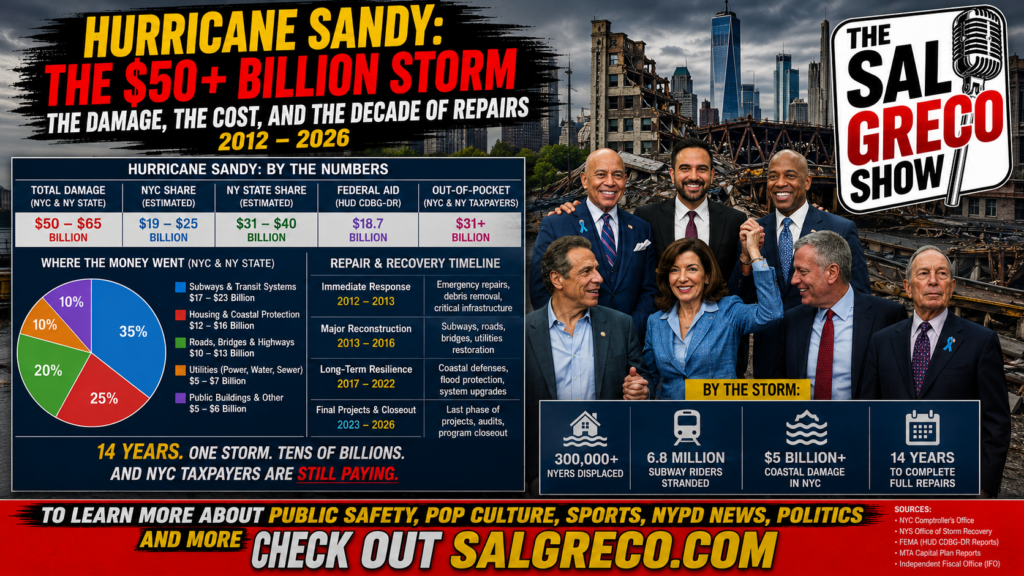
When Superstorm Sandy devastated New York City in 2012, it exposed vulnerabilities that had accumulated over generations.
Subway tunnels flooded.
Electrical substations failed.
Hospitals evacuated patients.
Roadways disappeared beneath storm surge.
Entire neighborhoods were submerged.
Politicians promised Sandy would become the turning point.
To be fair, billions of dollars have since been invested in resiliency projects, coastal protection, sewer upgrades and flood mitigation. But many large-scale projects remain incomplete, while other systems were only repaired rather than fundamentally modernized. Meanwhile, heavier rainfall and rising seas continue to test infrastructure that, in many cases, was designed generations ago.
Building Higher While the City Ages Below
Today, New York continues approving billions of dollars in new development.
Projects like 2 World Trade Center symbolize the city’s economic future.
Developers continue constructing taller residential towers, office buildings and mixed-use complexes throughout the five boroughs.
Yet just beneath those projects lies an aging city.
Water mains over a century old continue to rupture.
The subway system, much of which dates to the early 1900s, remains vulnerable to flooding.
Roadways continue deteriorating.
The Brooklyn-Queens Expressway has become one of the city’s most visible examples of aging infrastructure, requiring repeated emergency repairs while officials debate long-term reconstruction.
Many bridges now require constant maintenance simply to remain operational.
The contrast is difficult to ignore.
New York continues building upward while struggling to maintain what already exists beneath its streets.
Is New York Literally Sinking?
Scientists say yes—but not in the dramatic way often portrayed on social media.
NASA, the U.S. Geological Survey and university researchers have found that most of New York City is gradually subsiding by roughly 1 to 2 millimeters per year, with certain neighborhoods experiencing faster localized sinking due to geology, historic landfill, groundwater conditions and development.
By itself, that amount may appear insignificant.
However, when combined with rising sea levels, stronger storms and increasingly intense rainfall, even small changes in elevation increase flood risk over time.
The issue is not whether Manhattan’s bedrock can support skyscrapers—it can, and modern skyscrapers are engineered with deep foundations anchored into bedrock where appropriate. The larger challenge is whether the city’s surrounding transportation, drainage and utility infrastructure is being modernized quickly enough to keep pace with both development and changing climate risks.
Decades of Promises
For decades, administrations under Mayors Rudy Giuliani, Michael Bloomberg, Bill de Blasio, Eric Adams and now Zohran Mamdani have all acknowledged infrastructure needs.
Likewise, Governors George Pataki, Eliot Spitzer, David Paterson, Andrew Cuomo and Kathy Hochul have each overseen major transportation or resiliency initiatives.
Despite significant capital spending over those years, many projects require decades to complete because of funding constraints, environmental review, permitting, procurement rules and the complexity of rebuilding infrastructure in one of the world’s most densely populated cities.
The result is that New Yorkers often experience years of construction while still seeing recurring flooding, traffic bottlenecks and aging transit systems.
Who Is Responsible?
Responsibility begins at City Hall.
Mayor Zohran Mamdani oversees the agencies responsible for maintaining much of New York City’s infrastructure, including the Department of Environmental Protection, Department of Transportation, Department of Design and Construction, Department of Buildings and NYC Emergency Management.
At the state level, Governor Kathy Hochul oversees agencies with enormous responsibility for regional infrastructure, including the Metropolitan Transportation Authority, New York State Department of Transportation, Department of Environmental Conservation and the Division of Homeland Security and Emergency Services.
No single agency can solve this problem alone.
The city and state must operate as partners.
The Price Tag
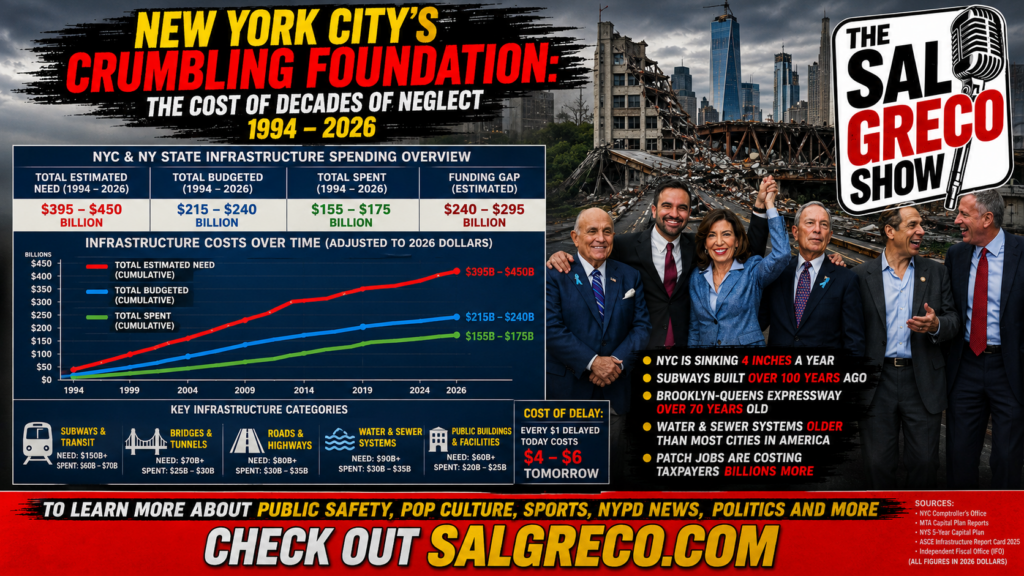
There is no single estimate to modernize every piece of New York City’s aging infrastructure.
Experts generally agree the total cost would likely reach well into the tens of billions of dollars, and a truly comprehensive overhaul—including transit, roads, bridges, tunnels, sewer systems, stormwater capacity, coastal protection and utilities—could ultimately approach or exceed $100 billion over many years.
That figure is staggering.
But so is the cost of repeated flooding, emergency repairs, business interruptions, property damage, lost productivity and disaster recovery.
The question is no longer whether New York can afford to invest.
It is whether New York can afford not to.
The Red Tape
The biggest obstacle may not be engineering.
It may be bureaucracy.
Projects often spend years navigating environmental review, permitting, procurement rules, utility coordination, community review, litigation and multiple layers of government approvals before construction even begins.
Every year of delay increases construction costs while the infrastructure continues to deteriorate.
The Next Steps
New York needs more than emergency declarations after every storm.
It needs a comprehensive, bipartisan infrastructure strategy that survives changes in political leadership.
That should include:
- An independent engineering assessment of the city’s highest-risk infrastructure.
- Accelerated replacement of aging sewer and stormwater systems.
- A long-term reconstruction plan for the Brooklyn-Queens Expressway.
- Continued modernization of the subway system to improve flood resilience.
- Faster procurement and permitting for critical public works.
- Annual public progress reports so taxpayers can track where their money is going.
Conclusion
This weekend’s flooding should not become just another headline forgotten by next week.
Superstorm Sandy was the warning.
This weekend was the reminder.
New York remains one of the greatest cities in the world, but its future depends not only on the skyscrapers rising into the skyline—it depends on the roads beneath them, the tunnels below them, the bridges connecting them, and the infrastructure that millions of people rely on every day.
The measure of leadership will not be how many ribbon-cuttings accompany new developments. It will be whether the generations who inherit this city can trust that the foundation beneath their feet is as strong as the skyline above their heads.