
BY SAL GRECO
Questions surrounding NYPD overtime, CityTime, 12-hour tours and disability pensions are growing — and the New York City Police Department has so far provided The Sal Greco Show and SalGreco.com no response to questions seeking its side of the story.
DCPI was tagged in the original public report concerning the alleged overtime and timekeeping problems. The Sal Greco Show subsequently submitted questions seeking confirmation, denial or clarification of the allegations. As of publication, DCPI has not responded to those questions or the request for comment.
Silence, of course, is not confirmation.
But neither does it resolve the allegations.
Sources speaking on condition of anonymity because they are not authorized to discuss internal NYPD matters continue to stand by and reaffirm the information they provided to SalGreco.com concerning alleged unpaid overtime, CityTime problems, night differential, 12-hour tours and other timekeeping issues.
The allegations now intersect with a separate issue backed by something far more concrete: an official New York City Department of Investigation report identifying significant vulnerabilities in the city’s administration of NYPD accident-disability pensions. DOI publicly released that report September 15.
The result is this week’s Friday Fiasco.
THE 45TH PRECINCT: WHERE IS THE MONEY?
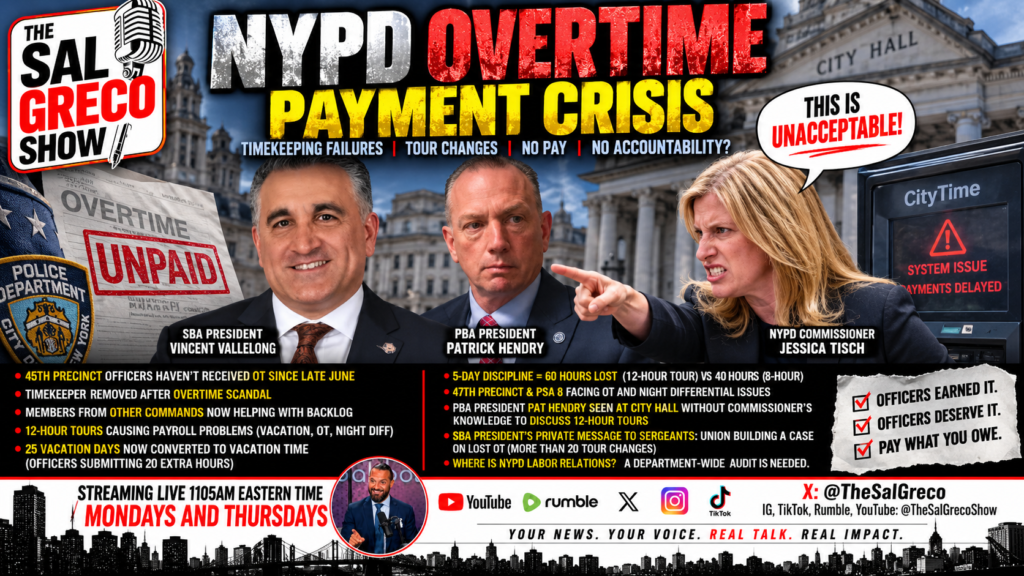
According to sources, members of the NYPD’s 45th Precinct have experienced delays involving overtime and night-differential payments, with some alleged problems dating back to late June.
Sources say the problems followed the removal of a timekeeper who handled overtime at the command and who, according to those sources, had also been attached to former Chief of Department Jeffrey Maddrey.
The Sal Greco Show reported in its Friday Fiasco video that the command had been operating without its former timekeeper and that members were allegedly not being paid overtime and night differential on time.
Sources further allege that personnel from other commands have been brought in to help reconcile the resulting timekeeping problems.
Those assertions remain source allegations. DCPI was asked to address the underlying claims and has not responded as of publication.
But there is a significant piece of documented history: the 45th Precinct was one of the original commands chosen for the NYPD’s extended-tour pilot.
So were the 47th Precinct and PSA 8. The city’s original agreement explicitly identified the 45th, 47th, PSA 8 and Transit District 11 for the pilot and established rotating 12-hour tours.
That matters because sources are now independently identifying the 45th, 47th and PSA 8 as locations experiencing alleged timekeeping and compensation problems.
THE PROBLEMS ALLEGEDLY DON’T END AT THE 45TH
Sources speaking on condition of anonymity tell SalGreco.com that members of the 47th Precinct and PSA 8 have experienced similar problems involving overtime and night differential.
Those sources further allege that timekeepers from the 47th and PSA 8 have been operating out of PSA 7 and that the situation has received scrutiny from One Police Plaza.
Again, DCPI has been given an opportunity to address the underlying allegations.
It has not responded.
The NYPD’s own public information confirms the operational relationship among some of these commands: PSA 8 serves NYCHA developments within the 43rd and 45th Precincts, while its Edenwald satellite covers NYCHA developments within the 47th Precinct.
Whether the alleged payroll problems themselves extend across these commands is something NYPD can establish through its records.
So far, the Department has not provided SalGreco.com with that answer.
CITYTIME AND THE 12-HOUR TOUR
The issue may be bigger than any individual timekeeper.
The 12-hour-tour program was supposed to improve officers’ quality of life by reducing the number of days they had to report to work. The original agreement established a schedule of three consecutive 12-hour tours followed by three consecutive regular days off.
But sources tell SalGreco.com that applying the Department’s existing timekeeping, vacation and disciplinary systems to 12-hour schedules has produced problems that were never adequately resolved.
One issue involves vacation.
In his Friday Fiasco video, Sal Greco described information provided by sources concerning the conversion of vacation days into hours under the extended-tour system and the additional hours members allegedly must reconcile when leave accrued under one schedule is applied against a 12-hour schedule.
Then there is discipline.
Sources have raised questions about what happens when a five-day penalty is imposed upon an officer working 12-hour tours.
Five 12-hour tours equal 60 hours.
Five traditional eight-hour tours equal 40 hours.
The obvious question is whether two officers receiving the same five-day disciplinary penalty can effectively suffer dramatically different hourly consequences because of their respective work schedules — and, if so, what contractual provision authorizes that result.
DCPI was given an opportunity to clarify that issue.
No response has been received.
NYPD’S OWN RULES SAY MEMBERS SHOULD BE PAID CORRECTLY AND ON TIME
This portion isn’t based on anonymous sources.
It’s in NYPD’s own Administrative Guide.
The Department’s January 2026 payroll procedure states that its purpose is to enter members’ electronic-timesheet information into CityTime so their paychecks can be generated and to ensure members are “properly compensated in a timely manner.”
Timekeepers are responsible for entering tour changes, leave, sick time, overtime and command disciplines into CityTime.
That makes the questions straightforward.
If members haven’t been properly paid, how many?
How many overtime hours remain outstanding?
How much night differential remains unpaid?
How long have the discrepancies existed?
Who discovered them?
And why weren’t they caught through the Department’s existing payroll controls?
These aren’t questions requiring speculation.
The records should provide the answers.
AND WHERE IS LABOR RELATIONS?
There is another development that deserves scrutiny.
The Sal Greco Show obtained what it understands to be a private message from SBA leadership directed to sergeants concerning members subjected to numerous tour changes and potential lost overtime.
According to the communication reviewed by the show, affected members were being asked to provide information as the union assembled a case concerning the issue.
This is particularly notable because extended tours were themselves the product of collective bargaining.
When the city announced a subsequent SBA agreement in 2025, the administration specifically described an SBA 12-hour-tour pilot and publicly credited the Office of Labor Relations for helping negotiate the agreement.
So where is Labor Relations now?
DID UNION LEADERS GO AROUND COMMISSIONER TISCH?
Sources have made an additional, politically significant allegation.
They tell SalGreco.com that SBA President Vincent Vallelong and PBA President Patrick Hendry were seen at City Hall attempting to address the extended-tour situation with the administration.
More significantly, sources allege those efforts occurred without Police Commissioner Jessica Tisch’s knowledge.
DCPI has been asked about the underlying matter and has not provided SalGreco.com with a response.
If union leaders did seek City Hall intervention without involving the commissioner, the circumstances deserve an explanation from all sides. What was discussed? Who attended? What remedy was requested? Was Tisch informed before or afterward? And what role was NYPD Labor Relations playing?
Until those questions are answered, claims about what the episode demonstrates concerning union leaders’ confidence in Tisch should be identified as interpretation rather than established fact.
THEN THERE’S THE DISABILITY-PENSION SYSTEM
While members allegedly struggle over overtime, night differential and vacation hours, an entirely separate official investigation has raised questions about a system responsible for enormous disability-pension expenditures.
This isn’t anonymous sourcing.
It’s DOI.
The New York City Police Pension Fund states that an officer can apply for Accident Disability Retirement regardless of age or years of uniformed service. The Medical Board must determine that the member is unable to perform police duties because of an accident sustained in the line of duty, after which the Board of Trustees makes the final determination.
On September 15, DOI released “Issues in the Application of ‘Accident Disability’ at the Police Pension Fund.”
The investigation identified systemic vulnerabilities serious enough for DOI to recommend reforms.
And that brings the story back to former Chief of Department John Chell.
THE FORMER CHIEF’S DISABILITY PENSION
The Sal Greco Show has separately reported allegations from sources concerning the ankle injury underlying a former chief’s disability retirement.
In the second Friday Fiasco video, Greco reported that sources described a torn ligament, no surgery and an alleged conversation during the medical-review process concerning whether weight loss could improve the ankle condition.
Those particular allegations have not been independently established by the DOI report or by medical records reviewed for this article.
They should therefore remain identified as source allegations unless documentary evidence or an official response confirms them.
But the larger disability-pension controversy is no longer hypothetical.
DOI itself has now publicly identified weaknesses in the system governing these pensions.
That distinction is critical.
The question isn’t whether legitimately injured officers deserve their pensions.
They do under the law when they meet the statutory requirements.
The question is whether every applicant receives equivalent scrutiny and whether the system contains adequate safeguards after an accident-disability pension is awarded.

THE PUBLIC DESERVES ANSWERS, NOT ASSUMPTIONS
There are now two parallel stories.
One is supported primarily by sources: alleged overtime delays, night-differential problems, CityTime complications, questions surrounding vacation and disciplinary calculations and alleged efforts by union leadership to seek intervention from City Hall.
Those allegations need records and official answers.
The second involves disability pensions and is supported by an official DOI investigation identifying vulnerabilities requiring reform.
Neither should be exaggerated.
Neither should be ignored.
And NYPD’s failure thus far to answer SalGreco.com’s questions should be reported accurately for what it is: no response as of publication — not an admission that the allegations are true.
THE TISCH QUESTION
The accumulating controversies inevitably raise questions about Commissioner Jessica Tisch’s management of the Department.
Sal Greco has argued that the payroll allegations, unresolved labor questions, controversies involving senior NYPD leadership and the questions surrounding the pension system demonstrate a broader failure of leadership and undermine the image of Tisch as the institutional reformer some supporters portrayed when she became commissioner.
The allegation that union leaders circumvented Tisch cannot fairly be transformed into a finding that they have “lost faith” in her unless the union leaders themselves say so or other evidence establishes it.
What can be demanded journalistically are answers.
Did Tisch know about the alleged payroll problems?
When?
What corrective action was ordered?
Did senior union officials approach Mayor Zohran Mamdani’s administration concerning the extended-tour problems?
Was Tisch included?
If she wasn’t, why wasn’t she?
What does City Hall believe happened?
Those answers would allow readers to reach their own conclusions about the commissioner’s leadership.
AND WHO IS ACCOUNTABLE AT THE PENSION FUND?
Accountability cannot stop at One Police Plaza.
The Police Pension Fund has its own governing and administrative structure, and public records show that pension matters continue to come before the city’s pension apparatus in 2026. The Comptroller’s office publishes Police Pension Fund meeting materials and records, including its September 9 meeting and upcoming October meeting.
Questions therefore extend to the Fund’s executive leadership, its Medical Board and its trustees.
What reforms will actually be implemented following DOI’s findings?
Which recommendations will be rejected?
How will disability retirees be selected for re-examination?
How will officials ensure that a patrol officer, detective, sergeant, captain or chief is evaluated under a consistent and defensible standard?
And who accepts responsibility when the safeguards don’t work?
FRIDAY FIASCO: FOLLOW THE RECORDS
This story should now move beyond rhetoric.
Audit the overtime.
Audit the night differential.
Determine whether vacation and disciplinary calculations under 12-hour tours are being applied correctly.
Identify every member who was underpaid and determine what is owed.
Explain the role of Labor Relations.
Establish exactly what occurred between union leadership and City Hall.
And implement transparent safeguards governing accident-disability pensions so that legitimate injured officers are protected while taxpayers can have confidence that extraordinary benefits are being administered consistently.
The Department has had an opportunity to address the allegations reported by SalGreco.com.
DCPI was tagged publicly when the original allegations were reported and was subsequently asked for answers. As of publication, it has not responded to SalGreco.com’s questions or request for comment. Sources speaking on condition of anonymity continue to reaffirm the information they provided.
That does not prove their allegations.
It makes obtaining the records and official answers even more important.
Because whether you’re an officer waiting for overtime, an injured cop seeking a disability pension, a union representing thousands of members or a New York City taxpayer funding the system, there should be one standard:
Account for the hours. Account for the money. Apply the rules consistently. And show the public the receipts.
That’s this week’s Friday Fiasco.