
Former NYPD Sergeant Matthew Portoles alleges that police supervisors and Medical Division officials ignored his line-of-duty injuries, denied reasonable accommodations, threatened his career and ultimately pushed him into disability retirement. The latest lawsuit adds to mounting questions about accountability, employee treatment and leadership at One Police Plaza.
By Sal Greco | The Sal Greco Show | SalGrecom.com
NEW YORK CITY — Another lawsuit has landed on the doorstep of the New York City Police Department, adding to a growing collection of legal challenges involving allegations of retaliation, discrimination, harassment and questionable supervisory practices that have been examined in previous reporting by SalGreco.com.
This time, the allegations come from former NYPD Sergeant Matthew Portoles, who claims that after suffering serious injuries in a line-of-duty collision with an MTA bus, the Department failed to accommodate his disabilities, subjected him to retaliatory treatment and ultimately forced him out of the career he had spent more than a decade building.
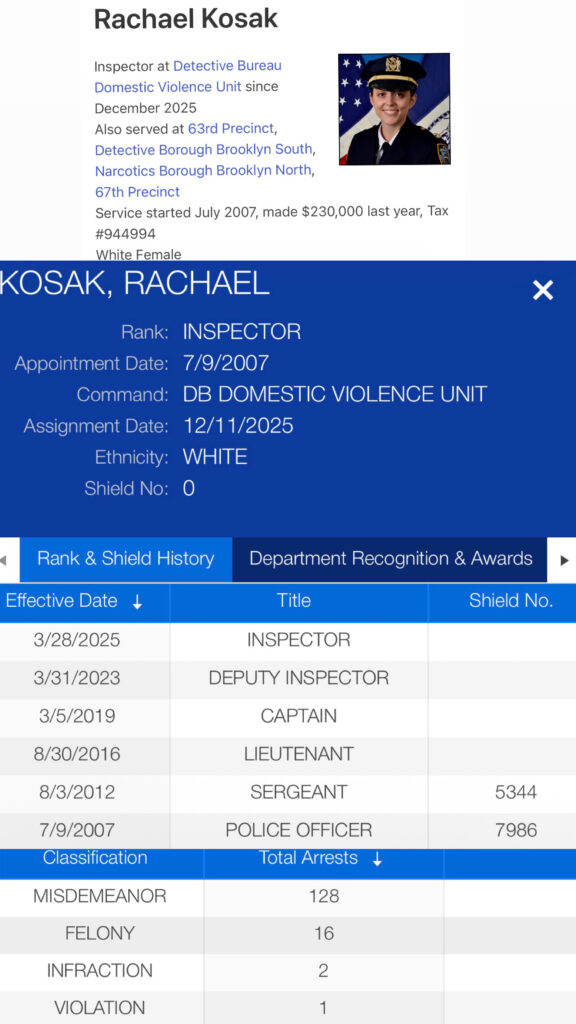
The 21-page verified complaint, filed October 28, 2026, in New York State Supreme Court, New York County, by attorney John A. Scola, names the City of New York, NYPD Deputy Chief Surgeon Dr. Salia Detore, District Surgeon Dr. James Sullivan and Inspector Rachael Kosak as defendants.
The lawsuit, filed under Index No. 163554/2026, alleges violations of the New York State Human Rights Law and New York City Human Rights Law, including disability discrimination, failure to provide reasonable accommodations, failure to engage in a cooperative dialogue and retaliation.
The allegations have not been proven in court.
Nevertheless, the complaint raises serious questions about how the nation’s largest police department treats officers injured while performing their duties, how its Medical Division exercises its authority and whether internal procedures designed to protect employees are being properly followed.
And as additional lawsuits continue to emerge, the NYPD under Police Commissioner Jessica Tisch faces increasingly pointed questions about its handling of allegations involving members of its own ranks.
AN NYPD SERGEANT INJURED WHILE SERVING THE CITY
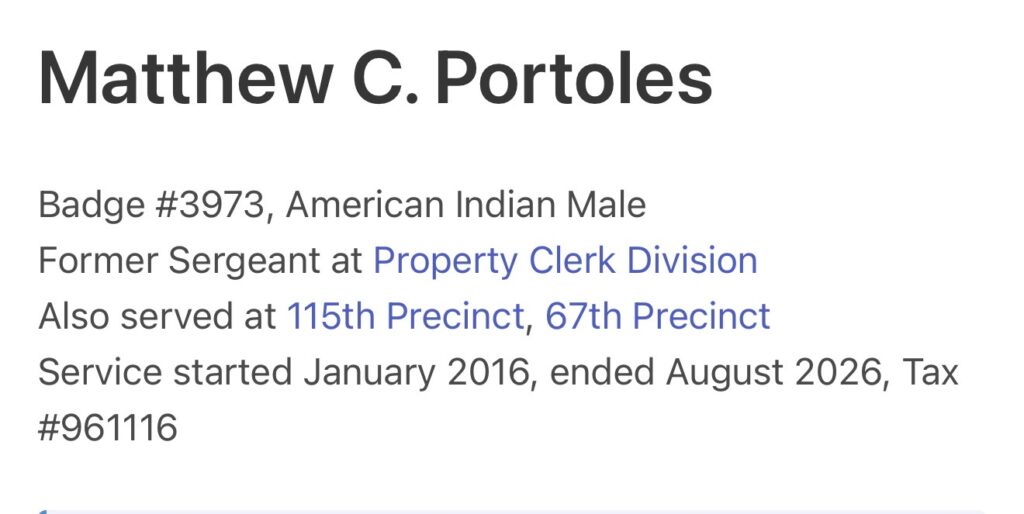
According to the complaint, Portoles joined the NYPD on January 6, 2016, and served in the 104th and 115th Precincts before being promoted to Sergeant in 2024.
On August 26, 2024, at approximately 7:48 a.m., Portoles was operating an NYPD vehicle in Queens when an MTA bus struck it.
The collision allegedly caused injuries to his head, left eye and left shoulder.
Rather than immediately report the full extent of his injuries, Portoles claims he continued working because he feared being placed on line-of-duty injury status could jeopardize his upcoming promotion.
He subsequently completed the Department’s Basic Management Orientation Course while experiencing significant pain and physical limitations.
After completing his training, he reported the injuries and was placed on restricted duty.
What followed, according to the lawsuit, was not a supportive effort to help an injured police supervisor recover and continue serving the Department, but a series of decisions that allegedly worsened his condition and placed his career in jeopardy.
INSPECTOR RACHAEL KOSAK ACCUSED OF IGNORING MEDICAL RESTRICTIONS
In late October or early November 2024, Portoles was assigned to the 67th Precinct in Brooklyn, commanded at the time by Inspector Rachael Kosak.
His medical restrictions allegedly prohibited contact with prisoners and members of the public.
Despite those restrictions, the complaint claims he was assigned to work as desk Sergeant, a position that required precisely the interactions his doctors had restricted.
Portoles alleges that his left eye remained swollen, his vision was impaired and his left arm was so severely affected that he struggled with ordinary physical tasks.
He reportedly requested an administrative assignment, explaining his medical condition and the circumstances surrounding his injuries.
According to the lawsuit, Kosak refused.
The situation allegedly escalated when a prisoner attempted suicide inside a precinct cell.
Portoles claims he intervened and was physically attacked by the prisoner, aggravating his already injured shoulder.
When he subsequently reminded Kosak that he was medically prohibited from prisoner contact, the complaint alleges that she told him, in substance, that he was expected to do his job.
Portoles further alleges that Kosak repeatedly subjected him to command discipline despite knowing about his injuries and denied him cash overtime that other Sergeants were permitted to receive.
He claims the treatment became so distressing that he contacted the NYPD’s Health and Wellness Unit and complained to Inspector Mark Wachter, describing the situation as depressing.
These allegations raise an important question: If the Department’s own medical personnel placed restrictions on a member of service, why was that member allegedly assigned duties that conflicted with those restrictions?
And if those assignments resulted in additional injury, what supervisory accountability mechanisms were available?
NYPD MEDICAL DIVISION ACCUSED OF DELAYING NECESSARY SURGERY

The complaint also levels allegations against two physicians within the NYPD Medical Division.
Portoles claims District Surgeon Dr. James Sullivan resisted recognizing the full extent of his injuries, including his left eye injury, and attempted to return him to full duty despite significant shoulder limitations.
His shoulder allegedly deteriorated into a frozen shoulder, leaving him unable to move his arm normally.
According to the complaint, Sullivan insisted on physical therapy before approving surgery recommended by Portoles’s treating physician.
Deputy Chief Surgeon Dr. Salia Detore is similarly accused of minimizing his injuries and requiring additional physical therapy before authorizing surgery.
Portoles claims he underwent cortisone injections, platelet injections, massage treatments and physical therapy without meaningful improvement.
He ultimately underwent shoulder surgery in approximately March 2025.
However, the complaint alleges that throughout this process, Detore repeatedly threatened him with a medical survey, the administrative process through which the Department may seek to separate a member deemed medically unfit for duty.
Following surgery, Portoles claims Detore told him, in substance, that the Department intended to get rid of him and that he needed to submit his retirement paperwork.
If supported by evidence, those alleged statements would raise substantial questions about whether medical determinations were being made independently and appropriately.
The physicians and the City have the opportunity to contest these allegations, including by presenting medical records and explaining the clinical and administrative reasons for their decisions.
CLASSIFIED AS CHRONIC SICK AFTER A LINE-OF-DUTY INJURY
Another troubling allegation concerns Portoles’s classification as a Category B chronic sick employee.
While recovering from surgery, he claims an NYPD Absence Control Sergeant visited his residence and informed him that he had been designated chronic sick because he had accumulated more than 40 days of absence.
Portoles alleges that these absences resulted from injuries sustained while performing his duties and that the Department improperly recorded them as ordinary sick leave rather than line-of-duty injury absences.
He further claims he was instructed to check in before leaving his home.
The distinction is significant because the classification of an employee’s absences can affect monitoring, workplace treatment and administrative decisions.
Whether the NYPD properly categorized Portoles’s absences is a factual issue that could be examined through Department records.
THE FIREARMS CONTROVERSY: A QUESTIONABLE TIMELINE
Perhaps one of the most striking allegations involves the removal of Portoles’s firearms.
According to the lawsuit, Portoles was instructed to qualify at the NYPD firearms range on August 11, 2025, despite informing Department personnel that he was taking prescribed narcotic medication and believed participating in firearms training could be dangerous.
He alleges that he nevertheless completed qualification with both his service and off-duty weapons.
The Department reportedly allowed him to retain his firearms afterward.
However, on October 21, 2025, after Portoles says he had discontinued narcotic medication and experienced improvement in his medical condition, Detore signed an order removing his firearms.
The order allegedly stated that he was medically unable to qualify at firearms training.
Portoles contends that the decision was retaliatory and inconsistent with his earlier successful qualification.
Five days later, on October 26, he submitted a written request for the return of his firearms, attaching documentation of his August qualification and disputing the medical justification.
According to the complaint, the request went unanswered.
The chronology raises questions that deserve a documented explanation.
Why was Portoles allegedly permitted to qualify while taking narcotic medication but later deemed unable to qualify after discontinuing it?
What medical findings supported the October determination?
Were the firearms restrictions based on new clinical information, Department policy or another legitimate consideration?
Those questions cannot be resolved from the complaint alone. But they warrant examination of the relevant medical orders, qualification records and internal communications.
PUSHED INTO DISABILITY RETIREMENT DESPITE REQUESTS FOR ACCOMMODATION
At the heart of the lawsuit is Portoles’s allegation that the NYPD failed to meaningfully explore reasonable accommodations that would have allowed him to continue working.
The complaint states that he repeatedly requested administrative assignments, continued restricted duty, appropriate medical treatment and recognition of his line-of-duty injuries.
He maintains that he was capable of performing administrative work and had already demonstrated that ability while assigned to the NYPD Property Clerk Division.
According to the lawsuit, the Department maintains numerous administrative, clerical and property-management positions staffed by uniformed members with physical limitations.
Portoles alleges that no defendant engaged him in a cooperative dialogue about accommodations and that he never received a written final determination explaining what accommodations were granted or denied.
Instead, the complaint claims his medical separation process moved forward unusually quickly.
His case allegedly reached the Police Pension Fund Medical Board in December 2025, approximately two to three months after his medical survey began.
Portoles contends that comparable cases ordinarily take longer and alleges that his process was accelerated to remove him before he could accumulate additional pension benefits.
That claimed comparison and alleged motive remain unverified.
On August 12, 2026, his accident disability retirement was approved, bringing his NYPD career to an end.
Portoles maintains that he did not want to retire.
The central legal question is whether the Department fulfilled its obligations under applicable disability discrimination laws before separating him from employment.
EVEN AFTER RETIREMENT, THE ALLEGED TREATMENT CONTINUED
The lawsuit alleges that Portoles encountered additional difficulties after his retirement.
When he visited One Police Plaza to surrender his Department equipment, shield and identification card, he claims he was denied a letter of good standing, commonly referred to among police officers as a “good guy letter.”
He also alleges that he was issued a retirement identification card bearing the restriction “NO FIREARMS.”
Portoles believes those decisions resulted from the earlier firearms removal ordered by Detore.
The complaint further contends that his accident disability retirement created financial limitations affecting his ability to pursue another career, including his stated goal of becoming an electrician.
He alleges that his disability pension does not fully replace the compensation, overtime opportunities, salary increases and retirement benefits he expected to earn had he remained employed.
The lawsuit seeks reinstatement with reasonable accommodation or alternative compensation, lost wages and benefits, emotional distress damages, punitive damages against the individual defendants, attorneys’ fees and other relief.
It also seeks the return of his firearms, a letter of good standing and an unrestricted retirement identification card.
NINE CAUSES OF ACTION AGAINST THE CITY AND NYPD OFFICIALS
The complaint asserts nine causes of action under state and city law, including disability discrimination, failure to accommodate, retaliation, failure to engage in a cooperative dialogue, aiding and abetting alleged discriminatory conduct, and employer liability.
The individual defendants are accused of personally participating in the alleged misconduct, while the City is accused of failing to prevent or appropriately address it.
Portoles has demanded a jury trial.
No determination of liability has been made.
ANOTHER LAWSUIT ADDS TO THE QUESTIONS SURROUNDING THE NYPD UNDER JESSICA TISCH
The Portoles lawsuit does not exist in isolation.
SalGreco.com has reported on other lawsuits involving allegations of retaliation, discrimination and mistreatment within the NYPD, including recent litigation involving the Department’s Cadet Corps and allegations concerning supervisory conduct.
In that reporting, attorney John Scola has represented NYPD personnel who claim they faced retaliation after raising concerns about discrimination.
The accumulating court filings raise broader questions about how the NYPD responds when its own employees report misconduct, challenge supervisory decisions or request protections afforded under the law.
It is important to distinguish the number of lawsuits filed from the number of allegations ultimately proven. Litigation alone does not establish a pattern of unlawful conduct, and each case must be evaluated on its own evidence.
Nevertheless, repeated allegations involving employee treatment, retaliation, medical accommodations and supervisory accountability deserve serious institutional scrutiny.
Police Commissioner Jessica Tisch, who leads the NYPD, is not personally named as a defendant in the Portoles lawsuit.
Nor does the complaint establish that she personally directed or knew about the decisions challenged in this case.
But as Commissioner, Tisch oversees the Department and its systems of accountability.
That responsibility includes ensuring that complaints are properly investigated, employees are treated lawfully, medical determinations are appropriately documented and supervisory personnel are held accountable when wrongdoing is established.
The growing collection of lawsuits reported by SalGreco.com makes those responsibilities increasingly relevant.
What procedures exist to identify repeated complaints involving the same units or officials?
How does the Department ensure that members who report discrimination or request accommodations are protected from retaliation?
Are its Medical Division and supervisory review systems subject to meaningful oversight?
And when credible allegations arise, does the NYPD investigate and correct underlying problems, or does it primarily respond through litigation?
Those are questions the Department should be prepared to answer.
ATTORNEY JOHN SCOLA BLASTS NYPD’S TREATMENT OF INJURED SERGEANT
Attorney John A. Scola, who represents former NYPD Sergeant Matthew Portoles, sharply criticized the Department’s alleged treatment of his client, accusing the NYPD of punishing an officer who was injured while serving the people of New York City rather than providing the accommodations required by law.
“Sergeant Matthew Portoles was hit by a bus while serving this City, worked through his injuries to earn his stripes, and in return the NYPD mocked him, disciplined him, took his guns, and pushed him out the door. The NYPD has made it clear that if you get hurt protecting New Yorkers, it would rather violate the law and survey you than accommodate you,” Scola told SalGreco.com.
Scola’s statement underscores the central allegations in the lawsuit: that an injured Sergeant who wanted to continue his career was allegedly subjected to disciplinary actions, denied reasonable accommodations and ultimately separated from the Department through its medical retirement process.
The allegations also raise broader questions about how the NYPD treats injured members of service and whether its internal medical and supervisory procedures adequately protect employees who seek accommodations.
With additional lawsuits involving allegations of retaliation, discrimination and improper supervisory conduct continuing to emerge, the Department’s handling of these complaints remains an important issue for Police Commissioner Jessica Tisch and NYPD leadership.
The claims against the Department and the individual defendants remain allegations that have not been adjudicated.
THE NYPD HAS A LOT TO ANSWER FOR — AND POTENTIALLY MUCH TO CORRECT
The NYPD demands professionalism, integrity, discipline and accountability from the men and women who wear its uniform.
Those same standards must apply to the supervisors, physicians, administrators and executives responsible for managing its workforce.
An officer injured while serving the public should be entitled to fair treatment, appropriate medical evaluation and the protections afforded by law.
That does not mean every injured officer must remain employed regardless of medical limitations. Nor does it mean every disputed medical or disciplinary decision constitutes discrimination.
It means that decisions affecting an employee’s career, health, livelihood and reputation should be supported by legitimate reasons, consistent procedures and meaningful review.
The Portoles complaint alleges that those protections failed him.
If the allegations are substantiated, the appropriate response should extend beyond financial compensation or the resolution of a single lawsuit. It should include examining the policies, supervisory decisions and administrative practices that allowed the alleged conduct to occur.
The Department also has an interest in demonstrating when its personnel acted properly and when allegations are unsupported.
Transparency and documented accountability serve both purposes.
With additional lawsuits being filed and previously reported cases continuing through the courts, the NYPD has an opportunity—and a responsibility—to explain its practices and correct deficiencies where they are found.
Commissioner Tisch’s administration should be prepared to address the questions raised by these cases rather than allowing the underlying concerns to remain unanswered.
For an institution entrusted with enforcing the law, compliance with the law inside its own ranks is not optional.
The lawsuits continue to accumulate. The allegations continue to raise questions. And the NYPD owes its members, the public and the courts clear answers supported by evidence.
© 2026 SalGreco.com | The Sal Greco Show — Independent Journalism. Your News. Your Voice.