
BY SAL GRECO
The New York City Police Department is confronting another painful reminder of the extraordinary mental and emotional strain carried by the men and women who wear the uniform.
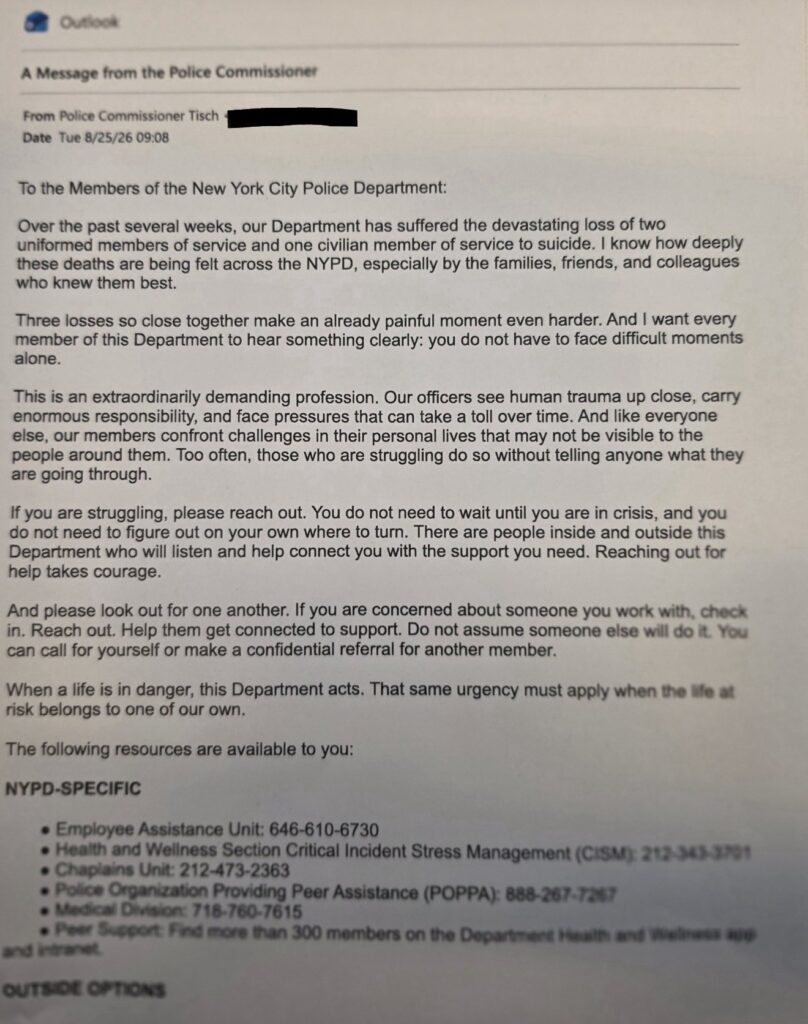
Over the past several weeks, the NYPD has suffered the deaths by suicide of two uniformed members of service and one civilian member of the department, according to an internal message sent Tuesday morning by Police Commissioner Jessica Tisch. The losses have once again placed officer mental health, supervision, departmental culture and the systems designed to identify and assist struggling officers under intense scrutiny.
For the everyday cop, the pressures of the profession can accumulate long before the public ever sees the consequences. Police officers routinely encounter violence, death, family tragedies and people experiencing the worst moments of their lives. At the same time, they operate inside an organization where overtime, changing schedules, disciplinary investigations, internal politics, staffing shortages and the pressures of simply doing the job can compound what officers already carry home with them.
Tisch acknowledged some of that burden in her August 25 message to the department.
“Over the past several weeks, our Department has suffered the devastating loss of two uniformed members of service and one civilian member of service to suicide,” Tisch wrote.
She described policing as an “extraordinarily demanding profession,” noting that officers witness human trauma up close, carry enormous responsibility and face pressures that can take a toll over time. She urged struggling members to seek assistance and called upon officers to watch out for one another.
“When a life is in danger, this Department acts,” Tisch wrote. “That same urgency must apply when the life at risk belongs to one of our own.”
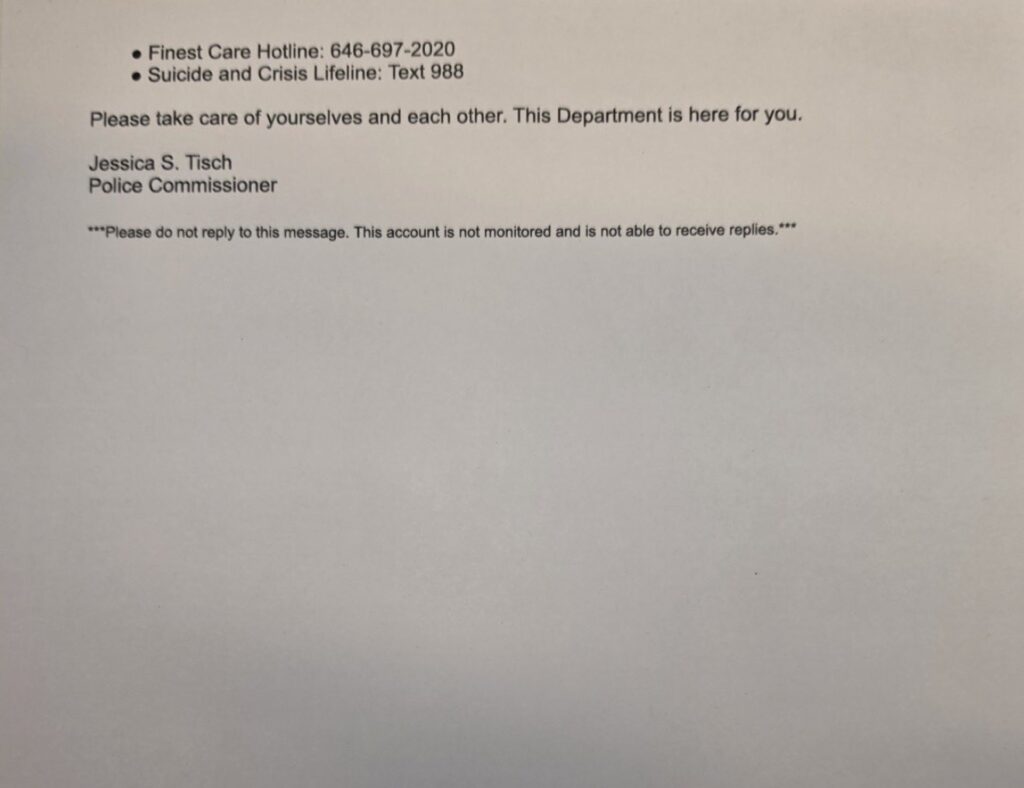
The commissioner listed several NYPD resources available to members, including the Employee Assistance Unit, Health and Wellness Section, Chaplains Unit, POPPA, Medical Division and peer-support programs.
It is an important message.
But after tragedies like these, the questions cannot end with an email.
What Happens Before Someone Gets the Shield?
The recent deaths have inevitably renewed discussion about another controversial corner of the NYPD: the Candidate Assessment Division, the operation responsible for screening applicants before they become police officers.
That division has already been at the center of one of the NYPD’s most complicated personnel controversies in recent years.
Former Candidate Assessment Division commanding officer Terrell Anderson—who has since been promoted to Deputy Chief—was reassigned in 2025 amid an Internal Affairs investigation involving applicants who had previously received disqualifications but were nevertheless permitted to continue through the hiring process.
Contemporary reporting alleged that Anderson overrode negative psychological recommendations involving dozens of applicants. The NYPD subsequently attempted to remove approximately 30 officers who it said had been hired despite final notices of disqualification. The PBA challenged the department’s actions in court.
As previously reported by The Sal Greco Show, the controversy raised a much larger question: Was this really the work of one commanding officer—or was Anderson taking the blame for problems embedded throughout the NYPD’s recruitment apparatus?
Our previous reporting detailed how Anderson became the public face of the controversy while questions remained about the responsibility of officials above him. Sources told the show that Anderson absorbed professional consequences while senior leadership avoided comparable scrutiny. Those allegations were not independently verified by the NYPD.
And Anderson’s subsequent promotion to Deputy Chief only made the situation more difficult to reconcile. If his actions were as egregious as initially portrayed, why was he later elevated into the executive ranks?
Serious Allegations—and an Important Counterpoint
Following the recent deaths, The Sal Greco Show again raised questions about the Candidate Assessment Division and the standards being used to determine who should become a New York City police officer.
Sources have alleged that candidates with significant psychological or character concerns were permitted to continue through the hiring process and that senior NYPD executives sometimes intervened on behalf of particular applicants.
There have also been allegations involving drug-screening issues and questions about whether recruitment pressures resulted in standards being relaxed or administrative mechanisms being used to keep applicants moving through the process.
These remain allegations, and they should be treated as such.
Public reporting nevertheless confirms that the broader hiring controversy was real. The NYPD itself said an internal investigation identified officers who had entered the department despite final notices of disqualification, while reporting identified issues ranging from psychological and character assessments to criminal histories and other background concerns.
But a source familiar with the Candidate Assessment process has now provided The Sal Greco Show with an important counterpoint—and one that complicates the narrative surrounding Anderson.
The source pushed back on some of the criticism, telling the show that concerns about psychological screening are legitimate, but that the problems run much deeper than any one commanding officer.
According to the source, the recent suicides and suspensions do not involve candidates for whose hiring Anderson was responsible.
The source also disputed the characterization that applicants simply “pass” or “fail” the psychological examination. According to the source, the process is instead based on whether an applicant is recommended or not recommended, an important distinction when discussing decisions later reviewed or reversed by department officials.
Most significantly, the source maintains that the psychological-assessment system itself is fundamentally flawed.
That contention deserves examination.
Questions About the Psych Process Didn’t Disappear With Anderson
Independent reporting has already raised substantial questions about the Candidate Assessment Division’s psychological screening system.
A 2025 City & State investigation examined the NYPD’s use of unlicensed psychologists in candidate assessments. The NYPD maintained that the practice was permissible under a state education-law exemption, while questions were raised about how that exemption interacted with other statutory requirements governing police psychological assessments. More recently, reporting indicated that the department has moved toward employing more licensed psychologists.
That is precisely why reducing the entire controversy to “Terrell Anderson let people through” risks missing the larger story.
The source speaking with The Sal Greco Show claims that despite Anderson’s removal as Candidate Assessment commanding officer and the installation of Inspector Glorisel Lee, little of substance has actually changed.
According to the source, Lee is operating within essentially the same system Anderson operated under.
In the source’s view, Anderson wasn’t creating the underlying problem—he was attempting to fix problems that already existed within the process.
That position is particularly notable considering that Anderson had previously discovered and reversed psychological determinations he believed were improper, according to reporting about the controversy. City & State reported that 80 assessments had been reversed out of approximately 6,200, while questions subsequently emerged about who performed some of those assessments and under what professional credentials.
None of this automatically vindicates every decision Anderson made.
But it does make the simplistic explanation—that one rogue commander single-handedly corrupted an otherwise functioning hiring system—much harder to accept without further scrutiny.
The NYPD Cannot Have It Both Ways
This is where the two stories—the mental strain on existing officers and the controversy surrounding candidate assessment—intersect.
No evidence presented here establishes that deficiencies in candidate screening caused the recent suicides, and such a connection should not be assumed. Suicide is complex, intensely personal and rarely attributable to one factor.
But the tragedies demand a broader conversation about how the NYPD evaluates psychological fitness before hiring, how it supports mental wellness after hiring, and how its organizational culture affects officers throughout their careers.
The department cannot tell its members that mental health is paramount while refusing to provide transparency about controversies involving the very psychological-assessment system used to select them.
It cannot place the blame for a hiring breakdown on one executive, transfer and discipline that executive, and then promote him to Deputy Chief without expecting questions about what actually happened.
And changing the name on the commanding officer’s door does not constitute reform if the underlying system remains substantially unchanged.
In fact, before the controversy erupted, Anderson himself had publicly emphasized suicide prevention, mental-health stigma, morale and positive leadership while commanding Candidate Assessment. A February 2025 program involving the division specifically addressed suicide prevention, mental wellness and creating a culture of respect.
That history makes today’s questions even more compelling.
The Rank-and-File Deserve Answers
The vast majority of NYPD officers show up, put on the uniform and perform an extraordinarily difficult job without ever becoming a headline.
They answer calls involving death, violence, abused children, domestic disputes, emotionally disturbed people and unimaginable tragedy. Then they are expected to finish their tour, go home and somehow leave all of it behind.
They deserve more than slogans about wellness after tragedy strikes.
They deserve a department willing to examine whether its internal culture contributes to unnecessary stress. They deserve supervisors who recognize warning signs. They deserve confidential mental-health resources they can trust. And they deserve confidence that the people standing beside them were evaluated through a professional, consistent and defensible hiring process.
Tisch’s message urging officers to reach out is necessary.
But the events of the last several weeks—and the unresolved questions surrounding Candidate Assessment—show why the conversation cannot stop there.
Who made the decisions involving disputed candidate assessments? What authority existed to reverse psychological recommendations? Were senior executives requesting favors for particular applicants? Were standards altered because the NYPD desperately needed recruits? What reforms resulted from the department’s review of Candidate Assessment? And if the system was truly fixed after Anderson’s removal, what specifically changed?
Those questions aren’t an attack on police officers.
They are questions for their protection.
Because when an organization asks its members to carry the weight that New York City police officers carry every day, it assumes an enormous responsibility in return: to make sure the systems responsible for selecting, supervising and protecting those officers are worthy of the people they serve.
Two uniformed officers and a civilian member of the NYPD have now been lost to suicide within a matter of weeks.
Their deaths should first and foremost be treated as human tragedies—not political ammunition and not proof of any unestablished theory.
But honoring those losses also means being willing to ask uncomfortable questions.
The NYPD’s mental-health crisis and its troubled candidate-assessment history may be separate issues. Yet both point toward the same fundamental question:
Is the department doing everything it can to protect the people who protect New York City?
Right now, that question deserves an answer.
NYPD Asked to Respond
The Sal Greco Show has submitted questions to the NYPD’s Office of the Deputy Commissioner, Public Information (DCPI), seeking the department’s response to the allegations and broader questions surrounding the Candidate Assessment Division. As of publication, DCPI has not responded.
This story will be updated if and when the NYPD provides a response.