
Attorney John Scola’s lawsuit involving Transit District 2 adds to mounting allegations of sexual harassment, retaliation and supervisory misconduct, as questions grow over Transit District 1 and accountability under NYPD Police Commissioner Jessica Tisch.
BY SAL GRECO | THE SAL GRECO SHOW | NOVEMBER 15, 2026
How many lawsuits will it take before the New York City Police Department finally confronts the allegations of sexual harassment, retaliation, favoritism and abuse of authority emerging from its own ranks?
How many officers must claim they were punished for speaking out before the NYPD demonstrates that its internal reporting and disciplinary systems are functioning properly?
And how many different commands must become embroiled in controversy before Police Commissioner Jessica Tisch and the Department’s executive leadership undertake a comprehensive examination of the workplace culture within the NYPD?
Another lawsuit, filed earlier this year and now examined by SalGreco.com, raises those questions once again.
This time, the allegations come from NYPD Transit District 2, where veteran Police Officer Garry Lamour alleges he endured years of racial discrimination, sexually explicit harassment, intimidation and career-damaging retaliation.
The 35-page verified complaint was filed on April 17, 2026, in New York County Supreme Court by attorney John A. Scola, Esq., of the Law Office of John A. Scola, PLLC.
The defendants are the City of New York and NYPD Lieutenants Kamil Choinski, Andre Reyes and Steven Spinelli.
The lawsuit, Garry Lamour v. City of New York et al., Index No. 154893/2026, alleges violations of New York State and New York City human-rights laws.
The claims have not been adjudicated, and the defendants are entitled to contest the allegations. Nevertheless, the level of detail in the complaint warrants scrutiny—particularly when viewed alongside the numerous other workplace-misconduct controversies SalGreco.com has documented.
A POLICE OFFICER DESCRIBES YEARS OF SEXUALLY CHARGED HARASSMENT
According to the complaint, Lamour joined the NYPD on July 6, 2011, and eventually spent more than nine years assigned to Transit District 2’s Special Operations Unit.
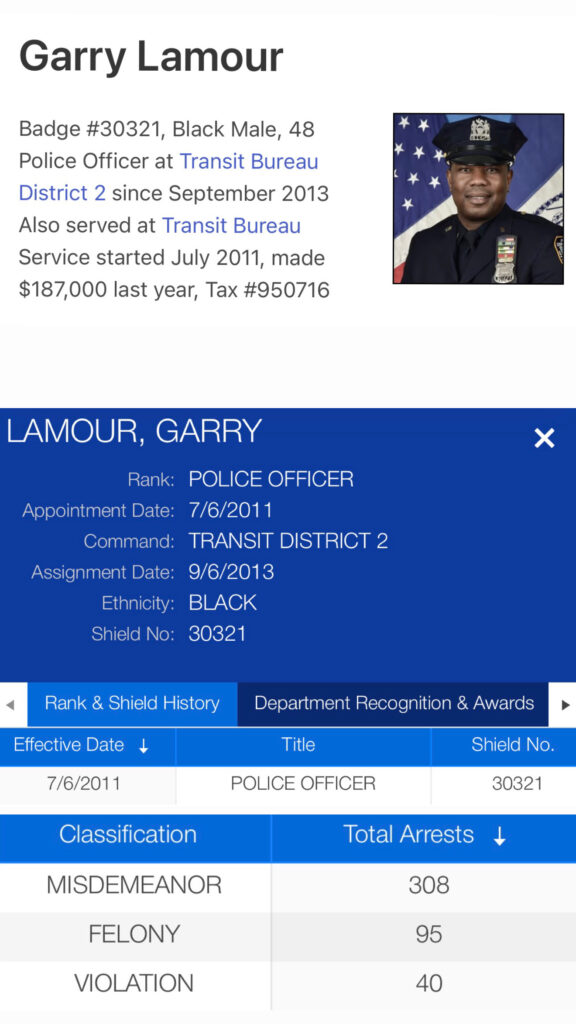
He describes himself as a productive officer with more than 435 career arrests.
But instead of being rewarded for his performance, Lamour alleges he became the target of harassment involving his race, Haitian national origin and sex.
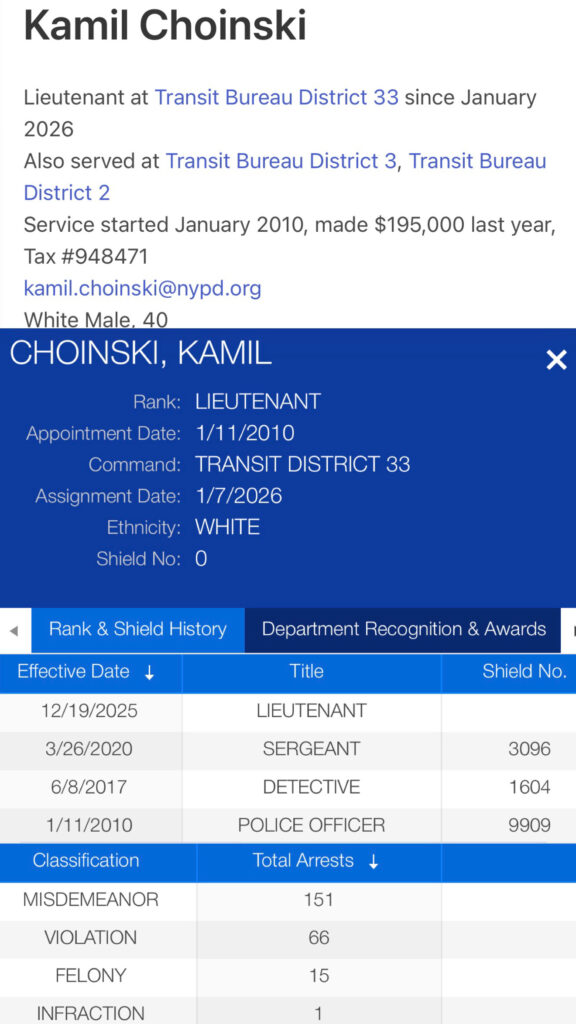
The complaint identifies Choinski, previously a sergeant and subsequently promoted to lieutenant, as the primary individual responsible for the alleged misconduct.
Lamour alleges that Choinski routinely made degrading remarks about Haitians and their ability to speak or understand English.
The allegations go considerably further.
According to the lawsuit, Choinski allegedly made repeated, graphic sexual comments about Black men in Lamour’s presence, sometimes specifically referring to Haitian men.
Lamour contends these remarks were unwelcome, humiliating and intended to provoke him.
The complaint identifies numerous incidents beginning in 2012 and intensifying after Choinski returned to the command as a sergeant in December 2020.
One particularly troubling allegation concerns March 6, 2024, when Choinski allegedly made a sexually inappropriate demand that personnel remove their clothing.
Lamour says he openly refused.
The complaint also describes an incident in September 2024 in which another officer allegedly showed Lamour messages suggesting that a favorable performance evaluation could be obtained by accompanying Choinski to a gay bar.
If established, allegations involving the exchange of workplace benefits for unwanted personal or sexual participation would raise profound questions about the misuse of supervisory authority.
This case is not about anyone’s sexual orientation. The issue is whether an NYPD supervisor used sexually explicit conduct, racialized remarks or his position of authority to harass, intimidate or discriminate against subordinate officers.
No NYPD member, regardless of sex or sexual orientation, should be subjected to unwanted sexual conduct as a condition of employment.
ATTORNEY JOHN SCOLA: NYPD PROTECTS ABUSERS THROUGH SILENCE
Attorney John A. Scola, Esq., who represents NYPD Police Officer Garry Lamour in the lawsuit, provided the following statement to SalGreco.com regarding the allegations of sexual harassment, racial discrimination and the alleged failure of NYPD supervisors to intervene.
“For years, Officer Lamour had to show up to work and take Choinski’s relentless, sexually explicit and racist harassment aimed at him as a Black Haitian man, while the lieutenants who were required to stop it watched and did nothing. The NYPD protects abusers through silence, and the only way to break that silence is for victims like Officer Lamour to come forward.”
— Attorney John A. Scola, Esq., counsel for NYPD Police Officer Garry Lamour
Scola’s statement underscores one of the central allegations in the lawsuit: that the alleged misconduct was not limited to the actions of a single supervisor, but was compounded by the purported failure of other supervisory personnel to intervene.
His criticism also raises broader questions about the NYPD’s internal accountability mechanisms, particularly when officers allege that reporting harassment exposes them to retaliation rather than protection.
The allegations involving Transit District 2 echo concerns raised in other lawsuits and investigations previously covered by SalGreco.com, including controversies involving Transit Districts 1 and 11.
While each case must be evaluated independently, the recurring allegations involving harassment, supervisory authority and retaliation warrant closer scrutiny of the Department’s handling of employee complaints.
For Police Commissioner Jessica Tisch and the NYPD’s executive leadership, the question remains whether existing safeguards are sufficient to protect employees who report alleged misconduct and hold supervisors accountable when violations are substantiated.
COMPLAINT ALLEGES SEXUAL ASSAULT OF ANOTHER OFFICER
Among the most serious allegations is an incident the lawsuit says occurred in April 2024.
Lamour claims he personally witnessed Choinski grab the genitals of another male police officer, identified in the complaint as Officer Ramzan, who was serving his probationary period.
According to the pleading, the alleged touching occurred openly in front of other NYPD personnel.
Lamour further claims the officer experienced substantial emotional distress and feared reporting the incident because he believed doing so could jeopardize his career.
These are allegations in a civil complaint. The document does not establish that Choinski was criminally charged or convicted in connection with the alleged incident.
Nevertheless, the account raises an important question.
If supervisory personnel witnessed or learned of such an allegation, what reporting, investigative and protective measures followed?
A police department cannot credibly demand that the public report suspected criminal misconduct while permitting its own personnel to fear professional consequences for raising allegations of sexual assault.
TWO LIEUTENANTS ACCUSED OF FAILING TO INTERVENE
The lawsuit does not focus exclusively on Choinski.
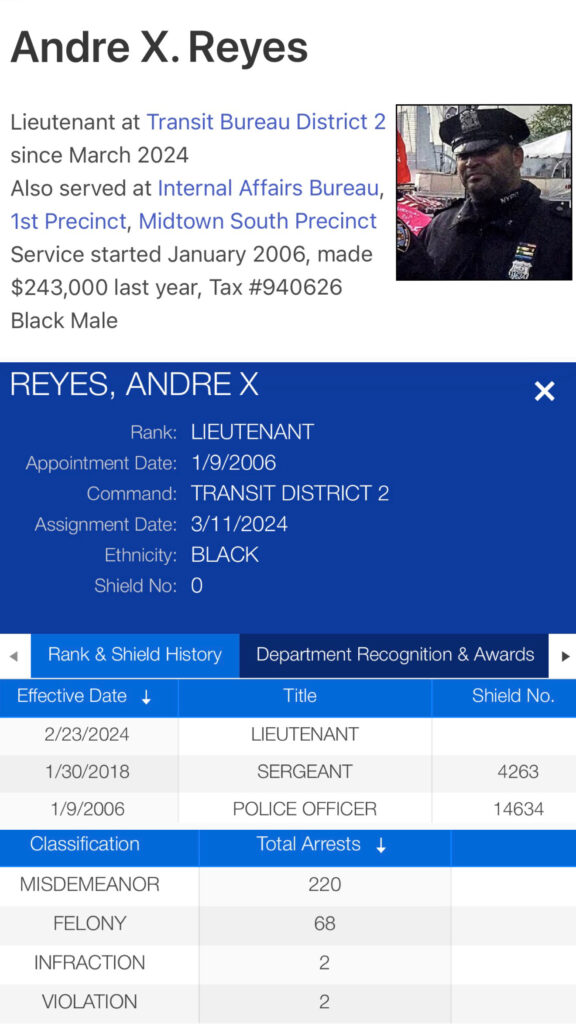
Lieutenants Andre Reyes and Steven Spinelli are also named as defendants.
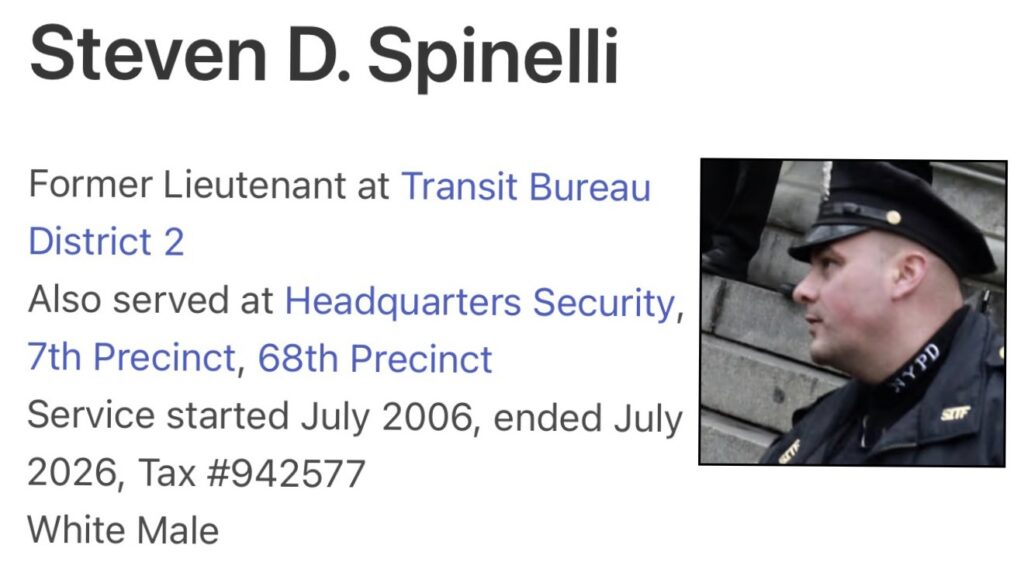
Lamour alleges that supervisory personnel were aware of the alleged harassment but failed to take adequate corrective action or make required reports to the NYPD’s Office of Equal Employment Opportunity.
He further alleges that after he complained to Spinelli about sexually offensive material placed on his desk, he was not provided effective protection.
According to the complaint, Choinski subsequently placed a pride flag and other items near Lamour’s workstation in a manner Lamour interpreted as deliberate provocation, along with an old telephone intended to mock his ability to contact EEO investigators.
The alleged misuse of those objects to intimidate a complainant—not the presence of a pride flag itself—is the basis of this portion of the retaliation claim.
Lamour also alleges that Reyes, who previously served in the Internal Affairs Bureau, invoked his investigative experience during an October 2025 meeting.
The complaint quotes Reyes as threatening to find damaging information about officers and take their jobs.
Lamour claims that what followed was a coordinated effort to undermine his professional standing.
If those allegations are substantiated, the issue would extend beyond inappropriate comments to the alleged weaponization of supervisory authority against an employee who resisted harassment.
RETALIATION: OVERTIME, PROMOTIONS AND CAREERS ALLEGEDLY PUT AT RISK
The retaliation allegations are particularly significant because they concern the financial and professional consequences that can discourage police officers from reporting wrongdoing.
According to Lamour’s complaint, his supervisors allegedly:
- Reduced or denied overtime opportunities.
- Assigned unfavorable schedules and duties.
- Excluded him from communications shared with other officers.
- Issued disproportionately negative performance evaluations.
- Interfered with promotional opportunities.
- Referenced his Haitian accent negatively in a performance assessment.
- Subjected him to increased scrutiny after he objected to harassment.
Lamour says his overtime losses also threatened to affect his eventual pension.
The lawsuit maintains that his record of more than 435 arrests did not translate into advancement, while officers with fewer arrests allegedly received more favorable consideration.
Arrest totals alone do not determine promotions, and the Department may have explanations for particular personnel decisions. Nevertheless, Lamour alleges that the evaluations and assignments were manipulated to punish him for complaining.
On February 19, 2026, he filed a formal discrimination complaint with the NYPD’s Office of Equal Employment Opportunity.
The lawsuit argues that the department failed to provide adequate protection against the harassment and retaliation he reported.
It seeks compensatory damages, lost wages and benefits, damages for emotional distress, punitive damages where legally permissible, and attorney’s fees.
No specific monetary demand is stated.
A SEPARATE DISCIPLINARY RECORD INVOLVING CHOINSKI
Beyond the unproven allegations in Lamour’s complaint, an official Civilian Complaint Review Board report documents a separate disciplinary matter involving Choinski.
The CCRB’s fourth-quarter 2025 Administrative Prosecution Unit report identifies case 202307821, in which Choinski pleaded guilty to an abuse-of-authority charge involving photographing a civilian.
He accepted Command Discipline B and forfeited ten vacation days. The police commissioner approved the plea.
That case concerns a different incident and does not substantiate Lamour’s sexual-harassment accusations.
It does, however, provide a documented disciplinary record relevant to questions about supervisory oversight and the personnel decisions concerning Choinski.
According to Lamour’s complaint, Choinski was promoted to lieutenant on or about December 19, 2025.
The appropriate question is what records, investigations and performance information were reviewed during that promotional process.
TRANSIT DISTRICT 1: MORE ALLEGATIONS, MORE QUESTIONS
The Transit District 2 lawsuit is not the only controversy raising concerns about workplace conduct within the NYPD’s Transit Bureau.
On October 30, 2026, SalGreco.com published NYPD’s Transit Bureau: A Breeding Ground of Toxicity, examining serious allegations involving Transit District 1 and its commanding officer, Captain Larry Meyers.
That investigation described accounts provided by sources alleging preferential assignments involving certain female officers, inappropriate personal attention, questionable overtime decisions and retaliatory treatment of supervisors.
Other allegations concerned irregular disciplinary decisions, disputes involving senior personnel, and questions about how internal complaints were handled.
Those source accounts require independent verification. They are not judicial findings or established evidence that the alleged conduct occurred.
Nevertheless, they raise questions comparable to those in Lamour’s lawsuit: Are assignments and performance evaluations being administered impartially? Are employees who report inappropriate conduct protected? Are internal complaints being independently investigated?
Perhaps the most disturbing connection is another lawsuit involving a former Transit District 1 commanding officer.
THE SANDHU LAWSUIT: ANOTHER TRANSIT COMMAND, ANOTHER SEXUAL HARASSMENT CASE
On October 21, 2026, NYPD Officer Maria Delacruz filed a separate lawsuit accusing former Transit District 1 commanding officer Amanjeet Sandhu and other defendants of sexual harassment, retaliation and related misconduct.
Represented by attorney Eric Sanders, Delacruz alleges that Sandhu initially provided favorable assignments and selected her as his driver before subjecting her to unwanted sexual advances.
Her allegations include inappropriate sexual communications, pressure involving personal interactions and subsequent workplace hostility.
The complaint also names Commissioner Tisch among the defendants.
These allegations remain disputed and must be assessed on their own evidence.
But the reported circumstances present another important oversight question.
When a commanding officer selects a subordinate for a special assignment involving extensive personal access, what safeguards prevent potential abuses of the power imbalance?
And when a subordinate complains, who ensures the investigation is not controlled or influenced by individuals with an interest in the outcome?
The Delacruz case and the Lamour case involve different defendants and alleged events. They do not prove a coordinated pattern of misconduct. They do, however, raise overlapping concerns about workplace boundaries, supervisory power and the treatment of officers who object to harassment.
TRANSIT DISTRICT 11: THE SAME RETALIATION QUESTIONS
SalGreco.com has also reported on allegations involving Transit District 11.
In our June 26, 2026 article, Another Lawsuit, Another Warning Sign: Why the NYPD’s Culture Continues to Face Serious Questions, we examined a lawsuit filed by Officer Donna Castillo-Diaz.
She alleged sexual harassment, discriminatory treatment, hostile working conditions and retaliation after reporting workplace misconduct.
Her lawsuit followed an earlier sexual-harassment case reportedly resolved through a financial settlement.
Once again, the allegations concerned not only the underlying workplace conduct but the treatment of an officer after she complained.
Across Transit Districts 1, 2 and 11, the recurring issue is whether employees can trust the Department to protect them when allegations involve supervisors or command leadership.
These are separate proceedings. Their similarity does not establish the truth of any individual accusation. But it is a legitimate reason to examine whether the NYPD’s complaint-handling systems are effectively identifying and addressing misconduct.
JOHN SCOLA AND ANOTHER SERIES OF NYPD RETALIATION LAWSUITS
Attorney John A. Scola’s involvement in Lamour’s lawsuit also connects this case with other litigation SalGreco.com has previously examined.
In August 2026, Scola filed a federal retaliation lawsuit on behalf of NYPD Lieutenant Karolina Ostrowska-Tuznik involving the Department’s Health & Wellness operation.
That complaint named the City of New York, Commissioner Jessica Tisch and Inspector Mark Wachter, and alleged retaliation after the lieutenant pursued an earlier discrimination lawsuit.
SalGreco.com examined the allegations in NYPD Health & Wellness Back Under Fire as Lieutenant Files Federal Retaliation Lawsuit Against Jessica Tisch and NYC.
More recently, Scola represented Sergeant Lee Helton and former Police Cadet Ali Alsaidi in two separate lawsuits filed in October 2026.
Our November 3 investigation, Two New NYPD Cadet Corps Lawsuits: Alleged Retaliation, Religious Discrimination and the Questions Facing Materasso and Tisch, detailed claims that employees who reported discrimination were punished instead of protected.
One of those plaintiffs, Alsaidi, alleges that retaliation cost him his opportunity to enter the Police Academy.
The cases span different NYPD divisions and different alleged incidents.
Yet the same institutional question repeatedly emerges: What happens to a member of the service after that person reports suspected misconduct?
Does the Department protect the employee’s rights?
Or does the complaint become the beginning of a new struggle involving assignments, evaluations, income and career opportunities?
JESSICA TISCH: REFORM CANNOT BE MEASURED BY PRESS CONFERENCES
Jessica Tisch became NYPD Police Commissioner on November 25, 2024, with a mandate to strengthen the Department and restore public confidence in its leadership.
To be clear, the alleged mistreatment of Lamour began long before Tisch became commissioner. She is not a defendant in his lawsuit, and the complaint does not establish that she personally authorized or knew about the alleged incidents.
However, significant events described in the complaint allegedly continued during 2025, and Lamour filed his formal EEO complaint in February 2026.
The question for Tisch’s leadership is not whether she personally committed the alleged acts.
It is whether the Department’s oversight, complaint-investigation and promotion systems have adequately addressed allegations of this nature during her tenure.
The responsibility for ensuring a safe and professional workplace extends through the chain of command.
That includes the NYPD’s Transit Bureau leadership, whose responsibilities involve overseeing the operation and supervision of Transit commands.
Commissioner Tisch and senior executives should be able to explain whether relevant allegations were investigated, whether appropriate safeguards were implemented and whether substantiated misconduct resulted in meaningful consequences.
THE NYPD’S NEVER-ENDING “CREEPFEST” REQUIRES REAL REFORM
SalGreco.com and The Sal Greco Show have repeatedly used the term “creepfest” in commentary about allegations of inappropriate workplace relationships, sexual misconduct, favoritism and questionable executive behavior within the NYPD.
The phrase is an editorial characterization of the accumulating controversies, not a finding that any particular defendant committed wrongdoing.
The underlying issues, however, are serious.
Sexual harassment is not harmless workplace joking.
Unwanted sexual touching is not acceptable conduct because the person accused wears a police uniform or holds supervisory rank.
Using performance evaluations, overtime assignments or promotional opportunities to punish employees for reporting discrimination would be an abuse of authority.
And an internal reporting system cannot function effectively if employees believe making a complaint will destroy their careers.
The NYPD needs meaningful reform—not simply another statement about professionalism and accountability.
That reform should include genuinely independent reviews of sexual-harassment and retaliation complaints involving supervisors, transparent enforcement of reporting obligations, protection against retaliatory assignment and overtime changes, and closer examination of disciplinary histories before command appointments and promotions.
Allegations involving nonconsensual sexual touching must receive appropriate investigative review and, where the facts warrant it, referral to criminal investigators.
Internal investigators should not be placed in situations where they must investigate allegations involving supervisors who control their employment or assignments.
The Department should also examine whether complaints from different Transit districts reveal systemic weaknesses in oversight, reporting and personnel decisions.
THE FINAL QUESTION: WHO IS HOLDING NYPD LEADERSHIP ACCOUNTABLE?
The majority of NYPD officers go to work to protect the public, support their colleagues and perform their responsibilities with professionalism.
Those officers deserve a workplace where misconduct allegations are investigated fairly and employees are not punished for reporting discrimination or harassment.
The Department also owes fairness and due process to those accused.
But fairness does not require ignoring allegations simply because the individuals involved hold rank.
From the allegations involving Lamour at Transit District 2 to the ongoing controversies surrounding Transit District 1, the lawsuit involving Delacruz, and previous reporting concerning Transit District 11, serious questions remain about the NYPD’s internal workplace culture.
Add the litigation involving the Police Academy, Cadet Corps, Health & Wellness and other commands, and the demand for accountable leadership becomes difficult to dismiss.
None of these allegations should be treated as proven merely because multiple lawsuits have been filed.
At the same time, a department facing repeated and detailed allegations of sexual harassment and retaliation should not wait for every lawsuit to reach a final judgment before examining whether its systems need improvement.
Police Commissioner Jessica Tisch and the NYPD’s executive leadership owe the rank and file—and the people of New York City—a transparent explanation of what is being done to address these recurring complaints.
Police officers are expected to enforce the law.
Their supervisors should be expected to follow it.
And no officer who reports suspected misconduct should have to fear losing a career for doing so.
The NYPD’s credibility depends on demonstrating that those principles apply equally to everyone, from a probationary police officer to the highest-ranking executive.
The time for serious institutional reform is now.
© 2026 SalGreco.com | The Sal Greco Show — Independent Journalism. Your News. Your Voice.