
By Sal Greco | October 30, 2026
How many allegations of retaliation, favoritism, inappropriate personal attention and punishment of officers who speak up must surface before the NYPD treats workplace culture as a serious problem?
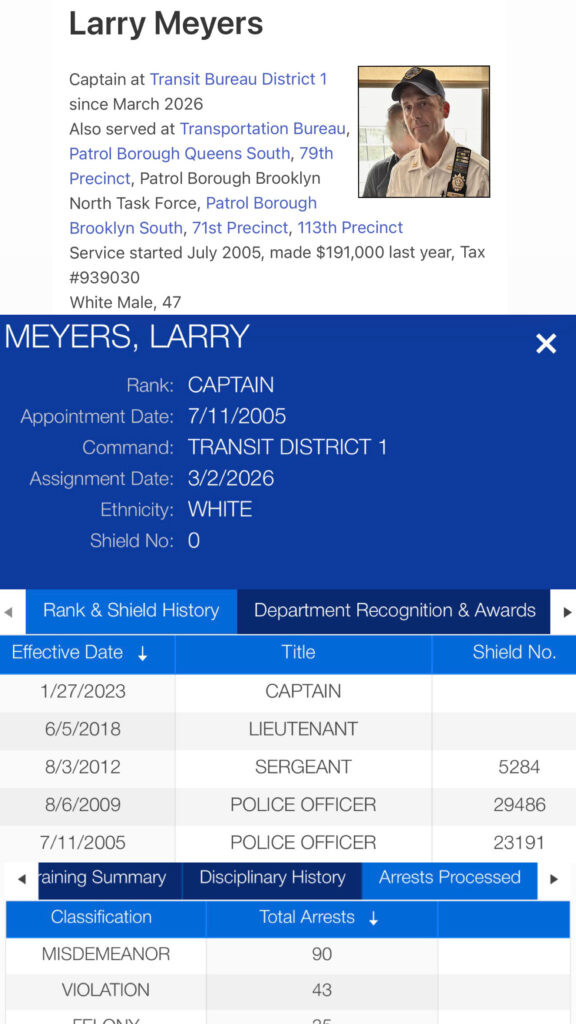
Following recent coverage by The Sal Greco Show, numerous sources have come forward with serious allegations concerning Captain Larry Meyers, the commanding officer of Transit District 1 since March of 2026.
The accounts describe what sources characterize as a toxic working environment in which certain young female officers allegedly receive preferential assignments while veteran supervisors face disciplinary pressure, lost overtime and retaliation.
These latest accusations arrive against a backdrop of documented disciplinary findings involving Meyers, a newly filed sexual-harassment lawsuit involving former Transit District 1 commander Amanjeet Sandhu and a history of litigation involving another Transit commander, Salvatore Marchese.
All of it raises questions about accountability under Police Commissioner Jessica Tisch and NYPD Chief of Transit Joseph Gulotta.
The Sal Greco Show sought comment from NYPD DCPI. As of October 30, 2026, no response has been received.
The absence of a response does not prove the allegations. It does, however, leave serious questions unanswered.
THE SERGEANT, THE “SMOKER” AND SEVEN LOST VACATION DAYS

One of the most unusual allegations concerns NYPD Sergeant Brad Lombardo.
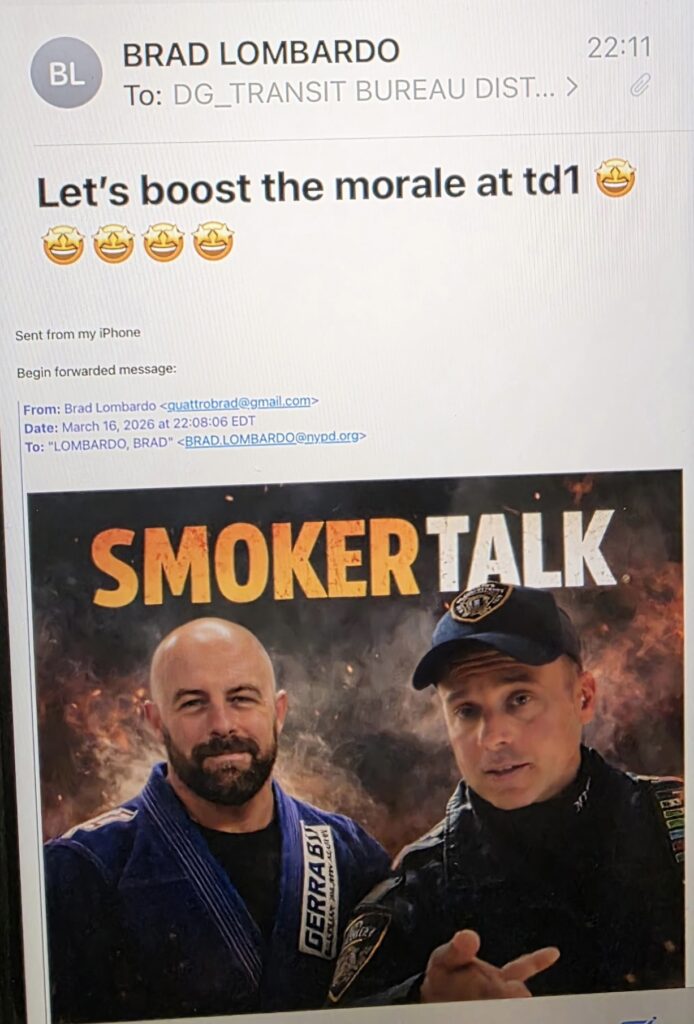
Material obtained by The Sal Greco Show includes a promotional-style graphic titled “Smoker Talk,” depicting Lombardo opposite Captain Meyers in a proposed combat-sports challenge.
Sources familiar with the dispute allege that Lombardo challenged Meyers after tensions developed between the two.
According to those accounts, Meyers subsequently threatened Lombardo with suspension unless the sergeant retired.
Sources further allege that Lombardo, who was already on terminal leave, was required to surrender seven accrued vacation days following the dispute.
The graphic corroborates the existence of material depicting the challenge. It does not independently establish the alleged threat or the circumstances of Lombardo’s retirement.
Nevertheless, the account raises questions about whether departmental disciplinary authority was used in response to a personal disagreement.
Who authorized the seven-day forfeiture? Was suspension threatened? What rule permitted the decision?
And did the challenge have anything to do with the final outcome?
FEMALE OFFICERS ALLEGEDLY RECEIVING EXCLUSIVE ASSIGNMENTS
Multiple sources describe what they believe is preferential treatment toward certain young female officers within Transit District 1.
According to the allegations, Meyers selects particular female officers for specialized assignments, including serving as his personal driver.
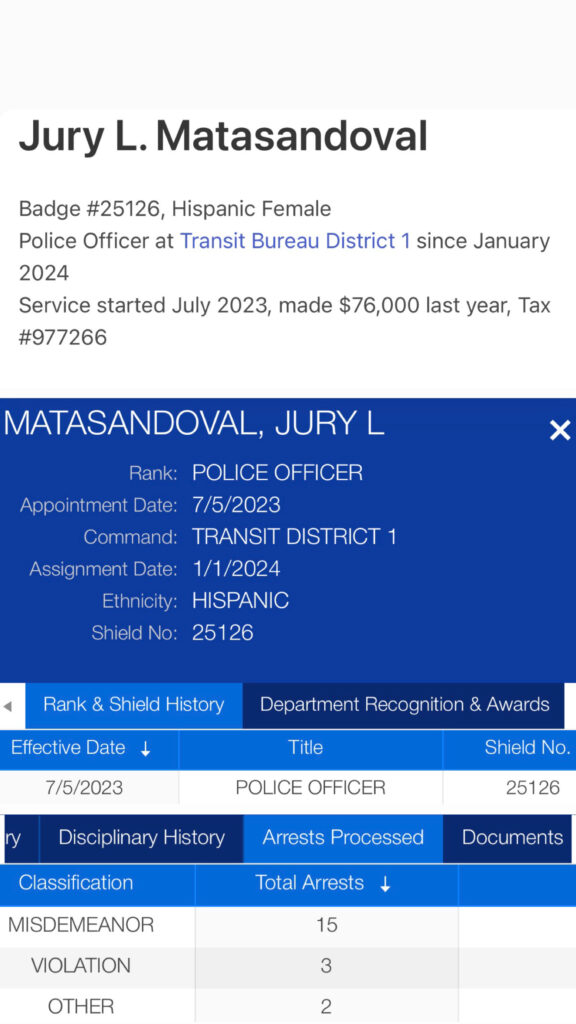
One officer identified by sources is Police Officer Jury L. Matasandoval, whose public-record profile identifies her as assigned to Transit District 1 since January 2024.
Sources allege Matasandoval has served as a designated driver and has been shielded from ordinary patrol assignments and special details.
The allegations include claims that:
- Desk personnel were instructed not to assign the captain’s designated driver to other duties.
- A female officer on the midnight tour reportedly told a supervisor not to assign her to patrol.
- An officer was permitted to study for the sergeant’s examination while on duty.
- A specialized team’s reporting time was changed to accommodate an officer’s commute from Long Island.
- Meyers sometimes personally drove female officers rather than having them drive him.
These accounts concern decisions allegedly made by command leadership. They do not establish that any subordinate officer requested improper treatment or committed wrongdoing.
AFTER-WORK MEALS, TEXT MESSAGES AND ALLEGED PERSONAL ADVANCES
Multiple sources further allege that Meyers takes female officers from Transit District 1’s specialized unit out to eat after their shifts.
The sources also claim that he sends text messages to certain female officers during working hours.
According to these accounts, Meyers allegedly uses some personal interactions to determine whether romantic or other advances might be welcomed.
Other sources describe alleged offers of professional advantages and personal attention toward younger female officers.
Whether any communications were unwanted, whether professional benefits were offered in connection with personal attention, and whether any officer reported the interactions are questions requiring further documentation and official responses.
The allegations raise legitimate concerns about professional boundaries and the relationship between supervisory authority and junior officers.
OVERTIME: SIX HOURS FOR ONE OFFICER, 65 TO 80 FOR OTHERS
Another account concerns overtime assignments during Knicks and FIFA-related details.
Sources allege that one officer received approximately six hours of overtime during the period in question while other officers accumulated between 65 and 80 hours.
Sources further claims that when the officer was assigned a detail, Meyers called the office and directed that the assignment be given to someone else.
The circumstances require review of actual duty rosters and payroll records.
TWO OFFICERS ASLEEP AND A QUESTIONABLE DISCIPLINARY DECISION
Another source claims to have personally discovered two female officers asleep inside a locker room when they were supposed to be conducting a Safe Passage operation.
According to that individual, command-discipline paperwork was prepared.
The account alleges that Meyers subsequently reduced the punishment to a warning and admonishment while considering disciplinary action against a desk sergeant.
A separate allegation claims Meyers sometimes directed favorable or “positive CRAFT” entries after certain female officers committed infractions.
The precise form and circumstances of those reported entries still require clarification.
If comparable misconduct is treated differently depending on the employee involved, the department must explain how its standards are being applied.
A SERGEANT ALLEGEDLY PUNISHED WITH 100 DAYS WITHOUT OVERTIME
Sources also describe allegedly harsh disciplinary treatment of certain supervisors.
One account claims a sergeant received a penalty of approximately 100 days without overtime following an A-level command-discipline matter.
The sergeant was allegedly threatened with demotion if he refused to accept the proposed punishment.
Other accounts describe a training sergeant subjected to repeated pressure and a veteran union delegate with approximately 19 years of service, including 14 years as a sergeant, feeling compelled to leave Transit for their final year.
Sources claim these departures followed sustained conflict with Meyers.
Another allegation concerns a female lieutenant with approximately 14 years of service who reportedly sought family or medical leave to care for a seriously ill parent.
The sources allege Meyers refused the request and that the lieutenant ultimately left the department.
The applicable personnel records and leave procedures are necessary to determine what actually occurred.
CITYTIME OVERTIME ENTRIES ALLEGEDLY REMOVED
Another source alleges that Meyers directed payroll personnel to remove two overtime entries from CityTime for a sergeant nearing retirement.
According to the account, Manhattan Borough had authorized the overtime.
Meyers reportedly objected that he had not personally known about the overtime and directed that the entries be removed.
The original approvals, CityTime audit history and payroll corrections would establish whether the entries were legitimately altered.
PRISONERS ALLEGEDLY HELD IN CELLS INSTEAD OF TRANSPORTED
Sources also allege that prisoners were kept inside Transit District 1 holding cells instead of being transported promptly to central booking.
One account attributes the delays to Meyers’s alleged frustration at remaining on duty while prisoners would be leaving the command.
The source further claims that sergeants who arranged prisoner transportation contrary to the captain’s instructions were punished.
Detention records, transport logs and relevant department policies are essential to evaluating those allegations.
THE CONTROVERSIAL JUVENILE ARREST
A particularly serious allegation concerns an encounter during a Knicks-related police detail.
According to sources, Meyers attempted to stop a teenager suspected of jumping a subway turnstile.
The sources allege that the teenager apologized and subsequently ran, after which Meyers pursued him, fell and injured a finger.
The accounts claim Meyers then directed officers to arrest the teenager on a second-degree assault felony charge.
The sources dispute whether the facts supported such a charge.
One source further alleges that Meyers had expressed frustration over having to work the detail and made a remark indicating that someone else’s night would be ruined.
Additional allegations concern the accuracy of a police incident report.
A source claims that when an officer requested Meyers’s age for a police “61,” the captain directed the officer to enter “June 2020” and said the officer did not need to know his age.
Meyers wore a ballistic helmet during the following detail which you can see in the picture below.
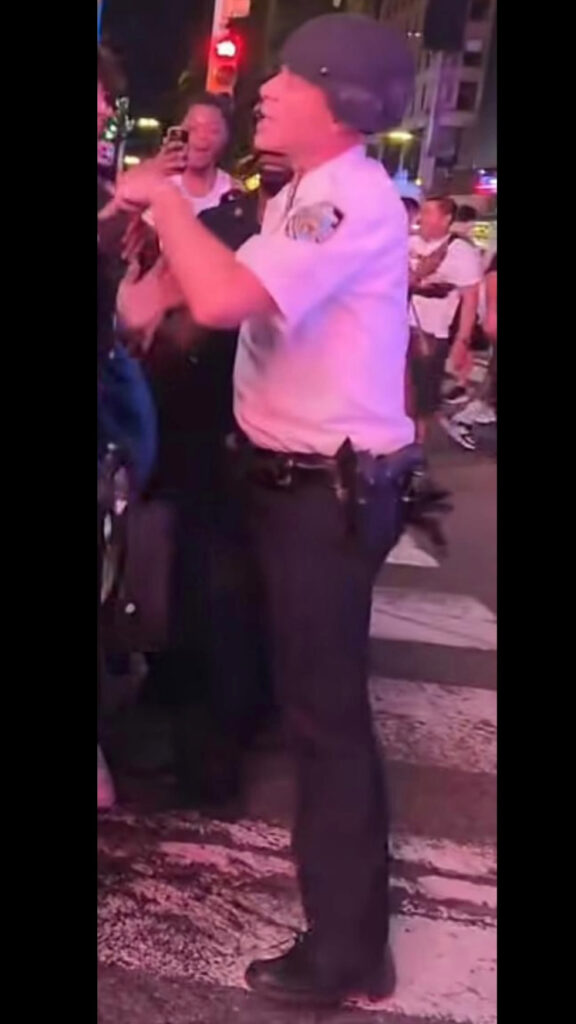
Those details require verification through original reports, body-camera footage and witnesses.
The legality of the teenager’s arrest cannot be determined without the charging documents and court disposition. The teenager is not being identified.
PUBLIC RECORDS: MEYERS HAD A DISCIPLINARY HISTORY BEFORE TRANSIT DISTRICT 1
Meyers’s previous disciplinary history is publicly documented.
According to 50-a.org, his record contains:
- 31 CCRB complaints.
- 62 individual allegations.
- Six substantiated allegations.
The remaining allegations have various dispositions, including unfounded, exonerated and unsubstantiated.
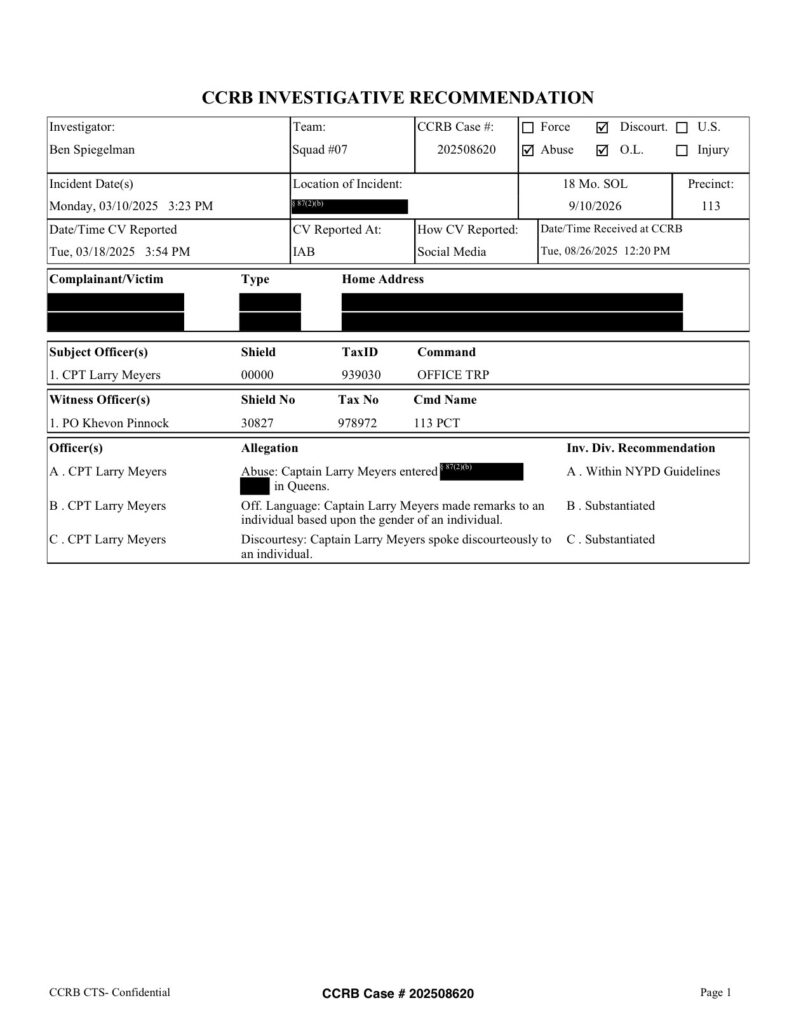
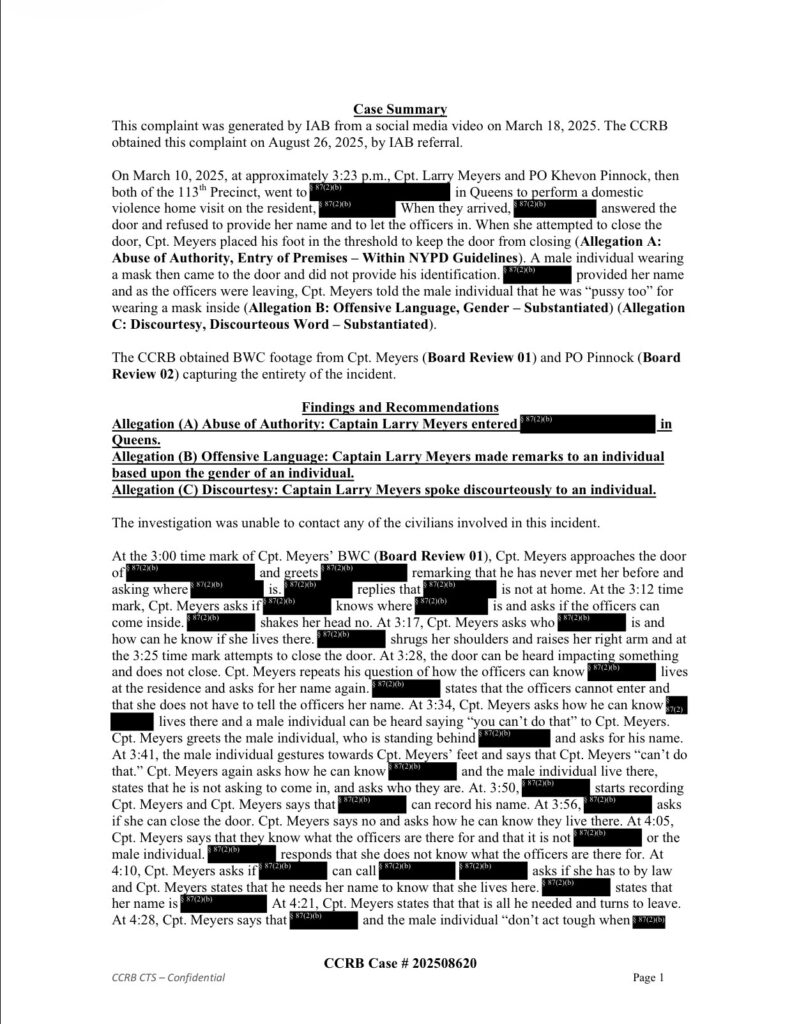
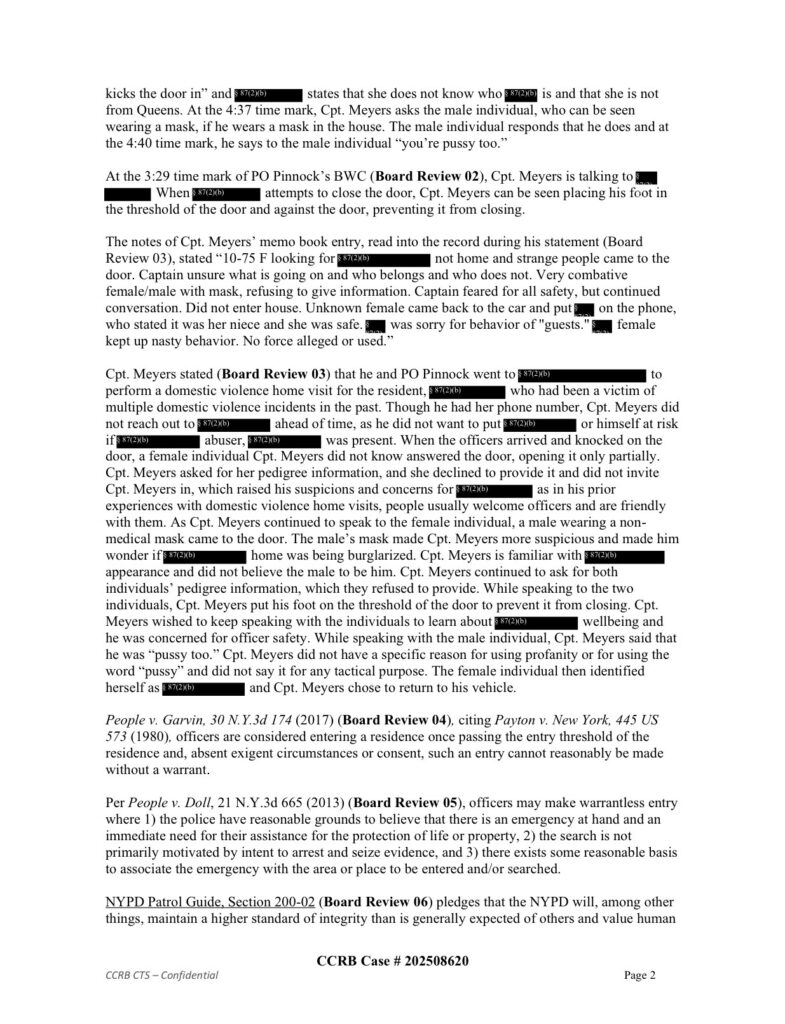
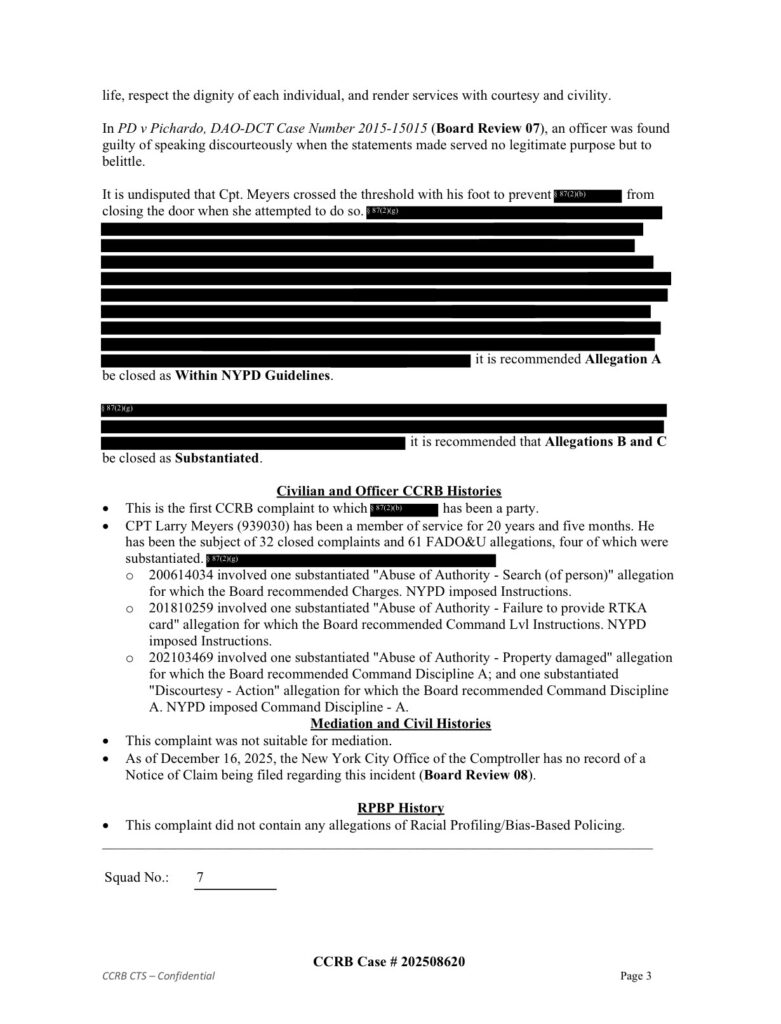
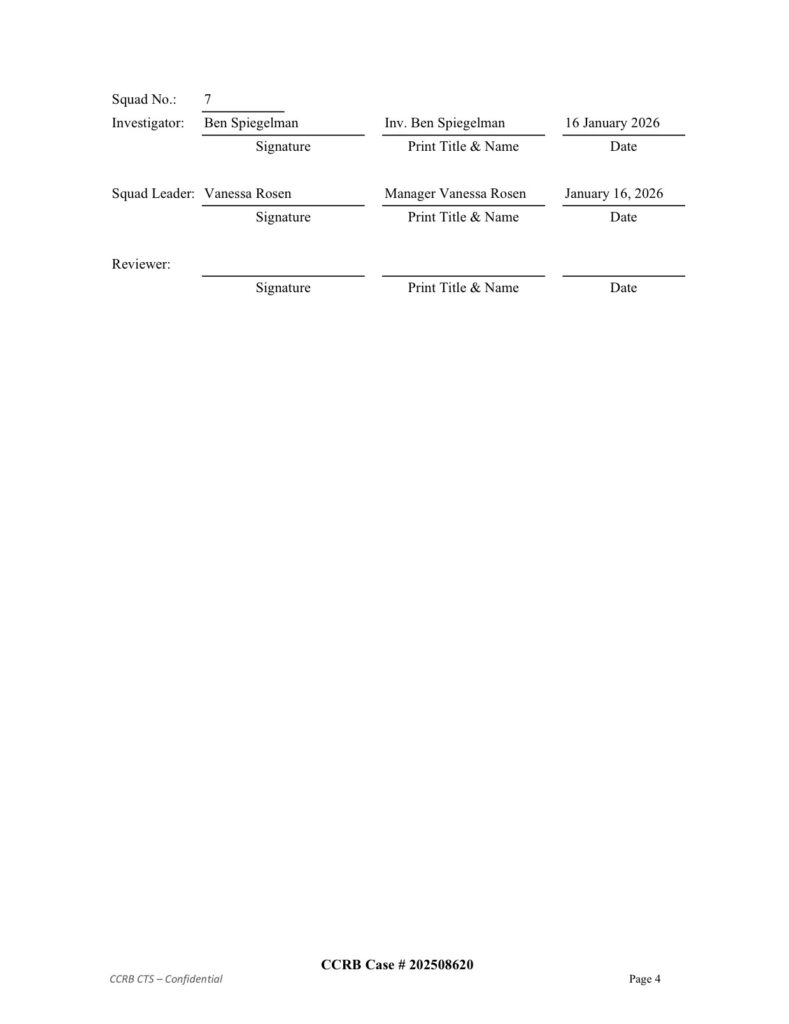
One documented incident is CCRB case 2025-08620.
The official investigation concerned a March 2025 domestic-violence home visit in Queens.
After reviewing body-camera footage, investigators substantiated allegations that Meyers used gender-based offensive language and spoke discourteously to a civilian.
The 50-a database lists a Command Discipline A disposition involving a one-day penalty.
This incident occurred before his reported March 2026 assignment to Transit District 1.
The earlier disciplinary findings do not prove the new allegations, but they raise questions about how prior misconduct findings are weighed when the department selects commanding officers.
APPROXIMATELY 50 IAB LOGS? SOURCES QUESTION INTERNAL ACCOUNTABILITY
Sources allege that numerous complaints concerning Meyers have been submitted to Internal Affairs and equal-employment channels.
One source estimated approximately 50 IAB logs.
Another account alleges that some complaints were reclassified as routine communications and referred back to personnel implicated in the underlying allegations.
Sources further claim that Group One has begun conducting what they describe as “G.O. 15” inquiries concerning Meyers after repeated reports.
The precise number of complaints, their classifications, the unit involved and whether those inquiries are ongoing require official verification.
The critical question is whether any complaint was improperly assigned to the subject of the complaint for resolution.
THE SANDHU LAWSUIT: A TROUBLING PARALLEL
The allegations involving female drivers are especially notable because of a newly filed lawsuit involving former Transit District 1 commander Amanjeet Sandhu.
On October 21, 2026, NYPD Officer Maria Delacruz filed a lawsuit accusing Sandhu and other NYPD personnel of sexual harassment, retaliation and related misconduct.
According to the complaint, Sandhu initially provided Delacruz with favorable assignments and selected her as his driver.
Delacruz alleges Sandhu subsequently made unwanted sexual advances and that she became the subject of workplace rumors and hostility.
These allegations remain subject to litigation.
Nevertheless, the similarity between alleged driver assignments under Sandhu and current claims involving Meyers raises questions about the NYPD’s oversight of such arrangements.
SALVATORE MARCHESE: MULTIPLE LAWSUITS AND QUESTIONS ABOUT PROMOTION
Another senior Transit supervisor whose record deserves scrutiny is Salvatore Marchese.
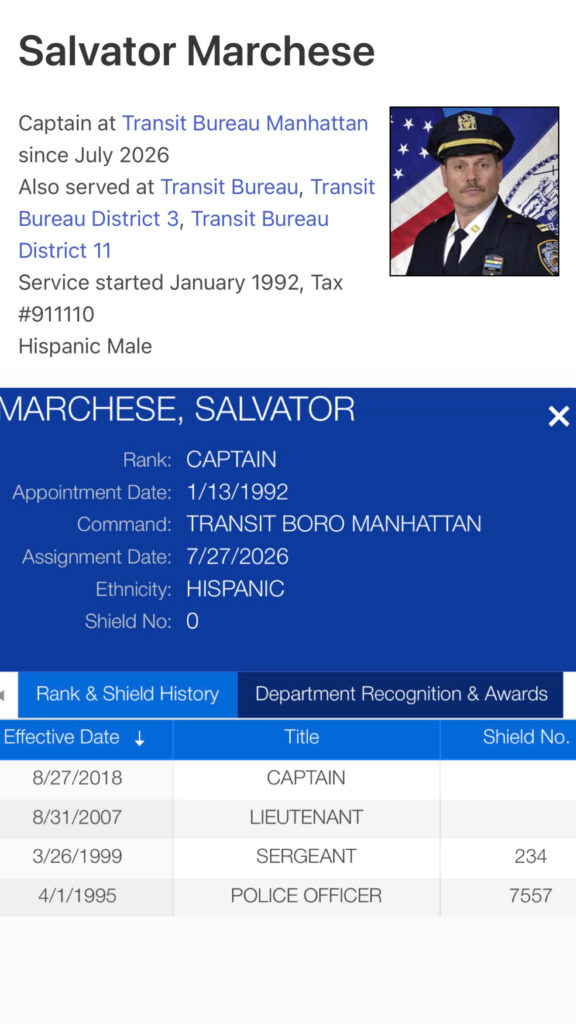
Sources identify Marchese as the executive officer of Transit Borough Manhattan and allege he may be considered for further advancement.
Sources also claim Marchese commanded Transit District 3 in 2023, faced a collective wave of IAB complaints and left after approximately six months before spending an extended period in a headquarters assignment.
The specific personnel chronology and reasons for those moves remain subject to confirmation.
However, the existence of lawsuits naming Marchese is documented.
In a 2013 federal lawsuit, Officer Lisette Pedrosa accused Marchese of sexual harassment and retaliation.
A January 2014 federal court opinion described allegations that an internal NYPD equal-employment investigation had substantiated a harassment complaint against him.
In another matter, former NYPD officer Kervelin Ramirez sued Marchese and the City, alleging sex discrimination, retaliation and hostile working conditions.
In April 2024, a Bronx Supreme Court judge denied a motion to dismiss and permitted Ramirez to amend her complaint.
That decision allowed the litigation to proceed; it was not a determination that the allegations were proven.
NBC News previously reported that Marchese had faced four sexual-harassment or gender-discrimination lawsuits, including an earlier case settled for $100,000 without an admission of wrongdoing.
Marchese has denied wrongdoing.
Salgreco.com’s position is that a supervisor facing such a history of serious workplace litigation should not be considered for further advancement without a transparent accounting of what was investigated, what was established and why the department considers that individual suitable for senior leadership.
JESSICA TISCH AND JOSEPH GULOTTA: WHO IS WATCHING THE TRANSIT BUREAU?
The responsibility for command oversight ultimately extends beyond any individual Transit District captain.
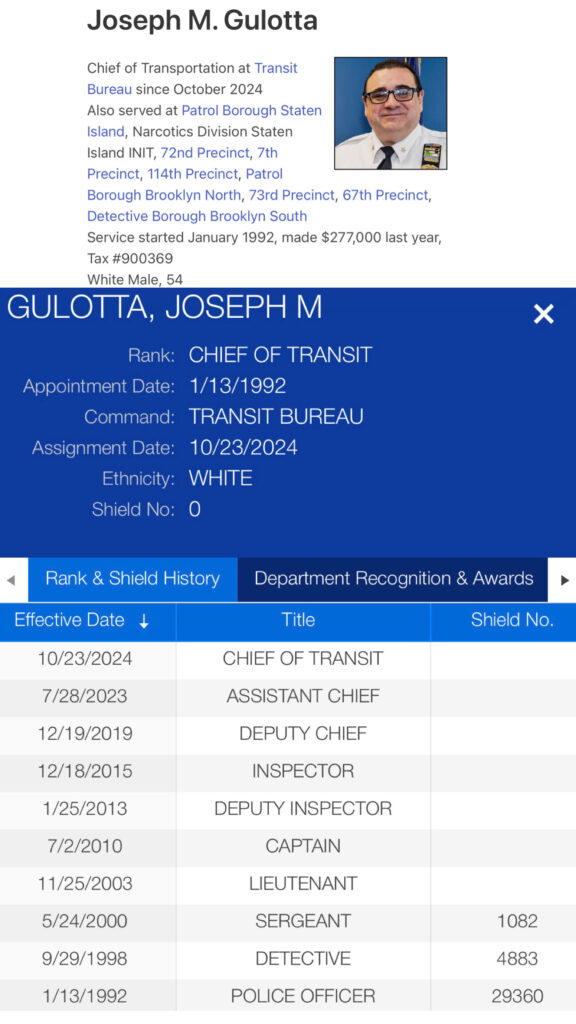
According to the NYPD’s official leadership roster, Jessica Tisch is Police Commissioner and Joseph Gulotta serves as Chief of Transit.
Gulotta’s position raises questions about what senior Transit leadership knew concerning the complaints and allegations at Transit District 1.
When was his office informed?
Were the allegations referred for independent investigation?
What measures were implemented to protect officers who raised concerns?
Sources have also circulated a suggestion that Gulotta could be considered for the position of Chief of Department if Michael LiPetri, who presently holds that office, were to retire.
ADDITIONAL QUESTIONS ABOUT CHIEF GULOTTA’S DRIVER ASSIGNMENT
Sources further allege that Chief Gulotta has a designated female driver, Lieutenant Special Assignment Carolyn A. Nitowitz.
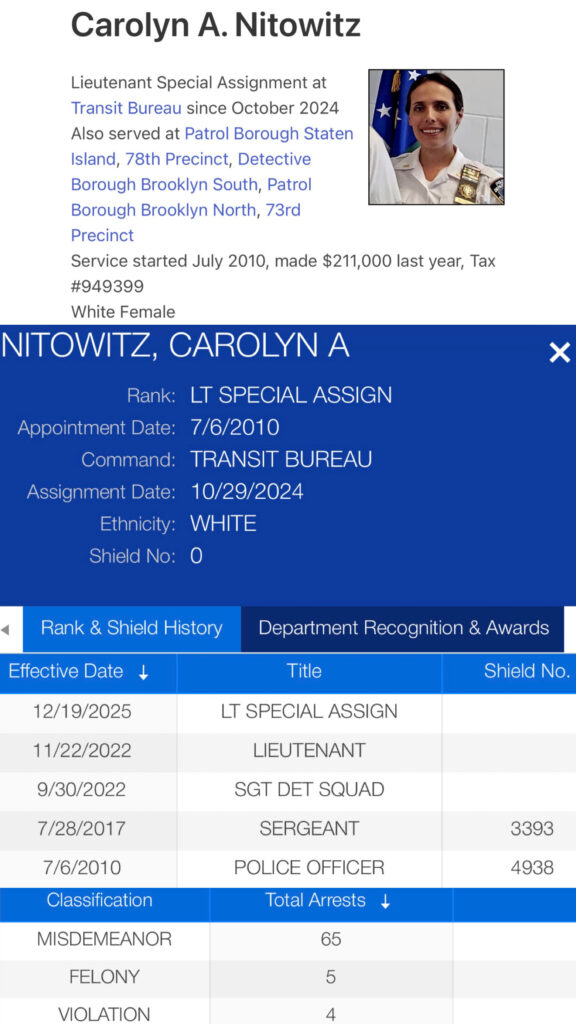
Multiple sources have additionally stated that their relationship extends far beyond their professional duties.
Public reporting shows that Gulotta and Nitowitz previously worked together, including during a charitable initiative supporting an injured NYPD detective.
The relevant accountability questions concern whether a designated driving assignment exists, why it was authorized, whether similar assignments are standard and whether applicable conflict-of-interest rules have been followed.
Both individuals should have the opportunity to respond.
A TOXIC WORK ENVIRONMENT? SALGRECO.COM HAS RAISED THESE QUESTIONS BEFORE
The current controversy does not exist in isolation from the broader reporting conducted by SalGreco.com.
In June, the site published “Another Lawsuit, Another Warning Sign,” examining allegations of workplace harassment and retaliation in Transit District 11.
In August, “How Many Lawsuits Before NYPD Confronts Its Culture?” addressed claims of harassment, retaliatory discipline and institutional failures involving another NYPD employee.
The Sal Greco Show has repeatedly questioned whether a culture of favoritism, internal loyalty and selective discipline makes it difficult for officers to challenge misconduct.
The recurring allegations across different cases do not establish that every claim is true.
They do, however, justify sustained scrutiny of whether members of the service trust the department’s internal accountability systems.
The phrase “toxic work environment” reflects the sources’ characterization of the conditions they describe, not a judicial finding concerning Transit District 1.
THE TISCH QUESTION: WHO ACCEPTS RESPONSIBILITY?
Commissioner Tisch has emphasized accountability and reform during her tenure.
But a department’s commitment to accountability cannot be measured only by its public statements.
It must also be measured by how complaints involving senior personnel are handled.
If the newest allegations are substantiated, they would represent a serious failure of professional standards and a disgrace to the badge.
No commanding officer should be permitted to use rank to pursue unwanted personal relationships, distribute favorable assignments for improper reasons, retaliate against supervisors or manipulate disciplinary processes.
Likewise, no female officer should be subjected to damaging speculation about a personal relationship merely because she works closely with a senior commander.
Both concerns matter.
A healthy workplace requires fair assignments, impartial investigations and meaningful protection against retaliation.
DCPI’S SILENCE LEAVES THE QUESTIONS UNANSWERED
The Sal Greco Show sought the NYPD’s response to the allegations involving Meyers.
According to Sal Greco, DCPI has not responded as of October 30, 2026.
No response should ever be confused with an admission.
But the department possesses the records necessary to clarify many of these issues.
Duty rosters.
Payroll records.
Disciplinary dispositions.
Internal complaint classifications.
Booking and transportation logs.
Arrest paperwork.
These records can help determine whether the allegations are supported, contradicted or explained by additional facts.
The public deserves more than speculation.
And the dedicated officers serving within the NYPD deserve confidence that they will be treated fairly, regardless of their rank or relationship with command leadership.
The hardest questions remain unanswered. How does Captain Larry Meyers, with a documented history of complaints and mounting allegations of favoritism, inappropriate conduct involving female officers, and intimidation of subordinates, remain commanding officer of Transit District 1? How could Meyers or Salvatore Marchese even be considered for promotion while the NYPD faces growing lawsuits and allegations of a toxic, frat-house culture?
Under Commissioner Jessica Tisch’s leadership, where is the accountability for women who report harassment, mistreatment, and abuse of authority? And what about Transit Chief Joseph Gulotta, a rumored candidate for Chief of Department, who now faces unverified allegations from sources concerning a possible personal relationship with a lieutenant reportedly assigned as his driver? Has the NYPD examined this serious allegation of fraternizing?
The allegations are disturbing, the silence from NYPD DCPI is deafening, and the apparent double standard is impossible to ignore. Commissioner Tisch owes the public—and especially the NYPD’s rank and file—an explanation. One standard of accountability must apply to everyone—from the newest police officer to the highest-ranking executive.
© 2026 SalGreco.com | The Sal Greco Show — Independent Journalism. Your News. Your Voice.