BY SAL GRECO
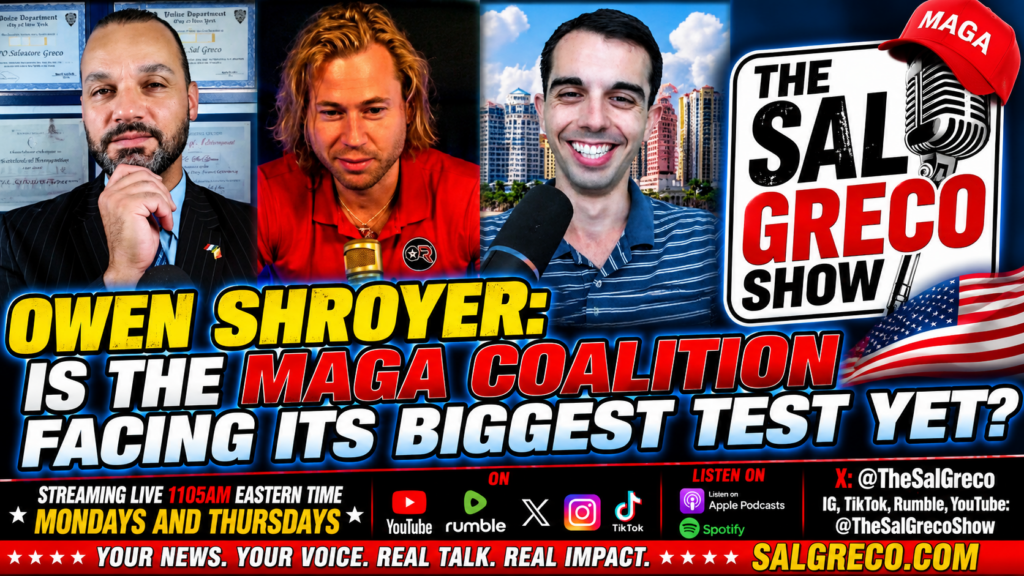
During Episode 214 of The Sal Greco Show, Owen Shroyer joined Sal Greco and Jack Stern for an in-depth discussion that moved beyond personalities and instead focused on what he believes is a defining moment for the future of the America First movement.
Rather than debating individual influencers, the conversation centered on accountability, campaign promises, public trust, and whether voters are beginning to demand measurable results instead of political branding.
“This Was Never Supposed To Be About Blind Loyalty”
Early in the interview, Shroyer argued that the original MAGA movement grew because millions of Americans believed Washington’s political establishment had failed them.
According to Shroyer, the movement’s foundation was never about unquestioning loyalty to any politician—it was about expecting elected officials to produce results.
Sal Greco: “We gave a lot. You literally went to jail. I lost everything—including family members—because of all this. Now we’re sitting here asking, ‘What happened?’ It feels like the movement we helped build has been completely co-opted.”
Owen Shroyer: “That’s exactly the frustration. The movement was built to challenge the establishment. Now many people seem satisfied simply defending politicians instead of demanding results. That’s the opposite of why this movement existed.”
Shroyer described what he calls a “new generational right”—voters who expect campaign promises to become policy instead of remaining campaign slogans.
Jack Stern: “People Want Results”
Jack Stern argued that many younger Americans are becoming increasingly frustrated with rising costs, foreign policy concerns and what they perceive as unmet expectations.
Jack Stern: “The people under forty are looking around and asking where the results are. They’re paying more to live, they’re watching what’s happening overseas, and they don’t want to hear talking points anymore.”
Owen Shroyer: “Exactly. Elections matter, but winning elections isn’t the finish line. The finish line is delivering on what people voted for.”
Throughout the interview, Shroyer repeatedly emphasized that political movements survive only when supporters continue holding their own leaders accountable after Election Day.
Polling Suggests Republicans Face a Difficult Midterm Environment
While Shroyer’s comments reflect his own political analysis, recent national polling suggests Republicans could face a challenging political environment heading into the November midterm elections.
Several national polling averages currently place President Donald Trump’s job approval underwater nationally, although individual surveys vary considerably.
Recent polling averages generally place Trump’s approval between 39% and 43%, with disapproval ranging from the mid-50s to upper-50s.
Political analysts often view presidential approval as one indicator—though not the only one—of the electoral environment heading into midterm elections.
Congress Could Be Competitive
National generic congressional ballot polling currently shows Democrats holding an advantage of roughly 4 to 6 percentage points nationally.
Historically, the generic ballot is one of the strongest indicators of House performance, although district-by-district dynamics can produce different outcomes than the national vote.
Decision Desk HQ’s current forecast estimates:
- Democrats have roughly a 62% chance of winning control of the U.S. House.
- Republicans retain approximately a 57% chance of holding the U.S. Senate.
The Senate map remains more favorable to Republicans because fewer Republican-held seats are considered competitive than House districts.
Accountability Versus Tribalism
One of the strongest moments of the interview came when the discussion turned toward political tribalism.
Jack Stern: “The problem today is we’ve become too tribal. If you question anything, people act like you’ve left the movement.”
Owen Shroyer: “That’s not how movements survive. If you stop expecting results, then politics becomes nothing more than cheering for your team.”
Shroyer argued that supporters should evaluate politicians using the same standards regardless of party affiliation.
Looking Toward November
Whether voters ultimately agree with Owen Shroyer’s analysis remains to be seen.
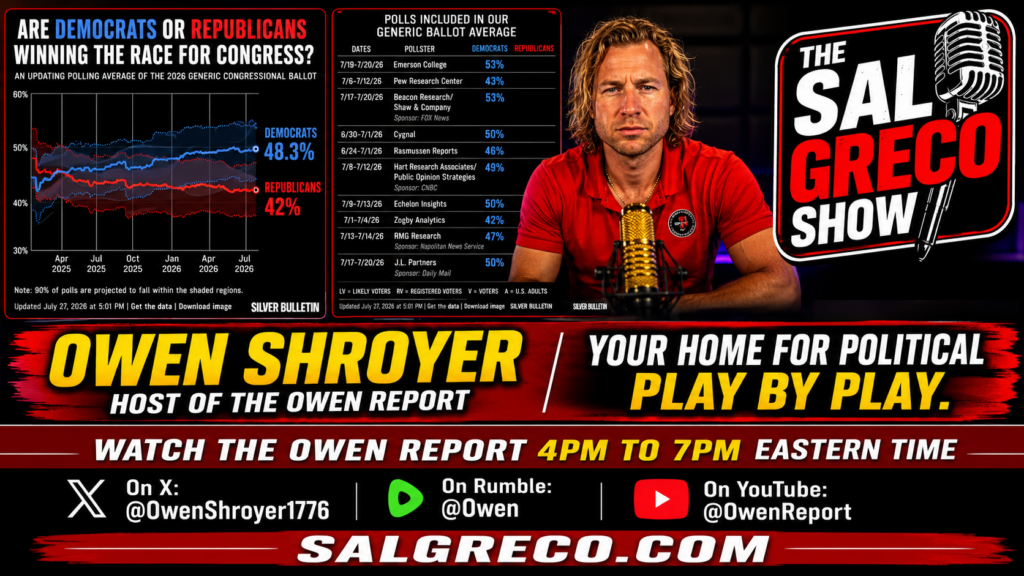
However, current polling suggests Republicans enter the 2026 midterms facing political headwinds. President Trump’s approval ratings remain below 50 percent nationally, Democrats currently lead on the generic congressional ballot, and several independent forecasting models project a competitive battle for control of Congress this November.
For Shroyer, the central question isn’t simply whether Republicans win elections.
It is whether political leaders—regardless of party—deliver the results they promised the voters who put them into office.