
BY SAL GRECO
The conviction of NYPD Police Officer Omar Habib has already become a landmark case in New York City. On August 13, a Bronx jury convicted Habib of second-degree strangulation, third-degree assault and unlawful methods of restraint, making him the first NYPD officer prosecuted and convicted under New York City’s post-George Floyd chokehold law.
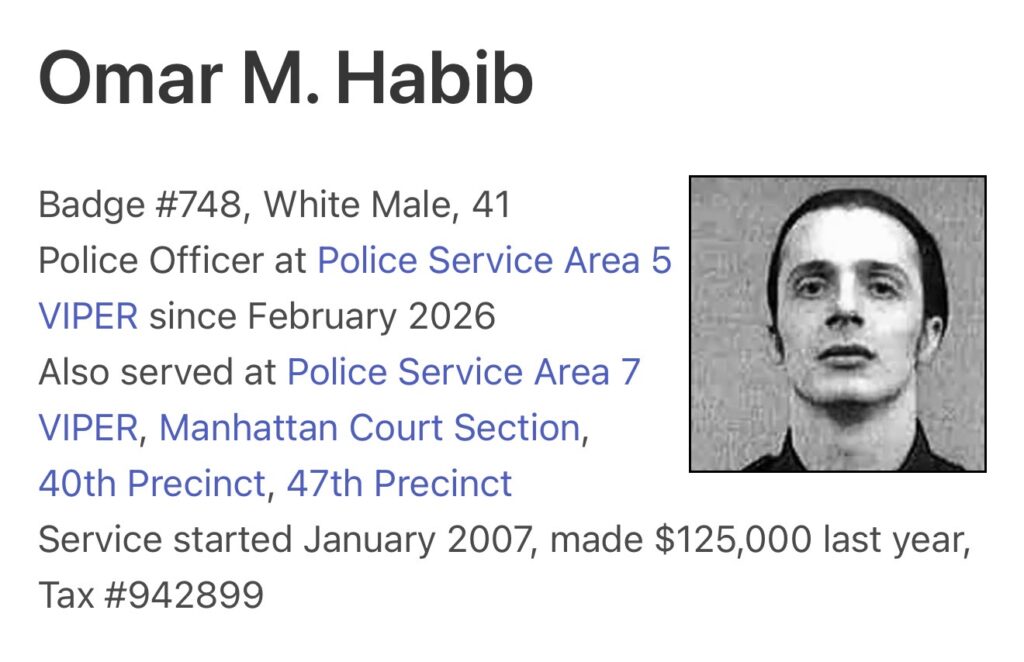
But now there are serious questions surrounding one of the prosecution witnesses who helped establish what Habib had supposedly been taught by the NYPD—and whether potentially significant information concerning that witness was ever placed in the hands of Habib’s defense.
That witness was NYPD Lieutenant Morgan F. Courgnaud.
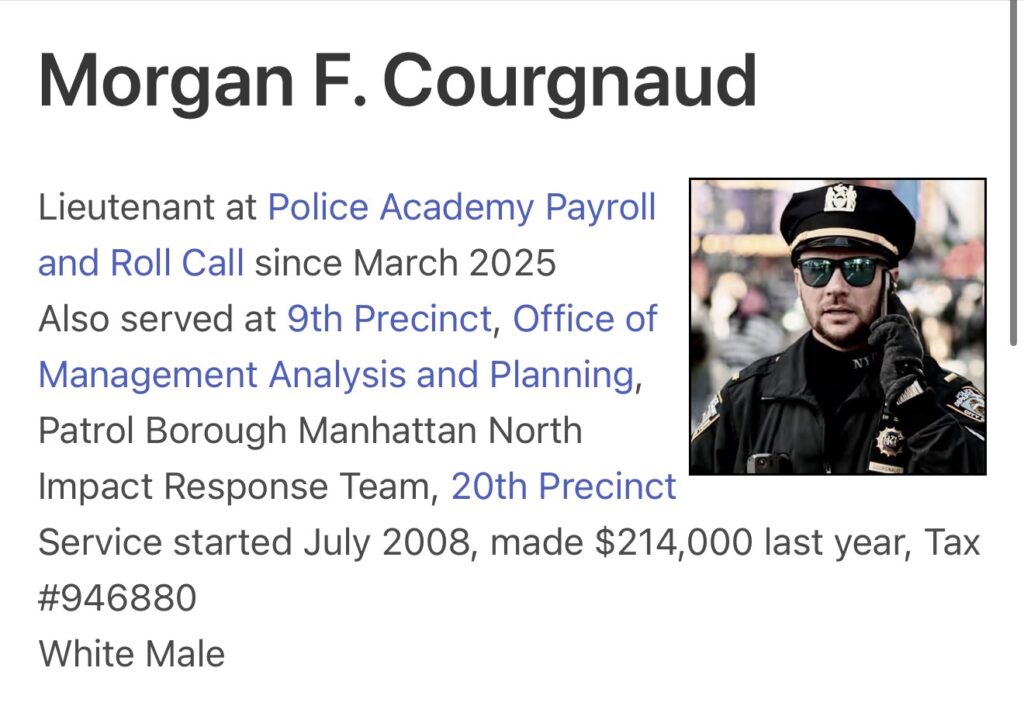
According to Gothamist’s reporting from the trial, Courgnaud testified as a supervisor assigned to the NYPD Police Academy. He explained the training Habib should have received and NYPD policies explicitly prohibiting chokeholds. Courgnaud also testified concerning an instructional video that NYPD records indicated Habib watched approximately a year before the July 2023 incident.
That makes Courgnaud’s role significant. The prosecution wasn’t calling a random NYPD witness. It presented a Police Academy supervisor to educate jurors about NYPD training and what Habib was supposed to know.
But there is considerably more to Courgnaud’s NYPD history than jurors may have known.
A Prior NYPD Disciplinary Case
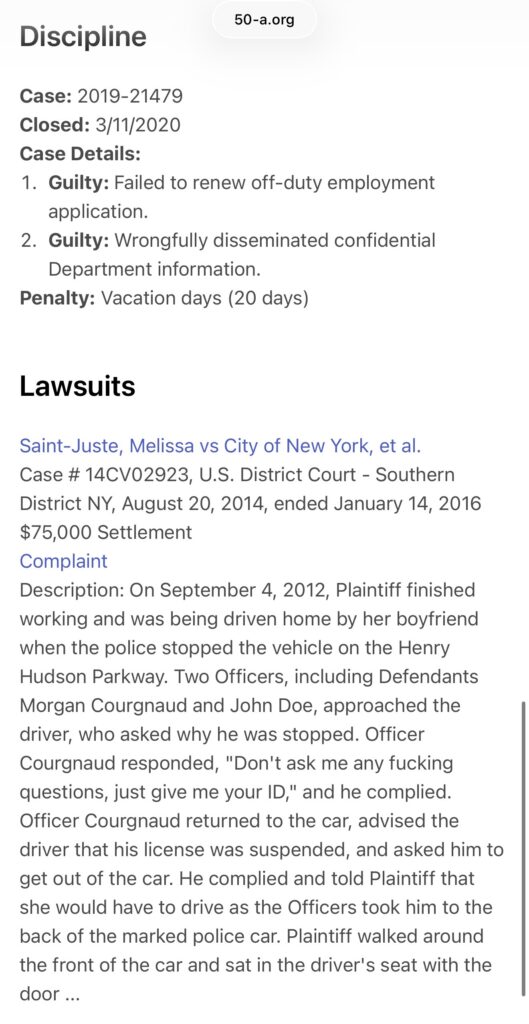
Publicly available disciplinary information from 50-a.org lists NYPD disciplinary Case No. 2019-21479 involving Courgnaud. According to that record, the case closed on March 11, 2020, and Courgnaud was found guilty of two departmental charges.
One was failing to renew an off-duty employment application.
The other is far more relevant to questions concerning credibility: wrongfully disseminating Department information.
The listed penalty was the loss of 20 vacation days.
That history raises an obvious question: What exactly was disclosed to Habib’s attorneys about the prosecution’s Police Academy witness before Courgnaud took the stand?
New York’s discovery law, CPL Article 245, imposes broad obligations on prosecutors concerning information that could impeach the credibility of prosecution witnesses. Whether Courgnaud’s disciplinary case—or the underlying records associated with it—was required to be disclosed and whether it actually was disclosed are questions that Habib’s attorneys should examine immediately.
The answer could matter considerably.
The Hairbag Times Question
There is another potentially important component that requires further documentary confirmation.
Information provided to The Sal Greco Show alleges that Courgnaud operated The Hairbag Times, an NYPD-oriented website, under a pseudonym and that the Department spent considerable effort attempting to identify the person behind it.
The website itself remains online.
However, the publicly available Hairbag Times article alone does not establish that Courgnaud operated the site. That connection needs to be established through primary documentation—such as NYPD charges and specifications, Internal Affairs records, disciplinary documents, admissions or other records.
That distinction matters.
If Courgnaud’s departmental guilty finding for wrongfully disseminating confidential NYPD information can be directly connected through official records to publishing Department material anonymously through The Hairbag Times, Habib’s defense would have an additional reason to investigate whether the prosecution possessed information that could have been useful in evaluating or challenging Courgnaud’s credibility.
The question isn’t simply whether someone once used an alias.
The real question is whether the Bronx District Attorney possessed—or was legally deemed to possess—information concerning a prosecution witness’s prior misconduct that should have been disclosed to the defense under New York discovery law.
Another Lawsuit Places Courgnaud in the Spotlight
Courgnaud also appears in a separate 2025 lawsuit involving NYPD First Deputy Commissioner Tania Kinsella.
In a verified complaint filed by Lieutenant Jermaine Oden against the City of New York, Kinsella and others, Courgnaud is specifically identified as a white male, junior lieutenant, 9th Precinct union delegate and administrative lieutenant. The lawsuit identifies Oden and Courgnaud among lieutenants the complaint describes as similarly situated for purposes of Oden’s discrimination allegations.
Courgnaud appears elsewhere in the factual allegations as well.
The complaint alleges that Oden had been recommended for promotion to Lieutenant Special Assignment for several years before then-Commanding Officer Pamela Jeronimo took command. It further alleges that Jeronimo informed Courgnaud that Oden would no longer be recommended for that promotion and would be removed from the promotional list.
Those remain allegations in a pending civil lawsuit—not findings of wrongdoing by Courgnaud. But they provide additional public documentation concerning his NYPD career and his role within the 9th Precinct.
The PBA Has Questions to Answer Too
There is another part of this story that cannot be ignored: the Police Benevolent Association.
PBA President Patrick Hendry publicly criticized the Habib verdict and said the union would support Habib during his appeal.
In my opinion, that’s too little and too late.
From where I sit, the PBA fed Omar Habib into the meat grinder.
If the union truly believes Habib was unfairly prosecuted, where was the aggressive examination of every NYPD witness the prosecution intended to put in front of that jury?
Where were the questions concerning Courgnaud’s disciplinary history?
Was the union aware that the Police Academy lieutenant being used by prosecutors had himself previously been found guilty in an NYPD disciplinary proceeding of wrongfully disseminating confidential Department information?
Was Habib’s defense aware?
Was the underlying disciplinary file turned over?
Was anything concerning The Hairbag Times provided to the defense?
And if not, why not?
Those are questions—not accusations of a proven discovery violation. We do not presently possess Habib’s complete discovery file, so nobody can responsibly state that the Bronx District Attorney withheld these materials without first determining exactly what the prosecution produced.
But that’s precisely why someone should be asking.
Can Courgnaud’s Testimony Be Considered Credible?
I have a serious problem with presenting a Police Academy lieutenant to a jury as an authoritative voice on NYPD rules, training and professional standards without examining the witness’s own documented disciplinary history.
In my opinion, Courgnaud’s history provides legitimate material with which a defense attorney could attempt to challenge his credibility and the weight jurors should give his testimony.
That does not mean a prior disciplinary case automatically makes everything Courgnaud said false. Nor does it mean his testimony was legally inadmissible.
But a witness’s credibility isn’t determined solely by the title attached to his name.
If a prosecution witness previously admitted departmental misconduct involving the wrongful dissemination of confidential NYPD information, Habib’s lawyers should at minimum determine whether that information was discoverable, disclosed and available for potential use during cross-examination.
A jury should decide credibility after the adversarial process works as intended—not after one side unknowingly enters the courtroom missing potentially useful information.
Courgnaud’s Testimony Wasn’t Meaningless
The prosecution can make a strong counterargument.
Courgnaud wasn’t the only witness addressing NYPD’s chokehold prohibition. Gothamist reported that officers who were present during the arrest also testified that they knew chokeholds violated NYPD policy. The prosecution additionally introduced body-camera evidence and medical testimony concerning the restraint.
Therefore, even if Habib establishes that information concerning Courgnaud should have been disclosed, prosecutors could argue that his testimony was cumulative and that any nondisclosure would not have changed the verdict.
But that’s an argument for a court to evaluate after the facts are established.
It isn’t a reason to ignore the issue.
Courgnaud told jurors about Habib’s training, NYPD policy and an instructional video records indicated Habib had watched. The prosecution plainly considered his testimony useful enough to put him on the witness stand.
The defense therefore has every reason to determine whether it received everything it was legally entitled to receive concerning that witness.
Habib’s Lawyers Should Investigate This Now
Habib’s attorneys should obtain and compare several things immediately:
- Courgnaud’s complete NYPD disciplinary file concerning Case 2019-21479, including the charges and specifications, investigative records and disposition.
- Any NYPD Internal Affairs investigation associated with the dissemination of confidential Department information.
- Evidence establishing—or disproving—the alleged connection between Courgnaud and The Hairbag Times.
- Every discovery disclosure and Certificate of Compliance provided by the Bronx District Attorney concerning Courgnaud.
- Courgnaud’s complete trial testimony.
- The prosecution’s summation to determine how heavily the People relied upon Courgnaud’s testimony when arguing Habib’s knowledge and training to the jury.
Only after those records are compared can Habib’s attorneys determine whether they have a viable CPL Article 245 discovery issue and whether it could support post-verdict relief, a new trial or an appellate argument.
The standard shouldn’t change because the defendant wears an NYPD shield.
And neither should the standard change because the prosecution witness wears lieutenant bars.
If prosecutors put a police officer on trial and examine his history, training and conduct, then the credibility and discoverable history of the police witnesses used against him deserve the same scrutiny.
The PBA says it will stand behind Omar Habib on appeal.
In my opinion, the better question is:
Where was this level of scrutiny before the jury returned its verdict?