
BY SAL GRECO
The questions surrounding the July 4 collision involving a cyclist and a vehicle allegedly assigned to the NYPD Police Commissioner’s security detail continue to grow, particularly after the NYPD publicly acknowledged that an official investigation is underway.
Long before other outlets began reporting on the incident, The Sal Greco Show discussed the allegations and revisited them during Monday’s live broadcast, raising questions about transparency, accountability, and whether the same standards applied to ordinary New Yorkers are being applied to those within the NYPD’s highest ranks.
Since then, additional reporting from multiple media outlets has confirmed that an investigation exists, but many of the most important questions remain unanswered.
What Has Been Confirmed
The NYPD’s Deputy Commissioner of Public Information (DCPI) has acknowledged that the incident is under official investigation.
According to public statements reported by media outlets, investigators determined the vehicle involved did not sustain any visible damage.
That fact, however, is being viewed by some observers as addressing only one portion of the incident.
The absence of vehicle damage does not, by itself, establish that the vehicle was not involved in causing the collision, nor does it resolve questions surrounding the driver’s actions after the incident.
Those are separate factual issues that investigators must determine.
Failure to Remain at the Scene?
Attorney Eric Sanders publicly argued on X that, if the allegations prove true, the conduct could implicate both NYPD Patrol Guide requirements and provisions of the New York City Administrative Code concerning leaving the scene and rendering aid following a collision involving an injured person.
Whether those violations actually occurred remains a matter for investigators and, if appropriate, prosecutors or administrative authorities to determine.
Who Was Driving?
Perhaps the most significant unanswered question remains the simplest:
Who was operating the vehicle?
To date, the NYPD has not publicly identified the driver.
If the vehicle is assigned to the Police Commissioner’s executive security detail, identifying the operator would appear to be a straightforward factual determination through assignment records, radio runs, GPS data, vehicle logs, body-worn camera evidence, AVL data, and departmental documentation.
The public has not yet been provided those answers.
Was the Police Commissioner Present?
Additional questions naturally follow:
- Was Police Commissioner Jessica Tisch inside the vehicle?
- If not, was she aware of the incident when it occurred?
- When was she first notified?
- Did anyone from her office participate in decisions regarding public messaging?
- Were any executive staff involved in handling the aftermath?
None of these questions necessarily imply wrongdoing by the Commissioner herself, but given the prominence of the office and the public interest, they are reasonable questions that remain unanswered publicly.
The Summonses Raise Additional Questions
Images circulating publicly appear to show parking summonses issued to the same Chevrolet Suburban bearing New York plate KYS7065, including:
- A March 4, 2025 summons for parking in a Safety Zone.
- A later parking violation in September 2025.
The photographs also indicate outstanding liabilities associated with the vehicle at the time the screenshots were taken.
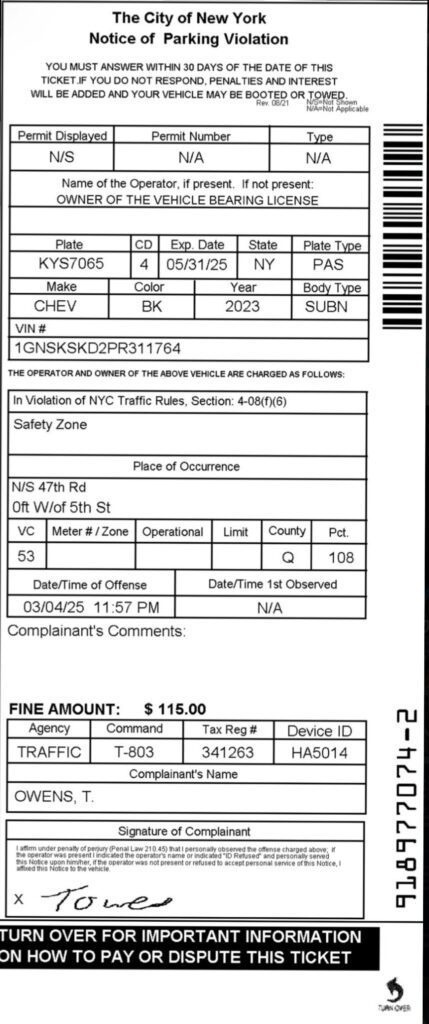
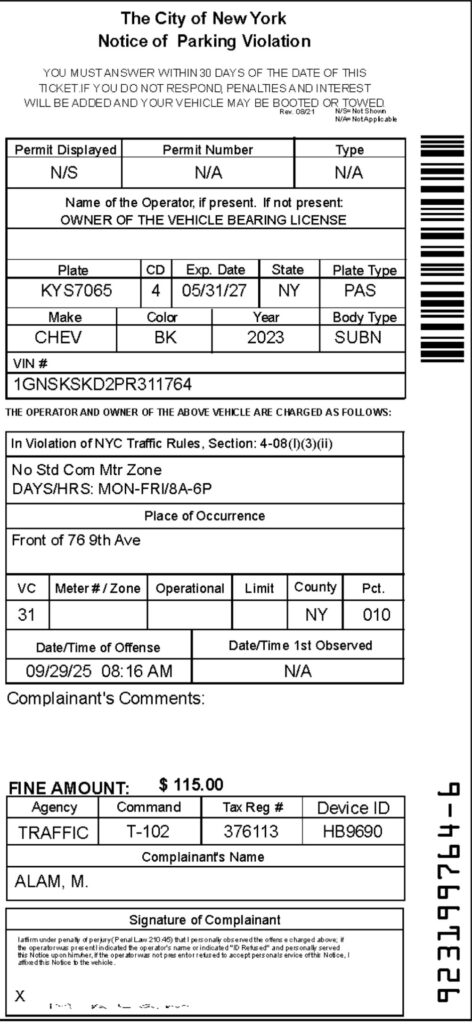
Standing alone, parking summonses do not establish misconduct related to the cyclist incident.
However, critics argue they contribute to broader questions about oversight of vehicles assigned to executive details and whether department policies are consistently enforced regardless of rank or assignment.
Public Confidence Depends on Transparency
Perhaps the largest issue extends beyond the collision itself.
Can the NYPD’s public statements be accepted without independent verification?
Over the past two years, critics—including The Sal Greco Show—have repeatedly questioned DCPI’s handling of information involving Police Commissioner Jessica Tisch’s administration, arguing that public messaging has at times emphasized favorable narratives while minimizing or delaying disclosure of potentially damaging information.
DCPI would likely reject that characterization.
Nevertheless, because public confidence is central to policing, transparency is critical.
The department possesses numerous investigative tools that should allow it to reconstruct exactly what occurred, including:
- Vehicle GPS data
- Department vehicle assignment records
- Radio transmissions
- Surveillance video
- Body-worn camera footage, if applicable
- Witness statements
- Collision Investigation Squad findings
If those materials exist, many believe the public deserves a clear accounting of what happened.
The Questions Continue
Until investigators complete their work and the NYPD releases additional information, several important questions remain:
- Who was driving the vehicle?
- Was the driver directed to leave the scene?
- Did the driver know a cyclist had been injured?
- Was aid rendered immediately?
- Was the Police Commissioner present or informed?
- Why has the driver’s identity not been disclosed?
- Will all investigative findings be made public?
- Will department policies be applied equally regardless of rank?
For now, the investigation continues.
As The Sal Greco Show first highlighted before wider media coverage and discussed again during Monday’s broadcast, this story is no longer simply about a traffic incident. It has become a test of transparency, accountability, and whether the NYPD will provide the public with complete answers regarding an incident involving a vehicle reportedly connected to its highest levels of leadership.
Editor’s Note: The article above distinguishes between confirmed facts (including the existence of an NYPD investigation and public reporting regarding the incident) and unresolved questions or allegations. No conclusion should be drawn regarding criminal or administrative liability unless and until the investigation establishes the relevant facts.