
Austin court records detail indecent-assault allegations against Detective Joseph Borrero. Sources tell SalGreco.com he has not been formally suspended while Texas authorities have yet to pursue his arrest and extradition. The case adds to mounting questions about how the NYPD handles misconduct allegations, discipline and public trust.
By Sal Greco | The Sal Greco Show | November 8, 2026
NEW YORK CITY — How comfortable should New Yorkers be knowing that an NYPD detective reportedly continues to work on a modified assignment while, according to sources familiar with the matter, an arrest warrant from another state remains outstanding?
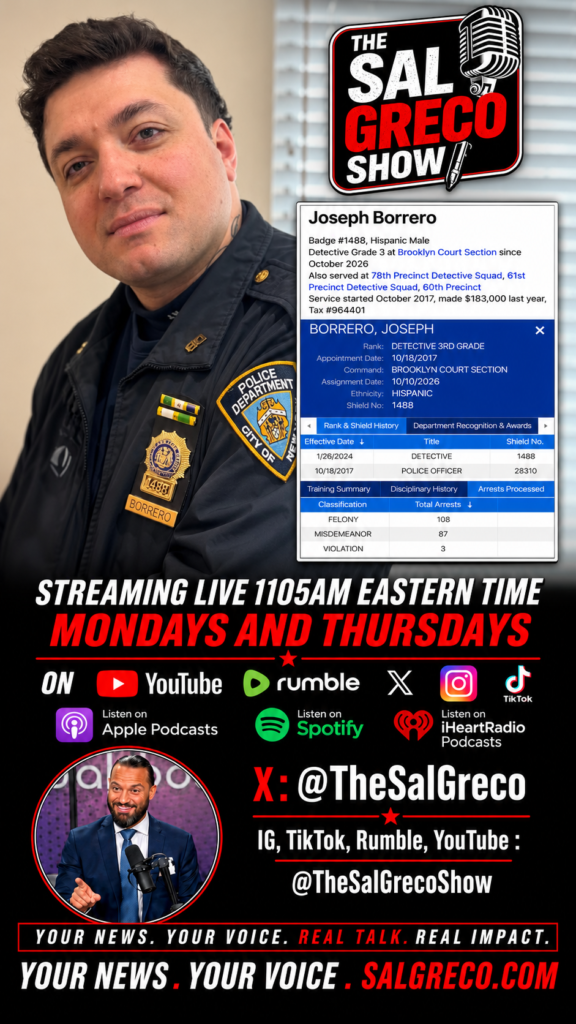
That is the question raised by the case of Detective Third Grade Joseph Borrero, shield No. 1488, a nine-year member of the New York City Police Department whose name appears in an Austin, Texas, court affidavit alleging indecent assault, a Class A misdemeanor under Texas law.
Sources tell SalGreco.com that Borrero has not been formally suspended because Texas authorities have not yet made a decision to pursue his arrest and extradition. Those sources expect a suspension if he is arrested.
SalGreco.com has not independently verified the current warrant status, an extradition decision or an NYPD rule requiring suspension upon arrest. But the underlying court paperwork and an NYPD internal personnel message reveal a significant sequence of events that deserves public explanation.
On October 7, 2026, an Austin magistrate found sufficient probable cause to support Borrero’s arrest.
On October 8, an NYPD FINEST message placed him on modified assignment, effective at 2:04 p.m.
The heading of that message refers to “Suspension/Modified Assignment,” but the operative language says only that Borrero was placed on modified assignment.
His personnel profile lists the Brooklyn Court Section as his command effective October 10.
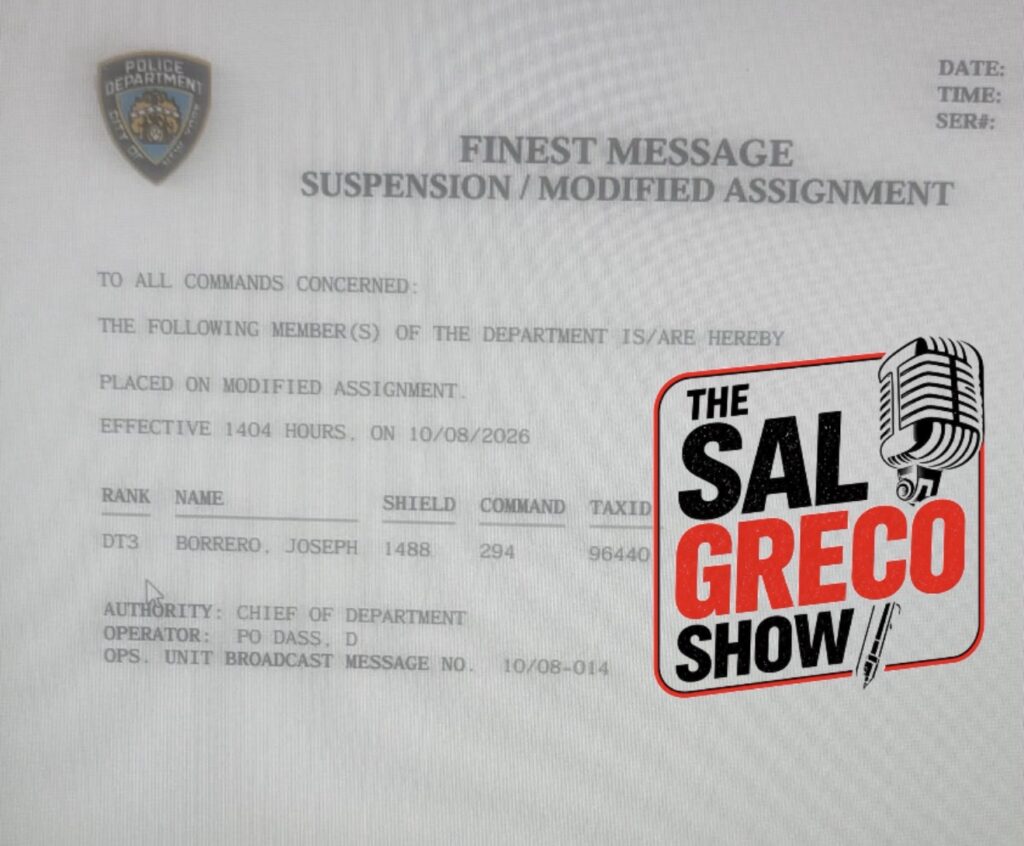
The documents do not establish that he was suspended without pay. Nor do they establish whether he is currently permitted to carry a firearm, exercise police powers, interact with the public or perform any particular duties.
What they do establish is that the NYPD took an administrative action one day after a Texas magistrate found probable cause.
The reason for that action is not stated in the FINEST message.
The striking timing raises questions that NYPD leadership should answer.
AN AUSTIN NIGHT OUT ENDS WITH A 911 CALL
The allegations stem from the early morning of August 14, 2026, near the Latchkey Bar on East Sixth Street in Austin.
An affidavit prepared by Austin Police Detective Daniel Hannah, with information obtained during an investigation involving Detective Moran, recounts a woman’s report that she was sexually touched without her consent.
The complainant and a female friend told investigators that Borrero approached them at the bar, introduced himself as a visitor from New York City attending a bachelor party and initially engaged them in ordinary conversation.
They alleged that the conversation turned sexually explicit, with graphic comments directed toward the complainant.
After the bar closed, Borrero accompanied the women toward their parked vehicle, according to the affidavit.
The complainant reported that he grabbed her buttocks twice, pressing his fingers against her anal area over her clothing, and later grabbed her breast.
She said she slapped him on the chest and told him not to touch her that way. The responding-officer summary also records her allegation that he tried to force her hand toward his genital area.
At the vehicle, she alleged, Borrero stood in front of her, demanded a kiss and placed a hand around her neck with some pressure after she tried to push him away.
She reported that she could still breathe.
Unable to get him to leave her alone, she called 911. She told police that Borrero insulted her before walking away.
Austin police responded at approximately 2:11 a.m. but did not locate the suspect at the scene.
These are allegations, not findings of guilt.
Borrero has denied the alleged nonconsensual touching.
WITNESS, SURVEILLANCE VIDEO AND PHOTO LINEUPS
Austin detectives interviewed the complainant on August 25 and her friend on August 26.
The friend reportedly corroborated important parts of the account.
She told investigators that she:
- Saw a grabbing motion toward the complainant’s buttocks.
- Saw the complainant pushing Borrero’s hand away.
- Witnessed Borrero blocking access to the vehicle.
- Saw his hand on the woman’s neck.
- Sounded her vehicle’s horn in an attempt to deter his behavior.
- Heard the woman call 911.
Detectives obtained security footage from a nearby commercial building.
According to the affidavit, that video confirmed the three individuals were walking together at the reported place and time.
The affidavit does not state that the video captured the alleged unwanted touching itself.
Investigators used a telephone number reportedly provided to the complainant to identify Borrero.
Both the complainant and her friend then independently identified him in photographic lineups, according to the filing.
On September 9, Detective Moran interviewed Borrero by telephone.
Borrero acknowledged that he was on East Sixth Street, met the two women at the bar and walked them to their vehicle.
He said he kissed the complainant goodnight and left, denied touching her without permission and described the encounter as uneventful.
That denial is an essential part of the story.
A probable-cause finding permits the criminal process to proceed. It is not a conviction, and Borrero is presumed innocent.
THE TEXAS WARRANT AND THE NYPD’S RESPONSE
The Austin affidavit identifies Texas Penal Code §22.012, indecent assault.
In the ordinary Class A misdemeanor classification described in the filing, the potential punishment upon conviction can include up to one year in jail, a fine of up to $4,000, or both.
The court paperwork bears:
- Court docket: C1CR26502634
- Austin Police report: 26-2260170
- Alleged offense: Indecent Assault
- Incident date: August 14, 2026
- Probable-cause finding: October 7, 2026
Magistrate Stephen Vigorito signed a finding of probable cause on October 7.
Sources familiar with the matter tell SalGreco.com that the warrant remains active and that Texas authorities have not yet pursued an arrest and extradition, leaving Borrero in a modified-duty status rather than a formal suspension.
A serious public-confidence question remains:
If an officer is reportedly subject to an arrest warrant in another jurisdiction, what safeguards govern his continued employment and assignment in New York City?
The NYPD should explain whether it has verified the Texas warrant, whether Borrero has law-enforcement authority or public-facing duties, what conditions were imposed on his modified assignment and what event would trigger a suspension or additional disciplinary review.
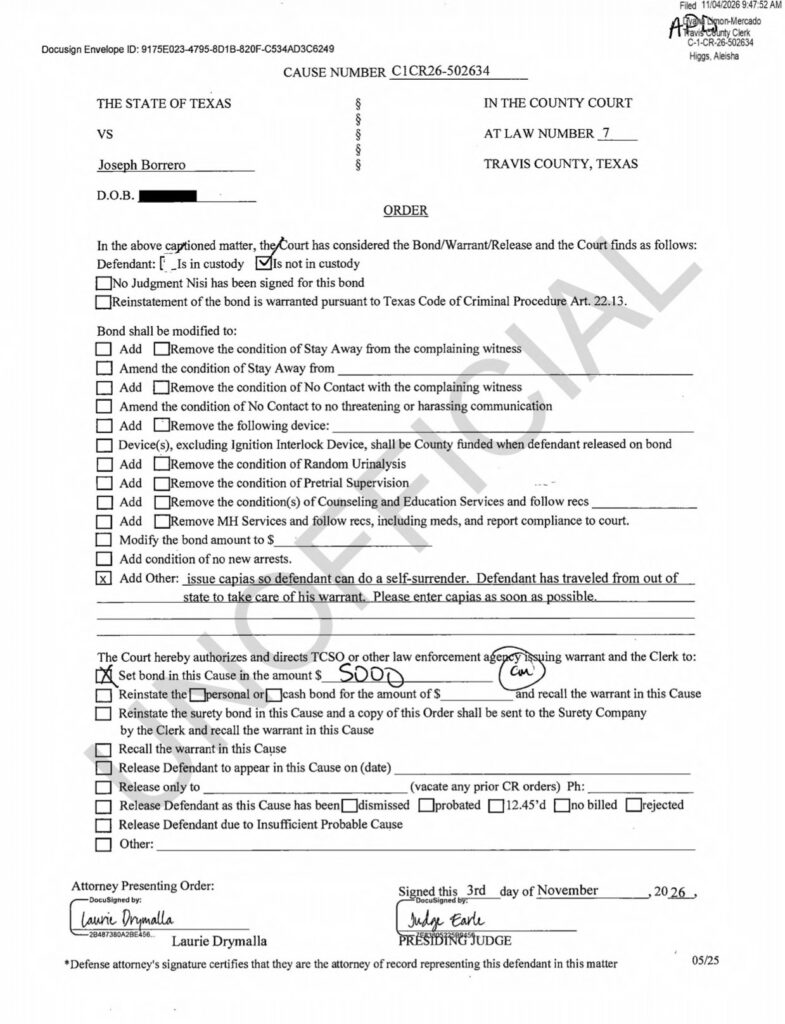
Obtained court records reviewed by SalGreco.com reveal further details in the criminal case involving NYPD Detective Joseph Borrero in Austin, Texas. According to an order signed November 3, 2026, and filed November 4 in Travis County Court at Law No. 7, the court specifically indicated that Borrero was “not in custody” at the time of the order. The document, filed under case number C-1-CR-26-502634, directs that a capias, a court-issued arrest warrant, be issued to facilitate Borrero’s voluntary surrender to Texas authorities. The order states that the defendant had traveled from out of state to address his outstanding warrant and requests that the capias be entered as soon as possible. The court also authorized a $5,000 bond, with defense attorney Laurie Drymalla identified as the attorney presenting the order. Although the document establishes that arrangements were being made for Borrero to surrender, it does not confirm that he subsequently surrendered, was arrested, or was released on bond. Travis County’s criminal docket also lists an attorney-only court proceeding for November 30, 2026. The records raise further questions about when Borrero will formally answer the pending misdemeanor indecent assault charge stemming from the August 14, 2026, incident in Austin.
ANOTHER CASE IN A GROWING NYPD ACCOUNTABILITY FILE
For months, SalGreco.com has documented a growing collection of criminal cases, civil lawsuits, substantiated administrative findings and source-based complaints involving NYPD personnel.
Those categories are different.
An allegation is not a conviction. A lawsuit is not a judicial finding. One person’s alleged misconduct cannot automatically be attributed to an entire department.
Nevertheless, the volume of controversies warrants sustained scrutiny of the leadership systems meant to detect and address problems.
Among the matters previously examined by SalGreco.com:
THE 46TH PRECINCT AND JEREMY SCHEUBLIN
Our July reporting detailed the arrest and indictment of former NYPD Inspector Jeremy Scheublin on charges including attempted first-degree rape and first-degree sexual abuse.
Those charges remain allegations unless proven in court.
Separate 46th Precinct lawsuits alleged sexual harassment, discrimination, retaliation and a hostile workplace.
THE NYPD POLICE CADET CORPS
Two lawsuits involving Cadet Ali Alsaidi and Sergeant Lee Helton raise allegations of discrimination and retaliation associated with Commanding Officer Giorlys Alvarez and questions about oversight within the Training Bureau.
SERGEANT MATTHEW PORTOLES
Our November 5 report examined his lawsuit alleging disability discrimination, retaliation, denial of accommodations and an allegedly forced retirement following serious line-of-duty injuries.
THE NYPD HEALTH & WELLNESS SECTION
Lieutenant Karolina Ostrowska-Tuznik’s federal litigation alleges retaliation after she challenged departmental treatment and spoke publicly about officer wellness.
The allegations remain contested.
TRANSPARENCY OVER NYPD DISCIPLINE
The Sal Greco Show’s own court challenge questions whether the NYPD is releasing the disciplinary records needed for independent scrutiny of outcomes and consistency.
These matters do not all involve the same type of wrongdoing or the same underlying facts.
They do, however, keep returning to a shared institutional question:
Does the NYPD’s system of internal accountability work consistently, transparently and promptly?
WHAT THIS CULTURE COSTS TAXPAYERS
There is also a financial dimension that cannot be dismissed.
In a September 2025 report, the New York City Comptroller’s Office documented 6,082 police-action claims filed in Fiscal Year 2025 and more than $113 million in settlements.
That figure covers a broad category of claims, including excessive or unnecessary force. It is not a tally of the lawsuits cited in this article, nor evidence that the Borrero matter has cost the City any settlement money.
Many underlying events predate Police Commissioner Tisch’s tenure.
But the larger point is undeniable: defending and resolving alleged police misconduct has substantial consequences for taxpayers.
Every avoidable lawsuit, settlement, judgment and legal defense expense is money that cannot be used elsewhere.
Litigation also consumes time and resources even when the City ultimately prevails.
The question for Tisch’s NYPD is not whether every plaintiff will win.
It is whether management is doing enough to prevent unlawful conduct, investigate complaints fairly, impose consistent discipline when warranted and reduce the public’s exposure to repeat failures.
JESSICA TISCH CANNOT DISMISS THE LARGER ACCOUNTABILITY QUESTION
Police Commissioner Jessica Tisch did not appoint every officer involved in these matters, nor did she necessarily know about every alleged incident when it occurred.
Nothing in the Borrero affidavit establishes that she personally knew of, approved or concealed misconduct.
Individual responsibility must remain individual.
But the commissioner is responsible for the department’s current response: how allegations are reviewed, whether officers remain in positions of public trust, how disciplinary decisions are documented and what information New Yorkers receive when serious criminal process is pending elsewhere.
If SalGreco.com’s sources are correct that an active Texas warrant has not yet resulted in Borrero’s arrest or formal suspension, the NYPD owes the public a clear explanation of why he remains assigned, what restrictions apply and what will happen next.
New Yorkers should not have to rely on leaked internal messages, civil lawsuits and independent reporting to understand whether the largest police department in America is holding its own members to a coherent standard.
A detective accused of indecent assault in Texas, a judicial probable-cause finding, an immediate NYPD modified-assignment notice and sources describing an unresolved out-of-state warrant are more than enough to justify serious questions.
They are not enough to declare Borrero guilty.
Both truths matter.
SalGreco.com will continue seeking answers about the current Texas court status, the NYPD’s administrative action and the broader pattern of accountability issues documented in our ongoing coverage.
The public deserves the facts. The accused deserves due process. And Commissioner Tisch’s NYPD owes New Yorkers transparent answers.
© 2026 SalGreco.com | The Sal Greco Show — Independent Journalism. Your News. Your Voice.