
BY SAL GRECO
Another senior NYPD executive is now at the center of serious allegations, raising renewed questions about accountability, transparency, and whether the Department applies the same standards to its executives as it does to rank-and-file officers.
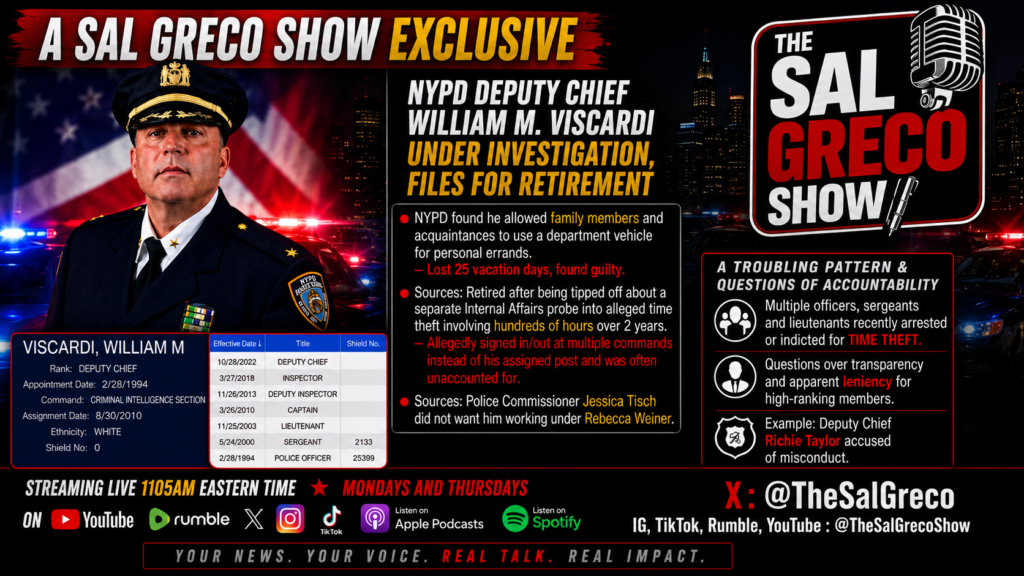
According to multiple sources, NYPD Deputy Chief William M. Viscardi, formerly assigned to the Criminal Intelligence Section, has submitted retirement papers while under investigation.
Sources allege that the matter began with a departmental investigation into the misuse of an NYPD vehicle. According to those sources, the NYPD concluded Viscardi improperly allowed family members and acquaintances to use a department vehicle for personal errands. Sources further allege he accepted responsibility for the internal disciplinary charges and was penalized with the loss of 25 vacation days.
If accurate, that would ordinarily have marked the end of the matter.
Instead, sources say a second and much more significant investigation followed.
Alleged Time Theft Investigation
According to sources familiar with the matter, the NYPD’s Internal Affairs Bureau opened a separate investigation into alleged misuse of department time.
The allegations reportedly mirror claims made in previous NYPD time-theft cases.
Sources allege investigators were examining whether Viscardi improperly signed in and out at multiple commands rather than his assigned post, was frequently unaccounted for during working hours, and accumulated hundreds of hours of alleged time misuse over approximately two years.
According to those same sources, Viscardi allegedly learned of the investigation through someone with knowledge of the Internal Affairs inquiry and immediately filed retirement papers.
If those allegations are true, they raise obvious questions.
Who allegedly warned him?
Was that alleged leak itself investigated?
If an Internal Affairs investigation was compromised, what disciplinary action, if any, followed?
The NYPD has not publicly addressed these questions.
Questions Surround Rebecca Weiner
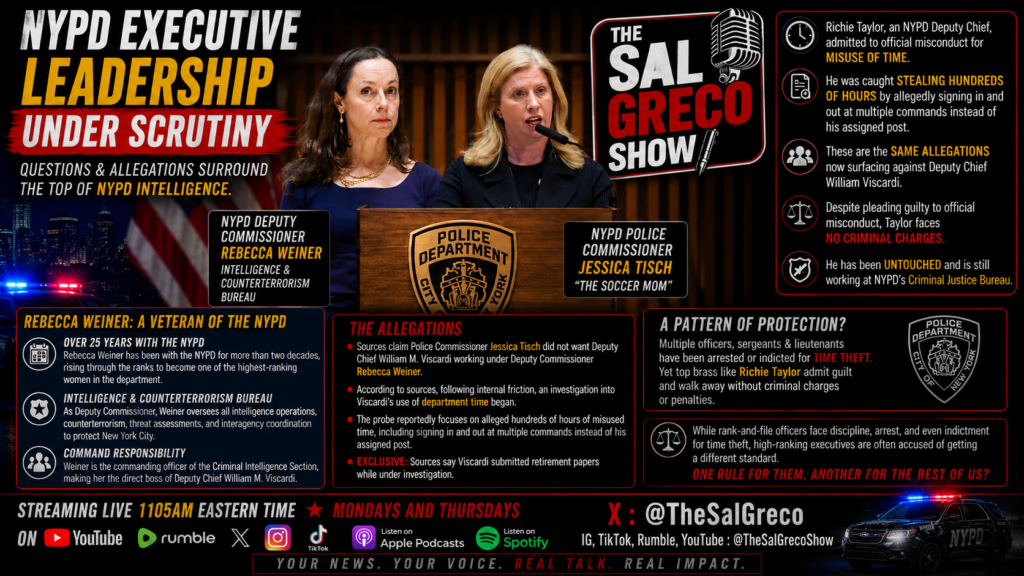
Sources also allege Police Commissioner Jessica Tisch did not want Deputy Chief Viscardi working under Deputy Commissioner Rebecca Weiner, who oversees the Intelligence & Counterterrorism Bureau.
Rebecca Weiner has spent more than two decades with the NYPD and is widely recognized for leading the department’s intelligence and counterterrorism operations.
Whether there was any relationship between that alleged personnel decision and the subsequent Internal Affairs investigation remains unknown.
That is precisely why this publication submitted detailed questions to the NYPD’s Deputy Commissioner of Public Information (DCPI).
Among other things, DCPI was asked to confirm or deny:
- whether Viscardi filed retirement papers while under investigation;
- whether he resolved internal disciplinary charges involving misuse of a department vehicle;
- whether Internal Affairs opened a separate investigation into alleged misuse of department time;
- whether anyone is being investigated for allegedly tipping him off; and
- whether Commissioner Tisch directed that Viscardi no longer work under Rebecca Weiner.
As of publication, DCPI has not responded.
A Familiar Pattern?
The allegations also invite comparison to several recent NYPD misconduct cases involving alleged misuse of department time.
Among them:
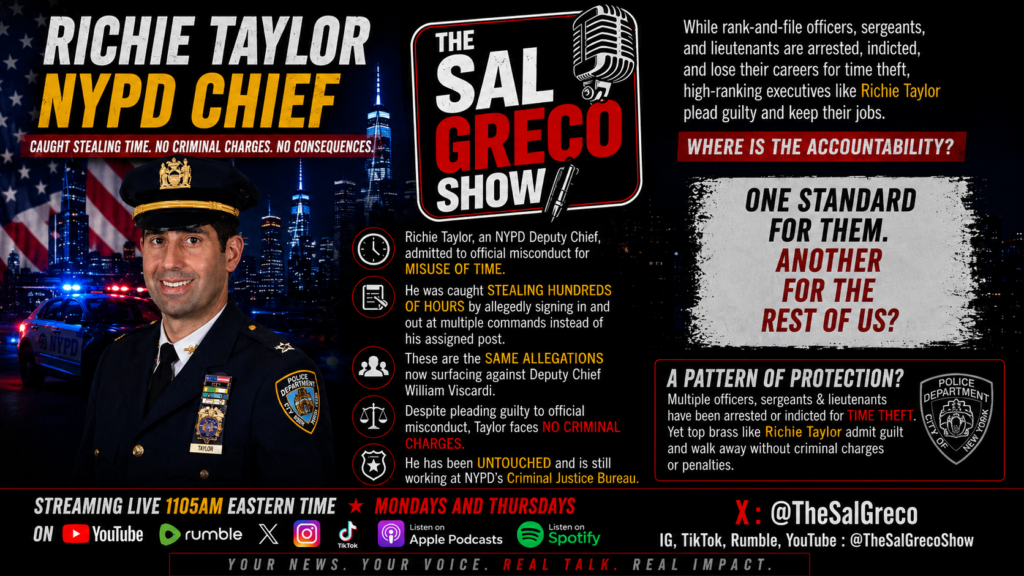
- Deputy Chief Richie Taylor, who publicly acknowledged official misconduct related to misuse of time but was not criminally charged.
- Matthew Graziano, whose alleged misuse of department time became the subject of public reporting and subsequent litigation.
- David Tzall, who also faced allegations involving department time.
- Brian Adams, whose employment became the subject of departmental controversy.
- Thomas Fabrizzi, who faced criminal prosecution.
- Sergeant Rayna Rampaul, who resigned and was later criminally prosecuted by the Manhattan District Attorney’s Office on official misconduct charges.
The differing outcomes naturally raise questions.
Why were Fabrizzi and Rampaul criminally prosecuted while other officials facing allegations involving department time were not?
What distinguishes one case from another?
Were prosecutors presented with materially different evidence?
Or are disciplinary standards being applied selectively?
Those are legitimate public-interest questions, particularly when taxpayer-funded salaries and public trust are involved.
The Walkout Ceremony Question
If the allegations surrounding Deputy Chief Viscardi are accurate, another question emerges.
Why would an executive allegedly under investigation for misconduct involving department resources and department time receive a retirement walkout ceremony?
Would that same courtesy be extended to a patrol officer?
A sergeant?
A lieutenant?
Or is there one set of standards for executives and another for everyone else?
Public Confidence
The NYPD has endured a series of high-profile controversies involving executive leadership over the past several years.
Whether involving alleged misconduct, time-theft investigations, procurement questions, or leadership controversies, each new allegation further erodes public confidence if left unanswered.
Transparency—not silence—is ultimately what restores trust.
A Challenge for City Hall
Mayor Zohran Mamdani has spoken frequently about his priorities for New York City.
But while political debates continue over issues outside the City’s direct authority, New Yorkers continue to face deteriorating infrastructure, public safety concerns, and persistent questions surrounding leadership within the NYPD.
Rather than focusing attention on symbolic political disputes that the City lacks authority to carry out—such as calls involving the arrest of foreign leaders—critics argue City Hall should devote equal energy to ensuring accountability within its own agencies, including the Police Department.
Whether the allegations involving Deputy Chief William M. Viscardi are ultimately substantiated or disproven, the public deserves answers.
The NYPD has been asked those questions.
As of publication, those answers have not come.