BY SAL GRECO
There is an old saying about getting caught with your hand in the cookie jar.
In American politics, however, the more troubling question increasingly seems to be: What happens when everybody’s hand is somewhere near the jar, but nobody can—or will—say whose hand actually took the cookies?
That question hung over our discussion on Episode 224 of The Sal Greco Show, after a sealed Florida grand jury report obtained by CBS News Miami concluded that the administration of Gov. Ron DeSantis had “misappropriated” $10 million connected to a Medicaid settlement.
This is not merely an accusation from a political opponent. According to the leaked grand jury report, taxpayer money was misused for political purposes, yet investigators said they lacked sufficient evidence to establish who was criminally responsible.
That distinction matters. The grand jury did not indict Ron DeSantis, Ashley Moody, James Uthmeier or anyone else, and allegations of criminal conduct should not be presented as convictions or established crimes.
But the absence of charges does not make what the grand jury found insignificant.
It makes the unanswered questions even bigger.
$67 MILLION BECOMES $57 MILLION
The controversy began with a settlement involving Centene Corp. and allegations that Florida had been overbilled through its Medicaid program.
Florida’s share was approximately $67 million.
According to CBS Miami’s reporting on the grand jury report, a 2021 draft contemplated returning the full amount owed to Florida. But when the matter was finally resolved in September 2024, the agreement changed.
First, $5 million was designated for the Hope Florida Foundation, associated with First Lady Casey DeSantis’ signature Hope Florida initiative.
The following day, that figure became $10 million, leaving approximately $57 million going back to the state. CBS reported that the grand jury found no explanation for why the Hope Florida amount doubled overnight.
What happened next is the part that deserves scrutiny.
The Hope Florida Foundation ultimately sent $5 million each to two nonprofits. According to PolitiFact’s reconstruction of the transactions, those organizations subsequently transferred $8.5 million to Keep Florida Clean, the political committee created to fight Florida’s 2024 recreational-marijuana constitutional amendment. Money subsequently flowed from that committee to other Republican political organizations.
The grand jury’s language was extraordinary.
CBS reported that it characterized the diversion as part of a “sophisticated scheme to fund political activities.” Yet its ultimate conclusion was that although the money had been misappropriated, there was insufficient evidence to charge anyone because investigators could not prove who was responsible for the decision.
Think about that for a moment.
Ten million dollars moves.
The grand jury says taxpayer money was misused.
The money eventually reaches political organizations.
And investigators cannot establish who made the decision.
That was precisely what troubled us during Episode 224.
As Jack asked on the program:
“Why is there no criminal prosecution?”
It’s a legitimate question even though the legal answer may ultimately be that prosecutors could not prove the necessary elements of a crime against a particular person beyond a reasonable doubt.
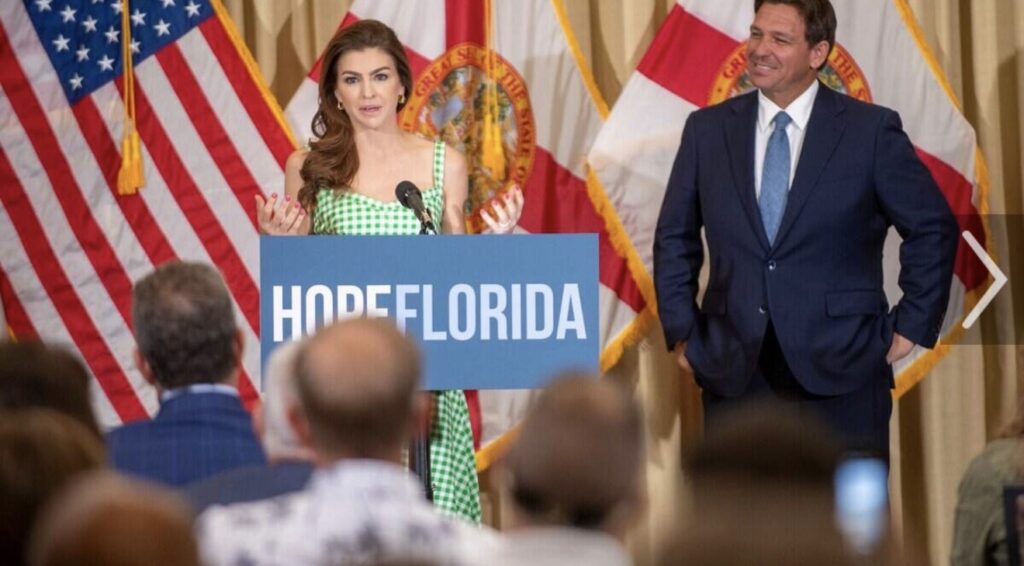
MOODY, UTHMEIER AND THE ACCOUNTABILITY GAP
The grand jury’s findings also placed two powerful Florida Republicans under an uncomfortable spotlight.
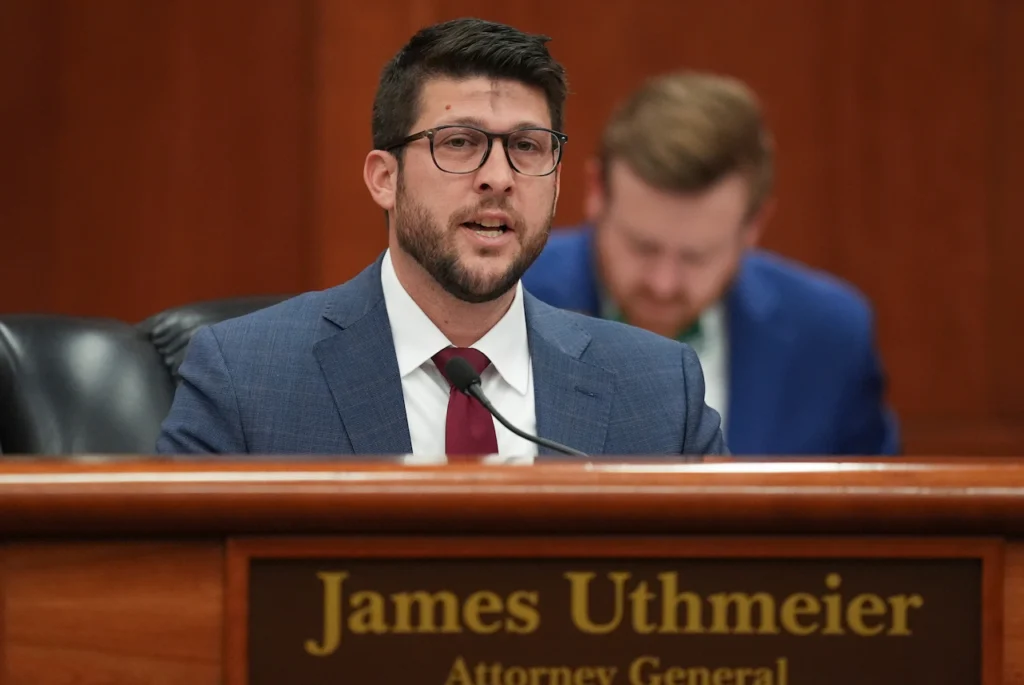
James Uthmeier was DeSantis’ chief of staff when the settlement occurred and is now Florida’s attorney general. According to the report, he occupied a position of authority over officials involved in the settlement and testimony identified him as involved in directing the money after it reached Hope Florida. His Keep Florida Clean PAC was described as the principal recipient of most of the $10 million.
Ashley Moody was Florida’s attorney general when the agreement was approved and is now a U.S. senator.
The grand jury said Moody knew of the plan to divert the $10 million to Hope Florida and authorized her chief deputy, John Guard, to execute the settlement. But there is an important qualification: publicly available evidence does not establish that Moody personally transferred $10 million into a political committee or knew in advance exactly where the money would ultimately go. PolitiFact recently rated such a broader characterization “Half True.”
That doesn’t eliminate the accountability question.
It sharpens it.
Guard reportedly acknowledged reservations about the transaction and agreed conceptually that the money belonged to Florida. The report says he was concerned about how legislators would react if they learned that $10 million had been directed elsewhere.
On Episode 224, our reaction was straightforward: if senior government lawyers had reservations about where $10 million was going, why was the agreement approved without stronger safeguards governing what happened to the money afterward?
That is a question government officials should answer regardless of party.
THE TIMING IS ITS OWN SCANDAL
There is another part of this story that deserves scrutiny: when the public learned the full findings.
The underlying transaction occurred in 2024.
The Hope Florida controversy was hardly secret by 2025. News organizations were reporting on it, Florida lawmakers investigated it, and prosecutors opened an investigation.
The grand jury report itself was filed under seal on January 28, 2026, according to CBS.
Yet the public did not see its explosive conclusions until late August.
CBS reported that individuals named in the report had been fighting its release in closed proceedings, although the precise status and responsibility for those efforts were not publicly clear.
And now we are in a general-election season.
That creates an unavoidable political question.
Why wasn’t this information available earlier?
The point isn’t that its release necessarily represents a deliberate attempt to manipulate the election. There is not sufficient evidence to state that as fact.
But the timing matters because voters choosing nominees in primaries did not have access to the same information voters have today.
Ashley Moody is now confronting renewed scrutiny as she seeks election to the Senate seat to which DeSantis appointed her. Uthmeier is also before voters.
Had the complete grand-jury findings been public earlier, would Republican primary voters have evaluated incumbents differently?
Nobody can know.
But voters deserved the information.
Suppressing politically damaging information until after a primary—whatever the legal or procedural reason—can effectively deny primary voters facts that later become central to a general-election campaign.
CBS reports that Democratic gubernatorial nominee David Jolly is now demanding a renewed investigation, while DeSantis has called the controversy a “hoax” and said the apparent crime was leaking the confidential grand-jury report.
The irony is impossible to miss.
The political world is now fighting over the leak while the underlying question remains:
How did $10 million identified by a grand jury as taxpayer money end up being used for political purposes without anyone being criminally responsible?
ROGER STONE WAS TALKING ABOUT THIS LONG BEFORE AUGUST 2026
There is another piece of history that shouldn’t disappear simply because it is politically inconvenient.
Roger Stone was publicly hammering the Hope Florida controversy more than a year before the grand jury report became public.
On April 16, 2025, Stone and Troy Smith published a StoneZone piece headlined “DESANTIS SNAGGED IN GIANT COVERUP.” It focused directly on the $10 million Hope Florida payment and the Medicaid settlement.
Days later, Stone defended interviewing Florida Democratic Party chair Nikki Fried about the scandal despite criticism from Republicans.
Stone called Hope Florida a “legitimate scandal” and accused Ron and Casey DeSantis of “epic corruption.”
In another discussion with Fried, Stone described the controversy as potentially the “greatest single corruption scandal in Florida history” and referred to the Hope Florida arrangement as a “slush fund.”
Say what you want about the “Wiseman.”
Those were allegations when Stone was making them, and some of his rhetoric went further than what has been established legally. No court has found DeSantis guilty of criminal conduct in this matter.
But on the central issue—that the $10 million Hope Florida transaction deserved serious investigation and public scrutiny—Stone was sounding the alarm publicly in April 2025, long before the leaked grand jury findings dominated headlines in August 2026.
The subsequent grand-jury finding that the money was indeed “misappropriated” for political purposes gives that earlier scrutiny considerably more significance.
THE DESANTIS IMAGE AND THE ACCOUNTABILITY TEST
For years, DeSantis built a national reputation around Florida being governed differently.
Competent government.
Accountability.
Law and order.
An administration supposedly immune to the dysfunction associated with Washington or New York City.
Hope Florida complicates that narrative.
And this is where Episode 224 went beyond partisan politics.
I’ve watched government scandals unfold around politicians from every corner of American politics. We’ve seen controversies consume Eric Adams’ mayoral administration in New York. We’ve watched investigations and controversies surrounding Joe Biden’s presidency and family. We’ve watched Donald Trump spend years fighting criminal cases, civil litigation and investigations.
The underlying principle shouldn’t change according to the letter beside someone’s name.
Government power requires accountability.
That applies to Democrats.
It applies to Republicans.
It applies to Eric Adams.
It applies to Joe Biden.
It applies to Donald Trump.
And it applies to Ron DeSantis.
I’m not equating the facts or legal circumstances of those separate controversies. They are dramatically different cases. The comparison is about the recurring political phenomenon: supporters often demand maximum scrutiny of the opposing party while searching for reasons to minimize troubling conduct inside their own.
Eventually, everybody gets caught reaching toward the cookie jar.
The question becomes whether institutions still have the courage to ask whose hand was inside it.
NOBODY REMEMBERS WHO DECIDED?
Perhaps the most astonishing part of this entire story is buried inside the grand jury’s explanation for why nobody was charged.
According to CBS’s publication of the report:
“Nobody will take responsibility for deciding the $10 million of taxpayer money would go to Hope Florida… or had any memory of who made it.”
The grand jury therefore concluded that it could not prove who was responsible, even though it said it could “plainly see that taxpayer money was misused for political purposes.”
That should disturb Floridians regardless of their politics.
If ten dollars disappears from a government cash drawer, somebody is expected to explain it.
If ten million dollars moves through a settlement, into a foundation, through nonprofits and eventually into political organizations, suddenly nobody remembers who made the decision?
That is not transparency.
That is a breakdown of accountability.
TWO YEARS LATER, VOTERS FINALLY GET TO SEE IT
There is still much we do not know.
We don’t know whether additional investigations will produce criminal charges.
We don’t know whether the grand jury’s conclusions will survive further legal scrutiny.
We don’t know what DeSantis personally knew about the original decision.
We don’t know whether Moody knew where the money would ultimately end up.
And we should not manufacture answers simply because they fit a political narrative.
What we do know is significant enough.
A Florida grand jury concluded that $10 million in taxpayer money was misappropriated and ultimately used for political purposes.
It couldn’t identify sufficient evidence to criminally charge an individual.
Senior officials associated with the transaction have moved into even more powerful positions.
And the public is reading the grand jury’s findings nearly two years after the original transaction—and during another election season.
That is the story.
Not Republican versus Democrat.
Not MAGA versus Never Trump.
Not DeSantis versus his enemies.
Ten million dollars of public money.
Where did it go?
Who authorized it?
Who knew?
Why were there apparently inadequate safeguards?
And why did Florida voters have to wait this long to see what a grand jury concluded?
Those questions shouldn’t disappear after Election Day.
Because if there is one lesson from covering government corruption and misconduct, it is this:
When politicians demand accountability only when the other team is implicated, eventually everyone gets a turn at the cookie jar.
And taxpayers are the ones paying for the cookies.