
BY SAL GRECO
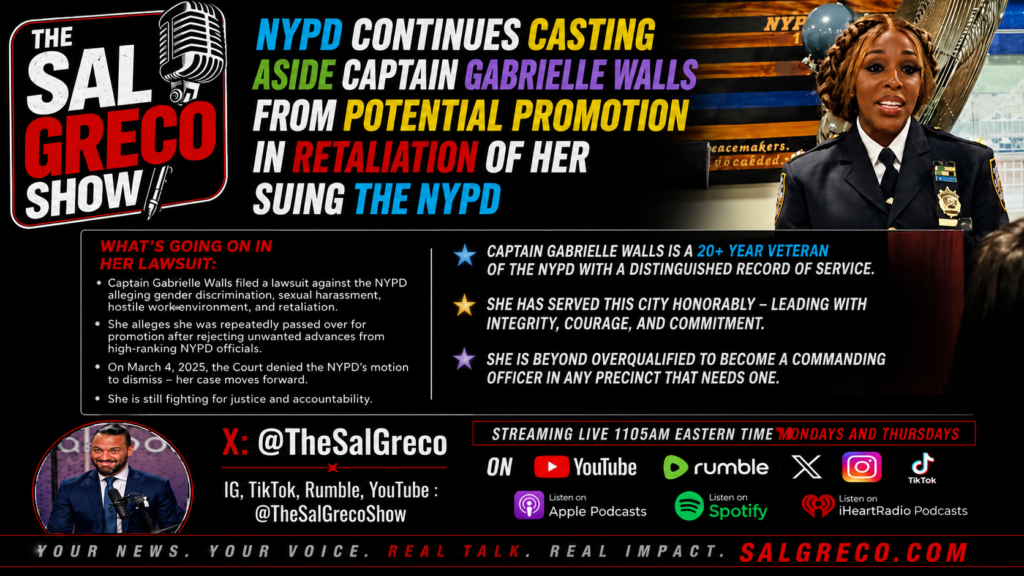
As the NYPD attempts to turn the page on one of its most troubled commands, the selection of new leadership raises another uncomfortable question: Why does Captain Gabrielle Walls—an experienced captain who has already alleged retaliation and discrimination in a lawsuit that survived a major dismissal attempt—remain without a command?
The leadership revolving door at the NYPD’s troubled 46th Precinct has turned again.
After more than a year of controversy involving allegations of sexual harassment, retaliation, a so-called “frat house” atmosphere, civil lawsuits and ultimately the criminal indictment of former Inspector Jeremy Scheublin, the NYPD has installed permanent leadership at the Bronx command.
Deputy Inspector Eric J. Carrasquillo is now the commanding officer of the 46th Precinct, according to the NYPD’s official precinct page. A recent personnel order also placed Captain Charisse Jenkins into the precinct’s executive-officer position.
There is nothing in this article intended to question the qualifications of either Carrasquillo or Jenkins. In fact, placing a female captain in a significant leadership position inside a command rocked by allegations involving the treatment of women could prove to be a positive step.
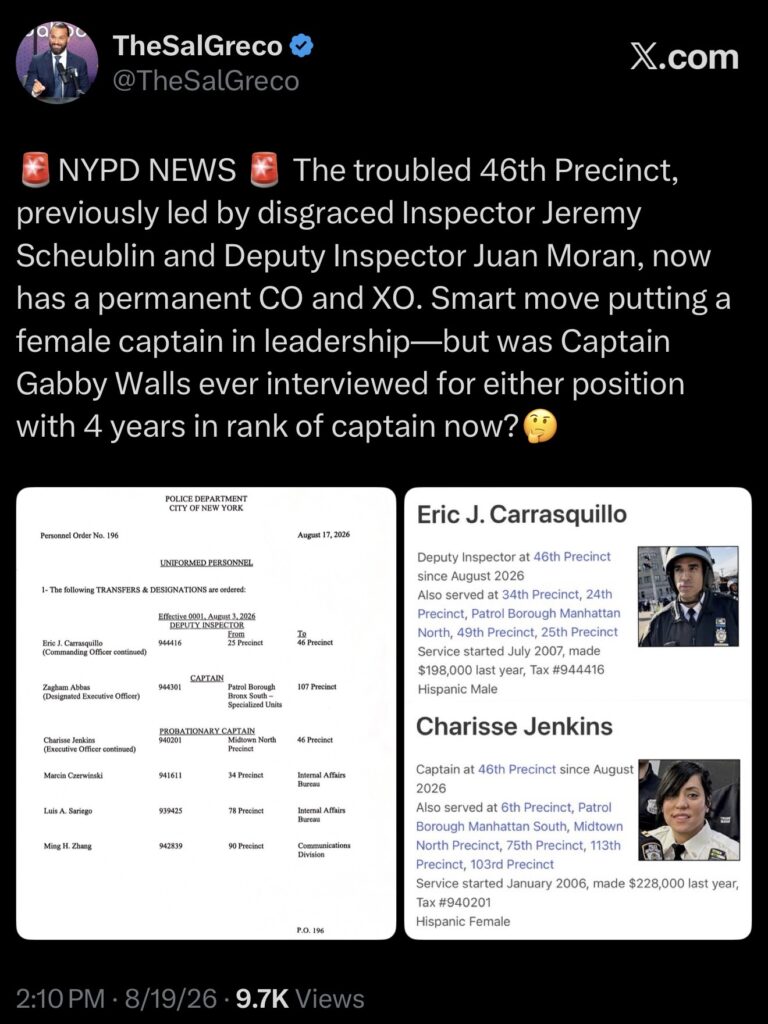
But the personnel moves raise a different question—one discussed at length during Episode 221 of The Sal Greco Show:
Was Captain Gabrielle Walls ever seriously considered for either job?
And if not, why not?
That question becomes considerably more important when Walls’ pending lawsuit against the City of New York and senior NYPD officials is examined.
From the Scheublin Scandal to Another Leadership Change
SalGreco.com previously documented how allegations surrounding the 46th Precinct eventually escalated far beyond an internal NYPD controversy.
Scheublin was criminally indicted in July 2026 on charges including attempted rape in the first degree, sexual abuse in the first degree, assault, unlawful imprisonment, forcible touching, official misconduct and obstructing governmental administration. Those charges remain allegations, and Scheublin is presumed innocent unless proven guilty.
But his arrest followed months of civil litigation and reporting concerning conditions inside the 46th Precinct.
Lawsuits described alleged sexual harassment, retaliation and what plaintiffs characterized as a “frat house” culture. Questions also emerged over why Scheublin remained in a leadership position while complaints and investigations were pending and why stronger departmental action apparently did not occur sooner.
After Scheublin was removed, Juan Moran subsequently led the precinct before another leadership change.
Now Carrasquillo has the permanent command, and Jenkins has been installed as executive officer.
The department may hope that represents a fresh start.
But a fresh start should also invite a broader examination of how the NYPD chooses its leaders—and, perhaps more importantly, whom it repeatedly chooses not to elevate.
The Gabrielle Walls Question
During Episode 221, I raised precisely that issue.
Walls has been a captain since May 2022. She has served in supervisory positions and has executive-officer experience. Her lawsuit itself describes her being assigned as executive officer of the 73rd Precinct and repeatedly competing for positions traditionally viewed as steppingstones toward command.
My position on the show was straightforward: Walls appears more than qualified to be seriously considered for a precinct command.
Yet more than four years after becoming a captain, she still has not received one.
That alone does not establish retaliation. NYPD command assignments and promotions above the civil-service rank of captain are discretionary, and numerous considerations can influence those decisions.
But Walls’ situation cannot reasonably be examined in a vacuum because she has already gone to court alleging that her career advancement was damaged after she rejected alleged sexual advances and complained about harassment.
Her lawsuit is Gabrielle Walls v. City of New York et al., Index No. 156492/2024, pending in New York County Supreme Court.
And what the court has already said about that lawsuit is significant.
Walls’ Lawsuit Survived the City’s Attempt to Gut It
Walls commenced the case in July 2024, alleging gender discrimination, sexual harassment, hostile work environment and retaliation under New York State and New York City human-rights laws.
The City and then-Assistant Chief Scott Henderson sought to strike portions of her complaint and dismiss significant allegations, including claims they argued were barred by the statute of limitations.
In March 2025, Supreme Court Justice Hasa A. Kingo largely rejected that effort.
The court denied the defendants’ motion to strike, denied their statute-of-limitations challenge and permitted Walls to amend her complaint. The court dismissed certain limited claims, including punitive damages against the City, but allowed the central discrimination, harassment and retaliation allegations to continue.
Most importantly for what is happening today, the judge addressed Walls’ allegations concerning her career.
The court found that her amended complaint contained sufficiently detailed allegations supporting gender discrimination in denied promotions, sexual harassment and retaliation through transfers and lack of upward mobility.
That is not a judicial finding that discrimination or retaliation actually occurred. Those allegations still must be proven.
But it is equally inaccurate to dismiss Walls’ lawsuit as a baseless complaint that went nowhere.
A judge examined the pleadings and allowed the central case to proceed.
What Walls Alleges Happened to Her Career
The amended complaint goes much further than simply alleging inappropriate comments.
Walls alleges that she was repeatedly bypassed for career-enhancing assignments and commanding-officer opportunities despite having greater time in rank and, in some instances, more relevant experience than male captains who advanced ahead of her.
Her complaint alleges that she was promoted to captain on May 27, 2022.
It identifies several male captains who allegedly obtained second executive-officer assignments or commanding-officer opportunities despite having less time in rank.
The complaint alleges that Captain Erek Powers, promoted more than a year after Walls, received a second executive-officer position ahead of her. It makes similar allegations concerning Captains Steve Hyland and Daniel Fennessy.
Walls further alleges that those second XO assignments were important because they placed those captains on the path toward obtaining their own commands.
Her complaint also alleges that in May 2024 she was passed over for executive-officer positions in the 73rd and 75th Precincts.
And the allegations become even more serious from there.
Walls claims Henderson repeatedly denied her advancement after she rejected alleged sexual advances. She alleges that when she questioned why she had not received a commanding-officer position, Henderson criticized her presentation skills.
According to the complaint, Walls challenged that explanation by pointing to another female commanding officer whom Henderson allegedly did not regard as a strong presenter. Walls alleges Henderson then made a remark suggesting that the other woman may have been willing to do things Walls was unwilling to do.
Henderson has contested the allegations, and they have not been proven at trial.
Nevertheless, they are now part of an active civil-rights case that survived a significant dismissal motion.
A Lawsuit Specifically About Being Denied Advancement
That makes what is happening in 2026 impossible to ignore.
Walls isn’t simply an NYPD captain who happens to have a lawsuit pending.
Being denied advancement is itself part of the lawsuit.
Her amended complaint explicitly alleges that she was denied a commanding-officer position because of her gender and in retaliation for rejecting alleged sexual harassment.
It further alleges that she was denied promotion to deputy inspector because of gender discrimination and retaliation.
The complaint even compares Walls with male captains who allegedly had less seniority or relevant experience but nevertheless advanced.
So every time another commanding-officer or executive-officer position becomes available—and Walls again does not receive the opportunity—the obvious question becomes unavoidable:
Is the NYPD evaluating Gabrielle Walls solely on merit, or has filing a lawsuit against the department effectively placed a ceiling over her career?
Episode 221: Is This Retaliation Happening in Real Time?
That was the central argument I made during Episode 221.
My opinion is that what we are watching has the appearance of institutional retaliation.
Jack Stern , co-host of The Sal Greco Show said on the show that once someone becomes a “thorn in the side” of the department, the institution can simply push that person aside.
The NYPD does not necessarily have to fire someone to damage a career.
It doesn’t have to suspend the person.
It doesn’t even have to formally discipline them.
With discretionary positions, it can simply keep selecting somebody else.
Again.
And again.
And again.
Eventually years pass.
Other captains obtain commands. Others receive discretionary promotions. Others move through executive assignments.
The employee who complained remains exactly where she was.
That is why Walls’ situation deserves scrutiny.
Four Years in Rank—and Still Waiting
Walls has now accumulated approximately four years in the rank of captain.
She is currently a captain assigned to the 111th Precinct.
Her lawsuit, however, demonstrates that the question of her advancement predates today’s controversy by years.
In fact, Walls alleged in the amended complaint that male Captain Dion Hinds obtained a commanding-officer position approximately fourteen months after becoming a captain, while she remained without a command after being promoted only months after him.
She similarly alleged that Hyland eventually became commanding officer of Transit District 20 despite being promoted to captain after Walls.
Her contention is not merely, “I deserve a promotion.”
Her contention is that a pattern exists in which similarly situated or less-senior men received opportunities that she did not—and that the pattern followed her rejection of alleged sexual advances and complaints about discrimination.
Those remain allegations.
But they are allegations a court has already determined are sufficiently pleaded to continue toward litigation.
Why the 46th Precinct Makes the Question Even More Striking
And that brings us back to the 46th Precinct.
If there were ever a command where the NYPD might want an experienced female captain with supervisory experience, community-engagement credentials and firsthand knowledge of navigating a male-dominated department, wouldn’t the 46th Precinct be somewhere near the top of the list?
This is a precinct emerging from allegations concerning the mistreatment and harassment of women.
It has been subjected to multiple lawsuits.
Its former commanding officer is facing serious criminal charges.
The department has already decided that placing a female captain in the executive-officer position makes sense.
So why wasn’t Gabrielle Walls considered?
Was she interviewed?
Did she apply?
Was her record reviewed?
Was she ever discussed as a potential commanding officer or executive officer?
And if the answer to those questions is no, why?
Those are questions—not assertions of established fact.
The NYPD should answer them.
The Irony Is Difficult to Miss
There is a particularly troubling irony here.
A woman alleges that senior NYPD officials sexually harassed her.
She says she rejected them.
She says her career subsequently stalled.
She complains.
She files a lawsuit alleging retaliation and discrimination.
The City attempts to dismiss substantial portions of the case.
The judge allows the core allegations—including lack of upward mobility as alleged retaliation—to proceed.
And years later, as commanding-officer positions continue opening around the department, she remains a captain without a command.
At what point does the continuing lack of advancement become additional evidence supporting the very retaliation she alleged in the first place?
That is ultimately a question for the litigation and, potentially, a jury—not for this publication to decide as a matter of fact.
But it is absolutely fair to ask.
The NYPD’s Discretion Cuts Both Ways
The amended complaint itself highlights another critical feature of NYPD promotions.
Above captain, advancement is discretionary.
There is no competitive civil-service examination that guarantees promotion to deputy inspector.
Commanding-officer assignments are similarly dependent on departmental selection.
That gives NYPD leadership considerable flexibility to identify talented executives.
But discretion also creates a responsibility to ensure that subjective decision-making is not being used as camouflage for retaliation.
When someone who has sued the department repeatedly fails to advance, the department can always point to discretion.
Someone else was selected.
Someone else was a better fit.
Someone else interviewed better.
Someone else had the right experience.
Any individual decision can be explained.
The real question is what happens when those individual decisions accumulate into a pattern.
The 46th Precinct Saga Is Now Bigger Than Scheublin
The 46th Precinct story was never simply about Jeremy Scheublin.
His indictment dramatically intensified the scrutiny, but the lawsuits surrounding the precinct raised broader questions about supervision, institutional culture and whether employees who complained about misconduct were adequately protected.
The NYPD now has an opportunity to demonstrate that changing the names on the command board means more than cosmetic reform.
Carrasquillo deserves the opportunity to lead.
Jenkins deserves the opportunity to succeed as executive officer.
But Gabrielle Walls also deserves something very basic:
A fair opportunity to compete based on her record rather than being defined by the fact that she challenged the department in court.
If the NYPD believes she isn’t qualified to command a precinct, then it should be able to articulate a legitimate professional reason.
Because four years into her captain’s rank, with executive-officer experience behind her and a lawsuit specifically alleging that harassment and retaliation obstructed her advancement, simply continuing to pass her over will inevitably raise questions.
My View: The Lawsuit Has Become the Elephant in the Room
My opinion remains the same as what I expressed during Episode 221.
I believe Walls’ lawsuit has become the elephant in the room when her name comes up for advancement.
I cannot state as a proven fact that Police Commissioner Jessica Tisch or anyone else has ordered that Walls not receive a command because she sued the NYPD. I have not seen evidence establishing such an instruction.
But I can look at the history.
I can look at Walls’ experience.
I can look at the allegations contained in her complaint.
I can look at the male captains she says advanced ahead of her.
I can look at the court’s refusal to dismiss the core allegations.
And I can look at the fact that, four years after becoming a captain, Gabrielle Walls is still waiting.
In my opinion, the continuing pattern deserves to be examined as potential retaliation—not ignored simply because discretionary NYPD personnel decisions happen behind closed doors.
The department cannot demand that employees report misconduct and then create a system in which employees reasonably believe that filing a complaint or lawsuit will destroy their chances of advancement.
If that is the message being sent, the consequences reach far beyond Gabrielle Walls.
Every NYPD employee watching learns the same lesson:
Keep quiet, or risk your career.
And after everything that has happened at the 46th Precinct, that is precisely the culture the NYPD should be trying to eliminate—not reinforce.
The Scheublin chapter may be entering the criminal courts, and the 46th Precinct may have new names at the top.
But the larger accountability story is nowhere near finished.