
BY SAL GRECO
A new controversy is emerging inside the New York City Police Department over what happens to members not while they are employed, but when they attempt to leave.
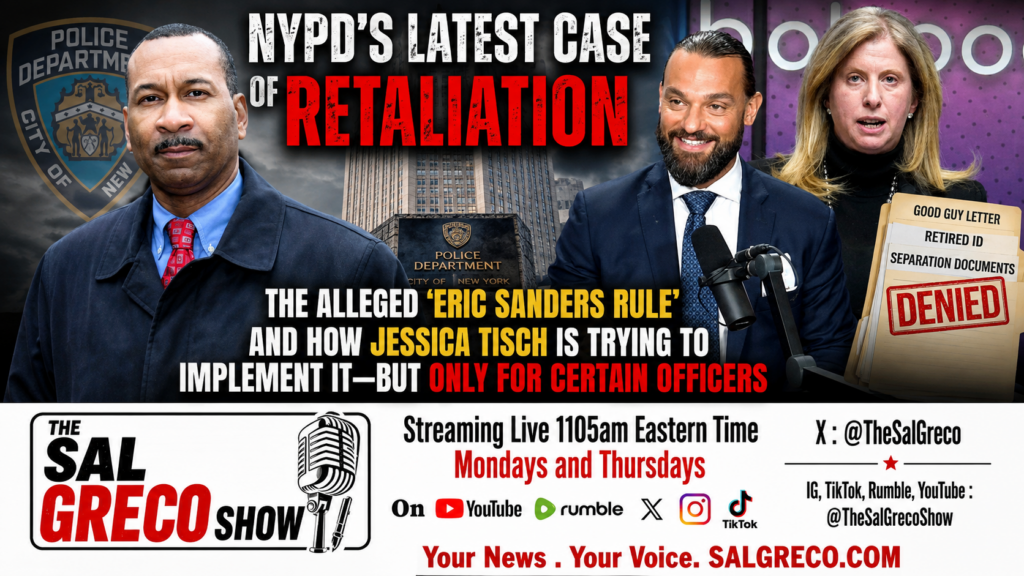
According to information provided to The Sal Greco Show and separately raised publicly by civil-rights attorney Eric Sanders, the NYPD is allegedly examining how it can formalize rules governing the denial of critical separation documents to certain departing members—including retired identification cards, so-called “Good Guy” letters and related documentation.
If accurate, the development raises a fundamental question: Is the NYPD attempting to establish a neutral, consistently applied policy—or is it searching for a way to institutionalize a practice that critics contend has already been used selectively against disfavored officers?
That distinction could have significant legal consequences.
Sources Describe a New Push Inside the NYPD
According to sources who spoke with The Sal Greco Show, members facing departmental charges or administrative proceedings can encounter another battle when attempting to separate from the NYPD.
The allegations concern officers who have been served disciplinary charges, are litigating those charges through the NYPD administrative process, have completed a departmental trial, or are attempting to negotiate a final separation from the Department.
The normal administrative process can extend for months while final penalties and separation paperwork work their way through the Department and ultimately the Police Commissioner’s office.
But according to the information provided to this publication, the dispute now goes considerably further.
The allegation is that NYPD officials are exploring a more formalized mechanism for determining when departing members can be denied documents that may affect their ability to obtain retired law-enforcement credentials, firearm licensing or potentially exercise rights available to qualified separated law-enforcement officers under federal law.
Sanders independently raised substantially similar allegations publicly.
In a recent post on X, Sanders wrote that, according to information he received, agency counsel assigned to the Police Commissioner’s Office had allegedly been tasked with determining how the NYPD could create what he characterized as “bulletproof” guidelines governing the denial of separation-from-service documentation.
The allegation has not been independently established as fact, and no publicly produced NYPD directive reviewed for this article confirms that Commissioner Jessica Tisch personally ordered such a policy. That distinction is important.
But Sanders’ public statement and the information provided separately to The Sal Greco Show raise questions serious enough to warrant an explanation from One Police Plaza.
What Sanders Says Is at Stake
The paperwork at issue isn’t merely ceremonial.
NYPD’s own published guidance demonstrates the significance of the “Good Guy” letter. Department instructions state that a retired law-enforcement handgun license will not be issued if a retiree does not receive the relevant Pistol License Inquiry Response form—commonly called the “good-guy letter”—or if the retired ID is marked “No Firearms.”
Federal law adds another dimension.
The Law Enforcement Officers Safety Act, commonly known as LEOSA or H.R. 218, establishes federal criteria under which a “qualified retired law enforcement officer” may carry a concealed firearm subject to statutory conditions and exceptions. The documentation requirements make agency-issued identification particularly important.
That is why the dispute cannot simply be dismissed as an argument over a retirement souvenir.
It can affect what happens to an officer after the NYPD no longer employs that person.
The Alleged “Eric Sanders Rule”
The irony is difficult to miss.
For months, Sanders has attacked what he describes as the NYPD’s practice of using separation procedures as a final mechanism of retaliation against members who challenged the Department.
Now, according to the latest allegations, the Department is considering creating stronger formal guidelines governing precisely the area Sanders has repeatedly challenged.
That has led to what could appropriately be called, at least colloquially, the “Eric Sanders Rule.”
Not because Sanders is proposing it.
Quite the opposite.
The allegation is that litigation and legal challenges brought by Sanders and others have exposed vulnerabilities in how the NYPD handles these cases, and the Department is now allegedly trying to develop a more defensible administrative structure around those decisions.
But putting a policy in writing does not resolve the central issue.
How will it be applied?
If every similarly situated member is treated under the same objective standards, the Department can argue that it is establishing uniform rules.
If one officer receives a retired ID and Good Guy letter while another officer with comparable—or less serious—circumstances does not, then a written policy could create more questions than it answers.
That is where allegations of selective enforcement become critical.
Jessica Tisch’s Problem Isn’t Merely Writing a Policy—It’s Applying It Equally
Commissioner Jessica Tisch has broad authority over the NYPD, but administrative discretion is not synonymous with unlimited discretion.
Any new policy needs transparent criteria.
What conduct triggers denial? Who makes the recommendation? Who reviews it? Can a departing member appeal? Are past disciplinary cases considered? Does the nature of the separation matter? Are pending charges treated differently from sustained charges? What objective public-safety standard is being used?
And perhaps most importantly:
Will the same rules apply to everyone?
If the Department intends to deny separation documents because an officer committed particular misconduct, it should be prepared to explain why other officers accused or found guilty of comparable misconduct received different treatment.
Otherwise, discretion risks becoming a vehicle for favoritism or retaliation.
A rule cannot credibly operate one way for officers favored by management and another way for whistleblowers, critics, litigants or employees who have become institutional headaches.
Sanders Warned About This Months Ago
The current controversy did not arise in a vacuum.
In January, Sanders published a detailed legal analysis titled Dignity at Exit Is Not Optional: When Courts Finally Call Administrative Retaliation What It Is.
Read Eric Sanders’ full analysis at The Sanders Firm
Sanders argued that law-enforcement agencies can use retirement IDs, good-standing determinations and certifications as instruments of punishment after the employer-employee relationship has effectively ended.
His argument relied heavily on Perros v. County of Nassau, a federal case involving former Nassau County correction officers.
According to Sanders’ analysis of the decision, retired officers were systematically denied Good Guy letters, and the federal court concluded the conduct constituted systematic retaliation rather than legitimate individualized discretion. Sanders further notes that the court treated the repeated conduct of the final policymaker as municipal policy for purposes of liability.
The case did not involve the NYPD or Jessica Tisch, an important limitation.
But its principles explain why the current NYPD allegations deserve scrutiny.
A municipality calling something “discretionary” does not automatically insulate a decision from constitutional review when evidence suggests that discretion is being exercised for an unlawful retaliatory reason.
Selective Enforcement Could Be the Achilles’ Heel
This is where the NYPD could face its biggest problem if these allegations ultimately prove accurate.
Suppose the Department establishes that certain disciplinary findings justify withholding a Good Guy letter or retired identification.
That creates a benchmark.
Researchers, attorneys and affected former members can then compare cases:
Who committed similar misconduct? Who received documents? Who was denied them? Who made each decision? What was the stated justification?
Patterns become evidence.
If dozens of similarly situated officers receive their documents while a small category of Department critics, litigants, whistleblowers or otherwise disfavored members are denied them, the existence of a written policy would not necessarily solve the Department’s problem.
It could help document it.
Sanders makes essentially that point in his recent public comments: an agency cannot turn arbitrary or retaliatory treatment into lawful treatment simply by creating a more elaborate administrative guideline.
That remains an allegation and legal argument, not a judicial finding concerning Tisch or the current NYPD. But it is an argument the Department should expect to confront if this purported policy moves forward.
LEOSA Adds Another Layer
There also needs to be precision regarding H.R. 218.
LEOSA does not mean every former police officer automatically receives nationwide concealed-carry rights simply because he or she once possessed a shield.
18 U.S.C. § 926C contains specific requirements for qualified retired law-enforcement officers, including separation in good standing, length-of-service or qualifying disability provisions, firearms qualification and other statutory conditions. Agency-issued photographic identification is also part of the statutory framework.
That nuance actually strengthens the need for transparent administration.
If eligibility depends partly upon determinations and documentation controlled by an officer’s former agency, those decisions carry significant consequences.
They should therefore be based upon articulable standards—not whether an outgoing member embarrassed management, filed a lawsuit, challenged Department leadership or became politically inconvenient.
From Administrative Procedure to Institutional Punishment
This controversy ultimately goes beyond firearms.
It concerns the limits of institutional power.
Discipline during employment serves a recognized governmental purpose. Police departments must investigate misconduct and have the authority to impose legitimate penalties.
But punishment becomes much harder to justify when it follows an employee through the exit door and affects opportunities or rights after employment—particularly if comparable employees are treated differently.
That is the essence of Sanders’ broader “dignity at exit” argument.
His January analysis describes withheld retired IDs, stalled certifications and adverse good-standing determinations as potential extensions of employment power rather than mundane paperwork.
And that brings us directly back to the allegations now surrounding the NYPD.
The Questions Commissioner Tisch Should Answer

If there is no such initiative underway, Commissioner Tisch and the NYPD can put the matter to rest by saying so.
If there is, the Department should disclose the policy and explain its purpose.
The public—and especially NYPD members approaching separation—deserve answers about whether agency counsel has been directed to develop new standards concerning retired identification cards, Good Guy letters or other separation documents; what criteria would permit denial; whether those criteria will apply prospectively and uniformly; and what safeguards will prevent retaliation or selective enforcement.
The Department should also explain whether comparable historical disciplinary cases are being reviewed to ensure equal treatment.
Because this issue becomes far more serious if the policy effectively says:
These are the rules—but only for certain people.
The Real Test of the “Eric Sanders Rule”
If the allegations are accurate, Jessica Tisch may believe formal guidelines will protect the Department from future litigation.
They might.
A legitimate, objective and consistently applied policy could provide clarity to everyone involved.
But a written policy cannot provide legitimate cover for selective punishment.
If two similarly situated officers receive radically different treatment because one is favored and the other challenged NYPD leadership, the issue ceases to be merely administrative.
It becomes a question of why the government’s power was exercised against one individual and not another.
Sanders has spent months warning that separation documents can become weapons when agencies use them to punish former employees.
Now, according to both his public statements and information independently brought to The Sal Greco Show, the NYPD is allegedly examining how to strengthen the rules surrounding precisely that power.
Perhaps that becomes the “Eric Sanders Rule.”
But if Commissioner Jessica Tisch’s NYPD intends to create such a rule, there is one standard more important than making it “bulletproof”:
Apply it equally.
Because a policy designed to withstand litigation while being selectively imposed on disfavored officers isn’t meaningful reform.
If proven, it would be evidence of the very institutional retaliation the policy was supposedly designed to regulate.