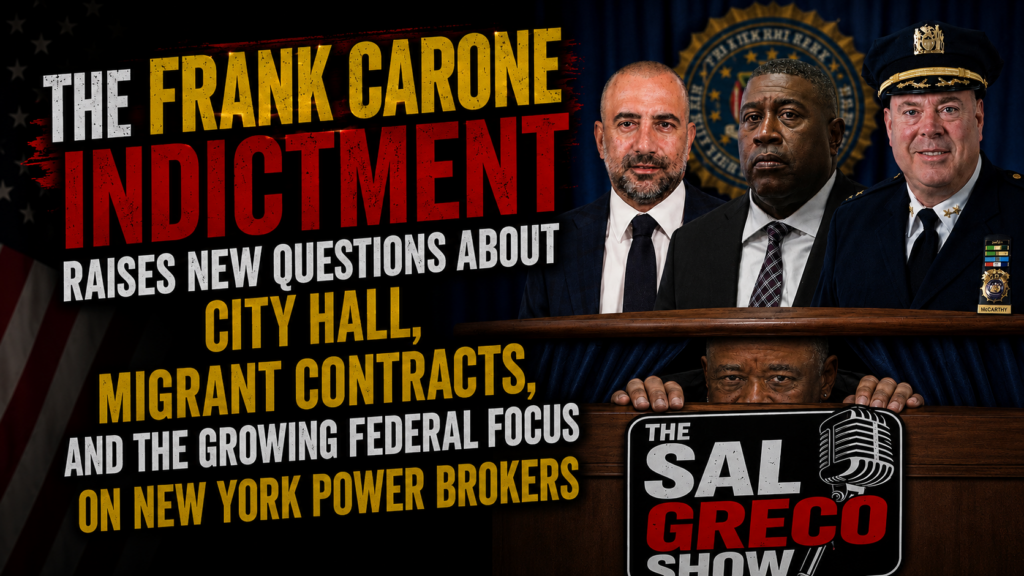
BY SAL GRECO
The federal indictment of former New York City Chief of Staff Frank Carone represents one of the most significant corruption cases to emerge from the Eric Adams administration to date. While the allegations remain unproven and Carone is presumed innocent unless and until convicted, the detailed charging document paints a troubling picture of how prosecutors believe political influence, personal relationships, and taxpayer-funded migrant shelter contracts intersected during one of the most chaotic periods in modern New York City history.
According to federal prosecutors in the Eastern District of New York, Frank Carone, his brother Anthony Carone, hotel owner Yan Po Zhu, and business manager Crystal Chen participated in a scheme in which a Long Island City hotel known as the Microtel allegedly received favorable treatment in obtaining a migrant shelter contract after city officials had repeatedly rejected the location.
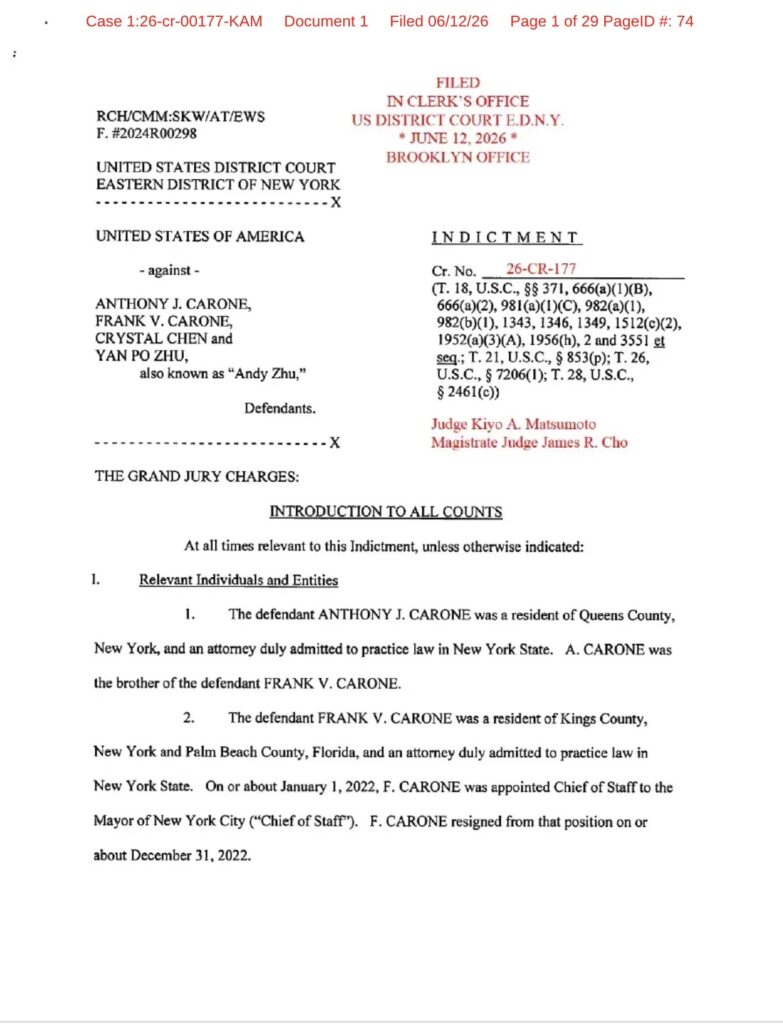
The indictment alleges that the hotel was initially deemed unsuitable by Department of Social Services personnel. Prosecutors claim that despite objections from professional staff, Frank Carone used his position as Chief of Staff to pressure decision-makers into reconsidering the property. The federal government further alleges that approximately $120,000 in bribe payments were disguised as legal fees and funneled through a law firm account controlled by Anthony Carone before ultimately benefiting Frank Carone.
Federal prosecutors also allege that the shelter contract generated approximately $6.8 million for the hotel owners and that efforts were later undertaken to conceal the nature of the payments once subjects became aware of a federal grand jury investigation.
Perhaps most damaging for those charged is the level of detail contained within the indictment itself. Prosecutors cite text messages, emails, financial transactions, photographs of social gatherings, and internal discussions among city personnel. The indictment alleges that career staff repeatedly resisted approval of the Microtel project while City Hall officials continued pressing for the property.
Frank Carone’s attorney Arthur Aidala gave a statement to the media. “Today’s indictment is a sad day for our criminal justice system. It epitomizes the government first finding a target and then spending three years and enormous taxpayer resources to find a crime. After intense investigations over many years, all the government was able to come up with was this weak indictment based on purely circumstantial evidence that’s not worth the paper upon which it’s printed. Everyone who knows the Carone brothers knows they do things the right way; that’s why it took over three years for them to come up with something that they could put on paper. We look forward to appearing before a jury and obtaining a swift acquittal.”
If these allegations are ultimately proven in court, they would represent not merely a case of bribery but a case involving the manipulation of public resources during an unprecedented migrant crisis that cost taxpayers billions of dollars.
The Question Hanging Over City Hall
One of the unavoidable questions arising from this indictment is how a scheme of this magnitude could allegedly occur within the Mayor’s Office without broader scrutiny.
Federal prosecutors have charged Frank Carone individually. Eric Adams has not been charged in this case and there is currently no public allegation in the indictment that Adams participated in the alleged bribery scheme.
However, the political reality is that Carone was not merely another city employee. He was arguably the most influential figure in City Hall during the early months of the Adams administration. Carone served as Adams’ Chief of Staff and was widely viewed as one of the mayor’s closest confidants and most powerful advisers.
As a result, many observers are likely to ask whether others knew what was occurring, whether warning signs were ignored, and whether additional investigations remain ongoing.
Those questions become even more significant when viewed alongside other federal investigations and prosecutions involving individuals connected to the Adams administration and New York City’s migrant shelter system.
The Kevin Taylor Prosecution and the Shelter Contract Web
The indictment arrives amid growing federal scrutiny of migrant shelter contracts.
Former NYPD Inspector Kevin Taylor was recently charged in connection with alleged misconduct involving migrant shelter contracting. While each case must be evaluated independently and defendants are entitled to the presumption of innocence, the emergence of multiple federal investigations involving shelter contracts raises obvious concerns about whether systemic vulnerabilities existed during the rapid expansion of emergency housing programs.
The migrant crisis created extraordinary pressure on city agencies. Billions of taxpayer dollars flowed through emergency programs. Contracts were awarded at unprecedented speed. Oversight mechanisms that ordinarily take months were often compressed into days or weeks.
Whenever large sums of public money move quickly through emergency procurement systems, corruption risks increase dramatically.
Federal prosecutors now appear to be examining exactly what happened during that period.
The NYPD Executive Raids Add More Questions
At the same time that the Carone indictment moves forward, federal attention appears to be expanding into the NYPD’s upper ranks.
Public reporting has indicated federal activity involving former Chief of Department Jeffrey Maddrey, current NYPD Assistant Chief James McCarthy, and former Deputy Commissioner Tarik Sheppard.
As of this writing, no criminal charges have been publicly announced against those individuals arising from the reported federal activity, and all remain entitled to the presumption of innocence.
However, the developments have intensified public scrutiny of NYPD leadership.
Particularly noteworthy is the status of James McCarthy.
Reports have indicated that federal investigators obtained McCarthy’s phone months before he was reportedly placed on modified assignment status by the NYPD. If true, a legitimate question arises: why was there no immediate administrative action at the time? Why was a senior executive apparently allowed to continue operating in a full-duty capacity while federal investigators were reportedly examining matters involving him?
Those questions do not establish wrongdoing. But they are questions that deserve answers.
The NYPD has historically moved quickly against lower-ranking officers who become subjects of criminal investigations. When executives appear to be treated differently, perceptions of unequal accountability naturally emerge.
The Maddrey Cloud Still Looms
Adding to the atmosphere surrounding these federal investigations is the continuing fallout from allegations involving former Chief of Department Jeffrey Maddrey.
For months, questions have persisted regarding overtime practices, management decisions, and allegations raised publicly through various media outlets.
While some allegations remain disputed and unproven, the broader issue is that public confidence suffers when questions linger without clear answers.
The same can be said for numerous controversies involving departmental leadership over the past several years.
The Paul Saraceno Files and the Question of Accountability
Recent reporting by The Sal Greco Show on SalGreco.Com concerning what have become known as the “Paul Saraceno Files” has focused attention on how internal investigations are conducted within the NYPD.
Those reports have raised questions regarding overtime oversight, investigative priorities, and whether certain lines of inquiry were pursued aggressively while others were not.
Whether one agrees with those conclusions or not, the central theme is difficult to ignore: many New Yorkers increasingly believe there are different rules for executives than for rank-and-file employees.
The Carone indictment only intensifies that perception.
Federal prosecutors are alleging that high-ranking government insiders manipulated official processes for private benefit. If those allegations are proven, they will reinforce concerns that influence and access mattered more than merit and transparency.
Jessica Tisch and the Future of Reform
Another question circulating within law-enforcement circles concerns Police Commissioner Jessica Tisch.
There is currently no public evidence establishing that Tisch directed any federal investigation or authorized federal raids. Federal investigations are conducted by federal agencies and prosecutors, not the NYPD.
However, if federal investigations ultimately expose misconduct among former or current NYPD executives, observers will inevitably ask what internal warning signs existed and how leadership responded.
Commissioner Tisch has repeatedly emphasized accountability and reform. The challenge now is that accountability must be perceived as applying equally at every level of the organization.
Public confidence depends on it.
Where This Goes Next
The Carone indictment may ultimately prove to be only one chapter in a larger story.
Federal investigations often unfold over years. Witnesses cooperate. Financial records are reviewed. Communications are analyzed. New evidence emerges.
What is already clear is that federal prosecutors devoted substantial time and resources to this case. The indictment suggests investigators examined text messages, emails, financial records, banking transactions, government communications, and personal relationships spanning multiple years.
That level of effort indicates investigators viewed the matter as serious.
Whether additional charges emerge against other individuals remains to be seen.
For now, the allegations remain allegations.
But the broader questions raised by the indictment are real.
How did a rejected hotel allegedly become a multimillion-dollar city contractor?
How did taxpayer money become entangled with alleged bribery payments?
Why did repeated objections from professional staff allegedly fail to stop the process?
And perhaps most importantly: if federal investigators continue climbing the ladder of influence within City Hall and the NYPD, where does that trail ultimately lead?
The answers to those questions may define the next chapter of New York City’s corruption story.