
Republicans lost the House and Senate amid anger over the Iran war, the economy and gas prices. But the political influencer machine that helped shape MAGA’s message deserves its own reckoning.
BY SAL GRECO | SALGRECO.COM
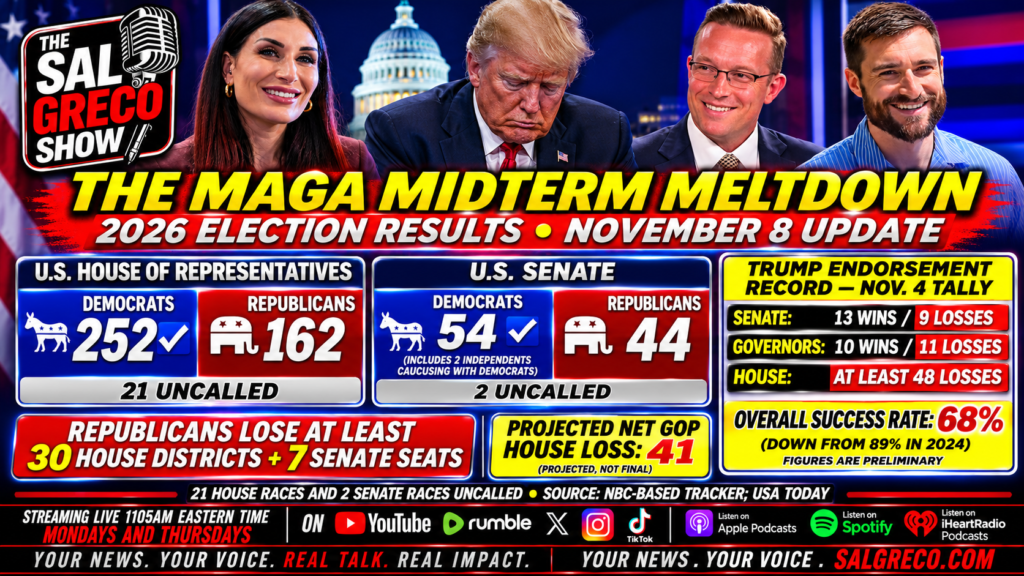
The Republican Party didn’t merely have a bad Tuesday. On November 3, voters delivered a political beating that stripped Republicans of control of both the House of Representatives and the Senate. Democrats won in places Republicans once considered secure, and Donald Trump’s carefully cultivated image as the ultimate political kingmaker took a serious hit.
There is no mystery about some of the causes. The war with Iran, rising gasoline prices, inflation, affordability, broken promises and frustration with Washington weighed heavily on voters. Even Trump acknowledged that the war and its effect on gas prices hurt Republicans. The election was, in substantial part, a rejection of the results people were seeing in their everyday lives. Reuters reported on a MAGA coalition increasingly angry with its own leadership.
But one major issue deserves far more attention than it is receiving: social engineering and perception management by the very online personalities who claim to speak for MAGA.
They are not the sole reason Republicans lost. There is no credible evidence proving that one influencer or any single online campaign caused the electoral collapse. But ignoring the consequences of years of outrage-based messaging, narrative control and celebrity-driven political access would be another costly mistake.
LOOMER’S ALLEGED PAY-TO-POST OPERATION: WHO WAS BUYING THE MESSAGE?
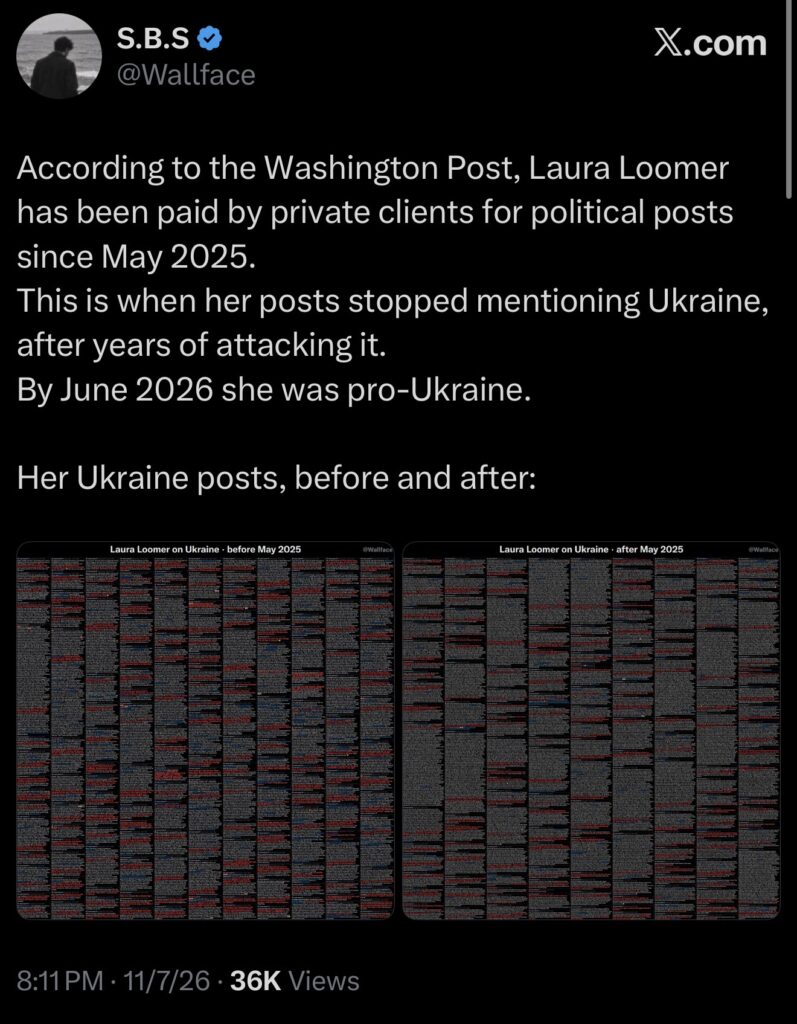
On November 7, The Washington Post reported allegations that Laura Loomer, one of Trump’s most prominent online allies, had received money from private clients to publish political messages on X without disclosing the financial arrangements to her roughly 1.9 million followers.
The newspaper said it reviewed transaction emails and a wire-transfer statement appearing to document four payments totaling more than $60,000 to Loomer or her Florida company, King Breaker Media, since May 2025. The records themselves did not identify what the payments purchased. Two people familiar with the arrangements told the newspaper that they were for political posts; sources also alleged prices of $3,000 to $5,000 or more per post.
Loomer denies that she is paid to tweet political opinions. She described her business as journalism, public affairs and opposition research and disputed the accounts of those who said they had paid her for posts. That denial matters, and the full terms of the arrangements have not been made public.
But so do the questions.
If political commentary was commercially commissioned, who were the clients? What positions did they want promoted? Which posts corresponded to which payments? Were readers told that money was involved? And were any clients seeking not merely a post, but a route into the president’s information stream?
The distinction is enormous. A genuinely held opinion is one thing. A message delivered as independent political conviction when it may actually be a paid assignment is something else entirely. It is perception management presented as grassroots enthusiasm.
This is not a declaration that Loomer committed a crime. The Federal Trade Commission says its rules for commercial endorsements do not give it jurisdiction over political advertising. Whether any particular payment created a disclosure obligation under some other law depends on facts and rules that have not been established here. But legality is not the same as transparency, and political audiences deserve both.
SALGRECO.COM WARNED ABOUT THE INFORMATION PIPELINE
Readers of SalGreco.com should recognize this broader problem. Months before the latest payment allegations, I was writing about the manipulation of public perception by political influencers, partisan media and the echo chambers around elected officials.
In my August article, From Bold to Routine: Has Donald Trump Lost Touch With the Electorate That Put Him Back in the White House?, I specifically challenged Loomer’s extraordinary access to Trump and warned about an information pipeline in which virality can be mistaken for expertise.
In Left vs. Right: Social Engineering, Zohran Mamdani and the Media’s Responsibility to Be Fair, I explained how selectively amplified information, anger and repetition can steer an audience toward a predetermined conclusion. My examination of the New York Post’s coverage of Mamdani made the same point: perception can be engineered even without fabricating an individual fact.
Those articles did not establish knowledge of Loomer’s particular financial transactions before The Washington Post’s report. They identified the system in which undisclosed paid political messaging, if substantiated, could thrive. That distinction is important. The warning was about the machine. Now the public is getting a closer look at how parts of that machine allegedly make money.
THE ULTIMATE INDIGNITY: A FELLOW MAGA CONSULTANT CALLS HER OUT
Perhaps the most revealing part of this dispute is who brought it into the open: Alex Bruesewitz, an adviser to Trump’s 2024 campaign and the founder of political consulting firm X Strategies.
During a public X feud after the midterms, Bruesewitz asserted that he had previously paid Loomer for tweets. Mediaite documented the exchange. He subsequently told The Washington Post that his firm had paid her in 2025 for posts about policy issues, while declining to name the clients. Loomer countered that the work involved producing and distributing research, not selling her opinions.
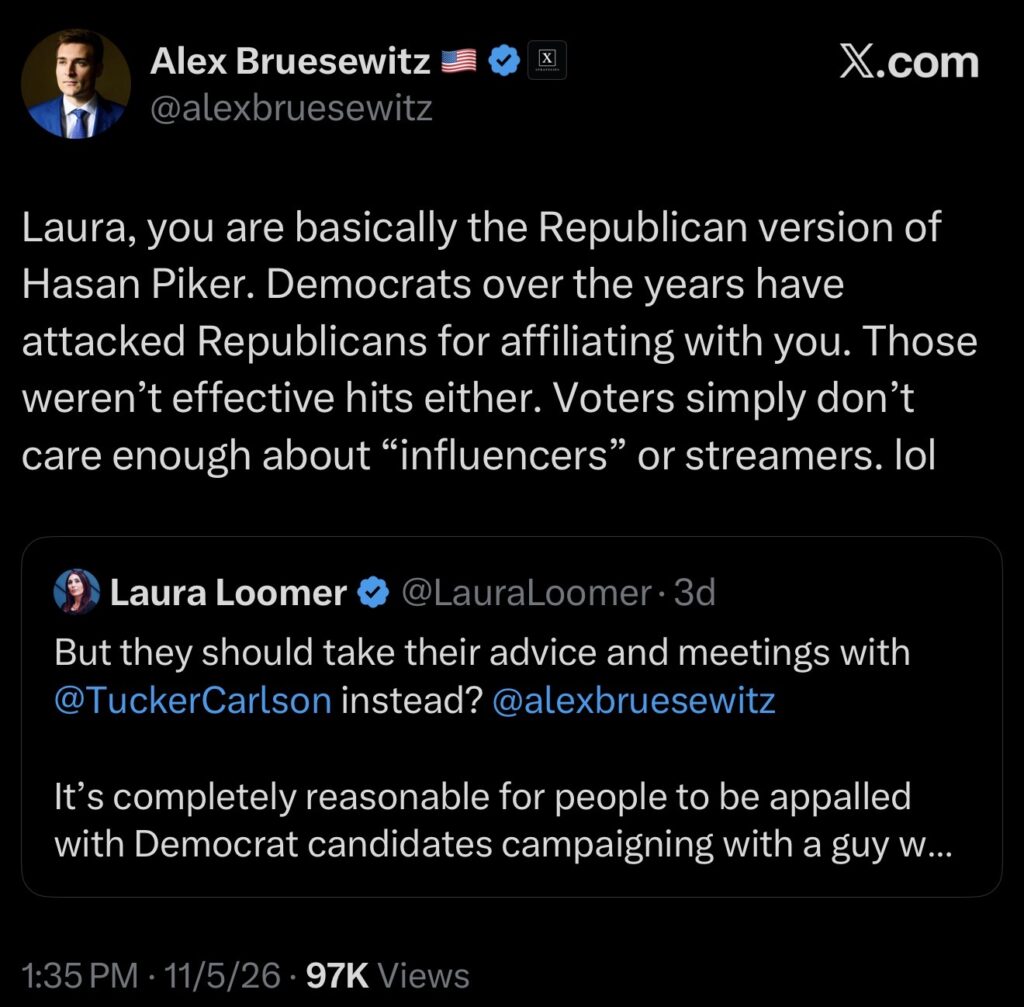
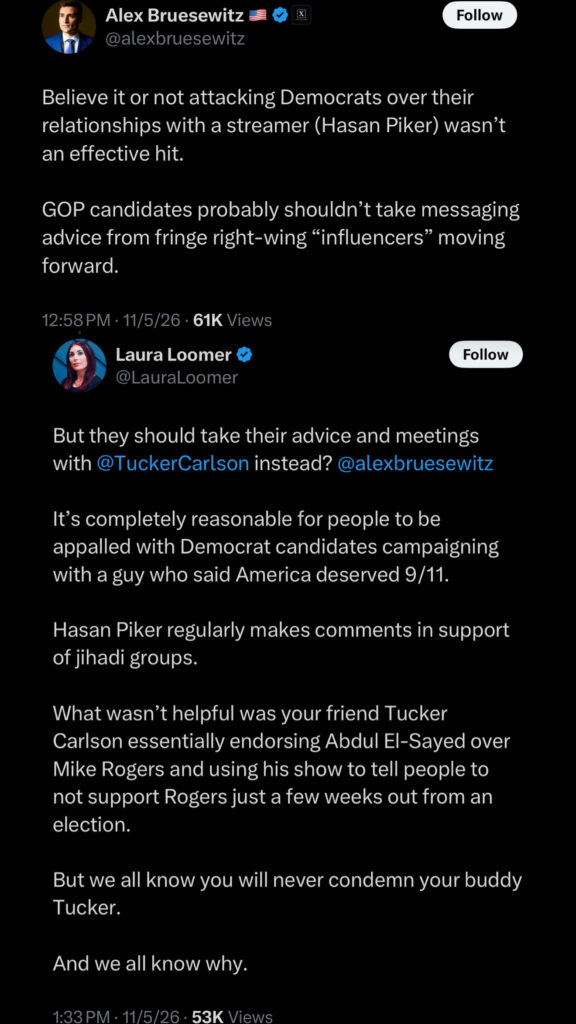
Consider the spectacle: a political consultant who acknowledges arranging paid messaging now publicly raises concerns about someone else’s alleged paid messaging. Bruesewitz himself says the influencer-payment business needs clearer disclosure. Fine. Then the same standard should apply across the entire political consulting industry, including his own firm and its clients.
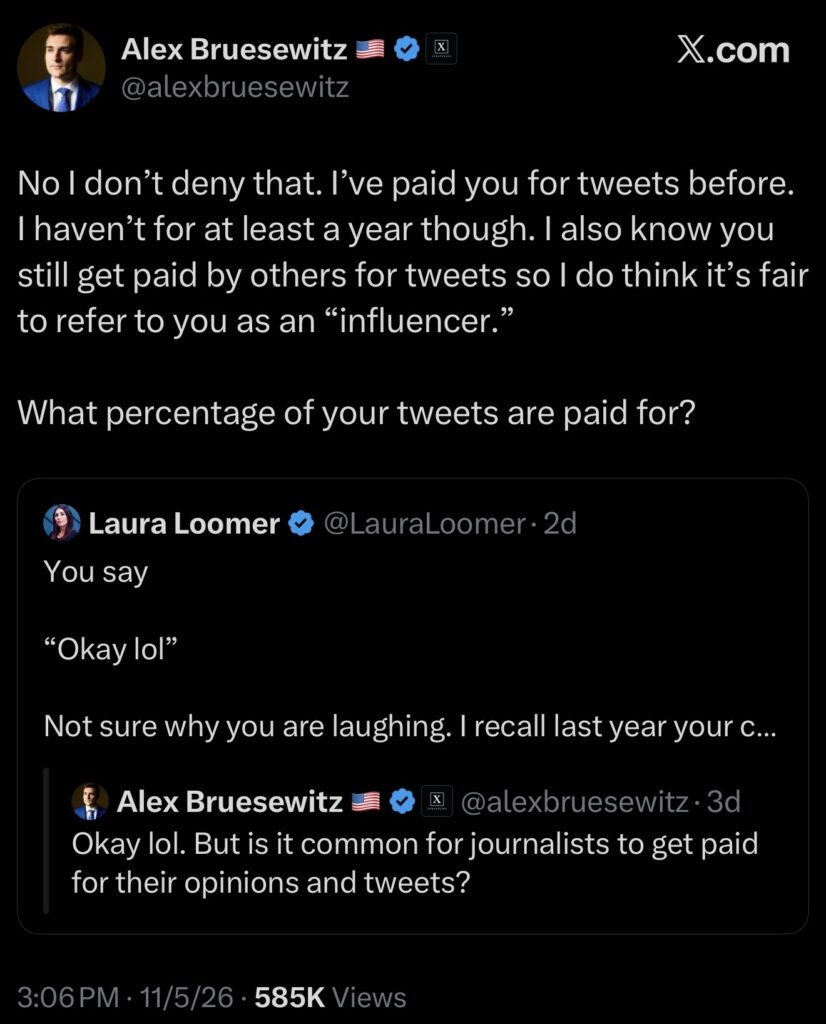
That is the ultimate indignity for a movement that sells itself as a crusade against hidden interests: two prominent figures from the same political-media ecosystem fighting over the machinery of influence, while millions of ordinary voters were left wondering whom they could trust.
BENNY JOHNSON, TALKING POINTS AND THE COST OF ALWAYS SELLING THE NARRATIVE
The problem is larger than Loomer or Bruesewitz. Look at the way influencers such as Benny Johnson package politics for mass consumption. On election night, Johnson celebrated a Republican result in Guam as an encouraging sign, even as the national story was becoming a devastating Democratic sweep. His election-night commentary was publicly reported.
An influencer is entitled to be partisan, make predictions and get them wrong. That alone is not proof of a hidden payment or coordinated deception, and I am not alleging Johnson was paid to make that particular claim. But the incident illustrates a persistent defect in the political-content business: select the most emotionally useful talking point, present it as momentum, keep the audience engaged—and deal with reality later.
Whether the influencer is on the right or left, this is how a narrative can begin to replace reporting. The same phrases ricochet across accounts. Fear gets engagement. Outrage brings clicks. A politician’s enemies become a daily emergency. Contradictory facts receive a fraction of the attention.
That is not an informed electorate. That is an audience being managed.
HOW A TWICE-DEFEATED CANDIDATE ENDED UP WITH THE PRESIDENT’S EAR
Loomer ran unsuccessfully for Congress in Florida in 2020 and 2022. Her media rise was intertwined with outlets such as Alex Jones’s Infowars and with political connections including Roger Stone, who backed her 2020 campaign. Those relationships are documented, although it would be simplistic to credit any two men exclusively for her large following.
Today, the former candidate commands an audience approaching two million on X and has had direct access to the president. The Washington Post reported that she met privately with Trump in the Oval Office and that Trump acknowledged she had made recommendations involving personnel, some of which he sometimes considered. Imagine that transformation: someone who could not win a congressional seat nevertheless became an influential voice in the orbit of the most powerful office in America.
There is nothing inherently illegitimate about a citizen gaining access to a president. The problem arises when the political value of access, the financial value of an online following and the independence of the messaging become difficult to separate.
In my judgment, the constant fearmongering, loyalty tests, personal attacks and online spectacles associated with parts of this ecosystem have helped damage MAGA’s public reputation. That is political criticism, not a claim that one individual can be assigned a measurable share of Tuesday’s losses.
UKRAINE: A REVERSAL, A RED-CARPET VISIT AND UNANSWERED FINANCING QUESTIONS
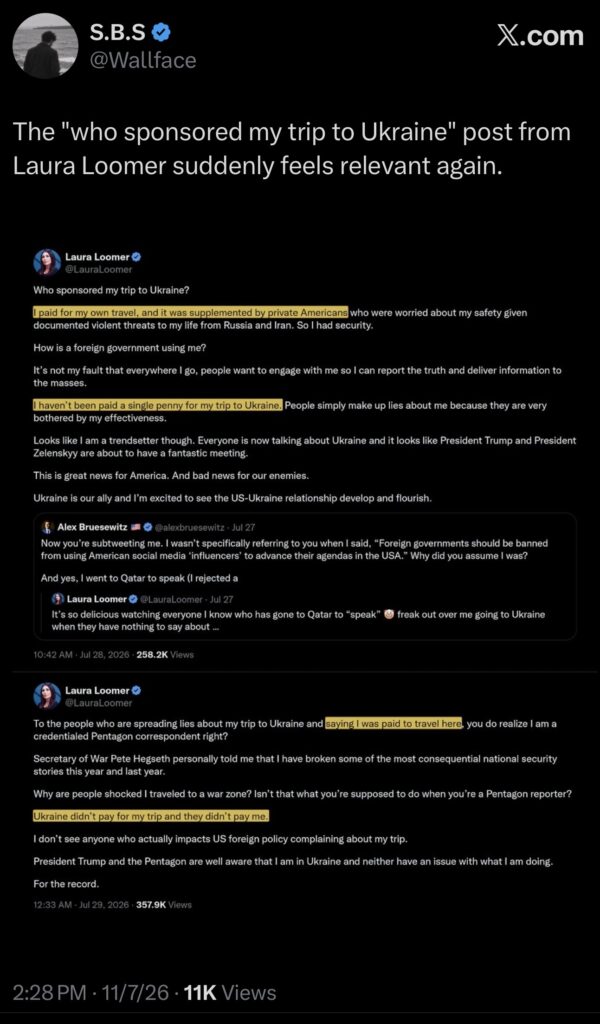
Then consider Loomer’s highly publicized July trip to Ukraine. After years of attacking Ukrainian President Volodymyr Zelenskyy and criticizing American support for Ukraine, Loomer traveled to Kyiv, interviewed Zelenskyy and returned publicly more sympathetic to the Ukrainian position. She said exposure to Russian propaganda had misled her earlier views.
People are allowed to change their minds—especially after seeing a war firsthand. But when a highly influential political personality makes such a dramatic reversal after a carefully arranged international visit, transparency about who organized and financed the trip is a reasonable public-interest question.
Puck reported that Loomer said she paid for her airfare but did not identify who covered other travel-related expenses. The Washington Post later reported that Loomer said unnamed American donors helped with security expenses. She denied receiving money from the Ukrainian government or other foreign sources. Nothing in the reporting establishes that Ukraine secretly paid her to change her position.
Still, readers have legitimate questions: Who were those donors? Who paid for ground transportation, lodging, production and security? Who arranged the official meetings? Were any funders or intermediaries seeking to influence the message reaching American conservatives or President Trump?
That is not an accusation dressed up as a question. It is a call for the same disclosure standards that should apply to any influential political commentator, regardless of whether I agree with the message they eventually deliver.
FOLLOW THE AMPLIFICATION—AND THE MONEY
Watch which accounts large influencers repeatedly repost. Some supposedly “small” accounts in political circles have around 100,000 followers—large enough to offer reach and value, but small enough to benefit enormously from a boost by a megaphone with millions of followers.
That is the business logic worth examining. What earns a repost? Genuine journalistic merit? Personal loyalty? Reciprocal promotion? A consulting relationship? Direct payment? A common client? And what happens to an independent account with a few hundred or a few thousand followers and no useful connection?
My criticism is that too much of this ecosystem appears designed around influence and profitability, rather than discovering and elevating worthy reporting. A repost pattern or a follower count, by itself, does not prove somebody was paid. Investigators and reporters would need contracts, communications, financial records or corroborating testimony to establish that. But a transparent industry should be willing to explain its commercial relationships without waiting to be dragged into the open.
TRUMP’S ENDORSEMENTS COULD NOT SAVE THE GOP
The ballot box is the ultimate reality check. Ballotpedia’s running endorsement tracker currently lists Trump’s 2026 general-election endorsement success rate at 68%, compared with 89% in 2024 and 84% in 2022. That percentage includes candidates in safe Republican seats and may change as remaining results are finalized; it is not a measure of success exclusively in competitive races.
What matters most is where the losses happened. Trump-backed Republicans lost high-profile Senate contests in Texas, Ohio, Iowa, Kansas, Michigan and North Carolina, among others. Democrats captured the House and Senate. The Associated Press’s election analysis underscored the political consequences of unpopular policies, rising costs and questionable candidate choices.
You can have millions of followers, a flood of favorable posts, carefully repeated talking points and the president’s personal endorsement. None of it guarantees that the person buying groceries or gas believes you anymore.
MAGA DOESN’T NEED MORE PERCEPTION MANAGEMENT. IT NEEDS ACCOUNTABILITY.
The Iran war matters. Gasoline prices matter. Rent, groceries, wages, economic security and candidate quality matter. A president’s decisions matter far more than any influencer’s posts. Those must remain at the center of the Republican Party’s reckoning.
But social engineering belongs on that list, too. A movement promising to expose powerful interests cannot ignore the possibility that its own information channels are being monetized by people who present themselves as independent truth-tellers. It cannot substitute a viral personality for an informed adviser, or a narrative for results. And it cannot keep calling every unwelcome fact a betrayal.
Let the receipts come out. Identify the clients where disclosure is required or ethically warranted. Label commercially sponsored political messaging. Disclose material travel sponsors. Ask the same questions of the right, the left and everyone in between.
Laura Loomer is entitled to answer the allegations against her, and those answers must be reported fairly. Alex Bruesewitz, Benny Johnson and every other powerful political communicator deserve scrutiny according to evidence, not guilt by association. The president’s decisions remain his responsibility. And the electorate deserves to know when someone is informing it—and when someone may be trying to sell it a conclusion.
MAGA was not decimated by a single social engineer. But a political culture addicted to engineering perception may have helped leave the movement unable to see its own collapse coming.
© 2026 SalGreco.com | The Sal Greco Show — Independent Journalism. Your News. Your Voice.