
BY SAL GRECO
Another lawsuit. Another allegation of retaliation. Another NYPD member whose career, reputation and future employment opportunities may hang on the actions of the very internal disciplinary system that is supposed to ensure fairness and integrity.
And once again, Police Commissioner Jessica Tisch is at the top of the Department while it is happening.
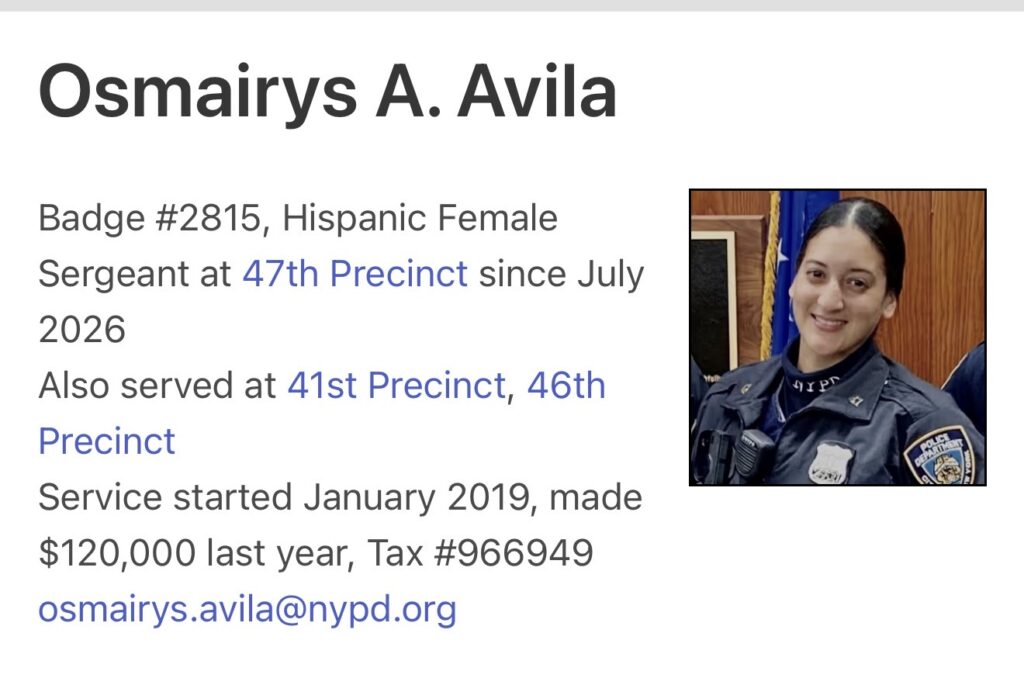
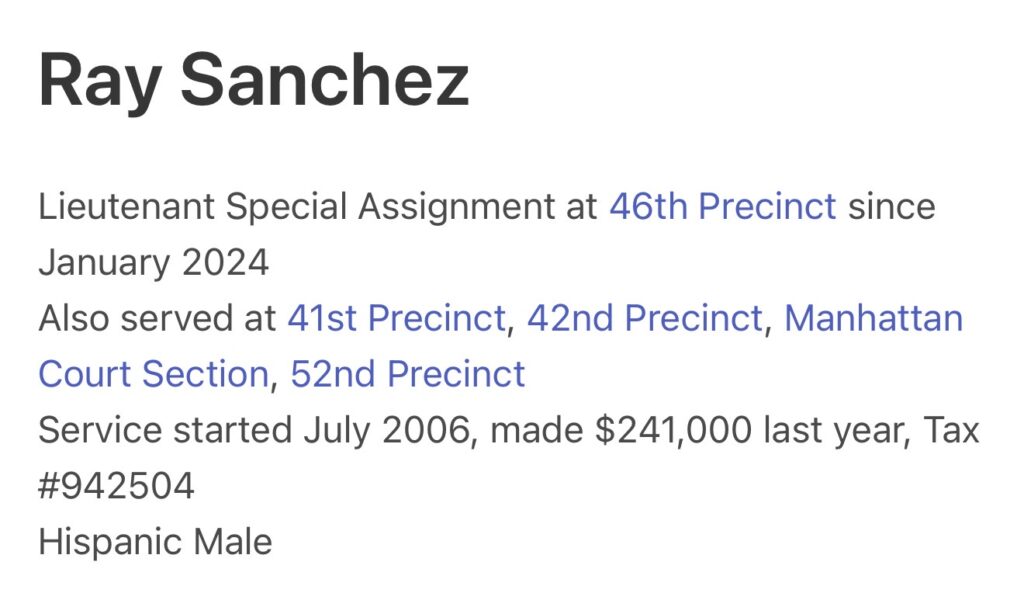
The latest lawsuit involving NYPD Sergeant Osmairys A. Avila and retired Lieutenant Special Assignment Ray Sanchez raises a question that should concern every active and retired member of the New York City Police Department:
When does accountability stop being accountability and become punishment by process?
That distinction matters.
An allegation is not a finding of guilt. An Internal Affairs investigation is not a conviction. Department charges are not an adjudication.
Yet according to this newly filed lawsuit, unresolved accusations were allegedly enough to follow Sanchez out the door after more than twenty years of NYPD service and affect the credentials and documentation that can be critically important to a retired law-enforcement officer.
That should terrify anyone wearing the uniform.
From Sexual-Harassment Allegations to Another Internal Affairs Battle
The lawsuit did not materialize in a vacuum.
Avila previously joined Police Officers Pamela Sosa and Brittany N. Romero in litigation alleging sexual harassment, discrimination and retaliation stemming from the NYPD’s 46th Precinct.
The latest complaint alleges that after Avila exercised her rights and sued the City, Commissioner Jessica Tisch and Deputy Inspector Juan Moran, the Department resurrected historical allegations involving Avila’s consensual relationship with Sanchez and Sanchez’s attendance-recording practices.
According to the complaint, the relationship had already been investigated in 2025. It further alleges Avila did not work directly under Sanchez and that the attendance allegations did not accuse Sanchez of failing to work or getting paid for work he never performed.
Nevertheless, the allegations resurfaced.
That is where this story becomes about something much larger than Avila and Sanchez.
It becomes about the enormous power an institution possesses when it controls not only the investigation, but the disciplinary process, the employee’s status and ultimately the paperwork that follows that employee into retirement.
Internal Affairs Is Supposed to Find the Truth
Internal Affairs has a legitimate and necessary purpose.
No police department can function without an independent mechanism for investigating corruption and misconduct.
But that enormous authority creates an equally enormous responsibility.
According to the complaint, investigators attempted on July 29, 2026, to question Avila and Sanchez simultaneously at separate locations using approximately twenty predetermined questions concerning overlapping subjects.
Even more troubling, the plaintiffs allege investigators planned to communicate through WhatsApp during the interviews, compare the two officers’ answers in real time, identify discrepancies and potentially use those inconsistencies as a disciplinary predicate against Sanchez shortly before his retirement.
Those are allegations, and they have not been proven.
But consider what is being alleged.
This wasn’t simply an accusation that investigators asked difficult questions.
The plaintiffs are alleging that historical matters were resurrected and a coordinated investigative process was constructed in an effort to generate disciplinary exposure.
The complaint alleges the process ultimately failed to produce the discrepancy investigators sought and that Sanchez was not suspended before his retirement became effective.
But the story didn’t end at retirement.
That’s where it becomes even more disturbing.
The Punishment That Can Follow You Out the Door
Sanchez retired effective August 11, 2026, after serving the NYPD for more than twenty years.
According to the complaint, no court, administrative tribunal or other adjudicative body had sustained the allegations involved in the revived investigation when he retired.
No hearing had found that Sanchez improperly fraternized with Avila.
No hearing had found that he made a false statement.
No hearing had found that he failed to work an assigned tour, received compensation for time he did not work or committed misconduct through manual attendance entries.
The allegations remained allegations.
Yet three days after his retirement became effective, Sanchez reported to One Police Plaza to complete his retirement processing.
According to the lawsuit, he spent approximately five hours waiting while other retirees came and went.
He was eventually told Internal Affairs had placed a hold on his retirement documents.
And when he finally left?
The lawsuit alleges Sanchez received only a restricted retired NYPD identification card prominently marked:
“No Firearm.”
His unrestricted retired identification card was allegedly withheld.
His H.R. 218-related documentation was allegedly withheld.
And his Good Guy Letter was withheld.
The stated reason, according to the complaint?
He had “retired pending charges.”
Think about those three words.
Retired pending charges.
Not convicted.
Not found guilty.
Not adjudicated responsible.
Pending.
And yet the consequences can be immediate.
The “Good Guy Letter” Is Anything But Just a Piece of Paper
People outside law enforcement may hear “Good Guy Letter” and think this is some ceremonial document handed to a retiring cop.
It isn’t that simple.
For someone who spent a career in law enforcement, retirement credentials and accompanying documentation can have consequences far beyond sentimentality.
The complaint cites the federal case Perros v. County of Nassau, arguing that the court recognized a Good Guy Letter as a meaningful law-enforcement retirement benefit upon which other benefits can depend.
The complaint also points to the court’s recognition that restrictive retirement credentials can visibly communicate that a former officer cannot carry a firearm — creating what the plaintiffs in that litigation characterized as a “scarlet letter.”
That description is painfully accurate.
Because for a career police officer, that scarlet letter can extend well beyond the Department.
You’ve spent twenty years — sometimes thirty — accumulating qualifications that most people will never possess.
Investigative experience.
Firearms training.
Supervisory experience.
Emergency response experience.
Knowledge of criminal investigations.
Courtroom experience.
Threat assessment.
Protective operations.
Security experience.
Leadership.
Then suddenly you’re looking for employment in the private sector.
Executive protection.
Corporate security.
Investigations.
Armed security.
Government contracting.
Security management.
And what happens when a potential employer wants your retired police credentials or asks about your standing when you left the Department?
That little piece of plastic and that supposedly insignificant piece of paper suddenly aren’t so insignificant anymore.
I Know What That Does to Someone
This part of the story isn’t theoretical to me.
I lived it, and still am.
I spent fourteen years in the NYPD.
I built a law-enforcement career. I accumulated experience, training and qualifications that were supposed to mean something when my time with the Department eventually ended.
Then the Department took that career away.
And when you leave law enforcement under a cloud created by the Department — especially without the credentials and documentation normally associated with leaving in good standing — you discover very quickly how much power the NYPD retains over your life even after you are no longer walking into an NYPD command every day.
Your résumé can say whatever it says.
Your qualifications can be extensive.
Your experience can be undeniable.
But prospective employers in the law-enforcement and security world want to know something else:
How did you leave?
Where is your retired ID?
Where is your Good Guy Letter?
Can you carry?
Did you leave in good standing?
Those questions can erase years of experience in seconds.
I know because I’ve experienced what happens when the career you spent years building suddenly becomes extraordinarily difficult to translate into another law-enforcement or security opportunity.
That is why I refuse to dismiss the Good Guy Letter issue as bureaucratic paperwork.
It can affect a person’s livelihood.
It can affect professional reputation.
It can affect earning capacity.
It can affect the ability to take the very jobs for which decades of law-enforcement service supposedly prepared that person.
The complaint makes essentially that same point, alleging that the actions involving Sanchez resulted in economic loss, reputational injury, impairment of professional standing and interference with retirement rights and benefits.
Accusation Cannot Become the Sentence
This may be the most important issue in the entire lawsuit.
The government absolutely has the authority to investigate its employees.
The NYPD has the authority to bring disciplinary charges.
Internal Affairs should investigate legitimate allegations wherever the evidence leads.
But there is an enormous difference between investigating an allegation and using the existence of an allegation as the punishment itself.
The complaint puts that distinction directly at issue.
It alleges that merely labeling Sanchez as having “retired pending charges” did not magically transform unresolved accusations into proven facts, yet the City and Tisch allegedly used those unresolved allegations to affect his retirement status, credentials, benefits and future economic interests.
That distinction should be obvious.
Otherwise, the Department doesn’t have to prove anything.
It only has to keep an investigation alive long enough.
Think about how dangerous that concept is.
Open a case.
Keep allegations pending.
Allow retirement to arrive before adjudication.
Then use the existence of those pending allegations to deny or restrict retirement credentials.
The process itself becomes the punishment.
And once that happens, guilt or innocence almost becomes secondary because the professional damage may already have occurred.
How Many Times Does This Have to Happen Under Jessica Tisch?

Jessica Tisch cannot personally conduct every Internal Affairs interview in an organization as large as the NYPD.
But she is the Police Commissioner.
The buck eventually has to stop somewhere.
This lawsuit specifically names Tisch and alleges that the City and Commissioner used unresolved allegations to restrict Sanchez’s retirement credentials and impair rights and benefits associated with more than twenty years of service.
Those allegations still have to be proven.
But they arrive amid a seemingly endless stream of NYPD litigation, retaliation allegations, disciplinary controversies and complaints about selective enforcement.
At some point leadership cannot continue treating every controversy as an isolated incident involving somebody several levels down the organizational chart.
Leadership establishes culture.
Leadership establishes safeguards.
Leadership determines whether Internal Affairs is fiercely independent or susceptible to command influence.
Leadership determines whether whistleblowers believe reporting misconduct will protect them — or put a target on their backs.
And leadership determines whether retirement procedures are administrative functions or another opportunity to exercise disciplinary leverage.
If these allegations are substantiated, the question shouldn’t merely be, “What happened to Ray Sanchez?”
The question should be:
How was the system capable of allowing it to happen?
The Never-Ending Cycle
That is what bothers me most.
It’s the cycle.
Someone reports misconduct.
The Department investigates.
Then suddenly the complainant, witness, associate, partner or person standing nearby finds themselves under scrutiny.
Old allegations resurface.
Internal Affairs becomes involved.
Charges remain pending.
Careers become jeopardized.
Retirement arrives.
Credentials get restricted or withheld.
And years later everyone meets in a courtroom while taxpayers pay lawyers to sort out what should have been handled fairly inside the Department in the first place.
Then everyone acts surprised when NYPD members become afraid to speak.
Why wouldn’t they be?
If an officer believes reporting misconduct could result in Internal Affairs looking backward through his or her entire career — or potentially reaching a spouse, partner, friend or colleague — silence becomes the safest career decision.
That is poisonous to a police department.
You cannot demand integrity while creating a culture in which people believe honesty could destroy their careers.
A Badge Has an Expiration Date. Your Life Doesn’t.
There is something police executives too often seem to forget.
Eventually everyone takes the uniform off.
Behind every shield number is a human being who has to build a life afterward.
People have mortgages.
Families.
Children.
Retirement plans.
Career plans.
They expect decades of training and experience to provide opportunities when police work ends.
When an institution can place a permanent question mark over someone’s professional reputation through unresolved accusations, that person’s punishment doesn’t necessarily end when he walks out of One Police Plaza.
It may only be beginning.
That’s why the Good Guy Letter matters.
That’s why the retired ID matters.
That’s why due process matters.
And that’s why this latest lawsuit deserves attention far beyond the 46th Precinct.
The allegations against the City, Jessica Tisch and the other defendants have not been adjudicated, and they are entitled to respond.
But the underlying policy question exists regardless of how this particular lawsuit ultimately ends:
Should an accusation alone have the power to destroy the value of a law-enforcement career before that accusation has ever been proven?
For anyone who spent years wearing a badge, the answer should be obvious.
An investigation should determine the truth.
It should never become the punishment.
And a system designed to police misconduct should never be allowed to become a system capable of destroying someone’s life simply because it can.
After twenty years of service, a person’s future should not be reduced to three words: “retired pending charges.”
Because once accusation becomes punishment, Internal Affairs isn’t protecting the integrity of the Department anymore.
It’s protecting the power of the institution.