
BY SAL GRECO
For years, the New York City Police Department has repeatedly emphasized that it has embraced a new era of “transparency” and “accountability.” Under Police Commissioner Jessica Tisch, those promises have continued, with the Department frequently touting public access to disciplinary records, trial decisions, and officer profiles.
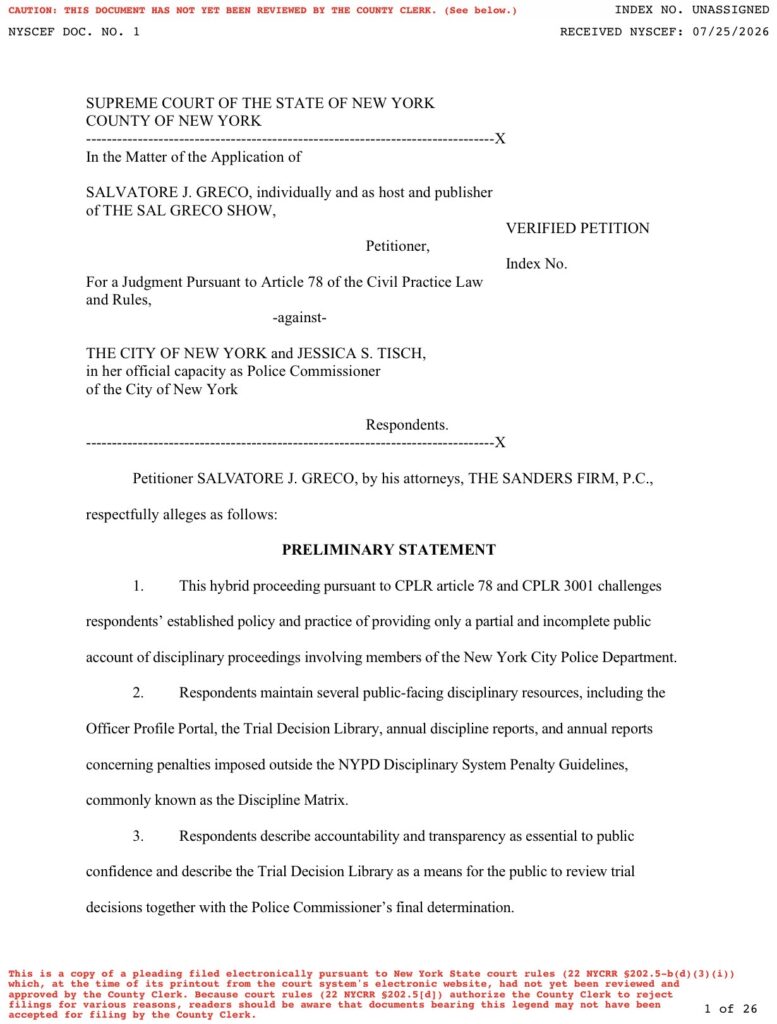
Now, however, The Sal Greco Show has filed legal action seeking records it argues should already be public, raising broader questions about whether the NYPD’s commitment to transparency extends beyond carefully curated statistics and public relations messaging.
At the heart of the lawsuit is a straightforward question:
If the NYPD says disciplinary outcomes are public, why must a news organization go to court to obtain them?
An Article 78 Proceeding Seeks Court Intervention
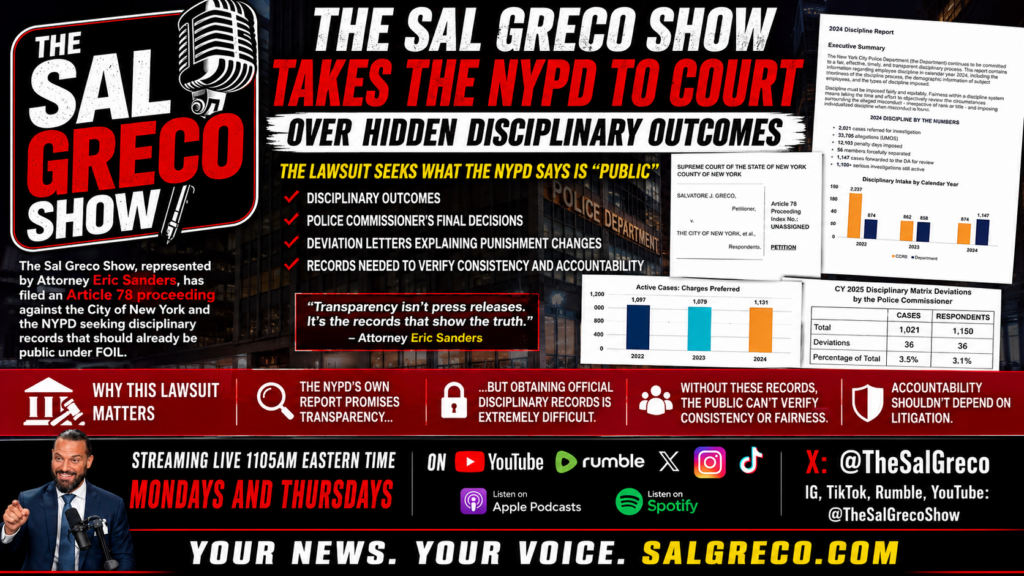
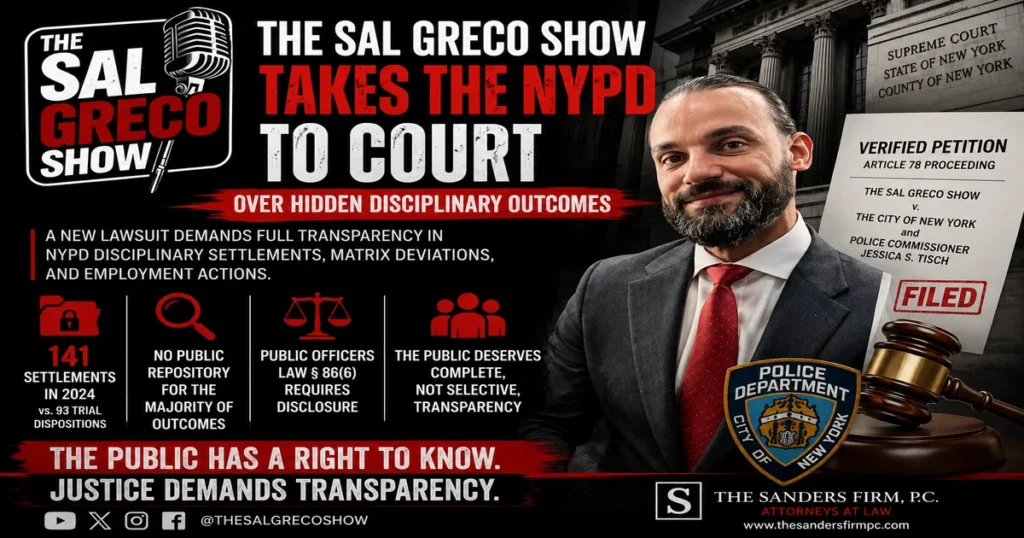
Represented by attorney Eric Sanders, The Sal Greco Show has commenced an Article 78 proceeding against the City of New York and the NYPD seeking judicial intervention after requests for records relating to disciplinary outcomes were allegedly denied or not properly produced.
The lawsuit argues that records concerning disciplinary decisions are public records and should be produced pursuant to New York’s Freedom of Information Law (FOIL).
The filing comes amid increasing public debate surrounding police accountability and follows numerous high-profile NYPD disciplinary controversies that have dominated headlines throughout 2026.
Why These Records Matter
The NYPD publicly states that discipline is intended to promote:
- accountability,
- consistency,
- fairness,
- public confidence,
- and transparency.
The Department’s own 2024 Discipline Report states that discipline is imposed to maintain integrity and assure the public that employees are held accountable for misconduct. It also repeatedly highlights transparency as one of the Department’s goals.
The report further states that:
- disciplinary cases are ultimately decided by the Police Commissioner,
- written disciplinary information is intended to be publicly available,
- deviation letters explaining departures from disciplinary guidelines are posted publicly,
- and Officer Profile pages are supposed to disclose disciplinary outcomes.
Yet according to the lawsuit, obtaining the complete disciplinary outcome information has proven anything but simple.
What Eric Sanders Says
Attorney Eric Sanders argues that transparency is not achieved merely by publishing annual statistics or generalized reports.
According to Sanders, meaningful transparency requires that the public—and particularly journalists—be able to obtain the underlying disciplinary decisions that explain:
- what misconduct occurred,
- what punishment was imposed,
- whether the Police Commissioner modified recommendations,
- and whether similarly situated officers received similar treatment.
Without access to those records, Sanders argues, neither the media nor the public can meaningfully evaluate whether the NYPD is applying discipline consistently.
The NYPD’s Own Report Highlights the Importance of Transparency
Ironically, one of the exhibits attached to the litigation is the NYPD’s own 2024 Discipline Report.
That report repeatedly emphasizes transparency.
Among the report’s key statements:
- The NYPD says it remains committed to a fair, effective, timely and transparent disciplinary process.
- It notes that disciplinary outcomes are intended to assure the public that officers are held accountable.
- It states that the Police Commissioner makes the final disciplinary determination.
- It explains that written deviation letters are generated whenever discipline differs from the established matrix.
- It points to the Officer Profile Portal as a transparency initiative.
Those representations form part of the backdrop to the lawsuit.
The legal action essentially asks whether those transparency commitments are being fully carried out when members of the press seek the actual records documenting disciplinary decisions.
Police Commissioner Has Final Authority
One significant portion of the Discipline Report explains that, regardless of whether a case resolves through settlement or trial:
The Police Commissioner ultimately approves the final disciplinary determination.
That authority makes records concerning the Commissioner’s decisions particularly significant.
They allow the public to understand:
- whether recommended penalties were accepted,
- reduced,
- increased,
- or otherwise modified.
Those final outcomes can be important in evaluating consistency across cases.
Deviations From the Discipline Matrix
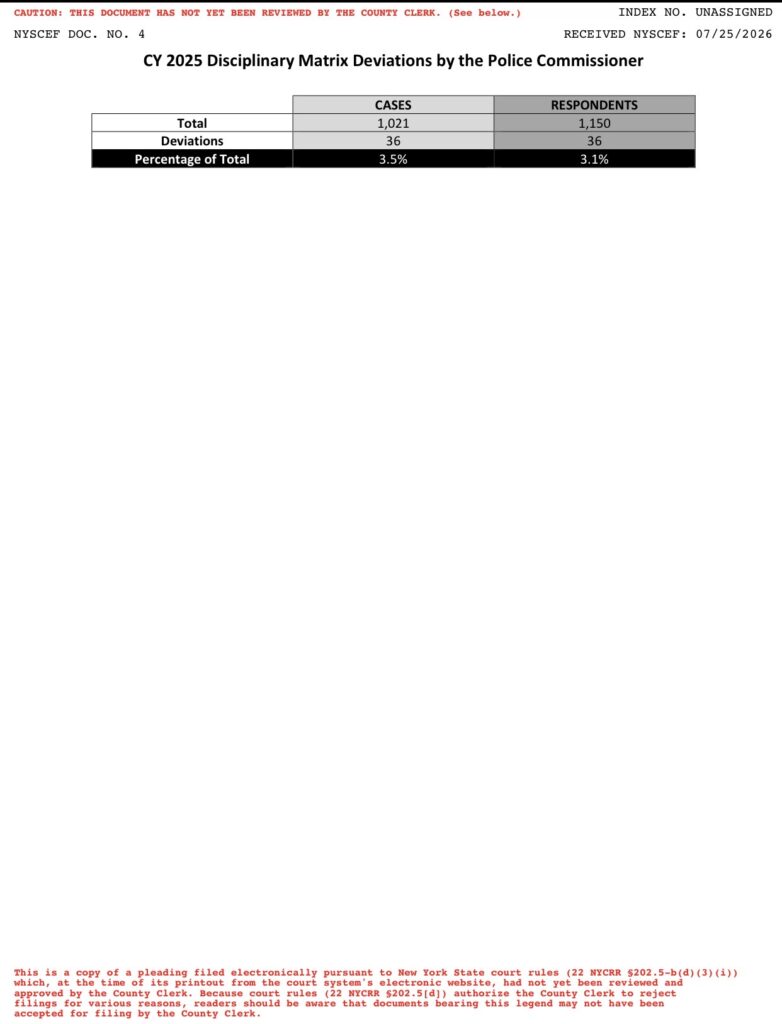
Another exhibit attached to the court filing summarizes deviations from the NYPD’s disciplinary matrix during calendar year 2025.
According to that exhibit:
- 1,021 disciplinary cases
- 1,150 respondents
- 36 deviations
- representing approximately 3.5% of cases and 3.1% of respondents.
While the percentage appears relatively small, deviation letters can be highly significant because they explain why discipline departed from standard guidelines.
Those explanations often provide insight into aggravating factors, mitigating circumstances, or discretionary decisions made by Department leadership.
Statistics Alone Do Not Tell the Full Story
The NYPD’s report contains numerous statistics regarding discipline.
Among them:
- 2,021 disciplinary cases were referred for investigation in 2024.
- 56 members of service were forcefully separated.
- 12,103 penalty days were imposed.
- Over 1,100 serious disciplinary investigations remained active at year’s end.
The report also details:
- trial outcomes,
- average prosecution times,
- disciplinary demographics,
- penalties,
- and disciplinary trends.
But statistics alone do not identify how individual disciplinary decisions were reached.
That distinction appears central to the litigation.
A Broader Transparency Question
The lawsuit also raises a broader issue affecting not only The Sal Greco Show but potentially any journalist, researcher, attorney, or member of the public seeking NYPD disciplinary records.
Obtaining official records from the Department can often require:
- lengthy FOIL requests,
- administrative appeals,
- repeated follow-up,
- and, in some cases, litigation.
For independent media organizations operating without the resources of large newsrooms, those hurdles can substantially delay reporting on matters of public interest.
The legal action argues that transparency has little practical value if records that are supposed to be public remain difficult or expensive to obtain.
A Pattern of Reporting
The filing also comes after The Sal Greco Show has published extensive reporting involving:
- executive discipline,
- Internal Affairs investigations,
- disciplinary inconsistencies,
- alleged selective enforcement,
- and senior NYPD leadership.
Many of those stories have centered on whether discipline is being applied consistently regardless of rank or political influence.
The requested records could provide additional insight into those questions by allowing comparisons between disciplinary outcomes across different cases.
The Bottom Line
At its core, this case is not simply about one FOIL request.
It is about whether public promises of transparency are matched by public access to the records necessary to verify them.
The NYPD’s own Discipline Report repeatedly emphasizes openness, accountability, and public confidence.
The lawsuit filed by The Sal Greco Show, through attorney Eric Sanders, asks the court to determine whether those commitments require the NYPD to produce disciplinary records that the petitioner contends should already be available under New York law.
Whatever the outcome, the litigation may have implications beyond a single media outlet. If the court clarifies what disciplinary records must be disclosed under FOIL, the decision could affect how journalists, attorneys, watchdog organizations, and members of the public obtain information about police discipline in the future.