
Recent DOI investigations, a Comptroller audit, questions surrounding disability pensions, and an executive director who has held the position for more than 15 years have put the structure of the New York City Police Pension Fund under a new microscope.
By Sal Greco
“The system is the system.”
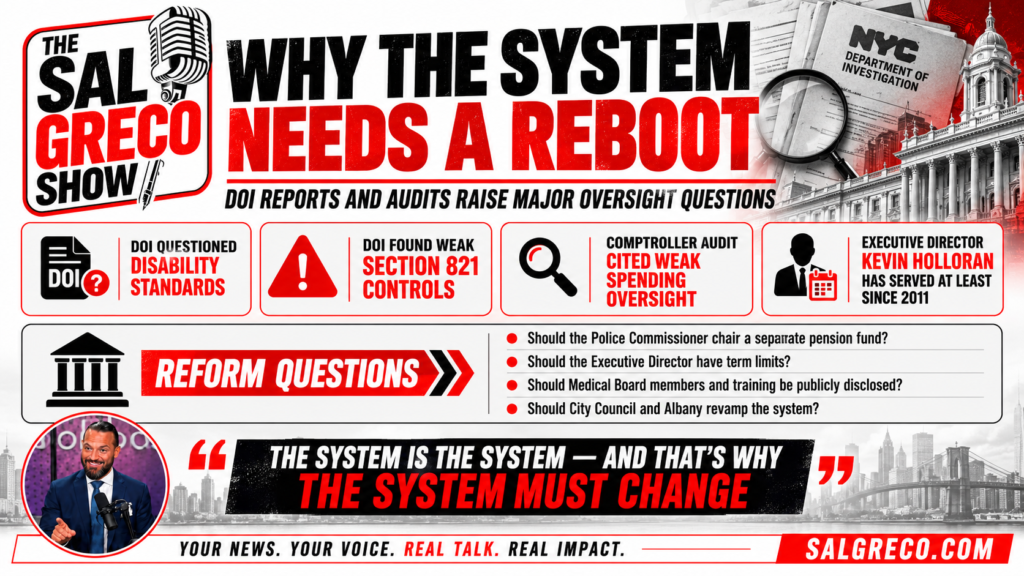
Those words, attributed by the New York City Department of Investigation to former NYPD Chief of Department John Chell while discussing his accident-disability pension, may unintentionally summarize the larger issue now confronting the New York City Police Pension Fund.
Because if the answer to questions about how pensions are administered is simply that the system is the system, then the next question is obvious: How is that system designed, who controls it, and is the structure itself overdue for examination?
That question has become harder to dismiss after two Department of Investigation reports released within days of each other in September 2026 and a separate 2025 Comptroller audit documented problems involving disability-retirement practices, pension eligibility, written policies, communication, spending controls and oversight.
The Police Pension Fund is not a small operation. The Comptroller says it administers benefits for more than 90,000 active members, retirees and beneficiaries. DOI reported that more than 50,000 retired officers received pension payments in fiscal year 2025, with total payments reaching approximately $3.59 billion. About $935 million of that went to accident-disability retirees.
With that much public money and the financial futures of tens of thousands of police officers involved, the Fund’s governance deserves scrutiny based on facts rather than personalities.

A Separate Pension Fund — With the Police Commissioner as Its Chair
The first thing New Yorkers should understand is that the Police Pension Fund is legally separate from the NYPD.
New York City Administrative Code §13-216 expressly states that the Police Pension Fund “shall be considered an entity separate” from the Police Department. But the same statute simultaneously gives the NYPD Police Commissioner a substantial position inside the organization.
The Police Commissioner automatically serves as chair of the Pension Fund’s Board of Trustees and holds 1½ votes. The Comptroller has 1½ votes, the mayoral representative has 1½ and the City’s finance official has 1½. Four PBA representatives receive one vote apiece, while the presidents of the CEA, LBA, SBA and DEA each receive one-half vote. Board action generally requires seven-twelfths of all authorized votes.
The City’s current Green Book identifies Police Commissioner Jessica Tisch as chair and identifies the current labor trustees as PBA President Patrick Hendry, Albert Acierno, Arthur Egner and Michael Freeman, along with CEA President Chris Monahan, LBA President Lou Turco, SBA President Vincent Vallelong and DEA President Scott Munro.
That distinction is important: Tisch does not single-handedly decide pension cases.
But her statutory authority extends beyond simply occupying one seat.
Administrative Code §13-216 also gives the Police Commissioner the authority to appoint the executive director of the Police Pension Fund. If the appointee is not a uniformed NYPD member, the Board must approve the appointment. The executive director then performs duties assigned by the Board chair, the Board itself or the law.
The current executive director is Kevin Holloran.
This creates an unusual governance arrangement: an entity that the law specifically declares separate from the NYPD is nevertheless chaired by the NYPD Commissioner, whose office also appoints its chief administrative executive.
Whether that statutory overlap constitutes a legal conflict of interest in any particular matter is a separate legal question. But from a governance standpoint, it presents an obvious subject for examination: Should the head of the police agency also automatically chair the separate pension entity deciding highly consequential matters involving members and former members of that agency?

The Commissioner Also Has a Role in Disability Applications
The overlap becomes more significant when disability pensions enter the equation.
Under Administrative Code §13-251, an ordinary disability application can be initiated by the officer, someone acting for the officer or the Police Commissioner.
Under §13-252, the same is true for an accident-disability application. The Commissioner can initiate the process, after which the Medical Board examines whether the member is incapacitated and whether the medical requirements have been met.
That means the office running the NYPD can initiate a disability case while the Police Commissioner simultaneously occupies the chair of the Pension Fund Board.
Again, that does not mean Tisch personally determines the outcome. The statutory process contains several separate decision-makers.
But it does mean the law deliberately places the Police Commissioner on multiple sides of the pension process.
That structure deserves to be understood before anybody debates whether it should remain unchanged.
Then There Is the Medical Board
Perhaps no part of the disability process is more important than the Police Pension Fund’s Medical Board.
Administrative Code §13-223 establishes a three-physician Medical Board.
One physician is appointed by the Pension Fund’s Board of Trustees. One is appointed by the City Health Commissioner. A third is appointed by the Commissioner of the Department of Citywide Administrative Services. Each appointing authority may also select as many as four alternate physicians.
So it would be inaccurate to say the Police Commissioner personally chooses all of the doctors deciding disability applications.
She does not.
But the Pension Fund Board she chairs selects one of the three positions, while two other mayoral agencies select the remaining physicians.
The Medical Board’s role is enormously consequential. It examines applicants, reviews their medical records and determines whether they are medically incapacitated. DOI noted that the Board of Trustees is bound by the Medical Board’s determination on the existence of disability, while the trustees retain responsibility for other issues such as whether the disability resulted from a qualifying service-related accident.
And DOI’s latest report exposed a remarkable transparency issue.
DOI reported that it had “no visibility” into how the Medical Board is trained. DOI said it served the Pension Fund with a subpoena on March 6, 2026 seeking Medical Board training and guidance material. According to DOI, the Fund had not produced responsive material or confirmed that none could be located by the time the report was issued. DOI also said PPF had not facilitated a requested informational interview with a Medical Board representative.
For a medical body with the power to make decisions that can ultimately lead to lifetime disability benefits, that finding raises significant oversight questions.
There is also a basic transparency question that remains: Who exactly is serving on these medical panels today?
A current roster of Medical Board physicians and alternates was not identified in the official Green Book materials reviewed for this article. Public disclosure of the physicians, their specialties, who appointed them, when they were appointed, their terms, training requirements and recusals would provide much greater transparency.
DOI Questioned the Disability Standard Itself
The September 15 DOI report went considerably further.
PPF informed DOI that its Medical Board determines disability by assessing whether an applicant can perform the generalized “essential functions of a police officer.”
That can include physical tasks such as controlling crowds, carrying an injured adult or physically subduing a resisting suspect.
DOI questioned applying that same standard to every member regardless of what that person was actually doing at the time of retirement.
That becomes particularly important for senior executives whose real day-to-day responsibilities may be predominantly managerial.
DOI cited former NYPD Chief of Department John Chell as an example. Its report said that under the PPF approach, his medical evaluation centered on whether he could perform the essential functions of a police officer rather than the particular duties he was performing as Chief of Department. DOI specifically cautioned, however, that it was not expressing an opinion about whether Chell would or would not have qualified under an actual-duty standard.
That distinction matters.
The issue raised by DOI is about the standard being used, not an accusation that a particular officer fraudulently obtained a pension.
DOI recommended that PPF adopt regulations, training and guidance requiring disability applications to be judged against an officer’s actual job duties. It also recommended formal rules governing reexaminations and periodic certifications that a disability continues.
PPF rejected those three recommendations.
It accepted two others: establishing a process for receiving information relevant to disability reexaminations and having the trustees consider examinations for four retirees identified in DOI’s investigation.
That disagreement between DOI and the Pension Fund is exactly the type of dispute that an oversight body can examine publicly: what standard is being used, why it is being used, who established it and whether written law should specify something different.

The Fund Rarely Used a Safeguard Already Available to It
The law already contains another important safeguard.
The Pension Fund has statutory authority under certain circumstances to call disability retirees back for medical examinations before they reach their applicable retirement age or service threshold.
DOI found the mechanism was rarely being used and recommended clearer rules governing reexaminations.
The principle is straightforward. Accident-disability benefits exist to protect officers genuinely unable to continue their work because of qualifying injuries. At the same time, the system has a mechanism to determine whether an individual remains disabled.
The oversight question is whether that mechanism is being used consistently, transparently and according to clear written standards.
Then Came the Section 821 Investigation
Two days after its disability report, DOI issued another investigation involving the Police Pension Fund.
This one concerned Section 821 designations, which can allow qualifying competitive-class employees to retain pension rights when moving into certain exempt or unclassified government positions.
DOI identified at least five instances in which officials were allowed to continue Police Pension Fund membership after moving to positions that were not pension eligible. According to DOI, the result was that their pensions were or would be higher than permitted under the law.
DOI also found three cases in which NYPD had agreements designed to limit how higher exempt-position salaries would increase eventual pensions. DOI reported that PPF was informed of those agreements but did not implement them.
Perhaps the most important systemic conclusion was less dramatic but more consequential.
DOI found poor communication and unclear policies between NYPD and the Pension Fund and reported that PPF, NYPD and DCAS lacked written policies governing important aspects of the Section 821 process.
PPF accepted DOI’s recommendation that it establish a written Section 821 policy and told DOI it was continuing to evaluate three other recommendations. DOI also expressly thanked Holloran and PPF for cooperating with that investigation.
Those details matter because DOI did not conclude that Kevin Holloran personally engaged in corruption.
What DOI documented were serious administrative errors, inadequate policies and breakdowns in communication.
Those findings should be reported for what they are — no more and no less.

Kevin Holloran: At Least 15 Years Running the Fund
There is another governance issue that rarely receives attention: tenure at the top.
A February 1, 2011 official Conflicts of Interest Board document already identifies Kevin Holloran as executive director of the Police Pension Fund. More than 15 years later, the City’s current directory still identifies him as executive director.
The governing statute establishes no fixed term limit for the position.
Holloran’s longevity by itself proves neither good nor bad management. Long tenure can provide institutional experience.
But when an executive position carries this much responsibility — and when multiple outside oversight agencies have identified control, procedural and policy deficiencies — there is a legitimate governance question about whether an executive director should remain in place indefinitely without a defined term, periodic public reappointment process or other formal accountability mechanism.
The Comptroller Found Another Set of Control Problems
The concerns are not limited to disability cases.
A June 2025 Comptroller audit found that PPF’s operating expenditures were mostly consistent with rules and its mission, an important qualification.
But the auditors also identified a substantial series of internal-control deficiencies.
PPF spent $69,814 during fiscal years 2023 and 2024 on three leased vehicles and related costs for its executive director, deputy executive director and chief information officer. Auditors found inadequate documentation supporting their business use and concluded the vehicles were not economical or necessary to the Fund’s mission. The audit noted that none of the City’s other four pension funds leased vehicles for their executives.
The audit also found $4,009 in sales tax paid even though PPF is tax exempt; nine sampled invoices paid more than 30 days after invoice dates without justification; problems with accrual accounting; $31,710 in out-of-town travel without required documentation; and $2,473 in improper reimbursements.
And regarding travel, the Comptroller used particularly noteworthy language: PPF lacked an internal travel policy and therefore there was “little to no oversight” or restriction over those expenses.
PPF agreed with four of the audit’s eight recommendations and said it would review several others.
Taken together with the DOI reports, the picture is not one isolated mistake.
It is a series of documented questions involving governance, disability standards, reexaminations, pension eligibility, written procedures, communication, financial controls and transparency.
What Legislative Review Could Examine
A comprehensive legislative review would not have to interfere with the pension benefits earned by rank-and-file officers.
Instead, lawmakers could examine the architecture surrounding how those benefits are administered: whether the Police Commissioner should automatically chair the PPF Board; whether the full Board rather than the Commissioner should select the executive director; whether executive directors should serve fixed terms subject to public reappointment; whether mandatory recusal provisions are needed when NYPD leadership is directly connected to a pension matter; whether Medical Board physicians and alternates should be publicly identified; whether appointment dates, qualifications, training and recusals should be disclosed; whether disability determinations should be based on actual assigned duties; whether periodic disability certification or reexamination rules should be codified; whether PPF should publish detailed annual statistics on approvals, denials and reconsiderations; and whether stronger audit and internal-control requirements should be written into law.
Some changes may not be achievable through a City Council local law alone. New York City pension law is heavily intertwined with State law, and the Council regularly passes home-rule resolutions requesting Albany to amend police-pension provisions. In May 2026, for example, the Council adopted a resolution requesting State legislation changing the salary base used for certain Police Pension Fund members.
So a genuine restructuring could require a combination of City Council legislation, a home-rule message and action by the State Legislature.
That is a jurisdictional issue — not a reason the structure cannot be examined.
The Questions an Oversight Hearing Could Put on the Record
An oversight hearing could establish answers to questions that, after these reports, are now difficult to ignore:
- For Commissioner Tisch: Why should the Police Commissioner remain automatic chair of an entity the Administrative Code declares legally separate from NYPD? What safeguards exist when the Commissioner’s office initiates a disability application that later reaches a Board she chairs? Has Tisch ever recused herself from a PPF matter, and what written recusal policy currently exists?
- For Kevin Holloran: When exactly was he first appointed executive director, and has the Board ever conducted a formal public reappointment or performance review during his more than 15 years in office? Why did PPF lack written Section 821 guidance before DOI’s investigation? Why were the salary-limitation agreements identified by DOI not implemented? What changes have been made since?
- For the Medical Board: Who are every current physician and alternate? Which appointing authority selected each doctor? When were they appointed? What are their specialties? What written training do they receive? What disability standards are physicians instructed to apply?
- For PPF leadership: Why had DOI not obtained the Medical Board training material it subpoenaed before issuing its September report? Why did PPF reject DOI’s recommendations concerning actual job duties, reexamination regulations and continuing disability certifications?
- For the full Board of Trustees: How does the Board oversee the executive director? What performance measures are used? How often does it conduct management or compliance reviews? Why were the expenditure weaknesses identified by the Comptroller not detected internally?
- For City Council and Corporation Counsel: Which governance reforms can be enacted locally and which would require State legislation? Could the Commissioner be replaced as automatic chair? Could the executive-director appointment process and Medical Board appointment structure be altered? Could statutory terms and public confirmation be established?
Those answers would allow officers, retirees, taxpayers and lawmakers to judge the system on a complete record.
“The System Is the System”
There is an irony in that phrase.
“The system is the system” can be offered as an explanation for why a result occurred.
It can also become the reason to examine the system itself.
The Police Pension Fund performs an essential function. Police officers injured in the line of duty deserve a disability process that works. Officers who complete careers of public service deserve the pensions they earned. Taxpayers deserve assurance that billions of dollars are being administered according to law. And rank-and-file officers deserve confidence that a senior executive and a police officer walking into the same pension system are being measured against consistent, written and transparent standards.
The recent record does not establish that every pension decision was improper, nor do the DOI reports establish that Holloran or Tisch personally engaged in corruption. What the record does establish is that outside watchdogs have identified multiple significant vulnerabilities and control failures across different areas of PPF operations.
That gives policymakers a substantial factual basis to examine whether a system designed decades ago still provides the independence, transparency and accountability expected of a modern multibillion-dollar public pension operation.
Because when the response to an old system is that “the system is the system,” the next chapter of this story is determining whether that system should remain exactly as it is.