
Police officers are entrusted to enforce the law, not use private messaging applications to circumvent accountability, conceal misconduct, or conduct official business outside proper departmental channels.
By Sal Greco | October 22, 2026
When did WhatsApp become an acceptable substitute for official police communications? And more importantly, why are law enforcement agencies continuing to tolerate its misuse?
From the New York City Police Department to the Miami Beach Police Department, troubling incidents involving officers and private group chats are exposing a serious accountability problem in American law enforcement.
The issue is no longer simply whether officers are exchanging inappropriate messages. It is whether police departments have lost control over how their personnel communicate, conduct official business, and potentially shield their activities from appropriate oversight.
And frankly, it needs to stop.
Miami Beach: A Disturbing Internal Affairs Investigation
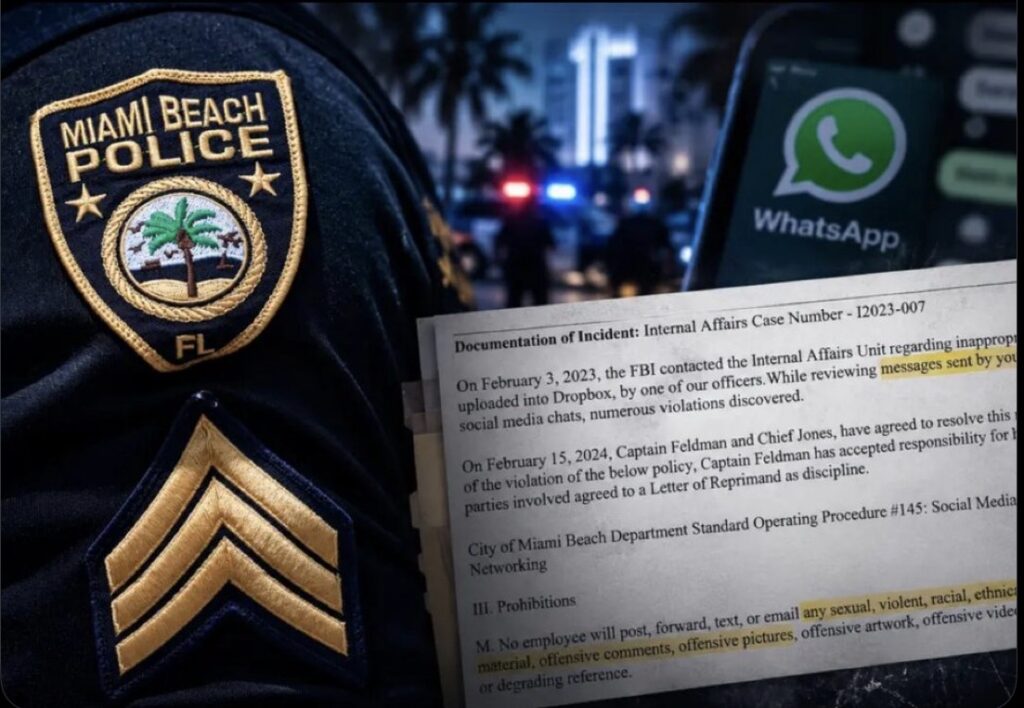
An October 21, 2026, Miami New Times investigation by Natasha Yee describes disturbing findings involving Miami Beach police officers who exchanged hundreds of sexually explicit messages through WhatsApp.
According to the reporting, an Internal Affairs investigation identified communications that included material classified in the report as child sexual abuse material.
Earlier reporting by the Miami Herald identified four Miami Beach officers involved in the exchanges, which occurred between 2016 and 2021. Investigators documented numerous sexually explicit messages exchanged while officers were on duty or working paid off-duty details.
The FBI and Miami-Dade prosecutors ultimately declined to bring criminal charges. The four officers received letters of reprimand for departmental policy violations. One officer, Steven Feldman, was subsequently promoted to major.
Those distinctions matter. An Internal Affairs finding is not the same as a criminal conviction, and allegations must be evaluated individually.
Nevertheless, the documented misuse of workplace time and the disturbing nature of the material raise serious questions about professionalism, supervision, and departmental accountability.
How does conduct serious enough to attract federal investigative attention ultimately result in reprimands and continued advancement within a police department?
What message does that send to the hundreds of honest officers who report for duty every day, follow departmental procedures, and take their oath seriously?
And what message does it send to the public?
The NYPD Has Its Own WhatsApp Problem
Unfortunately, these concerns are not confined to Miami Beach.
SalGreco.com and The Sal Greco Show have repeatedly raised questions surrounding communications, accountability, and alleged misconduct within the NYPD.
Two narcotics commands that deserve particular scrutiny are Patrol Borough Manhattan North Narcotics and Brooklyn North Narcotics.
In April 2026, Brooklyn North Narcotics became the center of controversy following a widely circulated video showing detectives using force during an arrest inside a Brooklyn liquor store.
Subsequent reporting by FOX 5 New York revealed another alarming detail.
Detectives reportedly relied on WhatsApp to summon backup because officers did not have police radios readily available.
Think about that.
NYPD detectives conducting dangerous narcotics enforcement operations were reportedly depending on a consumer messaging application to communicate during an unfolding police encounter.
Where was the proper equipment?
Where was the supervision?
How did officers come to rely on WhatsApp in a situation requiring immediate, dependable police communications?
The NYPD subsequently placed several Brooklyn North Narcotics personnel on modified duty or reassigned them, and announced a review that included the unit’s use of WhatsApp.
Meanwhile, allegations concerning inappropriate group-chat material involving Manhattan North Narcotics personnel have raised separate questions about the culture within specialized police units. Those allegations require independent investigation and should not be mistaken for established disciplinary findings.
SalGreco.com has also previously reported allegations in NYPD litigation that Internal Affairs investigators intended to coordinate simultaneous interviews through WhatsApp.
Those allegations remain unproven, but they raise a legitimate question:
Why would investigators conducting official departmental business need an outside messaging application to coordinate their activities?
A department responsible for investigating criminal behavior should maintain communication systems capable of preserving records, establishing accountability, and protecting the integrity of its investigations.
That should be elementary police procedure.
WhatsApp Is Not a Shield Against Accountability
Let’s be clear about something.
WhatsApp is not inherently illegal, and merely using an encrypted messaging application does not establish wrongdoing.
Millions of people use the platform legitimately.
But police officers conducting official business are not ordinary private individuals acting solely in their personal capacity.
They are public employees exercising government authority.
There is an enormous difference between an officer privately messaging family members and a group of detectives conducting operational police communications, sharing sensitive information, or coordinating investigative activity outside approved departmental systems.
Police communications can become evidence.
They can affect criminal prosecutions.
They can become relevant to disciplinary investigations, public-records requests, discovery obligations, and civil litigation.
When officers move official business into unauthorized private group chats, legitimate questions arise about whether those communications are being preserved, whether supervisors have access to them, and whether relevant evidence can be recovered.
Private messaging applications must never become a convenient way to avoid the accountability that comes with wearing a police uniform.
Encryption protects communications from unauthorized access. It does not provide officers with immunity from departmental rules, evidence-preservation obligations, or the law.
If You’re Not Doing Anything Wrong, Why Hide Official Police Business?
Here is my question to police officers who insist on conducting official business through unofficial messaging groups:
What exactly are you trying to accomplish that cannot be accomplished through established departmental channels?
Why should police supervisors have to wonder whether critical operational information is being exchanged through privately controlled group chats?
Why should investigators have to chase down messages stored on personal devices when official communications should already be properly documented?
Why should prosecutors, defense attorneys, or members of the public question whether information relevant to an investigation has been preserved?
Officers have legitimate personal privacy rights. Nobody should confuse personal privacy with a license to conceal official government activity.
But if the communications involve legitimate police business, officers should be prepared to account for them through proper procedures.
And if the communications involve racism, sexual harassment, exploitation, threats, evidence manipulation, or potential criminal conduct, those responsible should face an appropriate and impartial investigation.
There is no legitimate place in law enforcement for using technology to conceal illegal, immoral, unethical, or otherwise improper conduct.
The badge does not change that standard.
It makes the standard even more important.
Where Is the Command Accountability?
Police departments across America spend considerable resources investigating misconduct by civilians.
They employ detectives, intelligence analysts, Internal Affairs investigators, specialized enforcement teams, and supervisory personnel.
Yet when questionable conduct surfaces within their own ranks, accountability can become a prolonged process of investigations, administrative reviews, transfers, reprimands, and unanswered questions.
That inconsistency damages public confidence.
It also damages the reputation of the overwhelming number of police officers who perform their duties honorably.
Police commissioners, chiefs, precinct commanders, and commanding officers of specialized investigative units must establish clear rules governing electronic communications.
Those rules should include:
- Approved official communications: Operational police business should be conducted through authorized systems, including dependable emergency radio communications.
- Preservation of records: Work-related messages must remain subject to applicable evidence-retention, discovery, and public-records requirements, regardless of the device or application used.
- Supervisory accountability: Commanding officers must know what communications platforms their personnel use for official operations.
- Meaningful consequences: Proven violations must result in discipline proportionate to their seriousness, with potential criminal conduct referred for independent investigation.
- Protection for whistleblowers: Officers who report inappropriate or unlawful group-chat activity must be protected from retaliation.
These are not unreasonable expectations.
They are fundamental safeguards for any professional law enforcement organization.
The Bottom Line: The Badge Is Not a License to Hide
The latest Miami Beach revelations should concern every police executive in America.
They should particularly concern the NYPD, where incidents involving narcotics personnel and allegations surrounding internal communications have already demonstrated why greater oversight is necessary.
This is not about attacking police officers.
As a former NYPD officer, I understand the demands, dangers, and responsibilities of law enforcement.
I also understand that the authority accompanying a police badge requires a higher standard of conduct, especially when government resources and public safety are involved.
Police officers cannot expect the public to respect the law while dismissing the importance of accountability within their own departments.
They cannot demand transparency from civilians while treating official police communications as something that should disappear into private group chats.
And police leadership cannot simply look the other way when technology is being misused.
From Manhattan North Narcotics to Brooklyn North Narcotics and now Miami Beach, the broader warning is unmistakable: private messaging must never become a substitute for professional police communications or a hiding place for misconduct.
The public deserves accountability.
Honest police officers deserve accountability.
And law enforcement leadership has a responsibility to provide it.
If you’re not doing anything wrong, there should be no reason to hide your official police activities from legitimate oversight.
Enough with the excuses. Enough with the double standards. Enough with the WhatsApp controversies.
It’s time for law enforcement agencies across America to regain control of their communications, restore professional standards, and hold their own personnel accountable.
Because the badge should represent integrity, not immunity.
Sal Greco is a former NYPD police officer and host of The Sal Greco Show, where he reports on law enforcement, government accountability, and issues involving the New York City Police Department.