
BY SAL GRECO
When Thomas Donlon accepted the position of Interim Police Commissioner of the New York City Police Department in September 2024, he stepped into one of the most politically volatile environments in modern New York City history.

The resignation of former Police Commissioner Edward Caban had already intensified public scrutiny surrounding City Hall and the NYPD. Federal investigators were examining multiple individuals connected to Mayor Eric Adams’ political orbit, allegations involving the now-defunct Con Sofrito nightclub and restaurant, and claims of improper influence within city government. Media reports increasingly focused on a network of Adams allies often referred to as the “Crumbs Crew,” while FBI raids and federal investigations generated headlines across the city.
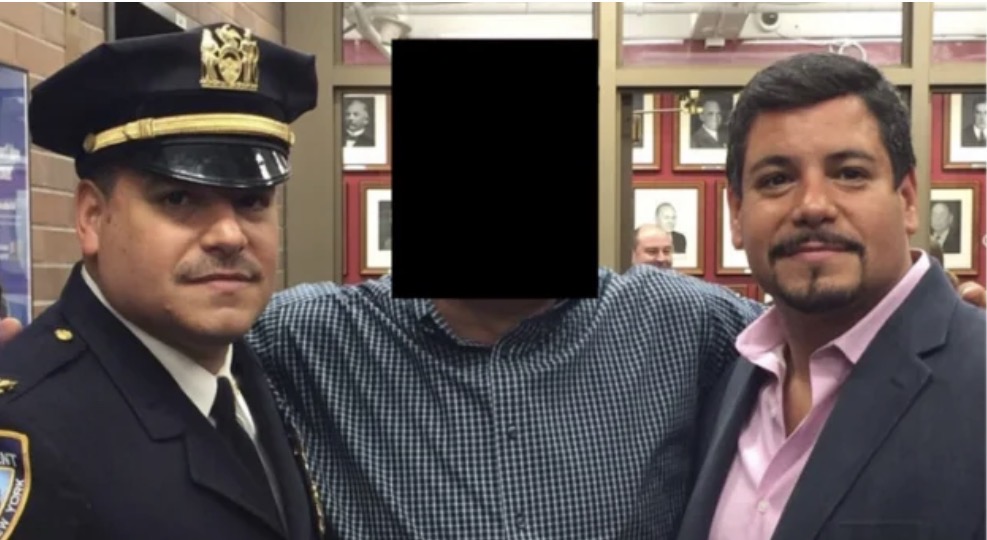
Into that storm walked Donlon.
A veteran federal law-enforcement official with decades of experience in national security, counterterrorism, and public safety, Donlon was presented as a steady hand capable of restoring public confidence during a period of unprecedented turmoil. Yet according to a lawsuit he later filed—and an appeal now pending before the United States Court of Appeals for the Second Circuit—Donlon alleges that the corruption and dysfunction he was brought in to address were far deeper than the public realized.
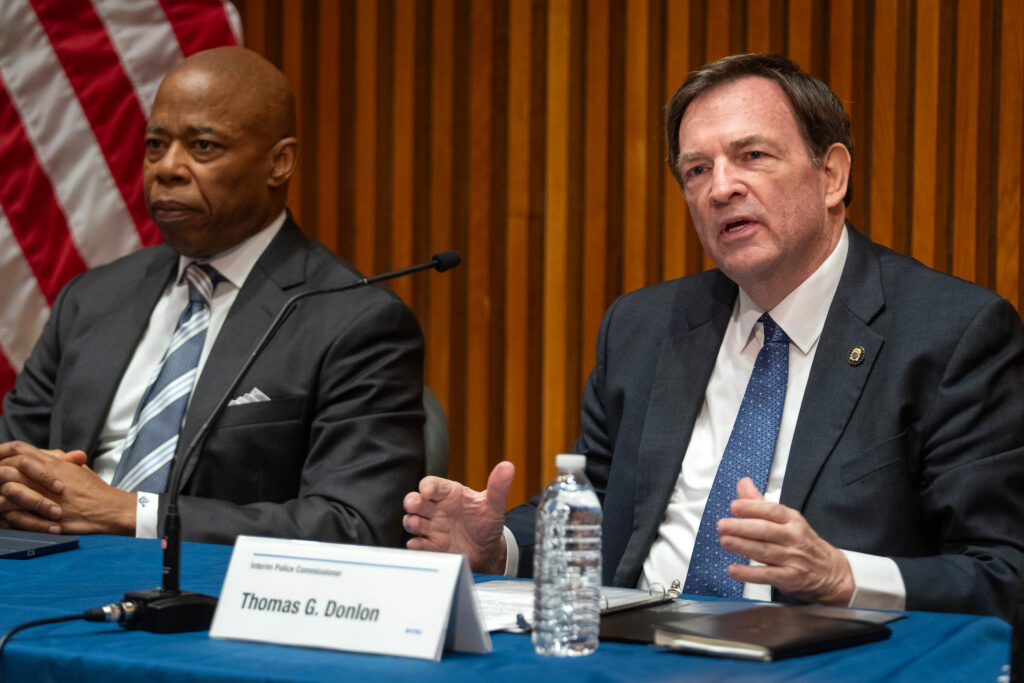
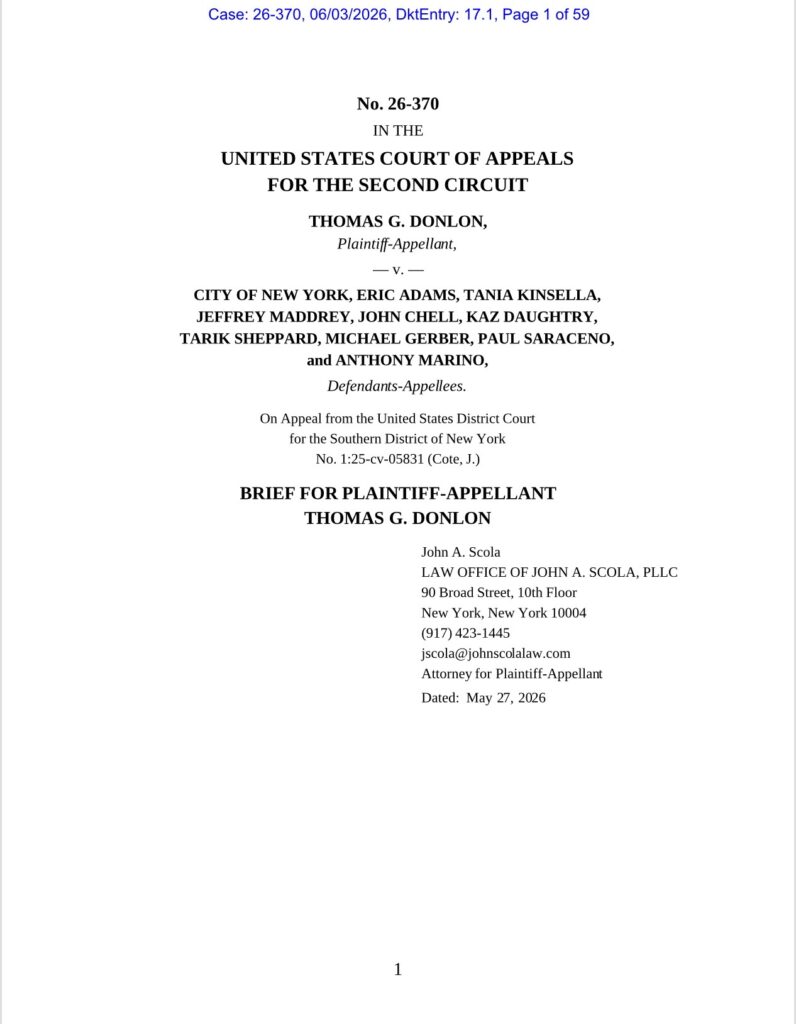
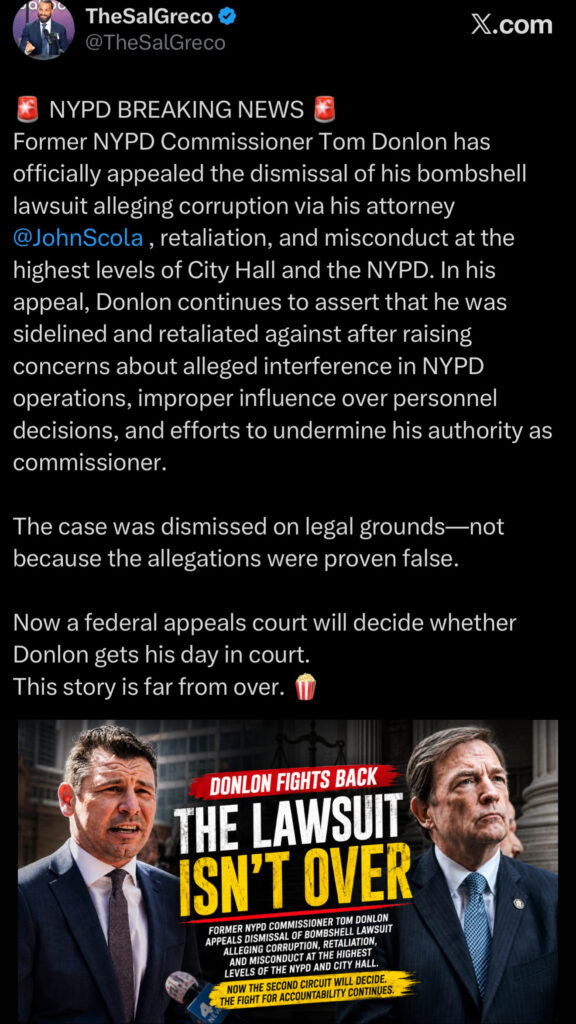
The appeal follows a federal judge’s dismissal of Donlon’s lawsuit in February 2026. Donlon is asking the Second Circuit to reverse that decision and permit the case to move forward into discovery, where evidence could be obtained through subpoenas, depositions, records requests, and witness testimony.
At the center of the appeal is a stunning allegation.
Donlon claims he was appointed as commissioner largely for appearances while real authority allegedly remained in the hands of entrenched senior officials and political loyalists. According to the appellate filing, members of Mayor Adams’ inner circle and senior NYPD leadership operated as a coordinated enterprise that used the machinery of government to reward allies, suppress oversight, retaliate against critics, and maintain political control.
Among the most explosive allegations is what Donlon describes as a signature-stamp promotion scheme.
According to the appeal, a rubber stamp bearing Donlon’s official signature was allegedly used without authorization to approve promotions and alter promotion lists. The filing claims officers selected by Donlon based upon merit were removed and replaced by favored individuals, while his signature was affixed to documents to make it appear he had approved the changes himself. Donlon alleges these promotions carried substantial financial implications through increased salaries, overtime opportunities, pension calculations, and future benefits.
The appeal further alleges abuse involving federally funded overtime programs.
According to the filing, hundreds of thousands of dollars in overtime payments were directed toward favored personnel while oversight mechanisms failed to stop or detect the alleged misconduct. Donlon argues these funds were improperly distributed within a system that rewarded loyalty over accountability.
The allegations do not stop there.
Donlon claims individuals were effectively embedded inside the Commissioner’s Office to monitor his communications, control access to him, and interfere with his authority as Police Commissioner. The filing alleges that attempts to remove those individuals or investigate their conduct were blocked by senior officials.
Perhaps most significant is Donlon’s allegation that he repeatedly reported misconduct directly to Mayor Adams.
According to the appeal, Donlon attempted to discipline officials he believed were engaging in wrongdoing. Instead, he alleges Adams instructed him to “back off” and work with the same individuals he was attempting to investigate. Donlon argues that this prevented him from exercising the disciplinary authority normally granted to the Police Commissioner under the New York City Charter.
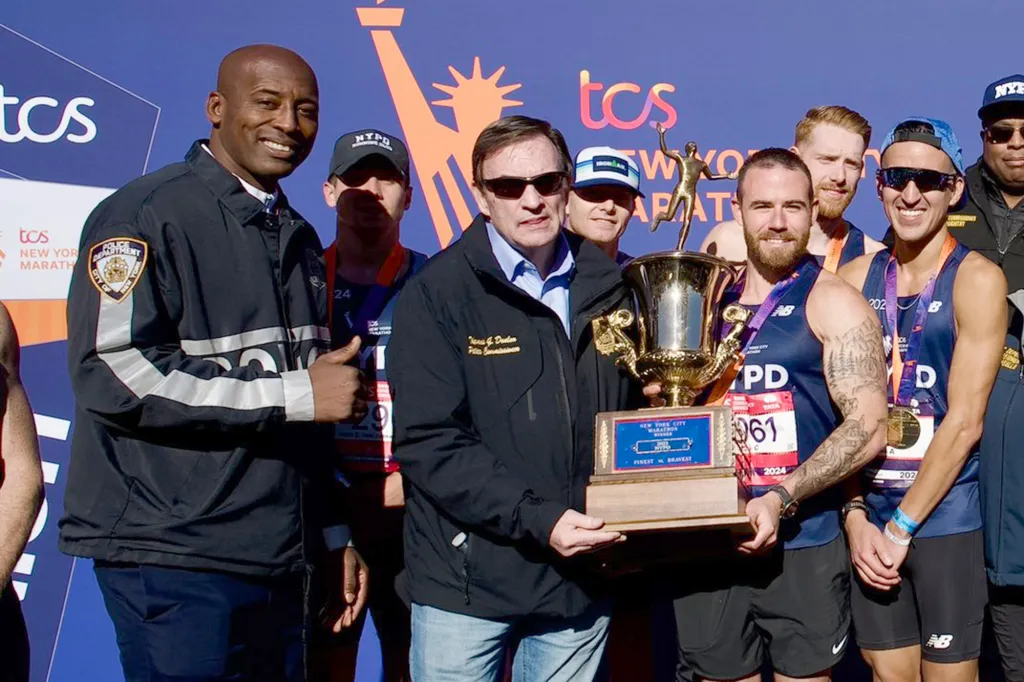
The filing also revisits an alleged confrontation at the 2024 New York City Marathon.
Donlon claims that then-Deputy Commissioner Tarik Sheppard publicly threatened him during the event and that no meaningful disciplinary action followed. The appeal alleges that the incident was downplayed despite concerns expressed by multiple NYPD executives.
The most personal allegations involve Donlon’s wife.
According to the appeal, Deirdre O’Connor-Donlon was arrested following a minor traffic incident despite allegedly possessing proof of valid insurance coverage. Donlon claims senior NYPD officials became involved in determining how she would be processed while she was in custody and that details of the incident were subsequently leaked to the media. The filing further alleges that after she filed a notice of claim against the City, Donlon’s position as Senior Advisor for Public Safety was eliminated in retaliation.
These allegations have not been proven in court.
That fact is crucial.
The Second Circuit is not being asked to determine whether corruption occurred. The court is being asked to determine whether Donlon’s allegations were sufficiently pled to survive dismissal and proceed to the evidence-gathering stage of litigation. The appeal argues that the district court improperly dismissed the case before discovery could occur and before witnesses could be examined under oath.
For supporters of Donlon, the appeal represents an opportunity to finally test allegations that have circulated for years regarding political favoritism, selective accountability, patronage, and retaliation inside City Hall and the NYPD.
For critics, it remains a collection of allegations that have yet to be substantiated.
Regardless of which side ultimately prevails, the appeal has revived uncomfortable questions that have lingered since the tumultuous final years of the Adams administration.
Why was a veteran federal law-enforcement official brought in during one of the largest corruption scandals in recent city history?
Why does Donlon claim he was prevented from disciplining individuals he believed engaged in misconduct?
And why, if these allegations are baseless, should the defendants fear a process that would allow evidence to be examined in open court?
Those questions now move to the Second Circuit.
The outcome could determine whether one of the most explosive lawsuits ever filed by a former NYPD Commissioner quietly fades away—or becomes a courtroom battle that forces some of New York City’s most powerful figures to answer questions under oath.