BY SAL GRECO
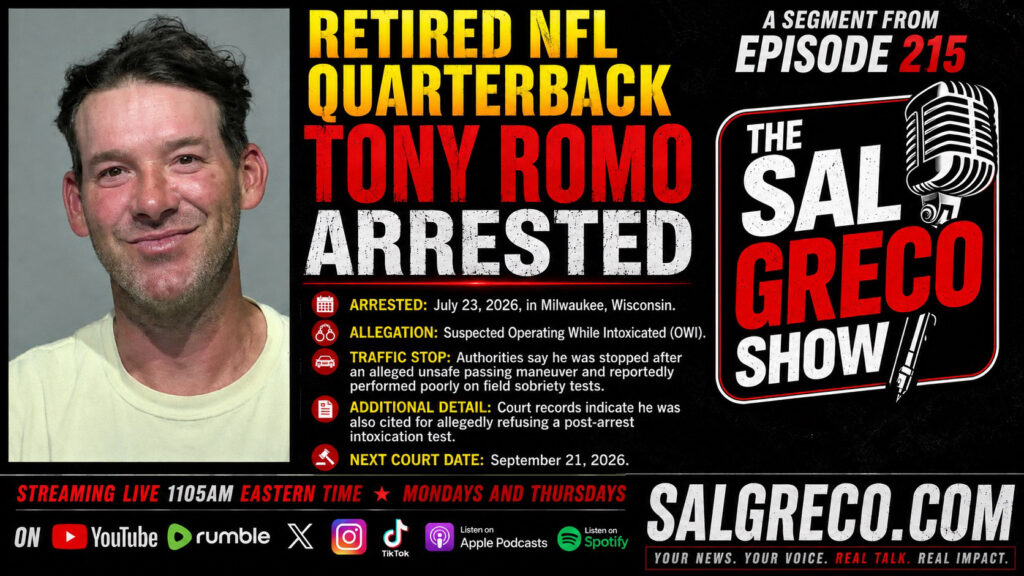
The arrest of former Dallas Cowboys quarterback and current CBS NFL analyst Tony Romo has quickly become one of the biggest sports stories of the summer—not simply because of the arrest itself, but because of the questions surrounding how the investigation was conducted and what it could mean for both Romo’s legal case and his future at CBS.
On Episode 215 of The Sal Greco Show, Sal Greco, a former NYPD police officer who specialized in traffic enforcement and DWI arrests, and co-host Jack Stern broke down the arrest from both a law enforcement and legal perspective, raising questions about whether deputies followed proper procedures during portions of the investigation while also acknowledging the evidence that reportedly led to Romo’s arrest.
The Arrest
According to multiple published reports and body camera footage released following the incident, Wisconsin deputies stopped Romo after observing alleged traffic violations.
Deputies reported several indicators of impairment, including:
- An odor of alcoholic beverage.
- Bloodshot and glassy eyes.
- An open alcoholic beverage container inside the vehicle.
- Statements and behavior that officers believed were consistent with impairment.
Romo was detained, transported from the roadside, and ultimately arrested on suspicion of first-offense Operating While Intoxicated (OWI).
Video later released publicly showed Romo performing various field sobriety exercises before being taken into custody.
Following his arrest, Romo retained legal counsel and reportedly refused the evidentiary chemical breath test.
Because Wisconsin treats most first-offense OWI cases as civil violations rather than criminal offenses, Romo is not facing felony-level consequences associated with many DUI arrests in other states.
Episode 215 Examines Police Procedure
During Episode 215, Jack Stern walked viewers through the sequence shown on body camera footage while Sal Greco evaluated the encounter from the perspective of someone who spent years enforcing DWI laws.
Greco explained that once deputies observed an odor of alcohol, an open alcoholic beverage container, and additional signs of impairment, they likely had sufficient grounds to continue the OWI investigation.
However, Greco questioned portions of what occurred afterward.
According to Greco, once probable cause begins developing, officers generally want to preserve evidence in a manner that will withstand courtroom scrutiny rather than create unnecessary opportunities for defense attorneys to challenge the investigation.
“I saw he was dancing and all this crazy stuff,” Greco said during the discussion. “Now it’s an embarrassment. You’re embarrassing him… bring him in.”
Greco questioned why portions of the testing shown on body camera appeared to continue after Romo had already been transported from the roadside.
Could Romo’s Back Surgeries Become a Major Issue?
One of the most significant issues discussed on Episode 215 involved Romo’s documented history of multiple back surgeries.
Body camera footage reportedly showed Romo attempting to stretch before performing certain balance exercises.
Jack Stern noted that Romo appeared concerned about his ability to complete portions of the test because of those previous injuries.
Greco explained that officers conducting standardized field sobriety tests are generally expected to document physical limitations disclosed by the driver.
“If you ask them, do you have any physical ailments?… Then you have to factor that in,” Greco explained during Episode 215.
Defense attorneys frequently challenge field sobriety results when underlying medical conditions, orthopedic injuries, age, neurological conditions, or other physical impairments could affect a person’s balance regardless of alcohol consumption.
Whether Romo’s attorneys pursue that strategy remains to be seen.
The Breath Test Question
Another topic discussed extensively during Episode 215 was Romo’s reported refusal of the evidentiary breath test.
Greco explained that refusing chemical testing does not prevent an arrest.
Instead, officers may still rely upon their observations, statements, and other evidence in establishing probable cause while the refusal itself may carry separate legal consequences under Wisconsin law.
Jack Stern also questioned whether relying so heavily on physical balance testing—given Romo’s known back injuries—could become one of the focal points of the defense.
Did Deputies Follow Wisconsin Procedure?
That question has generated considerable discussion online.
Some legal commentators, former law enforcement officers, and social media users have questioned whether portions of the field sobriety testing shown on body camera were conducted exactly as standardized National Highway Traffic Safety Administration (NHTSA) procedures contemplate.
Others have questioned whether Romo’s physical limitations should have resulted in modifications or different investigative decisions.
At this stage, however, no court has ruled that deputies violated Wisconsin law, departmental policy, or standardized OWI procedures.
Likewise, no public findings have concluded that the investigation was improperly conducted.
Those issues, if raised, will likely be argued by Romo’s defense attorneys during the legal proceedings.
Conversely, prosecutors are expected to argue that deputies properly relied upon the totality of the circumstances, including their observations, the reported odor of alcohol, the alleged open container, Romo’s performance during field sobriety exercises, and the reported refusal of chemical testing.
Could Celebrity Status Become Part of the Defense?
Another question raised during public discussion is whether Romo’s celebrity status resulted in deputies treating him differently—either more favorably or more harshly.
Some observers have argued officers appeared unusually patient throughout the encounter.
Others believe Romo may have been subjected to additional testing or extended interaction because of the high-profile nature of the stop and the presence of body cameras.
At this point, there is no public evidence establishing that deputies intentionally deviated from standard procedure because Romo is a nationally recognized sports broadcaster.
Nevertheless, defense attorneys often examine whether similarly situated drivers would have been treated the same way.
That issue could become part of any future legal challenge.
CBS Now Faces Difficult Questions
Beyond the courtroom, the arrest has placed CBS Sports in an uncomfortable position.
Romo remains one of the highest-paid sports broadcasters in television, but criticism of his game preparation had already become a recurring topic among NFL fans over the past several seasons.
The arrest has only intensified scrutiny surrounding his future.
Whether CBS ultimately stands behind Romo or eventually moves in another direction remains unknown.
For now, the legal process will likely dictate much of what comes next.
The Bottom Line
The facts currently known publicly are relatively straightforward: deputies stopped Tony Romo, observed what they believed were signs of impairment, conducted field sobriety testing, and arrested him on suspicion of first-offense OWI.
The legal questions are considerably more complicated.
Did deputies strictly follow every standardized procedure?
Did Romo’s history of multiple back surgeries affect the reliability of portions of the field sobriety tests?
Could defense attorneys successfully challenge aspects of the investigation?
Those questions remain unanswered and will likely be decided in court—not on social media.
As Sal Greco concluded during Episode 215, Romo has the financial resources to retain experienced legal counsel and Wisconsin’s handling of first-offense OWI cases may ultimately limit the long-term consequences. But until the legal process runs its course, one thing is certain: this case will continue to generate debate among lawyers, law enforcement professionals, football fans, and anyone interested in how high-profile OWI investigations are handled.