
BY SAL GRECO
President Donald Trump’s latest meeting with New York City Mayor Zohran Mamdani produced something few would have expected during last year’s heated political campaign: a remarkably cordial public appearance, praise from Trump for the Democratic socialist mayor, and a potentially enormous federal-city partnership involving one of the most valuable and complicated pieces of real estate in New York.
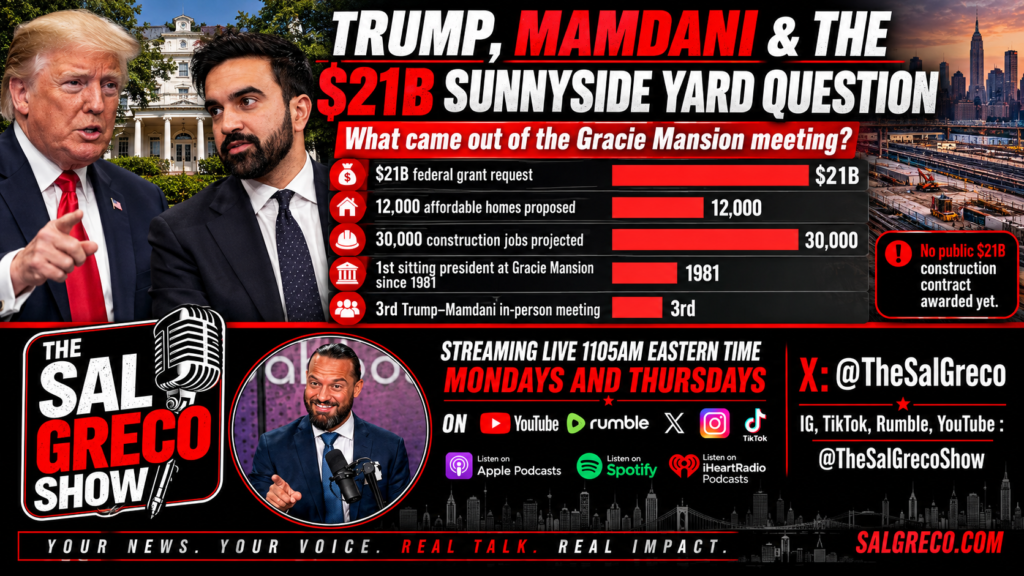
Trump traveled to Gracie Mansion on September 21 while in New York for the United Nations General Assembly, making him the first sitting president to visit the mayoral residence since Ronald Reagan met Mayor Ed Koch there in 1981. It was Trump and Mamdani’s third in-person meeting since Mamdani’s election.
The political optics were difficult to miss. These are two men who have publicly attacked one another and remain far apart on immigration, taxation, Israel and other major issues. Yet outside Gracie Mansion, Trump was openly complimentary.
“I want him to be a great mayor,” Trump said, adding that Mamdani had “great potential.”
Mamdani returned the cordial tone, telling reporters that he appreciated Trump’s “commitment to the city” and arguing that he would continue working with anyone capable of delivering results for New Yorkers.
That extraordinary political reversal is precisely what generated much of the reaction after the meeting.
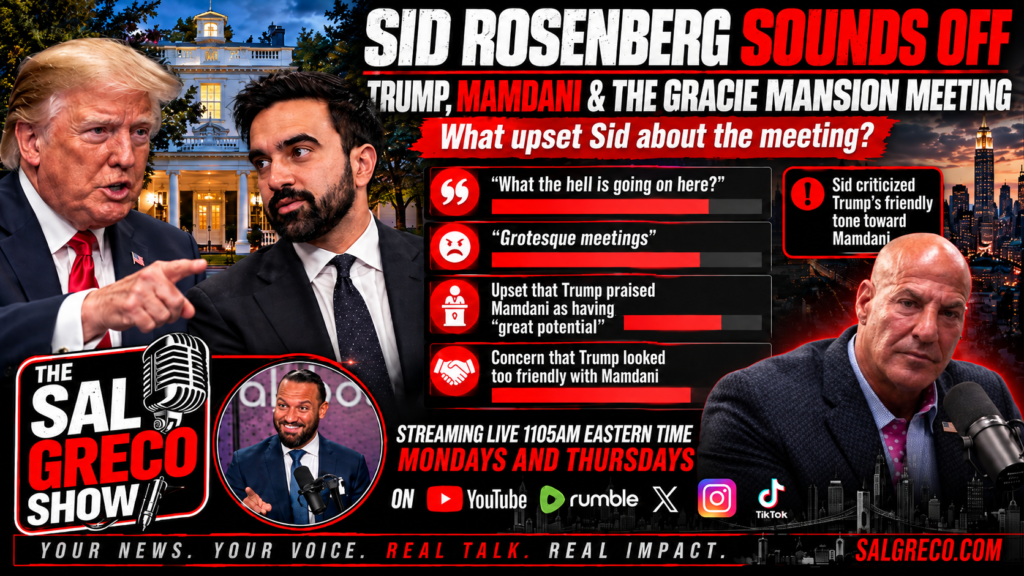
Conservative New York radio host Sid Rosenberg, a longtime Trump supporter, was anything but pleased. Rosenberg attacked the friendly relationship on his WABC program, asking, “What the hell is going on here?” He described the earlier White House meetings as “grotesque” and criticized Trump for suggesting Mamdani could become a great mayor.
But beneath the handshakes and political theater was something far more consequential: Sunnyside Yard.
THE $21 BILLION PROJECT
Sunnyside Yard is not simply an empty parcel waiting for apartment buildings.
The massive Queens rail complex serves Amtrak, the Long Island Rail Road and New Jersey Transit and is among the busiest passenger-rail facilities in North America. The basic idea is to construct an enormous structural platform above portions of the active rail yard, effectively creating new land upon which an entire neighborhood could be built. NYCEDC and Amtrak have studied versions of such an overbuild for years, with the current master plan tracing back to work begun after Amtrak approached the city in 2014.
Mamdani revived the concept after taking office and brought it directly to Trump during their February White House meeting.
The mayor’s proposal calls for more than $21 billion in federal grants to construct the deck. City Hall says that platform could ultimately support approximately 12,000 affordable homes, including 6,000 Mitchell-Lama-style residences, while generating roughly 30,000 construction jobs and creating parks, schools, health-care facilities and other neighborhood infrastructure.
That distinction is important: $21 billion has not been awarded.
There is no $21 billion federal construction contract currently in place for the housing development. Trump did not announce that Washington was writing New York a $21 billion check. In fact, after the Gracie Mansion meeting, Trump stopped well short of making such a commitment.
Trump called Sunnyside “a big job” and said he had been watching proposals for the yard for approximately 35 years. He acknowledged that development would require extensive federal involvement.
“You’re going to need a lot of federal approvals and probably some federal money to do it,” Trump said.
Mamdani similarly acknowledged that the project remains at an early stage. What the two men actually agreed to at Gracie Mansion was to elevate discussions from conversations between the president and mayor to more technical negotiations involving City Hall’s housing and operations officials and their White House counterparts. Those discussions are expected to address financing, federal authorization and the complicated legal and engineering requirements for constructing the platform.
That is considerably different from a funded construction project.
Council Member Julie Won, whose district includes the yard, emphasized that point after the meeting, saying there was currently no federal, state or city legislation allocating the necessary money and no established construction timeline. Queens Borough President Donovan Richards supports the site’s long-term potential but argued that other Queens developments already further along in planning and construction should also receive federal attention.
WHO IS ACTUALLY BEHIND SUNNYSIDE YARD?
The concept long predates both Trump and Mamdani.
The present master-planning effort has principally involved New York City Economic Development Corporation and Amtrak. The major 2020 master plan was led by Practice for Architecture and Urbanism, or PAU. Its interdisciplinary team included Carlo Ratti Associati, HNTB, Langan, Nelson Byrd Woltz, Sam Schwartz Engineering and Thornton Tomasetti on design and engineering, with BJH Advisors, CBRE, Dharam Consulting, Fried Frank and Municap performing financial or legal work.
An earlier feasibility study for NYCEDC was led by FXCollaborative, with HR&A Advisors handling economic analysis and WSP working on structural and rail issues.
Those companies should not, however, automatically be described as the construction contractors for Mamdani’s new $21 billion proposal. Much of that work involved feasibility, engineering, architecture, finance and planning. Based on the public information I found as of September 25, there has been no publicly announced general contractor selected to build the proposed $21 billion housing deck.
That is one of the areas worth watching closely if the project advances.
Sal Greco made exactly that point, asking on episode 229 of The Sal Greco Show while speaking to Jack Stern: “Who are the contractors? What are they making out of federal government? Who’s lobbying for them for the federal government?”
Those are legitimate subjects for investigation as contracts eventually materialize. What cannot currently be stated as fact is that the Trump Organization, Trump’s sons, or companies tied to the Trump family have been awarded work on the proposed housing development. There is no public evidence establishing that connection.
Trump himself did tell reporters that he once owned a building in Sunnyside and knows the area well.
BUT THERE ARE CONTRACTORS WORKING AT SUNNYSIDE RIGHT NOW
This is where things become particularly interesting — and where the distinction between two separate projects is essential.
While no builder has publicly been awarded the proposed $21 billion housing deck, there is already a massive federally backed construction project underway inside Sunnyside Yard.
Amtrak broke ground on a new maintenance complex there on August 28. The project represents more than $1 billion in investment and will provide maintenance, inspection, cleaning and storage infrastructure for Amtrak’s new Airo trainsets and other equipment. Funding comes primarily through Federal Railroad Administration-administered grants.
The design-build contractor is the Scalamandre–Citnalta Joint Venture, comprising Peter Scalamandre & Sons and Citnalta Construction. Amtrak publicly identified that joint venture in 2025 as the team selected to design and construct the maintenance, inspection and servicing facilities at Sunnyside.
Citnalta says the approximately $769 million design-build portion also includes Dewberry Engineers, RailWorks Transit and L.K. Comstock. Construction is underway, with completion anticipated around 2030.
Again, those contractors are working on the Amtrak rail modernization program, not the proposed Mamdani housing deck.
That distinction should be explicit in the article because otherwise someone could easily see construction at Sunnyside Yard, see hundreds of millions of dollars in contracts, and assume those companies have already been hired for the Trump-Mamdani housing proposal. They have not, based on the public records currently available.
NETANYAHU ADDS ANOTHER LAYER
The friendly Trump-Mamdani meeting also occurred against an extraordinary international backdrop.
Israeli Prime Minister Benjamin Netanyahu was preparing to address the United Nations while publicly feuding with Mamdani. Mamdani has repeatedly called Netanyahu a war criminal and has urged that the International Criminal Court’s warrant against him be honored, although Mamdani has acknowledged that a New York City mayor does not have the authority to carry out such an arrest independently. Netanyahu rejects the accusations surrounding Israel’s conduct in Gaza.
Netanyahu did not, based on any public reporting found, publicly issue a direct critique of Trump for meeting Mamdani. So we would not attribute such a quote to him.
What Netanyahu did do, one day after the Gracie Mansion meeting, was directly attack Mamdani.
“Shame on you, Mr. Mamdani,” Netanyahu said in a video, accusing the mayor of supporting Hamas and telling him: “I’m going to tell the truth about you.”
Mamdani rejected Netanyahu’s accusations and continued his criticism of the Israeli prime minister.
The contrast was striking: Trump, one of Netanyahu’s closest American political allies, had just spent the previous afternoon praising a mayor who was simultaneously engaged in an intensely hostile public dispute with Netanyahu. Netanyahu’s trip also did not include a meeting with Trump because their schedules did not overlap.
That does not establish some secret political alliance or falling-out. It does illustrate why the Gracie Mansion images generated so much attention from people across the political spectrum.

SUNNYSIDE IS ALREADY ATTRACTING DEVELOPERS — AND HUDSON YARDS OFFERS A ROAD MAP
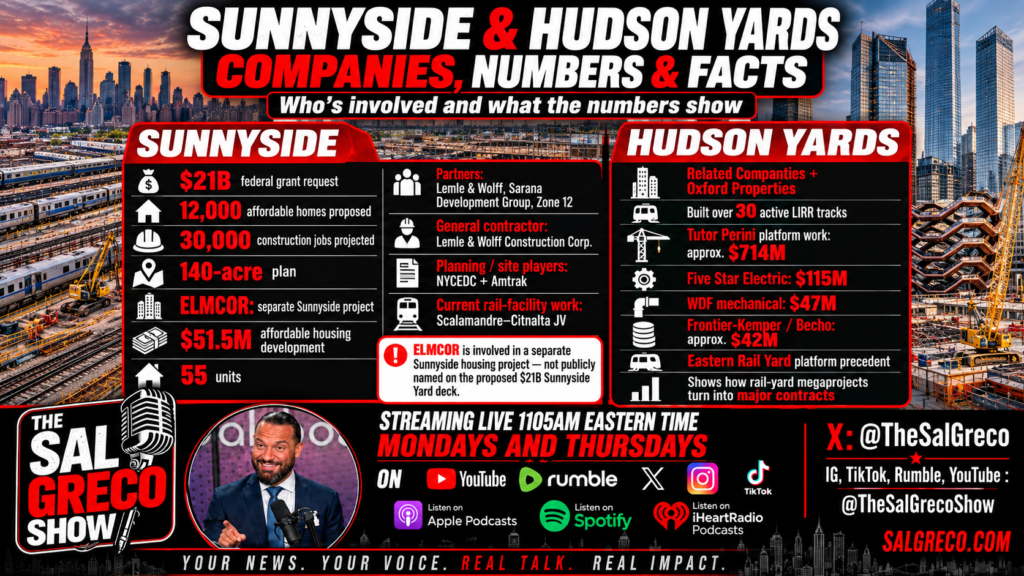
The proposed Sunnyside Yard megaproject is not the only affordable-housing development underway in the neighborhood. ELMCOR Youth & Adult Activities, a Queens-based nonprofit, is already participating as a co-developer in a separate $51.5 million affordable-housing project at 43-12 50th Street in Sunnyside. The 55-unit development is being built with Lemle & Wolff Companies, Sarana Development Group and Zone 12 LLC, with Lemle & Wolff Construction Corp. serving as general contractor. ELMCOR is also expected to provide on-site behavioral-health, youth, family and workforce-development services. That project should not be confused with Mamdani’s much larger Sunnyside Yard proposal, and there is currently no public evidence showing ELMCOR has been selected for the proposed $21 billion rail-yard development. But its existing involvement in Sunnyside demonstrates that affordable-housing developers and nonprofit partners are already active in the immediate area.
And there is another New York project that may provide the clearest comparison for what Sunnyside Yard could eventually become: Hudson Yards.
Like Sunnyside, Hudson Yards required developers to create usable real estate above an operating rail facility. Related Companies and Oxford Properties Group developed Hudson Yards through leases over MTA rail property. The Eastern Rail Yard platform spans more than 30 active Long Island Rail Road tracks and three subsurface rail tunnels. It is supported by roughly 300 massive caissons drilled around the operating railroad infrastructure.
And Hudson Yards provides a glimpse of the scale of contracts that can emerge once a rail-yard development moves from planning to actual construction. Tutor Perini was retained as the platform contractor; the company’s current project records list its platform work at approximately $714 million. Five Star Electric is listed with a $115 million electrical subcontract, WDF with a $47 million mechanical subcontract and Frontier-Kemper/Becho with approximately $42 million of excavation and foundation work. Thornton Tomasetti served as structural engineer, Langan handled geotechnical and environmental engineering, and Arup worked on life-safety systems.
Hudson Yards also shows why the financing side of Sunnyside Yard deserves as much attention as the construction contracts. New York created the Hudson Yards Infrastructure Corporation to finance major infrastructure, including the No. 7 subway extension, through bonds backed by revenues generated within the Hudson Yards financing district and certain city-supported mechanisms. The MTA separately entered long-term rail-yard leases with the Related-Oxford venture.
The comparison is becoming even more relevant today. New York’s latest Western Rail Yards plan once again calls for constructing a deck above active tracks, and the city announced in 2025 that future tax revenues generated by the development would be used to help finance that platform. The city comptroller reported that Related estimated the Western Yard platform’s cost had increased from roughly $1.1 billion in 2008 to about $2 billion in 2025.
That history raises the next set of questions surrounding Trump and Mamdani’s Sunnyside discussions: Will Sunnyside eventually use a Hudson Yards-style development structure? Who will receive the platform contract? Which engineering and construction companies will compete for potentially billions of dollars in work? Will private developers receive long-term development rights above federally important rail infrastructure? And what combination of federal grants, city financing, tax revenues and private capital will ultimately pay for it?
Those questions matter because the current Sunnyside Yard master plan is enormous: approximately 140 acres, with proposals encompassing 12,000 affordable homes, more than 30,000 construction-industry jobs, public space and other infrastructure.
FROM POLITICAL ENEMIES TO A REAL-ESTATE NEGOTIATION
Jack Stern and Sal Greco on episode 229 of The Sal Greco Show framed much of the Trump-Mamdani relationship as political theater while repeatedly returning to what might be occurring behind the public performance: infrastructure, federal money and real estate. It specifically noted that the publicly disclosed agenda centered heavily on Sunnyside Yard and questioned which private interests might ultimately become involved if billions of federal dollars begin flowing.
There is presently no evidence that proves the more sweeping theory that Trump’s private real-estate companies will participate in the development.
There is, however, a legitimate multibillion-dollar story sitting in plain sight.
Mamdani wants the federal government to provide more than $21 billion to turn an active Queens rail yard into developable land. Trump says the project will require Washington and appears interested enough to put White House personnel into technical discussions with City Hall. Meanwhile, more than $1 billion in separate federally backed Amtrak construction is already underway at the same rail complex.
And despite all the ideological warfare surrounding the two men, Sunnyside Yard is one issue on which Trump and Mamdani have now held repeated discussions.
For an undertaking that has been contemplated in various forms for generations, Trump offered perhaps the most accurate description of its present status himself:
“Maybe they have a shot at doing it.”
For now, that is where Sunnyside Yard stands — a proposal, not a $21 billion awarded project.
If Washington actually commits the money, the next questions become far more important: Who receives the contracts? Who builds the deck? Who develops the housing? Who finances the project? Who lobbies Washington and City Hall? And which private companies ultimately stand to make billions from transforming one of New York City’s largest remaining development sites?
Those answers do not exist publicly yet. But if this proposal moves from political conversation to procurement, that paper trail is where the next story will be.