
BY SAL GRECO
In professional wrestling, there is a word for maintaining the illusion that what the audience sees in the ring reflects the complete relationship between the performers behind the curtain.
Kayfabe.
American politics is obviously not professional wrestling. Government decisions have real consequences. Wars are real. Terrorism is real. Federal money is real. Elections are real.
But every so often a sequence of political events unfolds that makes the public wonder exactly how much of the hostility they witnessed before Election Day was political substance — and how much was performance.
The rapidly evolving relationship between President Donald Trump and New York City Mayor Zohran Mamdani is becoming one of those stories.
Consider what voters were watching barely a year ago.
Trump publicly branded Mamdani a “100% Communist Lunatic.”
Mamdani represented nearly everything Trump and the MAGA movement publicly opposed: democratic socialism, aggressive government intervention in housing, progressive immigration policies, sharp criticism of Israel and opposition to Trump’s approach toward Iran.
Mamdani, meanwhile, repeatedly attacked Trump and his policies.
They appeared to be ideological opposites.
Political enemies.
The promos practically wrote themselves.
Then Mamdani won the election.
And something changed.
FROM POLITICAL ENEMIES TO TEXTING EACH OTHER
Trump and Mamdani’s first White House meeting after the election was not the confrontation many expected.
It was remarkably cordial.
Trump complimented Mamdani, said they agreed on more than anticipated and publicly expressed hope that the new mayor would succeed.
The relationship continued developing after Mamdani took office.
By September 2026, Mamdani publicly acknowledged that he and Trump sometimes text each other, including communications involving housing and New York City issues.
There is nothing inherently suspicious about that.
A president and the mayor of America’s largest city should communicate.
But politically, the transformation is impossible to ignore.
The man Trump once presented as a communist political threat had become someone with whom the president was maintaining direct personal communication.
Then came September.
And the story became considerably more interesting.
THE GRACIE MANSION MEETING — AND $21 BILLION
On September 21, Trump went to Gracie Mansion for another meeting with Mamdani.
It was already their third face-to-face meeting since Mamdani’s election.
Again, the public tone was surprisingly warm.
Trump spoke positively about Mamdani and said he wanted him to succeed as mayor.
Behind those pleasantries, however, sat an enormous policy and financial issue:
Sunnyside Yard.
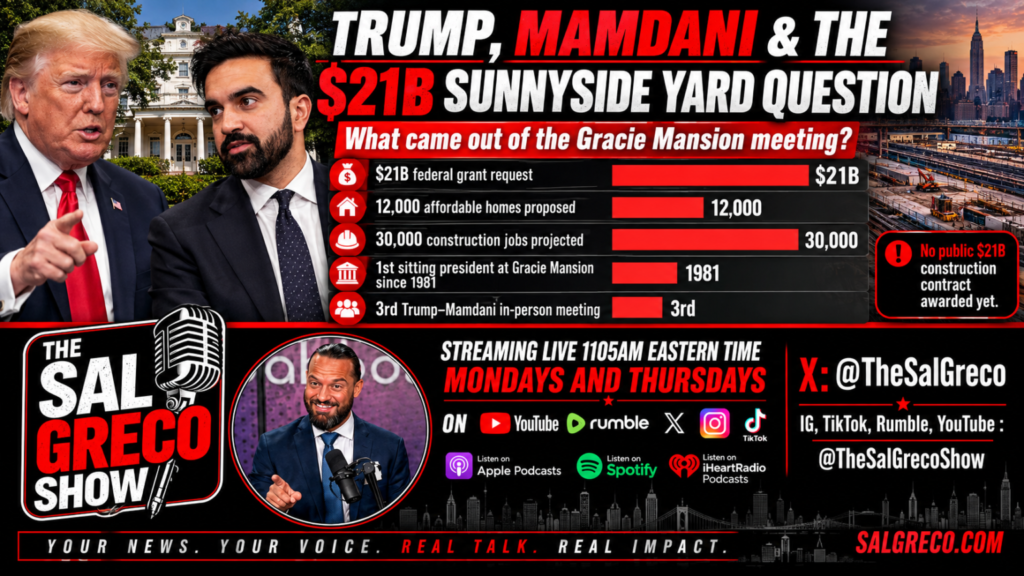
As SalGreco.com previously reported, Mamdani is pursuing a plan involving the construction of a massive platform over Sunnyside Yard in Queens that could support approximately 12,000 housing units.
The proposal could require more than $21 billion in federal grants and assistance.
That number deserves to be repeated.
Twenty-one billion dollars.
No such $21 billion grant has been awarded.
No construction contract of that magnitude has been announced.
No general contractor has been publicly selected for Mamdani’s proposal.
What emerged from the Gracie Mansion meeting was an agreement to continue detailed discussions between City Hall and the Trump administration concerning federal money, federal approvals, engineering issues and the massive logistical undertaking required to develop Sunnyside Yard.
Trump acknowledged that substantial federal involvement would likely be necessary.
That alone makes the Trump-Mamdani relationship worth following closely.
They are no longer merely two ideological opponents trading insults.
Potentially billions of taxpayer dollars are now part of their working relationship.
THREE DAYS LATER, NIAC ACTION SUES TRUMP
Then came September 24.
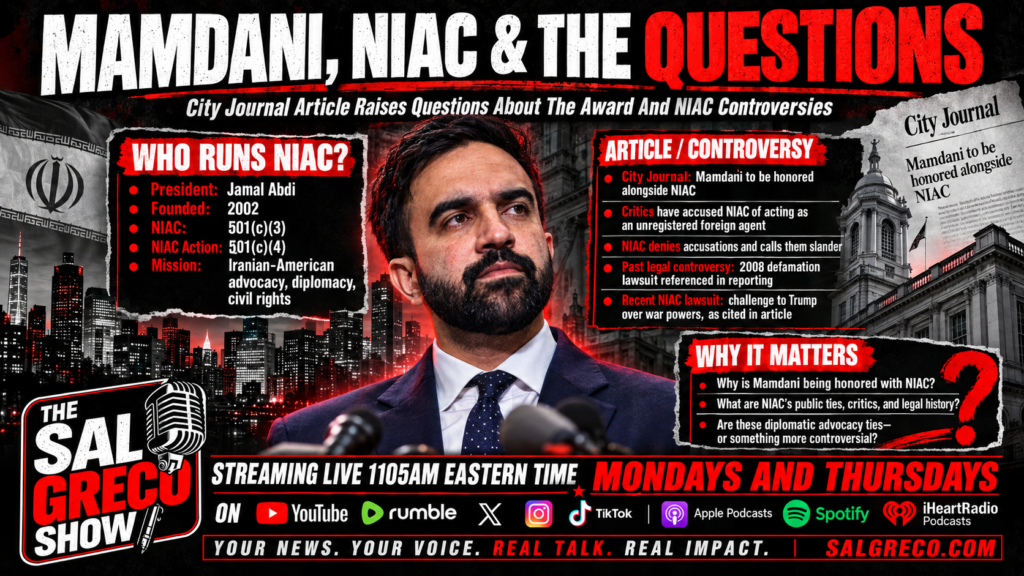
Only three days after the Gracie Mansion meeting, NIAC Action filed a federal lawsuit against the Trump administration challenging Trump’s military campaign involving Iran.
NIAC Action argues that the president is conducting military operations without proper congressional authorization and is asking a federal court to declare the continuing campaign unconstitutional.
There is an important legal distinction here.
The organization suing Trump is NIAC Action, a 501(c)(4).
It is affiliated with, but legally distinct from, the National Iranian American Council, or NIAC, which operates as a 501(c)(3) public charity.
The relationship between the organizations is nevertheless significant.
NIAC’s own tax filings identify NIAC Action — EIN 47-3979683 — as a related organization.
NIAC’s publicly available Schedule R also reported $245,176 involving shared paid employees between NIAC and NIAC Action in the 2022 reporting year.
None of that is inherently unlawful.
Nonprofit organizations can operate affiliated 501(c)(3) and 501(c)(4) entities and can share employees and resources when expenses and activities are properly allocated.
But the distinction becomes important because the two organizations operate under different political and lobbying restrictions.
NIAC is the charitable entity.
NIAC Action has considerably greater latitude for lobbying and political advocacy.
And NIAC Action was now suing the administration of the same president who had just spent hours meeting cordially with Mamdani.
Then another development occurred.
MAMDANI’S LONG-AWAITED SECURITY CLEARANCE ARRIVES
Throughout much of Mamdani’s first year as mayor, he had been waiting for the federal security clearance necessary to participate fully in classified terrorism and national-security briefings.
As recently as September 16, City Hall said the process remained underway.
Then came the Gracie Mansion meeting on September 21.
Days later, the situation changed.
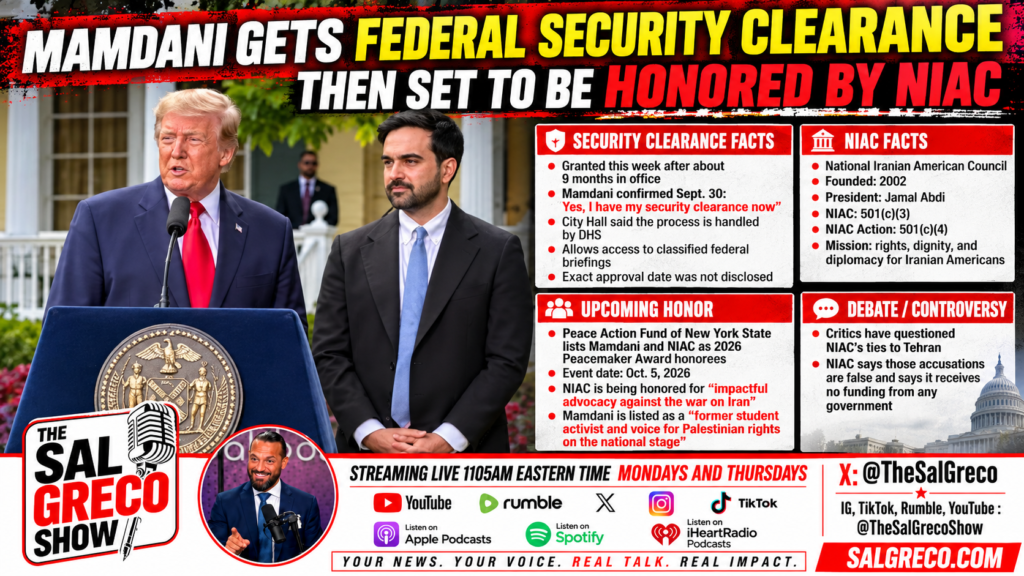
On September 30, Mamdani announced that his federal security clearance had been approved.
City Hall said the clearance had been granted during the preceding days.
The clearance process is overseen federally, including through the FBI.
There is currently no public evidence that Trump personally ordered the clearance approved.
There is no evidence establishing that Sunnyside Yard was exchanged for a security clearance.
And there is no evidence of a quid pro quo between Trump and Mamdani.
Those points need to be stated clearly.
Background investigations can take months, and the conclusion of Mamdani’s investigation shortly after the meeting could simply represent the normal completion of that process.
But journalism exists precisely because timing creates questions worth answering.
Was Mamdani’s pending clearance discussed during his conversations with Trump?
Did City Hall raise the issue with anyone in the administration?
Did the White House contact the FBI or any other federal agency concerning the status of Mamdani’s clearance?
Had the clearance already been approved before the September 21 meeting?
Was its completion entirely unrelated?
Those are factual questions.
The answers would eliminate speculation far more effectively than pretending the timing isn’t noteworthy.
NOW ADD NIAC AND THE IRAN CONNECTION
Then there is the National Iranian American Council.
On October 5, Mamdani and NIAC are scheduled to receive separate William Sloane Coffin Jr. Peacemaker Awards from the Peace Action Fund of New York State.
NIAC is being recognized for what the organization describes as its advocacy opposing the war involving Iran.
Mamdani is separately being recognized for his activism and advocacy involving Palestinian issues.
City Journal highlighted the pairing on October 1.
One correction is important because chronology matters:
The awards were not announced after the September Trump-Mamdani meeting.
Peace Action New York State announced the Mamdani and NIAC awards on July 6, 2026, more than two months before Trump’s September 21 visit to Gracie Mansion.
There is therefore no factual basis for claiming that the award was suddenly created because of that meeting.
But look at the broader picture now surrounding October 2026.
Trump is engaged in a major confrontation with Iran.
NIAC Action is suing Trump over that conflict.
NIAC is receiving an award for its advocacy against the war.
Mamdani — who has himself strongly opposed Trump’s Iran policy — is receiving a separate award at the same event.
At the very same time, Mamdani and Trump have developed an unexpectedly cordial working relationship involving potentially billions of dollars in federal investment.
That doesn’t establish coordination among these parties.
It does create one of the more unusual political arrangements New Yorkers have seen in a while.
SO WHAT IS NIAC?
NIAC is a Washington, D.C.-based 501(c)(3) organization established in the early 2000s.
Its EIN is 73-1626026.
For more than two decades it has sought to influence American policy concerning Iran, sanctions, diplomacy, war and Iranian-American affairs.
Its activities have also generated considerable controversy.
Critics have long accused NIAC of advancing policies favorable to the Iranian government and have questioned whether its relationships and lobbying activities warranted scrutiny under the Foreign Agents Registration Act.
NIAC forcefully disputes those accusations and says that it represents Iranian Americans rather than Tehran.
There is an important factual limitation:
There is no public DOJ judgment establishing that NIAC is an agent of the Iranian government.
Calling NIAC definitively the Iranian government’s “No. 1 lobbyist” therefore converts a disputed political accusation into a statement of established fact.
That is not what the available record proves.
What the record unquestionably establishes is that NIAC has been one of the most visible Washington organizations advocating on American policy toward Iran for more than two decades.
And NIAC’s history contains another episode that deserves serious attention.
NIAC WAS HIT WITH FEDERAL COURT SANCTIONS
NIAC and its former president Trita Parsi previously sued Iranian-American writer Seid Hassan Daioleslam for defamation over allegations concerning NIAC and Parsi’s relationship with Tehran.
What happened during that litigation became significant in its own right.
A federal district court imposed $183,480.09 in monetary sanctions against NIAC and Parsi arising from discovery conduct.
The D.C. Circuit Court of Appeals later upheld most of those sanctions.
The appellate court described conduct that included delaying production of relevant materials, failing to produce documents, representations concerning whether documents existed and violations of court discovery orders.
That isn’t political commentary.
It is contained in a federal appellate decision.
The underlying defamation lawsuit ultimately ended in summary judgment against NIAC and Parsi because they could not establish the “actual malice” required in a public-figure defamation claim.
The district court also wrote, while examining evidence concerning Parsi, that certain statements were “not inconsistent with the idea that he was first and foremost an advocate for the regime.”
But there is another essential legal distinction.
The court did not issue a judgment declaring NIAC an Iranian government agent.
And failure to prove actual malice in a defamation case does not automatically establish every accusation made against the plaintiff as true.
There is plenty in the documented record to investigate without exaggerating what the court actually decided.
FOLLOW THE 501(c)(3) AND 501(c)(4) MONEY
The NIAC structure itself deserves additional scrutiny.
NIAC’s Form 990 identifies NIAC Action as its related 501(c)(4).
Its Schedule R reports the sharing of paid employees between the organizations, with $245,176 associated with that arrangement in the publicly available 2022 filing.
Again, shared staffing is not automatically improper.
The serious accounting question is whether employee time, expenses and politically oriented activity are appropriately separated and allocated between the tax-deductible charitable organization and the more politically active 501(c)(4).
That question becomes particularly relevant when one of those organizations is litigating directly against a sitting president.
The public is entitled to understand where the financial and operational boundaries lie.
NOW LOOK AT THE SEQUENCE
Strip away everybody’s ideology for a moment and simply examine the timeline.
Trump spends the mayoral campaign attacking Mamdani.
Mamdani attacks Trump.
Trump calls Mamdani a communist lunatic.
Mamdani wins.
They meet.
Trump praises him.
They develop direct communication.
Mamdani acknowledges that they text.
They meet multiple times.
Trump travels to Gracie Mansion.
They discuss a gigantic housing proposal that could eventually involve more than $21 billion in federal assistance.
Three days later, NIAC Action files suit against Trump over the Iran war.
Within days, Mamdani receives the federal security clearance he had been awaiting for months.
Days after that, Mamdani and NIAC are scheduled to receive separate awards at the same event while NIAC’s affiliated advocacy organization remains in federal court fighting the Trump administration.
And Trump and Mamdani remain publicly cordial.
Read that sequence again.
None of it, standing alone or together, proves corruption.
It does not prove a secret deal.
It does not establish that Trump’s administration traded a security clearance for cooperation on Sunnyside Yard.
It does not establish that NIAC controls Mamdani.
It does not establish that Trump and Mamdani secretly share the same politics.
But it certainly makes the simplistic campaign story — two mortal ideological enemies incapable of working together — look very different after the election.
POLITICS OR KAYFABE?
This is where the WWE comparison becomes difficult to avoid as a metaphor.
Professional wrestling works because the audience is encouraged to become emotionally invested in conflict.
The personalities attack each other.
The promos become increasingly personal.
The audience chooses sides.
The bell rings.
Then, behind the curtain, everyone still has a business to run.
Politics is far more consequential than wrestling.
But voters repeatedly watch campaigns in which candidates describe their opponents in almost apocalyptic terms.
Dangerous.
Radical.
Communist.
Fascist.
A threat to democracy.
A threat to America.
Then Election Day passes.
The cameras move elsewhere.
And yesterday’s mortal enemies sometimes become today’s negotiating partners.
That can be perfectly legitimate.
Government often requires people who profoundly disagree to work together.
A president working constructively with a mayor can be good government.
But that doesn’t erase what voters were told while the campaign was underway.
And that is where the public’s skepticism comes from.
When political leaders spend months convincing Americans that the person on the opposite side represents something almost existentially dangerous, only to establish a warm working relationship immediately afterward, voters are entitled to ask how much of the pre-election hostility was genuine policy conflict and how much was political theater.
With Trump and Mamdani, that question becomes even more compelling because real money and national-security issues now surround the relationship.
$21 billion.
A federal security clearance.
A war involving Iran.
A lawsuit against the president.
An influential Iran-policy organization.
Two related nonprofit entities.
A shared awards ceremony.
And two politicians who once sounded like they couldn’t stand being in the same country together now texting one another.
Maybe all of it has perfectly ordinary explanations.
Some of it almost certainly does.
But journalism shouldn’t begin with an assumption that everything is sinister.
Nor should it begin with an assumption that everything is harmless.
It should begin with questions.
Did Trump’s administration have any role in accelerating Mamdani’s security clearance?
Was the clearance discussed before or during the Gracie Mansion meeting?
What exactly is being negotiated concerning Sunnyside Yard?
Who will benefit financially if federal money eventually flows into the project?
Which developers, contractors, consultants and lobbyists are positioning themselves around it?
What contacts exist between Mamdani’s administration, NIAC and NIAC Action?
How exactly are NIAC and NIAC Action dividing personnel expenses and political activity?
And what communications exist that the public hasn’t seen?
Those are not accusations.
They are the questions created by an extraordinary political timeline.
Because maybe the Trump-Mamdani story is simply an example of two ideological opponents discovering that governing requires cooperation.
Or maybe what Americans are watching is something politics has perfected for generations:
A spectacular fight in front of the cameras — followed by business backstage.
Either way, the bell has already rung.
And somebody should keep watching what happens outside the ring.