
BY SAL GRECO
Three officials inside the United States Secret Service have been placed on administrative leave amid an internal investigation into potential misconduct, including the agency’s own chief of communications, Anthony Guglielmi.
But the developing story raises a question that extends well beyond three employees or one federal agency:
Is the Trump administration becoming more concerned with discovering who is talking than examining why people inside government feel compelled to talk in the first place?
It is a question that should sound familiar to anyone following the turmoil inside Jessica Tisch’s NYPD.
Three Secret Service Communications Officials Sidelined
CNN reported Tuesday, August 25, that three Secret Service employees have been placed on administrative leave while the agency’s Office of Professional Responsibility investigates potential misconduct. Sorry MAGA, this is NOT Fake News.
According to the reporting, all three are non-law-enforcement employees assigned to the Secret Service communications office. Their security clearances have reportedly been suspended and access to their government devices removed while the investigation proceeds.
The Secret Service confirmed that three employees were placed on leave but did not publicly identify them or disclose the specific misconduct being investigated.
At this point, only one of the three has been publicly identified: Anthony Guglielmi, the agency’s chief of communications. The identities of the other two remain undisclosed.
That distinction is critical. Until additional credible reporting identifies those employees, publishing names based on speculation would be irresponsible.
Even more important, there has been no public confirmation that these three officials are accused of leaking information. The Secret Service has described the matter only as an investigation into “potential misconduct.”
That leaves a major unanswered question hanging over Washington: What exactly happened?
Who Is Anthony Guglielmi?
Guglielmi isn’t an obscure government employee.
He has spent years as one of the most recognizable public-information professionals in American law enforcement.
He joined the Secret Service in 2022 as chief of communications, taking responsibility for media relations as well as internal and strategic communications. Before arriving at the federal agency, he held senior communications positions with the Fairfax County Police Department, Chicago Police Department and Baltimore Police Department. His broader career has also included government and private-sector communications work.
That background makes his placement on administrative leave particularly noteworthy.
For years, Guglielmi has been the person standing between major law-enforcement institutions and the press, explaining controversies and delivering official statements during crises.
Now he is on the other side of an internal investigation.
And there is another remarkable piece of recent history.
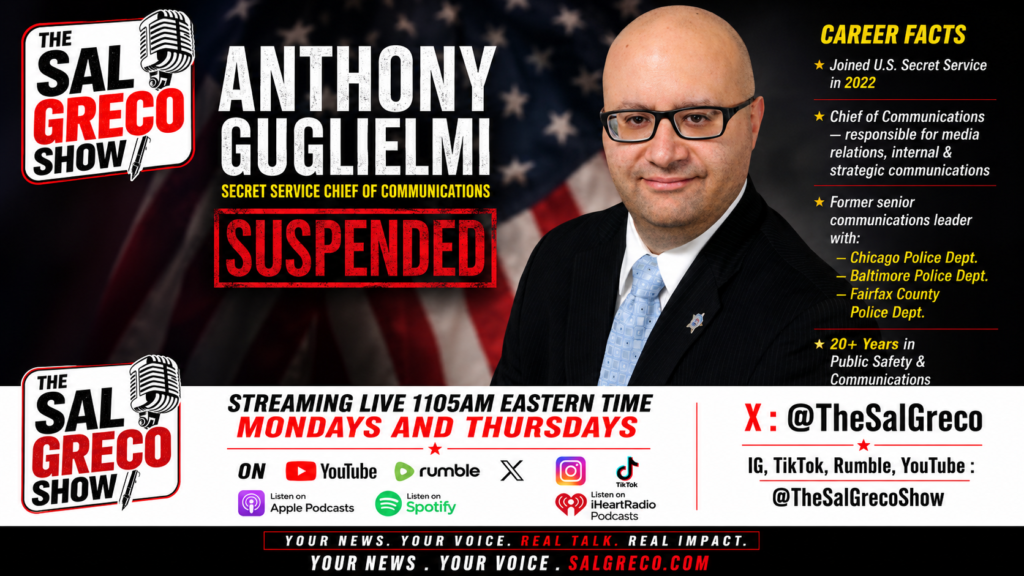
Last Month, Guglielmi Announced a Leak Investigation
Only last month, Guglielmi publicly confirmed that a member of Vice President JD Vance’s Secret Service protective detail was under administrative investigation — and potentially a criminal inquiry — involving allegations of compromising operational and information security.
That investigation followed reporting concerning frustrations within Vance’s protective detail, including complaints about last-minute travel and other demands. CBS reported that the underlying story described agents’ concerns about trips and assignments they considered unusual compared with previous vice presidents.
The Secret Service did not identify that agent.
Guglielmi was the spokesman announcing the investigation.
Now, approximately one month later, Guglielmi himself has been placed on administrative leave as part of an entirely separate investigation whose subject remains publicly unexplained.
There is currently no evidence establishing that Guglielmi’s suspension is connected to the Vance investigation. But the sequence makes the lack of information surrounding Tuesday’s action even more noteworthy.
The Trump Administration’s Growing War on Leaks
This development does not occur in isolation.
The investigation involving Vance’s detail was explicitly about potentially compromised information. CNN reported at the time that publication of information concerning protective movements generated concern within the Secret Service, FBI and White House. Other reporting has placed that episode within a broader Trump administration effort to identify unauthorized disclosures to journalists.
There is an important distinction here.
Some Secret Service information absolutely must remain secret.
Specific protective movements, vulnerabilities, security procedures and operational plans can literally become matters of life and death. Investigating the unauthorized disclosure of information that could endanger a president, vice president or their families is not merely justified — it is necessary.
But that cannot become a blanket justification for treating every embarrassing disclosure as a security problem.
There is a fundamental difference between someone leaking a protectee’s sensitive movements and an employee telling a reporter that an agency has a morale, management, staffing or resource problem.
One potentially compromises physical security.
The other potentially exposes a management failure.
Government cannot conveniently erase that distinction.
We’ve Seen a Similar Dynamic Inside Jessica Tisch’s NYPD
That brings us to New York City.
Under Police Commissioner Jessica Tisch, the NYPD has increasingly projected an image of an organization determined to control its internal information while simultaneously facing serious questions about overtime, executive conduct, Internal Affairs investigations, personnel decisions and morale.
There are legitimate reasons for the NYPD to protect confidential information. Criminal investigations, sealed records, intelligence and private personnel information cannot simply be distributed indiscriminately.
Tisch has also pursued genuine corruption allegations. In June, for example, the NYPD and FBI executed search warrants as part of an investigation involving current and former NYPD officials, including former Chief of Department Jeffrey Maddrey, former department spokesman Tarik Sheppard and Manhattan South commander James McCarthy.
Those are serious matters and should be investigated on their merits.
But another question remains:
When embarrassing information reaches reporters, does leadership spend more energy identifying the source than addressing the underlying allegation?
That question has become increasingly relevant inside the NYPD.
As I previously reported, sources alleged that Lt. Katherine Guerrero was transferred after investigators obtained private communications involving former Deputy Commissioner of Public Information Tarik Sheppard that allegedly included criticism of Tisch. Those remain allegations rather than established findings, but if accurate, they raise an obvious concern about whether internal investigative material can ultimately be used against employees whose private criticism of leadership is uncovered along the way.
And that is where the comparison to Washington becomes significant.
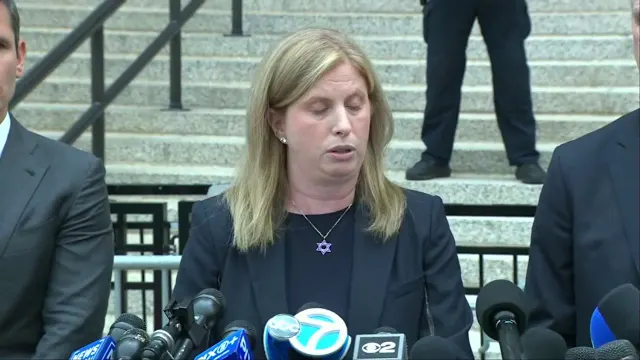
Find the Leak — But What About the Problem?
There is an old institutional instinct in government:
A damaging story appears.
Leadership becomes furious.
Phones are examined. Emails are reviewed. Access logs are checked. Investigators start asking who spoke to whom.
Eventually everyone knows one thing with certainty:
Management wants the leaker.
But what sometimes gets lost is the question that should have been asked first:
Was what the person revealed true?
If Secret Service employees have concerns about morale, staffing, travel demands or misuse of resources, investigate those concerns.
If someone disclosed sensitive protective information that endangered a protectee, investigate that person too.
Those two things are not mutually exclusive.
The same standard should apply at One Police Plaza.
If someone improperly releases confidential NYPD information, investigate the disclosure. But if the leaked information reveals overtime abuse, favoritism, selective discipline, corruption or management failures, investigate that too.
An organization interested primarily in accountability investigates both.
An organization interested primarily in controlling the narrative investigates only the leak.
A Dangerous Culture for Any Administration
President Donald Trump has every right to demand that people entrusted with classified or operationally sensitive information protect it.
Jessica Tisch has every right to demand that NYPD personnel comply with department rules regarding confidential information.
But neither the White House nor One Police Plaza benefits from creating an environment where employees believe reporting misconduct will make them the target.
That kind of culture doesn’t stop problems.
It drives them underground.
And eventually those problems become bigger.
The Secret Service has endured enormous scrutiny in recent years over security failures, leadership, staffing and morale. Its mission is too important for legitimate internal concerns to be dismissed merely because they become embarrassing when reported publicly.
Likewise, the NYPD cannot restore confidence through information control alone. Transparency is uncomfortable precisely because it reveals things powerful institutions would sometimes prefer the public not know.
The Two Names We Still Don’t Know
For now, the Secret Service investigation contains more questions than answers.
Anthony Guglielmi is the only suspended communications official publicly identified. The other two have not been named by the Secret Service or credibly identified in the reporting available as of August 25.
The agency has also not disclosed what misconduct it believes occurred, and there is currently no established evidence that the three-person investigation concerns leaking.
Those facts matter.
But so does the broader pattern surrounding the story.
Only weeks ago, Guglielmi was announcing an investigation into someone suspected of compromising information within the vice president’s protective detail.
Today, Guglielmi’s own clearance has reportedly been suspended while internal investigators examine allegations against him and two colleagues.
The public deserves to know why.
And when that answer finally comes, there is another question worth asking — in Washington and New York alike:
Are our institutions investigating people because they endangered their organizations, or because they embarrassed the people running them?
There is an enormous difference.
And accountability depends on knowing which one it is.