
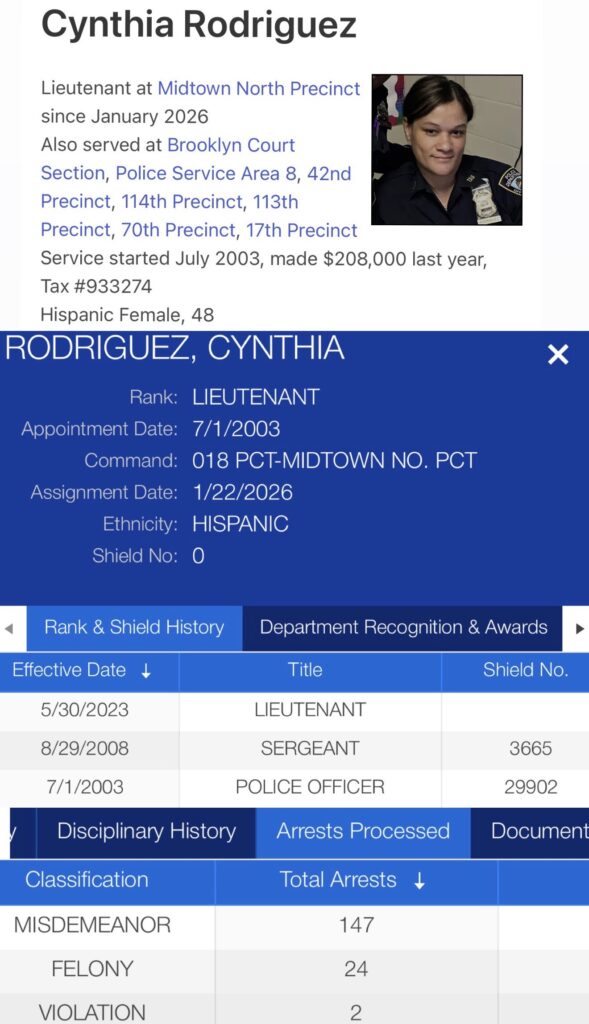
Officer says he was questioned for praying, denied a suitable prayer space and hit with a negative evaluation after going to Internal Affairs. A separate officer alleges racial discrimination and punishment posts. Both name Lt. Cynthia Rodriguez.
By Sal Greco | October 25, 2026
How many complaints involving the same NYPD supervisor does it take before Police Commissioner Jessica Tisch and the department’s leadership conduct a thorough, transparent review?
That question is growing louder at Manhattan’s Midtown North Precinct after two separate civil complaints submitted on September 21, 2026, named NYPD Lieutenant Cynthia Rodriguez and alleged discrimination and retaliation against officers under her supervision.
The newest document reviewed for this article is a 50-page verified complaint filed in New York County Supreme Court, Tamer Sergany v. City of New York and Cynthia Rodriguez, Index No. 161868/2026, NYSCEF Doc. No. 1.
Sergany, an Egyptian-American Muslim officer who joined the NYPD in 2016, alleges that the department denied him meaningful religious accommodations and that Rodriguez interfered with his prayers, restricted his field-training duties and retaliated after he complained.
The other matter is a 34-page complaint brought by Officer Shane Worrell-Louis, a Black officer at the same precinct, alleging racial discrimination and retaliation. It names Rodriguez alongside the City, Inspector Maggie Clamp, Lt. Arnoldo Martinez and Sgt. Lucas Alves.
These are allegations, not court findings. The filings do not establish liability, and no response from Rodriguez or the City is included in the documents reviewed. But the overlap between them makes the allegations worthy of close examination.
A Muslim Officer Says His Prayers Became a Problem
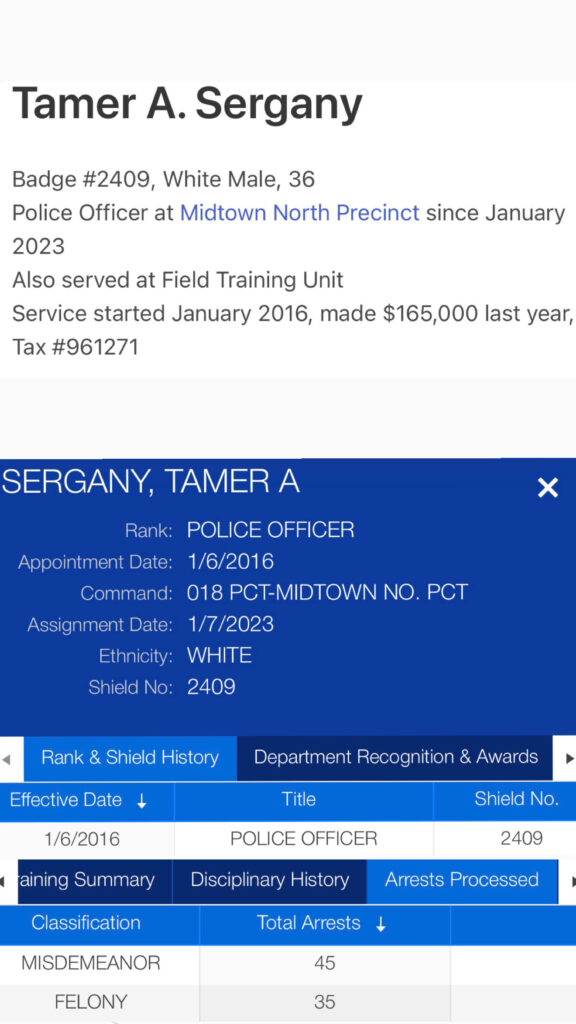
Sergany’s complaint centers on his efforts to observe daily Islamic prayers and attend Jumu’ah, the congregational Friday prayer.
He alleges that Midtown North denied his request for Friday and Saturday regular days off even though, according to the complaint, officers of other faiths had received scheduling accommodations for religious observance.
The department did not reject every adjustment: an April 2025 determination offered Sergany a 4 p.m. Friday start time, subject to exceptional circumstances.
He argues that this alternative did not adequately address his request, and that officials did not meaningfully consider other options he proposed, including reassignment or changes to his field-training duties.
Then there is the allegation involving a prayer room.
According to the complaint, a July 2023 Midtown North order designated Room A103 for members of any faith to pray, with approximately 10 minutes of out-of-service time.
Sergany says access effectively disappeared after a short period.
In January 2026, after he sought restoration of an interfaith prayer space, the command instead identified a basement electrical room.
The lawsuit describes high-voltage switchboards, cockroaches, dust, construction materials and pornographic magazines inside that room.
Sergany says he and another officer cleaned it themselves.
The irony is stark: the lawsuit quotes a January 2025 NYPD bulletin advertising more than 100 prayer and meditation spaces and requiring clean, private facilities.
According to the filing, the department’s own Equal Employment Opportunity office closed Sergany’s request based on the command’s representation that the electrical room was available.
An important distinction: the original prayer-room and scheduling disputes began before Rodriguez was assigned to Midtown North in approximately January 2026. The complaint attributes those earlier decisions to the command, other supervisors and the City’s accommodation process—not solely to Rodriguez.
Sergany’s allegations against Rodriguez concern what happened after she arrived.
He says that on April 15, 2026, she asked why he needed to pray and allegedly described his praying in her presence as a personal attack.
The complaint further alleges that she altered his work tour during Ramadan, assigned him duties that caused him to miss Friday prayers, interrupted a prayer session with repeated calls and directed him to hurry back to patrol.
On one August evening, Sergany alleges, he became so concerned about being reprimanded for praying inside his precinct that he performed his religious ablution at a hotel and prayed on a public sidewalk while his partner watched over him.
No police officer should have to choose between following lawful orders and requesting a reasonable accommodation for sincerely held religious beliefs.
Whether that happened here is a question for evidence, testimony and the court—not an assumption that can be drawn from the complaint alone.
Internal Affairs Complaints—and a Disputed Negative CRAFT
The complaint states that Sergany contacted NYPD Internal Affairs on August 28, 2026, receiving log number 2026-30808.
Approximately a week later, according to the filing, Rodriguez submitted a negative CRAFT performance evaluation, dated September 5, concerning a September 3 arrest and prisoner search.
Sergany says the entry falsely blamed him for failing to find contraband when, in his account, he was the officer who located it while following supervisors’ instructions.
He alleges that Rodriguez had supervised the arrest, that an arrestee in a wheelchair had not been searched before he came to assist, and that she nevertheless blamed him for deficiencies in the search.
The complaint describes his written challenge to the evaluation and asserts that negative CRAFT records may affect future assignments and promotions.
Sergany says he complained to Internal Affairs again on September 15, receiving log number 2026-33209.
The existence of those log numbers is asserted in the pleading; the underlying IAB files and any investigative conclusions have not been independently reviewed for this article.
This is one of the most consequential factual disputes.
If the evaluation was justified, the NYPD should be able to support it with underlying arrest, search and supervisory records.
If it was fabricated to punish a complaint, that would raise a much broader issue about whether internal performance systems can be weaponized against officers who report misconduct.
Another Lawsuit, Another Allegation of Retaliation
The separate case involving Officer Worrell-Louis was previously reported by SalGreco.com.
Worrell-Louis alleges that he and his Black partner were repeatedly assigned a defective patrol vehicle during a hot week in late June and early July 2026 while other officers received serviceable cars.
He says he complained about the vehicle and raised concerns about racial treatment, only to be removed from his Traffic assignment the day after a written discrimination complaint.
His filing describes an emergency-room visit after exposure to another patrol vehicle without working air conditioning; it says the department accepted the event as a line-of-duty injury.
The complaint also alleges that Rodriguez warned him about accepting his punishment, restricted him to undesirable patrol sectors, subjected his work to unusual scrutiny and imposed negative documentation.
On August 26, Worrell-Louis says he asked directly whether she was retaliating against him through a punishment post.
His pleading alleges that she answered, “Yes, I am.”
That alleged response is potentially important—but it must be evaluated against the full recording and context.
The actual body-camera footage has not been independently reviewed here. Both complaints refer to an allegedly recorded exchange, and the NYPD should preserve and review the evidence.
The Striking Connection Between the Two Officers
Here is what makes these two cases particularly noteworthy:
The officers are not strangers whose complaints merely happen to name the same lieutenant. Each filing intersects with the other’s account.
In paragraphs 40–41 of Worrell-Louis’s complaint, Tamer Sergany is identified by name as someone who saw the allegedly overheated police vehicle on June 30 and advised Worrell-Louis to return it to the precinct.
In paragraphs 204–208 of Sergany’s complaint, he describes another Midtown North officer who complained of discrimination, was allegedly given defective cars and punishment posts, and asked Rodriguez on August 26 if she was retaliating.
That description closely matches Worrell-Louis’s pleaded account.
These overlapping assertions do not independently prove either case. They do, however, identify a set of dates, potential witnesses, departmental records and camera footage that investigators and litigants can check rather than relying on rumor.
The Separately Reported Paid-Detail Questions
SalGreco.com has also reported allegations surrounding a paid-detail incident involving Rodriguez.
According to sources previously cited by The Sal Greco Show, Rodriguez was allegedly working a paid detail associated with a Mount Sinai location when an incident with an emotionally disturbed individual resulted in a disputed attempted arrest, the person’s departure and a reported injury to Rodriguez.
That reporting also raised questions about her alleged past dismissal-probation status and paid-detail eligibility.
Those are separate, source-based allegations, not findings in either lawsuit.
The incident classification, any prisoner custody status, Rodriguez’s personnel history and her eligibility for the detail require confirmation from official records. They should not be presented as established misconduct.
The Questions Commissioner Tisch’s NYPD Should Answer
Under the New York City Human Rights Law, employers have obligations concerning religious accommodations, cooperative dialogue, discrimination and retaliation.
The issue here is whether the NYPD followed those obligations and its own written procedures when officers brought concerns forward.
Commissioner Tisch and Midtown North’s command should face direct questions:
- Were Sergany’s two reported Internal Affairs complaints and Worrell-Louis’s EEO complaint independently investigated, and what steps were taken to protect the complainants?
- Why did a precinct that had designated a conventional prayer room later offer an electrical room, and was that room inspected for safety and compliance with NYPD policy?
- Has the NYPD preserved the August 26 body-camera footage and all relevant assignment, vehicle, telephone and evaluation records?
- Were the negative CRAFT entries and other disciplinary measures supported by objective evidence and applied consistently?
- What did the command and NYPD leadership know about the separate paid-detail allegations, and what records establish what occurred?
Police officers are expected to follow rules, respect constitutional protections and document their actions.
Their supervisors should be held to those same standards, and complaints against supervisors deserve meaningful review—not prejudgment in either direction.
Two officers have now put serious allegations involving the same lieutenant into separate legal pleadings.
One raises the treatment of a Muslim officer seeking religious accommodation.
The other raises the treatment of a Black officer who complained of possible racial discrimination.
Both allege retaliation, and both point toward records capable of being checked.
The NYPD’s credibility depends on what it does with those records—not on how quickly it dismisses the questions.