
From the Cadet Corps to the Police Academy, four lawsuits described in SalGreco.com’s reporting raise a larger question: who is accountable for the culture in which New York City’s future police officers are trained?
BY SAL GRECO | The Sal Greco Show | November 3, 2026
The NYPD Police Academy is supposed to teach its recruits integrity, accountability and respect for the law. The Police Cadet Corps is supposed to develop college students into the next generation of officers.
But two new lawsuits filed in New York County Supreme Court describe something very different inside the Cadet Corps: allegations of religious discrimination, humiliation, unequal discipline and retaliation against a veteran sergeant and a young cadet who reported the treatment of a female colleague.
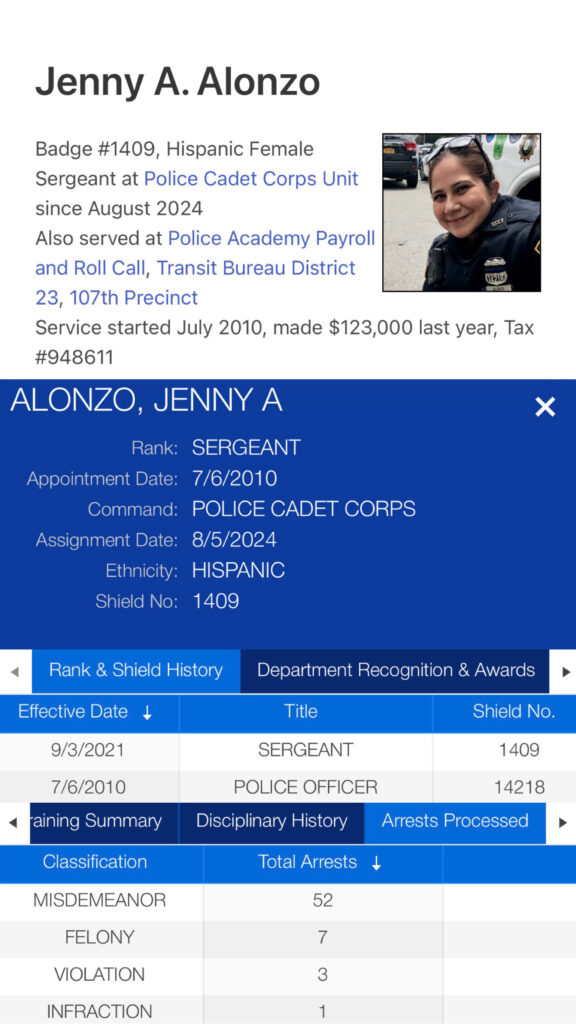
The cases concern Captain Giorlys J. Alvarez, commanding officer of the Police Cadet Corps Unit; Lieutenant Lei Cui, its executive officer; and Sergeant Jenny A. Alonzo, a supervisor in the unit. The plaintiffs are Lee Helton, a veteran NYPD sergeant, and Ali Alsaidi, a former police cadet who says he was just sixteen days away from entering the July 22, 2026 Police Academy class.
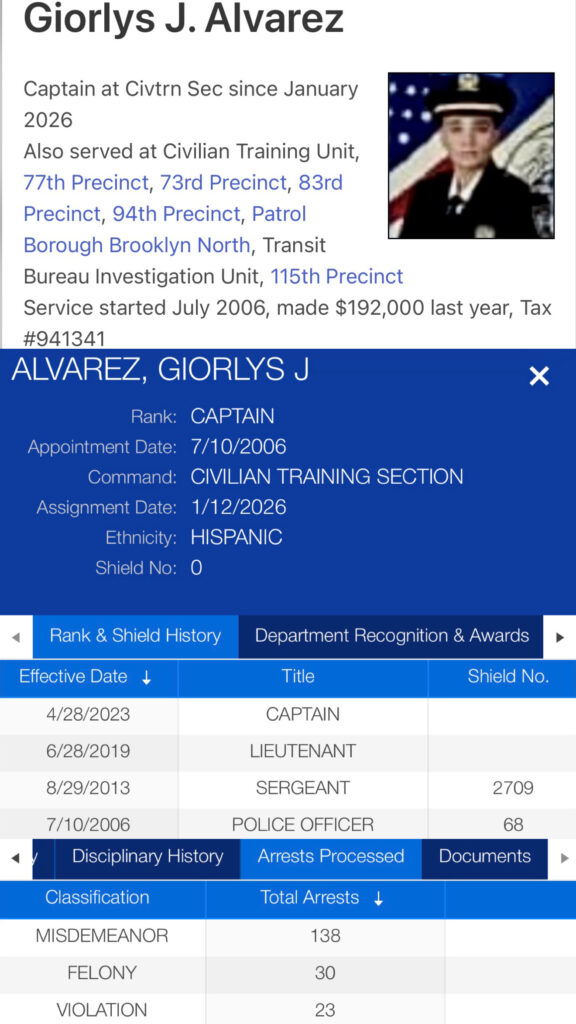
These are not findings of misconduct. They are allegations in two verified civil complaints, which the defendants are entitled to contest. But the complaints are specific about dates, conversations, assignments and the consequences the plaintiffs say followed their protected reports.
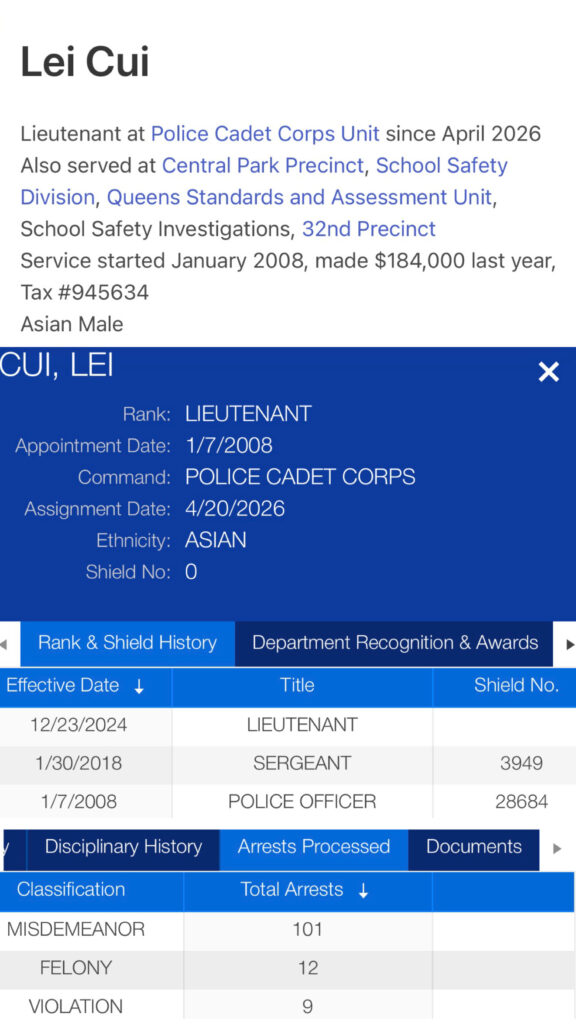
And they arrive after SalGreco.com reported on separate Police Academy lawsuits brought by former recruits Slims Florentino and Emilio Andino. Those cases involve different events and defendants. Their overlap is institutional, not proof of a coordinated scheme: once again, people inside the NYPD’s training pipeline allege that reporting mistreatment led to punishment or unequal treatment instead of protection.
TWO CASES, ONE FEMALE CADET AND TWO EEO COMPLAINTS
On October 15, attorney John A. Scola filed Lee Helton v. City of New York, Giorlys J. Alvarez and Lei Cui, Index No. 162924/2026.
Five days later, on October 20, Scola filed Ali Alsaidi v. City of New York, Giorlys J. Alvarez, Jenny A. Alonzo and Lei Cui, Index No. 163116/2026.
Both were filed in New York County Supreme Court. Both assert claims under the New York City Human Rights Law. Both center on complaints concerning the treatment of female cadet Daylin Monsalveblanco, whom Helton’s complaint identifies as Daylin Monsalve.
The lawsuits allege that Alonzo repeatedly criticized the cadet’s weight and physical appearance. Alsaidi’s complaint also describes allegations of degrading remarks concerning her Afro braids, race and skin color. According to the pleadings, Monsalveblanco sought help and complained about that treatment.
Helton says he filed an NYPD Office of Equal Employment Opportunity complaint on June 17, 2026, after Monsalveblanco approached him for assistance. Alsaidi says he witnessed a confrontation that day in which Cui brought the cadet to tears, heard discussion of a proposed command discipline, and overheard Alonzo contacting the Candidate Assessment Division about the cadet’s purported behavior. Alsaidi filed his own EEO complaint on June 20.
What allegedly happened next is the heart of both lawsuits.
SERGEANT HELTON: FROM TRUSTED ADMINISTRATIVE SERGEANT TO AN ALLEGED RETALIATION TARGET
According to Helton’s 17-page filing, Alvarez recruited him into the Cadet Corps in March 2026 after having worked with him at the 73rd Precinct. He says she promised administrative work directly under her, flexible hours, weekends off and significant overtime.
The lawsuit alleges that those arrangements were honored until he reported the treatment of Monsalveblanco.
When Helton returned from vacation on July 8, he says Cui asked why he had contacted EEO and told him, on Alvarez’s orders, that his assignment was changing. Helton alleges he was removed from his administrative role, lost overtime, was barred from the unit office, and was told not to speak with cadets. He describes repeatedly being assigned recruitment and inspection duties, having to obtain daily assignments from a less-senior sergeant, waiting in his car for extended periods and changing uniforms as many as three or four times in one day.
On July 23, Helton says he reported the alleged treatment of Alsaidi and Monsalveblanco to the Internal Affairs Bureau. His complaint identifies an IAB log number and alleges that the retaliation continued.
The financial effects, if proven, would be substantial. Helton claims approximately $3,540 a month in lost overtime and other income and estimates a long-term pension reduction. He says he was driven to choose retirement; the complaint states that he was using accrued leave and that his retirement was scheduled to become effective July 30, 2027. He seeks lost compensation, restoration of his former assignment and other relief.
Think about the message that allegation sends to every sergeant supervising cadets: if you believe a young employee is being mistreated, do you report it—or protect your own career?
ALI ALSAIDI: SIXTEEN DAYS FROM THE ACADEMY, THEN OUT OF THE PROGRAM
Alsaidi’s 19-page lawsuit is especially disturbing because of how close he says he was to becoming a police officer.
A Muslim cadet of Arab and Middle Eastern background, Alsaidi says he graduated cum laude from John Jay College, received a Cadet Corps academic award and was named Civilian of the Quarter at the 47th Precinct. His complaint states that he had completed the required hiring assessments and appeared on the Candidate Assessment Division’s list for the July 22, 2026 Academy class.
After he filed the June 20 EEO complaint, Alsaidi alleges that he and Monsalveblanco were barred from the Cadet Corps office and that his July leave request was denied. On July 6, he says Cui and Alonzo told him CAD had officially rejected him from the Academy class, urged him to resign and warned of unspecified “other routes” if he refused.
Alsaidi says that statement about CAD was false.
The complaint alleges that CAD personnel subsequently told other NYPD employees—and later Alsaidi himself—that he had completed his assessments and had not been disqualified. The underlying CAD records and communications have not been independently reviewed for this article; these are assertions in the filed pleading.
Alsaidi further alleges that his resignation paperwork was entered under reasons such as “Work/life balance” and “Another Job,” neither of which reflected why he left. Because his cadet promotional appointment required him to remain employed as a cadet until he was sworn in, he says the resignation itself cost him his July appointment.
There was another consequence: Alsaidi says the NYPD demanded repayment of $7,500 in tuition assistance, money that otherwise could have been forgiven after qualifying police service. His suit seeks, among other remedies, retroactive appointment and seniority as a police officer dating to July 22, back pay and relief from that repayment demand.
One factual question now deserves an especially direct answer: What did CAD actually tell the Cadet Corps before July 6, and who authorized the statement that Alsaidi had been rejected? Contemporaneous hiring lists, emails, calls and personnel records should answer that question.
Attorney John A. Scola, who represents both plaintiffs in the newly filed lawsuits, delivered a strong rebuke of the NYPD’s leadership and its treatment of employees who report discrimination. In a statement provided to SalGreco.com, Scola said: “Cadet Ali Alsaidi and Sergeant Lee Helton both witnessed discrimination and reported it, and in retaliation Commanding Officer Giorlys Alvarez ran them both out of the NYPD, ending Ali’s career before it even started. The NYPD says it wants a police force that looks like the city it serves, but it can’t build one while it punishes the people who speak up against discrimination.”
RELIGIOUS ACCOMMODATIONS, ACADEMIC SUSPENSIONS AND THE CADET HANDBOOK
Alsaidi’s complaint extends beyond the alleged forced resignation. It says he had a written religious accommodation to wear a beard but was confronted and publicly embarrassed about it, after which he shaved out of concern about further consequences. It also alleges questions and remarks concerning his Muslim religious practices and Middle Eastern background.
The suit describes what Alsaidi considers unequal treatment of Muslim and Jewish cadets in academic suspensions, working hours and requests to miss monthly training for religious observance. Helton’s complaint independently alleges disparate treatment of Muslim cadets in hours and assignments.
The publicly available 2017 Police Cadet Handbook matters here. Its academic rules expressly contemplate sanctions for deficiencies, including reduced hours and non-work status. That means a suspension is not automatically a handbook violation. The allegations instead demand a comparison of who received which sanction, for what violation, and whether the rules were applied consistently regardless of religion or background.
The same handbook says cadets should not be used for extended manual labor. Alsaidi alleges that he was repeatedly ordered to move and dispose of heavy boxes and supplies. The handbook also provides a process for excusing cadets from monthly training, while Alsaidi alleges that some Muslim and Jewish cadets faced more onerous make-up demands than others.
Those are testable claims. The Department should be able to produce the applicable 2026 handbook, academic-probation records, approved accommodations, UF-49 requests, duty assignments and disciplinary comparisons.
The NYPD advertises the Cadet Corps as a pathway to a police career, combining college education, paid work, tuition assistance and a promotional examination. A program with that much control over a young person’s income and professional future has a particularly serious obligation to exercise that control fairly.
ADDITIONAL QUESTIONS ABOUT HOW ALVAREZ RECEIVED THE COMMAND
Information provided to SalGreco.com separately raises questions about the circumstances of Alvarez’s January 2026 appointment, including her prior executive-officer assignments and the possible roles of Brooklyn North and Training Bureau executives in the selection process.
The specific account supplied to this publication names Assistant Chief Mark A. Vazquez and Deputy Chief Peter A. Fiorillo in an alleged effort to find Alvarez a command assignment. That account is not contained in either of the two filed complaints, and personnel records or communications establishing the asserted arrangement have not been independently reviewed. No alleged exchange of favors should be treated as established on the present record.
But the department can answer legitimate oversight questions without disclosing protected personnel details: Who recommended Alvarez? What review of prior performance and supervisory complaints occurred? What did Training Bureau leadership know before the appointment, and what corrective steps, if any, followed subsequent complaints?
ALLEGATIONS ABOUT CADETS REPORTING SEXUAL MISCONDUCT REQUIRE SEPARATE EXAMINATION
Another account supplied for this report describes female cadets seeking transfers after reporting alleged sexual harassment or assault at their assigned commands. One account alleges that a distressed cadet asking for a transfer was told by Alonzo to “grow tougher skin.”
These particular sexual-misconduct and transfer allegations are not set out in the two attached lawsuits. The underlying complaints, transfer requests and departmental responses have not been independently reviewed for this article, and the account should not be confused with a judicial finding or with the separate allegations concerning Monsalveblanco.
If corroborated, the concern would be grave. The Cadet Corps is the administrative command for cadets working throughout the Department. A cadet who reports sexual misconduct at an assigned precinct needs a safe, credible avenue for review and, when appropriate, protective reassignment. The NYPD should explain the safeguards, escalation routes and independent review procedures available in those situations.
THE CONNECTION TO THE FLORENTINO AND ANDINO POLICE ACADEMY CASES
SalGreco.com has already reported extensively on the lawsuits involving former NYPD recruits Slims Florentino and Emilio Andino.
In coverage published June 15, this publication described Florentino’s allegations of harassment, intimidation, retaliation, mishandled complaints and concerns over evidence preservation inside the Police Academy. That article identified Police Commissioner Jessica Tisch, Chief of Training Martine N. Materasso and Academy executive Chris Morello among the defendants in her lawsuit.
Our July 12 report on multiple Academy lawsuits examined Andino’s allegations of racial hostility, selective discipline, investigative unfairness and termination despite meeting academic requirements. That article also discussed allegations in the Andino complaint concerning Materasso and uneven enforcement of Department rules; those claims remain disputed.
The Helton and Alsaidi cases are different lawsuits, with different claims and different named defendants. They do not prove Florentino’s or Andino’s allegations, and the previous cases do not prove these new ones.
What connects the reporting is the recurring allegation that a person entering law enforcement—or a supervisor trying to protect that person—suffers adverse consequences after reporting mistreatment. Across the cadet-to-recruit pipeline, the question is whether complaint systems actually protect employees or merely process paperwork while disputes escalate.
CHIEF MATERASSO: THE RESPONSIBILITY OF THE TRAINING BUREAU
According to the NYPD’s own organizational description, Martine N. Materasso is Chief of Training, and the Police Cadet Corps is one of the Training Bureau’s sections. The same bureau oversees the Police Academy.
That organizational chart matters. The Cadet Corps and the Academy are not unrelated outposts. They belong to the department’s training structure, through which future officers move from recruitment and assessment toward their first assignments.
Materasso is not a named defendant in either the Helton or Alsaidi lawsuit, and the documents reviewed do not establish that she personally ordered the alleged retaliation or knew of each episode when it occurred. Nevertheless, a chief responsible for training should be expected to explain what supervisory reviews, independent investigations and remedial action have been undertaken when multiple complaints arise inside units under that bureau.
How are commanding officers selected for cadet and recruit training roles? How are EEO allegations tracked when they concern supervisory personnel? What prevents a complainant’s next assignment, overtime, examination status or career opportunity from becoming a tool of retaliation?
Those are leadership questions, and answering them should not require waiting years for the lawsuits to conclude.
COMMISSIONER TISCH: ACCOUNTABILITY CANNOT END AT THE PODIUM
Jessica Tisch has served as NYPD Police Commissioner since November 2024. Her administration has publicly emphasized professionalism and accountability. Now the Department faces further litigation over the treatment of people it is supposed to prepare for public service.
Tisch, like Materasso, is not named in the Helton or Alsaidi complaints. Nothing in those filings alone establishes that she knew of the alleged misconduct, directed it or deliberately allowed it to continue. Those distinctions matter.
But so does executive responsibility. Four lawsuits discussed in SalGreco.com’s Academy and Cadet Corps reporting have raised allegations involving disparate discipline, workplace hostility, retaliation or the handling of misconduct complaints somewhere along the training pipeline. The merits of each case must be judged separately; the cumulative demand for a transparent review is an editorial judgment about leadership.
Commissioner Tisch and Chief Materasso should explain what has been investigated, what has been substantiated or rejected, whether cadets and recruits have reliable protection against retaliation, and what changes have been made. Public confidence is not served by assuming every accusation is true. Neither is it served by refusing to ask difficult questions until a court issues a final judgment.
THE RECORDS THAT COULD ANSWER THE QUESTIONS
An independent review should examine:
1. The Cadet Corps command-selection process and the supervisory record reviewed before Alvarez’s appointment.
2. The June and July 2026 EEO complaints, access restrictions, assignment orders, and any IAB referrals and dispositions, with protections for complainants and witnesses.
3. CAD’s hiring lists and communications concerning Alsaidi and Monsalveblanco, including the decision-making surrounding Alsaidi’s July 6 resignation.
4. Consistency in academic sanctions, hours, religious accommodations, UF-49 requests and cadet duty assignments.
5. How cadets’ requests for safety-related transfers after reports of sexual misconduct are reviewed, escalated and documented.
6. What Training Bureau and commissioner-level oversight occurred after complaints reached senior leadership.
None of those questions requires prejudging an individual defendant. All demand a serious answer from an agency that exercises extraordinary authority over its employees and over the public.
THE BOTTOM LINE
The Police Cadet Corps should be an opportunity—not a warning to young people that speaking up can cost them their income or their future badge. The Police Academy should teach recruits that a complaint must be examined fairly, not treated as an act of disloyalty.
If the allegations in these lawsuits are proven, they will expose serious failures in how the NYPD treats some of the very people it is recruiting to become police officers. If the allegations are disproven, the records and the legal process should make that clear, too.
Either way, the issue now reaches beyond Captain Alvarez, Lieutenant Cui and Sergeant Alonzo. What did the Training Bureau know, what did it do, and what measures can Chief Materasso and Commissioner Tisch point to that protect the next cadet or recruit who reports misconduct?
That is the accountability question the NYPD cannot afford to ignore.