BY SAL GRECO
The most important fact first: these are two different men
The newly arrested Mohammad Yousef Hasna, also known as “Orhan Korkmaz” and “Abu al-Baraa,” is not Sezgin Baran Korkmaz, the Turkish businessman identified by multiple news organizations as “Businessman-3” in the former federal case against Eric Adams.
The similar use of the name Korkmaz creates understandable confusion, but the available records establish two separate individuals:
Mohammad Yousef Hasna is a 45-year-old Turkey resident and alleged global director of a purported international charity. He was arrested in the United Kingdom on July 31, 2026, and faces extradition to the United States on terrorism-financing charges.
Sezgin Baran Korkmaz is a Turkish businessman accused in Utah of laundering more than $133 million connected to a massive American biofuel-tax-credit fraud. He was also reportedly prepared to testify in the now-dismissed corruption prosecution of Eric Adams.
There is presently no public evidence that Hasna and Sezgin Baran Korkmaz are the same person, relatives, business partners, or participants in a common organization. Nor does the Hasna complaint mention Eric Adams, Donald Trump, Eric Trump, Sezgin Baran Korkmaz, the Trump Organization, the Bally’s casino proposal or the Adams prosecution.
That distinction is essential before examining the much larger—and stranger—story.
Part I: What Mohammad Yousef Hasna is accused of doing
The federal complaint charges Hasna with:
- Conspiracy to provide material support to Hamas.
- Conspiracy to finance terrorism.
- Financing terrorism.
Each charge carries a maximum possible sentence of 20 years, although Hasna is presumed innocent unless convicted.
The complaint alleges that Hasna used his leadership position in what prosecutors call the “Sham Charity” to raise money, procure goods, move supplies into Gaza and distribute money and materials according to instructions from senior Hamas officials.
The complaint identifies Hasna as Mohammad Yousef Hasna, using the aliases “Orhan Korkmaz” and “Abu Al-Baraa.”
According to the FBI, Hasna served from approximately 2009 until May 2017 as the Gaza coordination-office director for the Humanitarian Affairs Department of the Organization of Islamic Cooperation. He later became a regional director and eventually global director of the Sham Charity. The government alleges that he used the organization as a front through which supplies and resources were delivered to Hamas.
The allegations are not simply that aid entered Hamas-controlled Gaza. The FBI claims Hasna communicated directly with Ghazi Hamad, a member of Hamas’s Politburo and the head of Gaza’s Ministry of Social Development, or MoSD.
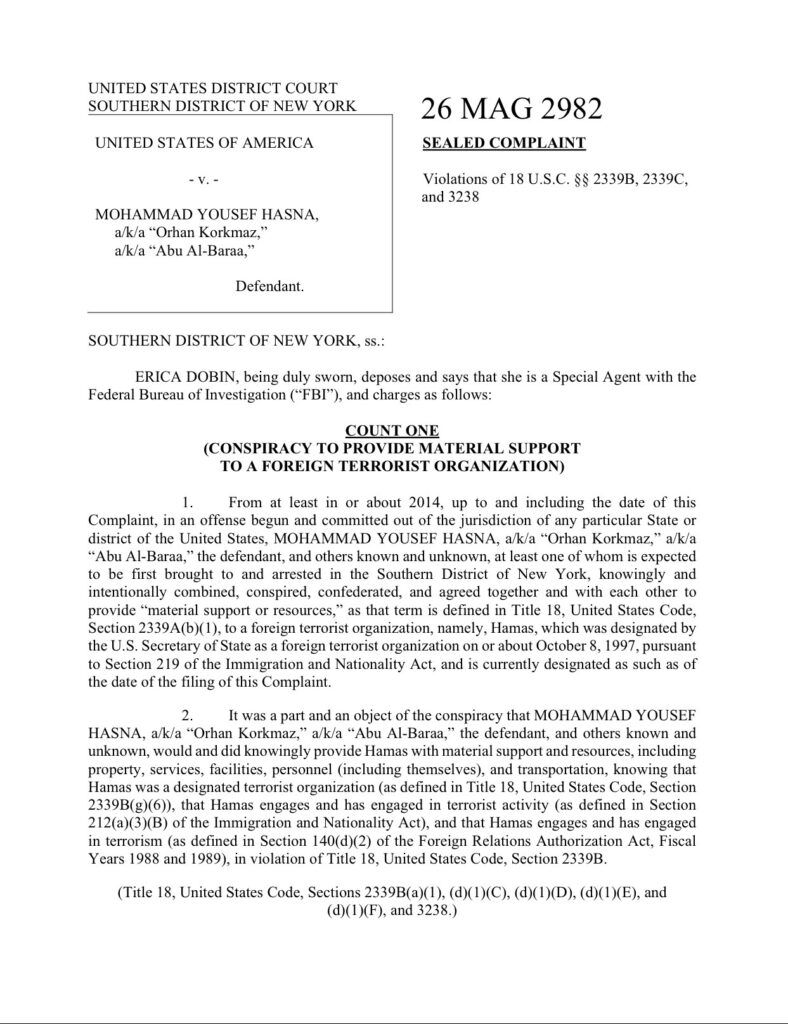
Prosecutors allege that Hasna:
- Arranged cash deliveries to Hamad.
- Procured food and hygiene parcels.
- Coordinated trucks entering Gaza from Egypt and elsewhere.
- Used Sham Charity, Jordanian and Hamas-controlled warehouses.
- Distributed supplies according to recipient lists provided by Hamad.
- Altered or controlled photographs and videos to obscure who received the goods.
- Used humanitarian organizations as intermediaries to conceal the actual distribution network.
The complaint says Hasna and Hamad discussed removing signs and identifying information from photographs and videos so that donors and outsiders would not understand who ultimately controlled or received the shipments.
One exchange allegedly concerned an order for approximately 20,000 food parcels, transportation by 30 trucks and an invoice totaling approximately $727,500. Investigators interpreted the communications as showing that approximately 5,000 parcels would be diverted to satisfy an agreement between Hasna and Hamad.
Other exchanges allegedly concerned shipments stored at Ministry of Social Development warehouses and efforts to conceal the true receiving and distribution structure. The FBI’s interpretation is that the parties were moving purported humanitarian assistance through a network ultimately benefiting Hamas.
The complaint also describes a ledger showing approximately $5.258 million in incoming funds, approximately $3.125 million in listed expenditures and approximately $700,000 described as being “in Dr.’s hand.” The FBI interprets “the Doctor” as Hamad.
The Department of Justice says the Sham Charity reported that its gross income increased from approximately $41.8 million in fiscal year 2023 to $81.56 million in fiscal year 2024, followed by approximately $100 million in reported income for fiscal year 2025.
Hasna was arrested in Britain with assistance from UK authorities, the Israeli Security Agency, the Justice Department’s Office of International Affairs and FBI counterterrorism personnel. That indicates a coordinated international national-security investigation, but it does not, by itself, establish that Hasna was a government intelligence asset or “cutout.”
Does the Hasna case resemble an intelligence operation?
It resembles an intelligence-derived case in the ordinary sense that investigators appear to have obtained encrypted communications, cloud-account records, voice messages, contact data, financial documents and information from foreign partners.
But that is different from proving that the defendant was an intelligence operative.
The complaint does not say:
- Hasna worked for the CIA.
- Hasna worked for the FBI.
- Hasna worked for Turkish intelligence.
- Hasna was a confidential informant.
- Hasna received immunity.
- Hasna was directed by the United States.
- Hasna had any relationship with Donald Trump or the Trump administration.
- Hasna had any relationship with Eric Adams.
Therefore, calling Hasna a CIA cutout would presently be speculation—not a conclusion supported by the charging document.
Part II: Sezgin Baran Korkmaz—the man connected to Adams and former CIA Director James Woolsey
The more plausible basis for the “CIA cutout” question is not Hasna. It is Sezgin Baran Korkmaz.
Korkmaz was indicted in Utah in 2021 and extradited from Austria in 2022. Federal prosecutors accused him of laundering more than $133 million in proceeds connected to a scheme that sought more than $1 billion in fraudulent renewable-fuel tax credits from the U.S. Treasury.
The alleged proceeds were used to purchase or finance:
- Borajet, a Turkish airline.
- Hotels in Turkey and Switzerland.
- A yacht called the Queen Anne.
- A villa and apartment along the Bosphorus.
- Other companies and luxury assets.
The government additionally accused Korkmaz of taking $6 million from Jacob and Isaiah Kingston after falsely claiming he could obtain protection for them through unnamed government officials.
That alleged representation—that he could use government relationships to interfere with American investigations—is particularly relevant when evaluating his political and intelligence connections.
Korkmaz’s connections to Trump-world figures
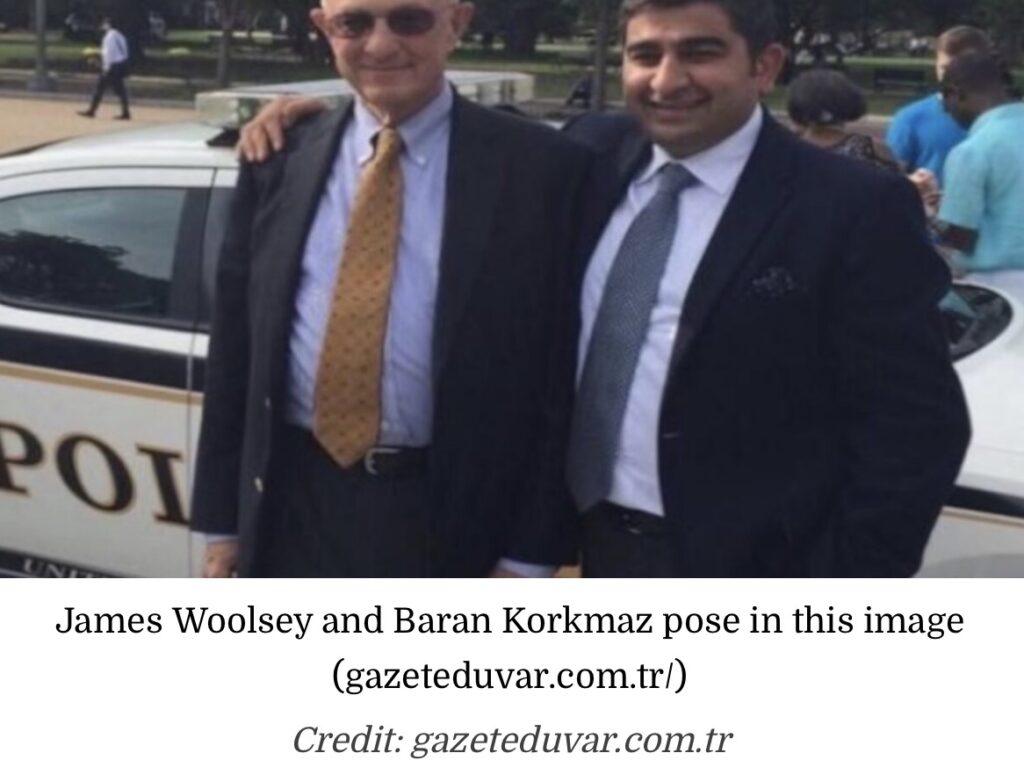
Korkmaz had documented contact with R. James Woolsey, the former CIA director who advised Donald Trump’s 2016 presidential campaign.
Reporting has placed Korkmaz and Turkish businessman Ekim Alptekin at a September 2016 meeting with Woolsey. The men reportedly discussed a multimillion-dollar project aimed at discrediting Fethullah Gülen, the Turkish cleric living in Pennsylvania whom President Recep Tayyip Erdoğan blamed for the attempted Turkish coup.
Korkmaz also participated in a 2018 backchannel effort involving Woolsey and Tommy Hicks Jr., a major Trump fundraiser, concerning efforts to secure the release of American pastor Andrew Brunson from Turkey.
Those contacts establish that Korkmaz moved within circles containing:
- A former CIA director.
- A Trump campaign adviser.
- A major Trump fundraiser.
- Turkish government-connected businesspeople.
- Individuals attempting unofficial diplomatic initiatives.
They do not conclusively establish that Korkmaz was a CIA asset. The Los Angeles Magazine article describes him as a “reputed CIA asset,” based largely on unnamed sources and his proximity to Woolsey and politically sensitive operations. No public CIA document, court finding or sworn government admission identified in this research confirms that status.
The most defensible description is:
Korkmaz had extraordinary relationships with former intelligence, political and diplomatic figures, and reporting has alleged that he was an intelligence asset, but that allegation remains publicly unproven.
Part III: Korkmaz and Eric Adams
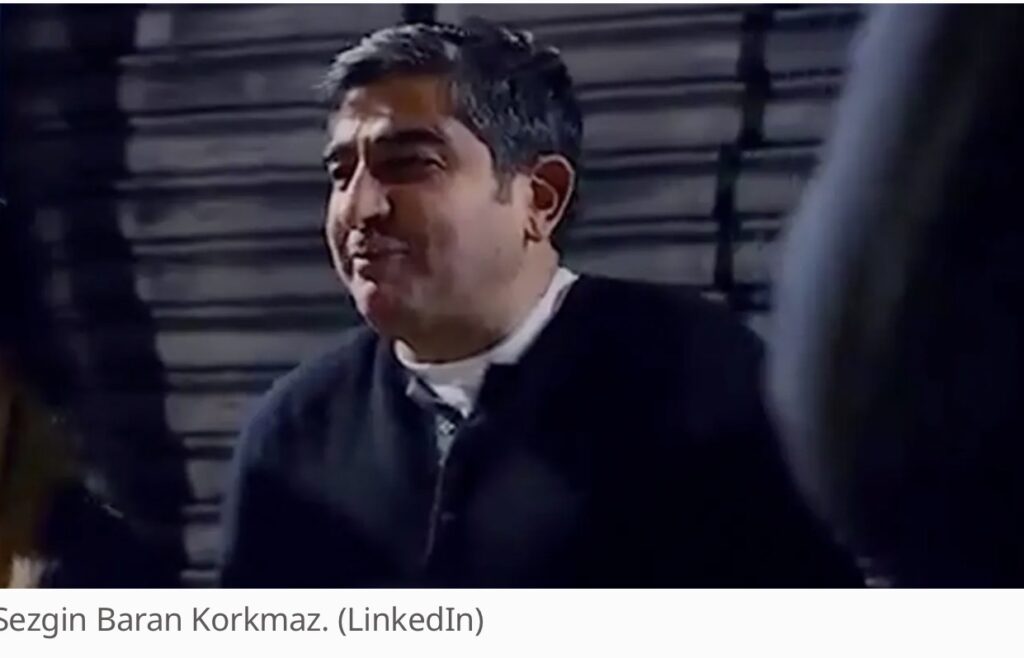
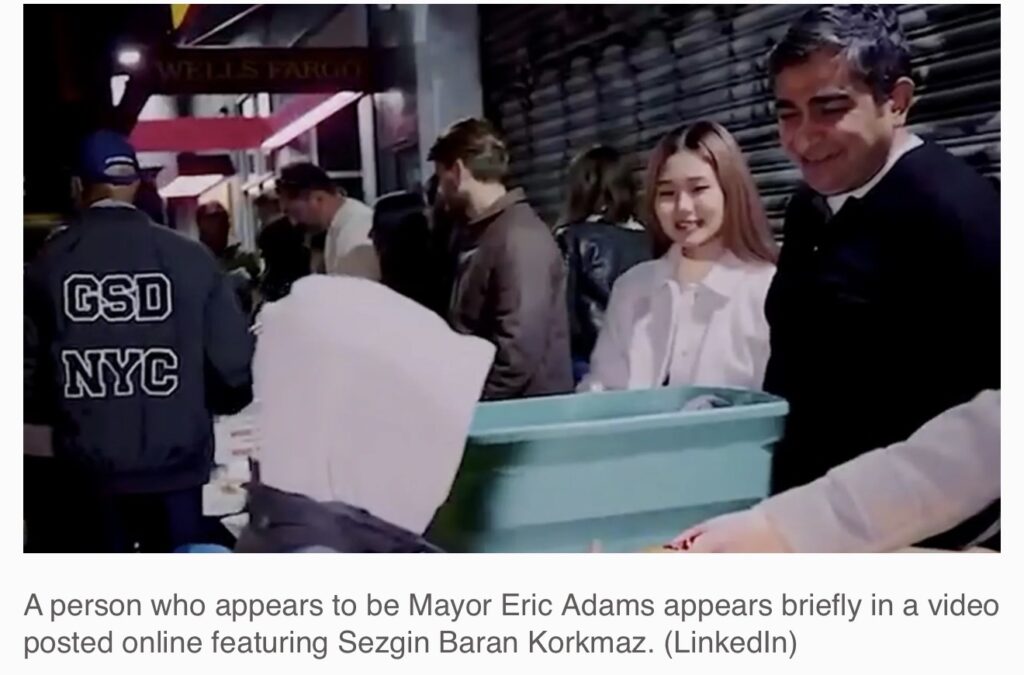
The original Adams indictment described a Turkish national called “Businessman-3.” Multiple reports identified that person as Sezgin Baran Korkmaz.
According to the indictment, Adams met Businessman-3 in Istanbul in January 2019, despite being warned by a Turkish official that the businessman was suspected of wrongdoing.
Prosecutors alleged that Adams and an intermediary discussed Businessman-3 contributing $50,000 or more toward Adams’s anticipated 2021 mayoral campaign. Because the businessman was a foreign national and legally prohibited from contributing directly, the discussion allegedly shifted toward making donations through U.S. citizens.
The indictment did not allege that Adams ultimately received Korkmaz’s proposed $50,000. It said Adams later stopped communicating with Businessman-3 after the businessman’s legal problems became public.
That helps answer the question: Why was Adams not separately charged specifically over Korkmaz?
The reported evidence concerned solicitation and discussion of an illegal foreign-funded straw-donor arrangement, but the indictment acknowledged that the planned contribution apparently was not completed. Adams was nevertheless charged with two broader counts involving solicitation of foreign-national contributions based on the overall Turkish fundraising operation.
Korkmaz was reportedly expected to testify at Adams’s 2025 trial. Los Angeles Magazine reported that he was cooperating with federal authorities and had been seen out of custody despite initially being detained as a serious flight risk.
His reported release does not automatically prove misconduct. Defendants can be released under strict conditions, particularly when they cooperate, provide substantial assistance or no longer present the same assessed risk. But the unusual circumstances and lack of public transparency naturally raised questions about whether Korkmaz had entered a cooperation arrangement.
Because the Adams prosecution was terminated before trial, the public never heard:
- Korkmaz’s sworn testimony.
- The full terms of any cooperation arrangement.
- How prosecutors authenticated his account.
- Whether defense lawyers could demonstrate that he expected leniency.
- Whether his testimony was consistent with his Utah case.
- Whether his claimed relationships with government officials were real or exaggerated.
- Whether he had intelligence connections.
That is one of the most consequential consequences of the Adams dismissal.
Part IV: What the original Eric Adams indictment actually alleged
Eric Adams was, in fact, indicted.
The September 2024 indictment charged him with:
- Conspiracy to commit wire fraud, receive foreign contributions and commit bribery.
- Wire fraud.
- Two counts of soliciting contributions from foreign nationals.
- Soliciting and accepting a bribe.
Federal prosecutors alleged that, beginning during Adams’s time as Brooklyn borough president, he accepted luxury travel and benefits from Turkish government-connected individuals and businesspeople.
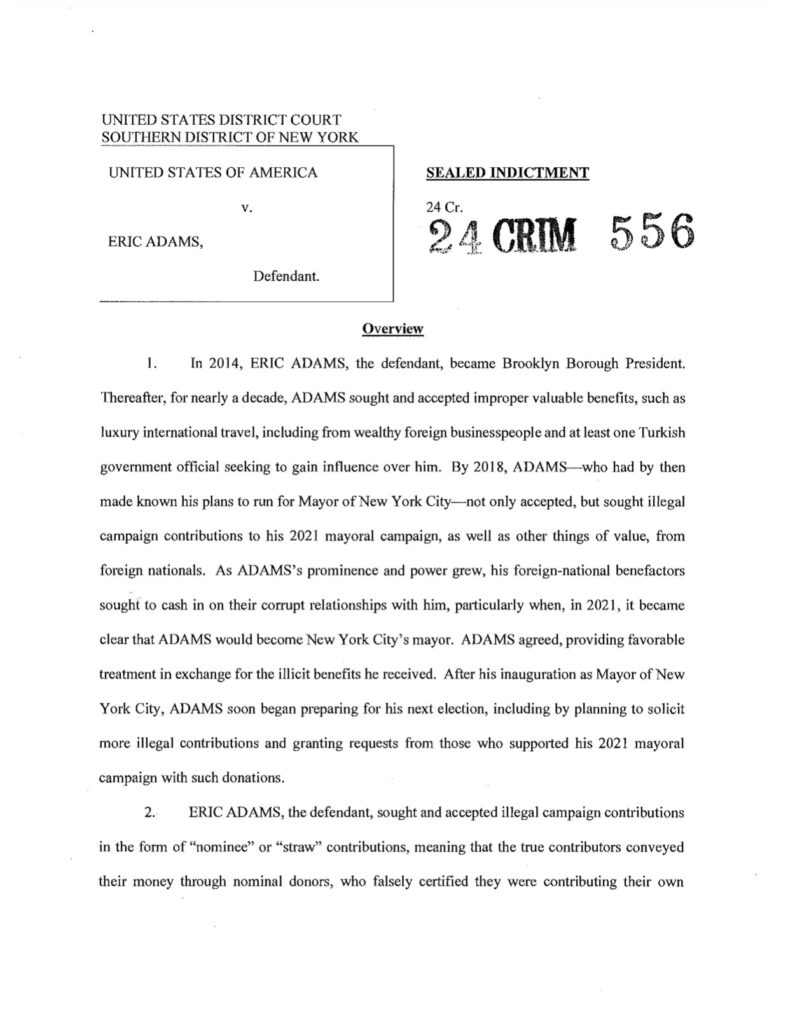
The alleged benefits included discounted or free business-class flights, hotel rooms, meals, entertainment and other travel accommodations worth more than $100,000. Prosecutors alleged that Adams concealed those benefits from required financial disclosures and sometimes created paper trails suggesting that he had paid when he allegedly had not.
The government further alleged that Turkish nationals secretly financed campaign contributions through American straw donors. Those contributions were particularly valuable because New York City’s matching-funds system could multiply eligible private contributions with taxpayer money.
The central bribery allegation involved the Turkish government’s new Manhattan consular building, the Türkevi Center.
Prosecutors alleged that a Turkish official who had helped arrange benefits for Adams requested that Adams pressure the FDNY to allow the building to open in time for a visit by Erdoğan despite unresolved fire-safety issues. Adams allegedly contacted senior FDNY leadership, after which an FDNY official was pressured to provide conditional authorization.
The indictment also alleged that Turkish representatives pressured Adams’s circle regarding Armenian Genocide Remembrance Day and that Adams did not issue a statement after the request.
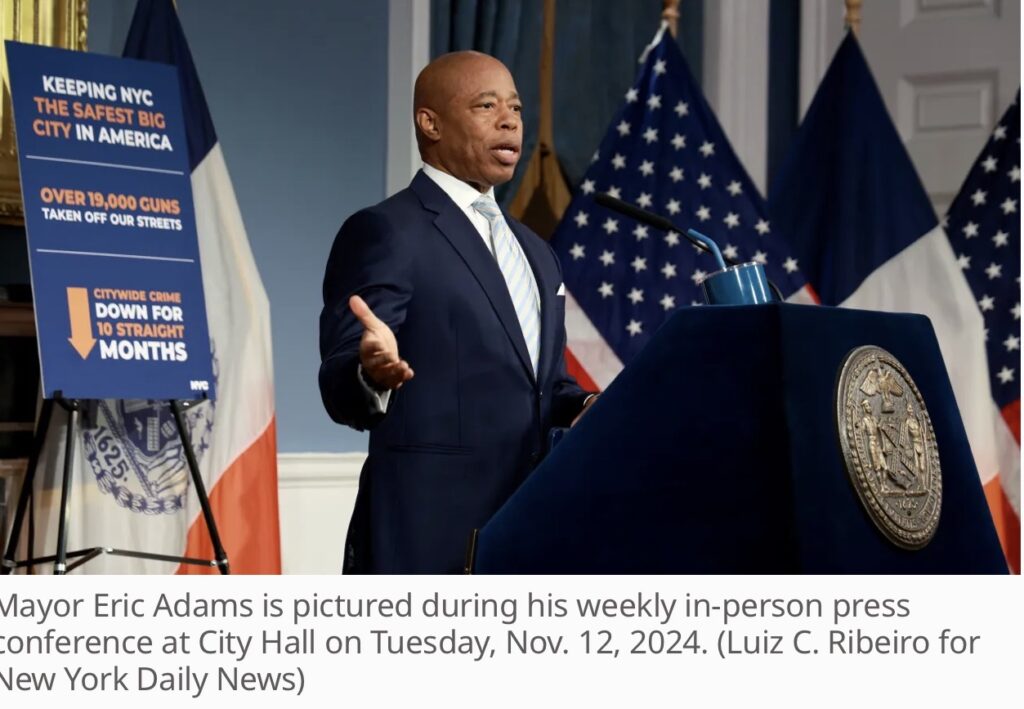
Adams denied every accusation and pleaded not guilty. His attorney maintained that the travel arrangements were lawful, the FDNY communication was an ordinary constituent-style request and no corrupt exchange existed.
None of these accusations were adjudicated at trial.
Part V: Why the Adams case was dismissed
The case was not dismissed because a jury acquitted Adams.
It was not dismissed after a judge found that the evidence was fabricated.
It was not dismissed because the court ruled that Adams was innocent.
The Trump Justice Department ordered prosecutors to seek dismissal, initially without prejudice, which would have allowed the government to revive the charges later.
DOJ leadership argued that the prosecution interfered with Adams’s ability to support the Trump administration’s immigration-enforcement priorities and affected the 2025 mayoral election.
That rationale led to an extraordinary institutional crisis. Acting U.S. Attorney Danielle Sassoon and several senior Justice Department prosecutors resigned rather than carry out the instruction.
Judge Dale Ho appointed an independent friend of the court because both prosecutors and Adams were now asking for the same outcome, leaving no adversarial party to scrutinize the government’s request. The judge emphasized the public importance of the matter and the unusual alignment between the prosecution and defense.
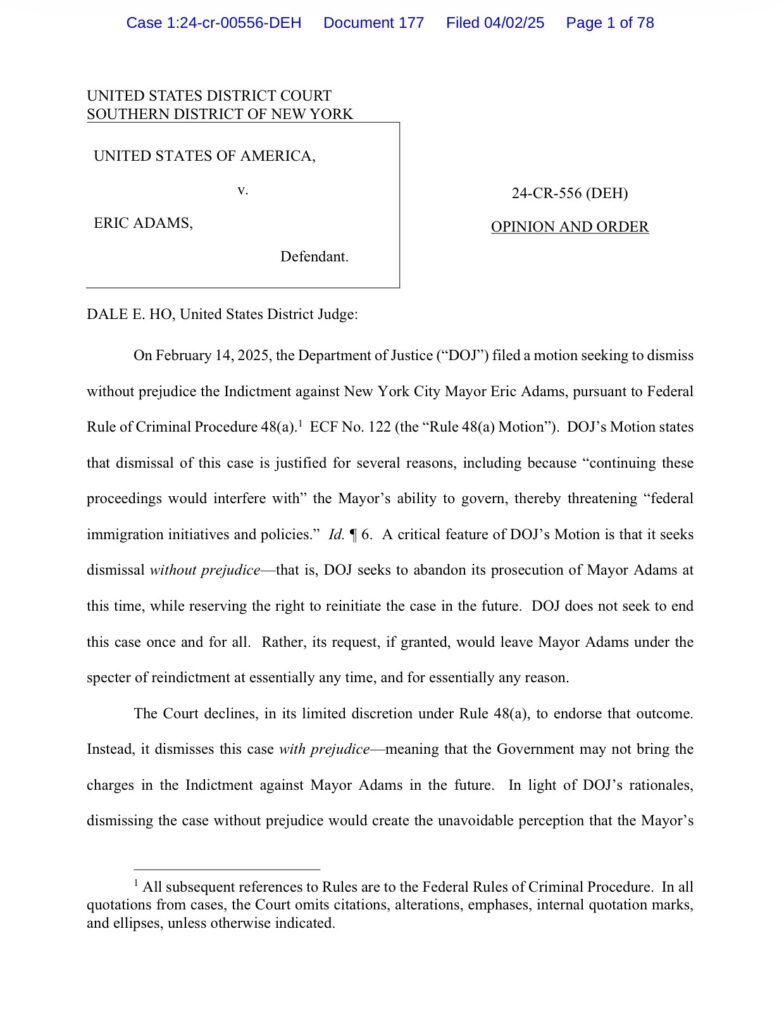
On April 2, 2025, Judge Ho dismissed the indictment with prejudice, permanently preventing the same prosecution from being restored.
The judge did so because leaving the charges hanging over Adams could have created the appearance that the mayor’s freedom depended on satisfying the federal government’s political demands. At the same time, Ho made clear that the dismissal did not determine whether Adams was guilty or innocent and did not vindicate the merits of the indictment.
Calling the dismissal “disgraceful” is an opinion, but there is a strong factual basis for describing it as extraordinary and institutionally damaging:
- Career prosecutors resigned.
- The government abandoned its own prosecution.
- Its stated justification included Adams’s usefulness to federal immigration policy.
- The court rejected the government’s request to preserve leverage through a dismissal without prejudice.
- No jury ever heard the evidence.
- Potential witnesses such as Korkmaz were never cross-examined.
- The public was deprived of a verdict.
Part VI: Adams, Trump and Mar-a-Lago
Adams met with President-elect Trump at Mar-a-Lago on January 17, 2025, while his criminal case remained pending. Adams said the meeting concerned public safety, economic development, infrastructure and other issues affecting New York City.
Trump had publicly expressed sympathy for Adams, suggesting that the mayor was treated unfairly and indicating he would consider a pardon.
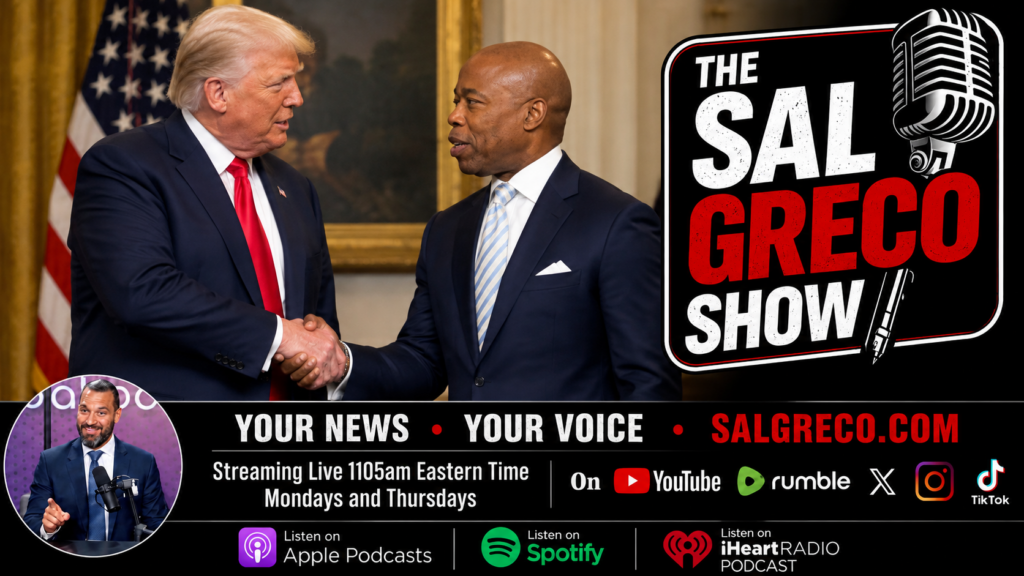
The criminal charges were later ordered dismissed by Trump-appointed Justice Department leadership.
Adams and Trump’s representatives denied that there was a quid pro quo.
Nevertheless, the sequence created an unavoidable appearance problem:
- Adams was federally indicted.
- Adams moved politically closer to Trump.
- Adams traveled to meet Trump at Mar-a-Lago.
- Trump’s Justice Department ordered the case dropped.
- The government cited Adams’s ability to assist federal immigration policies.
- Adams’s administration expanded cooperation with federal immigration authorities.
- Adams later took official action that protected a casino proposal carrying a potential nine-figure benefit for the Trump Organization.
That sequence does not itself prove a criminal agreement. It does justify aggressive investigation and public scrutiny.
Part VII: The Trump-linked Ferry Point casino deal
The Ferry Point transaction must be stated precisely.
Bally’s acquired the rights to operate the former Trump golf course in the Bronx. The reported agreement called for approximately $60 million paid to the Trump Organization up front, plus another $115 million if Bally’s obtained a casino license at the location.
That produces the widely reported $175 million total potential benefit. It is inaccurate to say Trump “pocketed $175 million” solely because of Adams’s veto. Approximately $60 million was tied to the original transfer, while the additional $115 million depended on the casino approval and licensing process.
Eric Trump publicly described the arrangement as too attractive to reject.
In July 2025, the City Council rejected a required land-use change, threatening to eliminate Bally’s proposal. Adams vetoed that rejection, keeping the project alive and preserving the Trump Organization’s opportunity to receive the additional $115 million.
Adams argued that every borough and every casino applicant deserved a fair opportunity, and that the Bronx project promised jobs, investment and community benefits. His office denied that political relationships influenced his decision.
However, the situation contained overlapping relationships:
- Trump’s Justice Department had caused Adams’s indictment to be dismissed.
- Adams had met Trump at Mar-a-Lago.
- Trump had publicly defended Adams.
- Steve Witkoff reportedly helped broker the original Trump-Bally’s arrangement before joining Trump’s administration.
- Adams campaign attorney Vito Pitta became a Bally’s lobbyist.
- Political consulting firms connected to Adams’s network worked with Bally’s or other casino bidders.
- Adams’s veto preserved a potential $115 million payment to Trump’s company.
No public charging document currently establishes that the criminal case was dismissed in exchange for Adams’s casino action. The timing is also important: the Justice Department began the dismissal process in February 2025, the court terminated the case in April, and Adams’s decisive casino veto came in July.
That timeline weakens a simplistic claim that the dismissal was directly traded for the July veto.
But a more nuanced question remains legitimate:
Did the dismissal create a political debt or relationship that later influenced Adams’s willingness to use mayoral power in a way that materially benefited Trump’s private business interests?
That question deserves records, testimony and investigation. It should not be presented as a proven criminal fact without evidence of communications or an agreement.
Part VIII: The Turkish hotel investigation
The Turkish article concerning The Plaza Bodrum relates to Sezgin Baran Korkmaz, not Mohammad Hasna.
Turkish prosecutors alleged that a group used high-interest lending, corporate pressure and manipulation of property rights to take control of a luxury Bodrum resort without properly compensating its owners. The suspected offenses include money laundering, usury and participation in a criminal organization.
Korkmaz was listed among suspects believed to be outside Turkey. The property was seized and transferred to the control of Turkey’s Savings Deposit Insurance Fund.
This adds to the questions surrounding Korkmaz’s credibility and leverage as a potential U.S. government witness.
A witness simultaneously facing:
- A major American money-laundering prosecution.
- Potential cooperation obligations.
- Turkish criminal exposure.
- Asset-seizure proceedings.
- Allegations involving politically connected property transactions.
would have powerful incentives to cooperate with whichever government could provide the most protection.
That does not make his testimony false. It makes disclosure and cross-examination critical—two things that never occurred in the Adams case because the prosecution was terminated.
Is this a CIA cutout operation?
The available evidence supports suspicion about Sezgin Baran Korkmaz’s access, not a definitive conclusion that he was a CIA cutout.
The strongest facts are:
- He had direct access to former CIA Director James Woolsey.
- He participated in politically sensitive Turkish-American backchannels.
- He had relationships with Turkish elites and Trump-connected figures.
- He allegedly claimed he could obtain protection through government officials.
- He was released pending a serious federal money-laundering trial after originally being described as a significant flight risk.
- Reporting indicated that he was cooperating against Adams.
- His anticipated testimony disappeared from public scrutiny when DOJ ended the Adams case.
But a cutout is normally an intermediary used to conceal the identity or role of an intelligence service. To responsibly establish that label, one would need evidence such as:
- Intelligence-tasking records.
- Payment or reimbursement records.
- Handler communications.
- Classified or declassified operational documents.
- Sworn testimony from intelligence officials.
- A cooperation agreement referencing intelligence work.
- Government motions invoking classified-information procedures.
- Records showing that his release was based on national-security assistance.
None of that has been made public.
The responsible conclusion is therefore:
Korkmaz’s political, intelligence-adjacent and government connections are real and deserve investigation. The public record does not yet prove that he was a CIA asset or cutout. Hasna’s new terrorism case currently appears separate from Korkmaz, Adams and the Ferry Point casino controversy.
The unanswered questions
The Adams dismissal did not make these questions disappear:
What were the precise terms of Korkmaz’s release from federal custody?
Did he sign a cooperation or non-prosecution agreement?
Was he promised consideration in the Utah case for information concerning Adams?
Did he perform services for the CIA, FBI, State Department, Department of Defense or any allied intelligence service?
What was his complete relationship with James Woolsey, Tommy Hicks Jr., Ekim Alptekin and other Trump-connected figures?
Did any Trump-world intermediary discuss Adams’s criminal case before or after the Mar-a-Lago meeting?
Did anyone discuss the Ferry Point casino with Adams while his prosecution was pending or during the dismissal process?
Did Adams, his campaign, his attorneys or his political advisers communicate with Bally’s, the Trump Organization, Steve Witkoff or Trump administration officials concerning both the prosecution and the casino?
Did DOJ preserve the evidence collected in the Adams investigation, including evidence involving Businessman-3?
Why has the Utah prosecution against Korkmaz remained unresolved for years?
What foreign governments or intelligence services provided information regarding Korkmaz?
Why was the public never permitted to hear the evidence against Adams or the defense’s response at trial?
Conclusion
The new Hasna indictment is a serious international terrorism-financing case. It alleges that a senior charity official secretly moved money, commodities and humanitarian shipments according to instructions from Hamas leadership while manipulating records and images to conceal the true beneficiaries.
But Hasna is not the Turkish businessman connected to Eric Adams.
That person is Sezgin Baran Korkmaz—a defendant in a sprawling American fraud and money-laundering case, an associate of former CIA Director James Woolsey, a participant in Turkish-American political backchannels and the reported Businessman-3 who allegedly discussed an illegal $50,000 campaign contribution with Adams.
Adams was indicted. His case was not disproven. It was terminated after intervention by the Trump Justice Department under circumstances so unusual that prosecutors resigned and a federal judge warned about the appearance of political leverage.
Months later, Adams used his veto power to preserve a Bronx casino bid that could produce an additional $115 million for the Trump Organization—on top of the approximately $60 million already connected to its transfer of the property rights.
There is not yet public evidence sufficient to charge that the criminal dismissal and the casino action were components of a provable quid pro quo. But the overlapping money, personalities, foreign relationships, intelligence-adjacent figures, government interventions and unexplained cooperation arrangements demand transparency.
The Hasna prosecution does not presently connect those dots.
The Korkmaz-Adams-Trump network, however, contains enough established connections that dismissing the questions as mere conspiracy theory would be just as irresponsible as declaring the theory proven.