
BY SAL GRECO
There is a difference between journalism and rooting for a team.
At SalGreco.com, we have criticized Mayor Zohran Mamdani when we believed he deserved criticism. We have questioned his priorities, challenged his policies and called attention to decisions we believed were disconnected from the everyday problems facing New Yorkers.
But journalism cannot simply become an endless exercise in attacking someone because you don’t like the person, his politics, his religion, his associations or the people standing around him.
Sometimes a politician you disagree with gets something right.
When that happens, you say so.
And on one of New York City’s most serious infrastructure problems—the deteriorating Brooklyn-Queens Expressway—the Mamdani administration deserves credit for finally putting forward a substantial plan.
That was the discussion at the center of Episode 222 of The Sal Greco Show.
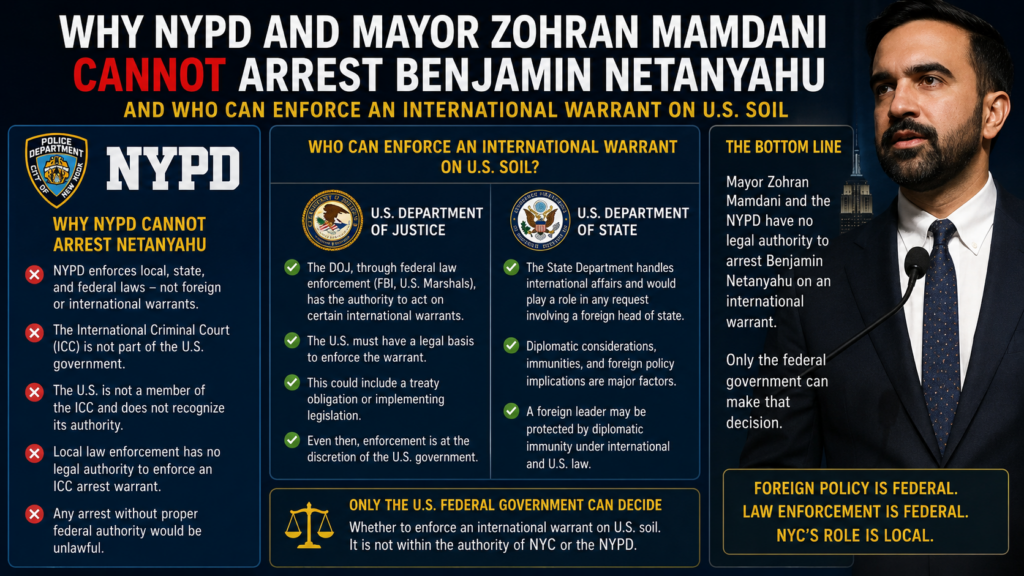
WE ASKED WHY CITY HALL WAS TALKING ABOUT NETANYAHU WHILE NEW YORK WAS FALLING APART
Only weeks ago, our coverage was considerably more critical.
New York City was dealing with repeated flooding and infrastructure problems. Major roadways were showing their age. New Yorkers were once again watching what happens when a nearly 400-year-old city attempts to function with infrastructure that has been patched, repaired, ignored and politically kicked down the road for generations.
Yet one of the subjects commanding attention from Mayor Mamdani was Israeli Prime Minister Benjamin Netanyahu.
Mamdani had repeatedly discussed the prospect of Netanyahu being arrested in connection with the International Criminal Court warrant if he came to New York.
Whatever someone’s position on Israel, Netanyahu, Gaza or the ICC, SalGreco.com’s criticism was about something much closer to home:
You’re the mayor of New York City. What about New York City?
While politicians and activists were arguing about an international conflict thousands of miles away, New Yorkers were dealing with flooding, aging transportation infrastructure and a BQE that has been deteriorating for decades.
We wrote about it.
We discussed it on The Sal Greco Show.
We questioned why the mayor was devoting oxygen to Netanyahu while the city he had actually been elected to run had enormous problems sitting directly in front of him.
It was a criticism of priorities.
And now something has changed.
MAMDANI’S ADMINISTRATION IS ADDRESSING THE BQE
The mayor’s administration has unveiled an ambitious plan to rehabilitate the city-owned portion of the Brooklyn-Queens Expressway.
The project focuses on approximately 1.5 miles of BQE Central, the city-controlled section running between Atlantic Avenue and Sands Street in Brooklyn.
And the price tag is enormous:
Approximately $4 billion.
Construction is currently expected to begin in 2030, with the massive rehabilitation potentially taking roughly a decade to complete.
This isn’t filling potholes.
It isn’t putting up some new signs and declaring victory.
The proposal tackles one of the most complicated pieces of aging infrastructure in New York City, including the famous Triple Cantilever beneath the Brooklyn Heights Promenade.
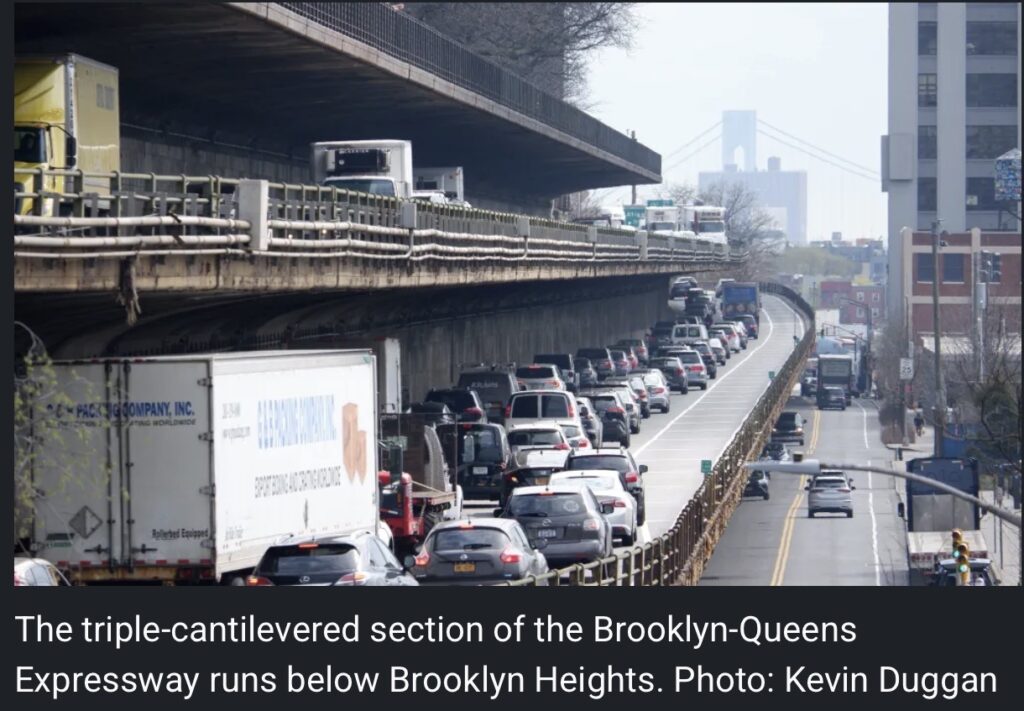
That structure has become a symbol of the larger BQE problem: infrastructure designed for another era now carrying a volume and type of traffic its original planners could never have realistically anticipated.
130,000 VEHICLES A DAY
The numbers tell the story.
The BQE Central corridor carries approximately 130,000 vehicles every day, including roughly 13,000 heavy trucks.
Think about that.
Day after day.
Year after year.
Decade after decade.
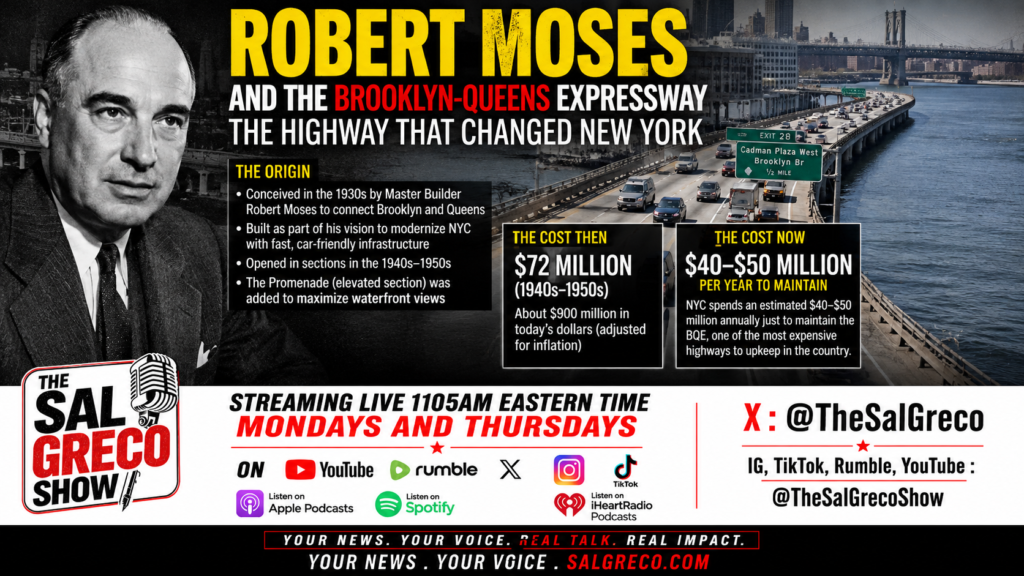
The expressway was built during the Robert Moses era and portions of BQE Central date to the 1950s. The roadway was designed around a dramatically different New York City and dramatically different traffic demands.
Now it is approximately 70 years old.
Mamdani’s own presentation made the problem clear: this isn’t a new crisis.
Previous administrations knew about it.
Panels were created.
Proposals were announced.
Studies were conducted.
Politicians talked.
And the BQE kept getting older.
That is precisely the kind of government paralysis we have criticized.
THE PLAN: REBUILD THE CITY-OWNED SECTION
Rather than attempting to remake the entire Brooklyn-Queens Expressway in one gargantuan project, the Mamdani administration’s proposal concentrates on the approximately 1.5 miles actually controlled by New York City.
The plan calls for rehabilitating the aging concrete and rebuilding the deteriorating infrastructure around the Triple Cantilever.
The project would also include improvements to drainage, lighting, railings and other infrastructure associated with the corridor.
The goal is to extend the useful life of this portion of the BQE by approximately 40 additional years.
If the project begins around 2030, takes approximately a decade and achieves its intended lifespan extension, New York could conceivably be relying upon the rehabilitated structure into roughly 2080.
That is not a temporary patch.
It is an attempt to deal with the problem on a generational scale.
HOW DO YOU REBUILD THE BQE WITHOUT PARALYZING BROOKLYN?
That brings us to one of the biggest problems discussed during Episode 222.
Where do you put the traffic?
You cannot simply shut down a highway carrying approximately 130,000 vehicles every day and tell everyone to figure it out.
Dumping that volume onto neighborhood streets would create chaos.
The administration’s proposal attempts to solve that problem through temporary bypass roadways designed to keep vehicles moving while sections of the existing BQE are rehabilitated.
One temporary structure would run through the area around Furman Street beneath the Brooklyn Heights Promenade.
Another temporary elevated bypass would accommodate traffic farther along the construction zone toward the Brooklyn and Manhattan Bridge approaches.
The concept is straightforward even if the engineering will be anything but:
Rebuild the BQE while keeping the BQE functioning.
That is going to be an enormous challenge.
There will be concerns about traffic.
There will be concerns about noise.
There will be concerns about construction.
There will be concerns from Brooklyn residents about what temporary roadways mean for their neighborhoods.
Those questions are legitimate and should be examined throughout the project’s development.
But doing nothing is also a decision—and New York has effectively been making that decision for decades.
THE PROJECT DOESN’T BEGIN UNTIL 2030
There is an important caveat.
This isn’t starting tomorrow.
The current timetable calls for construction to begin around 2030.
That means years of planning, engineering, environmental review and additional work remain before construction begins.
If everything proceeds according to the current timetable, the rehabilitation could continue until approximately 2040.
That is a long time.
But look at the scale of what we’re talking about.
This is one of the most heavily traveled urban roadways in the country, surrounded by some of the densest neighborhoods in America.
There was never going to be a realistic scenario where somebody showed up with a few bulldozers next year and finished the BQE by Christmas.
This is a monumental infrastructure project.
Our concern will be whether 2030 remains 2030.
Government has a remarkable ability to turn five years into ten and $4 billion into considerably more than $4 billion.
That is where journalism comes back into the picture.
Announcing a plan is one thing.
Executing it is another.
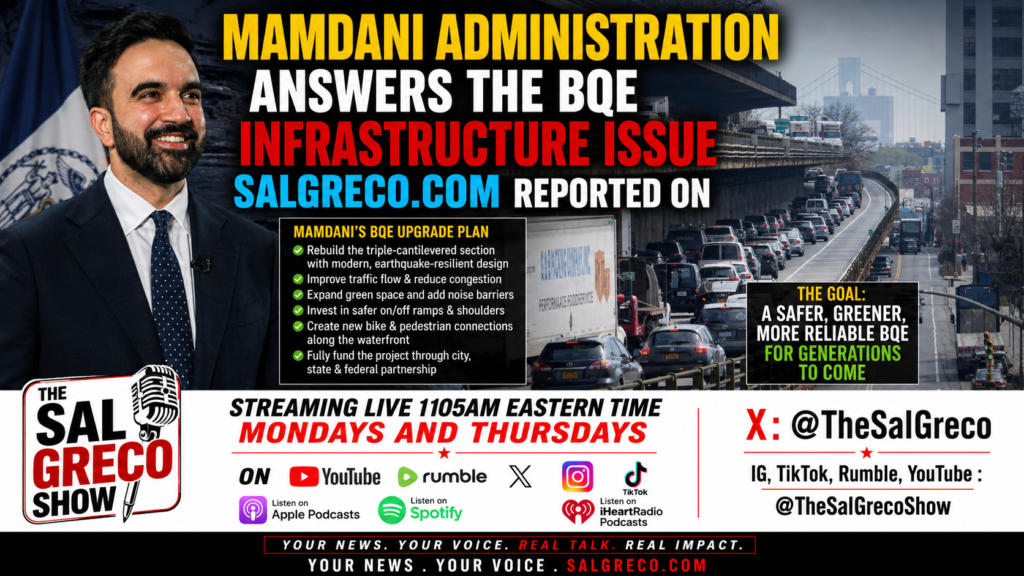
THE FEDERAL GOVERNMENT ISN’T THE CENTER OF THIS PLAN
Another significant component discussed during Episode 222 is that the city is not structuring this project around waiting for Washington to ride to the rescue.
That could prove important.
Major infrastructure projects frequently become trapped between city, state and federal governments, with every level waiting for somebody else to provide money, issue approvals or accept responsibility.
The Mamdani administration is concentrating on the section New York City owns and controls.
There is logic to that.
Instead of announcing an enormous reconstruction of an entire interstate corridor that City Hall does not completely control, fix what the city actually has jurisdiction over.
That doesn’t solve every BQE problem.
It does potentially solve one of the most immediate ones.
ROBERT MOSES BUILT FOR ANOTHER NEW YORK
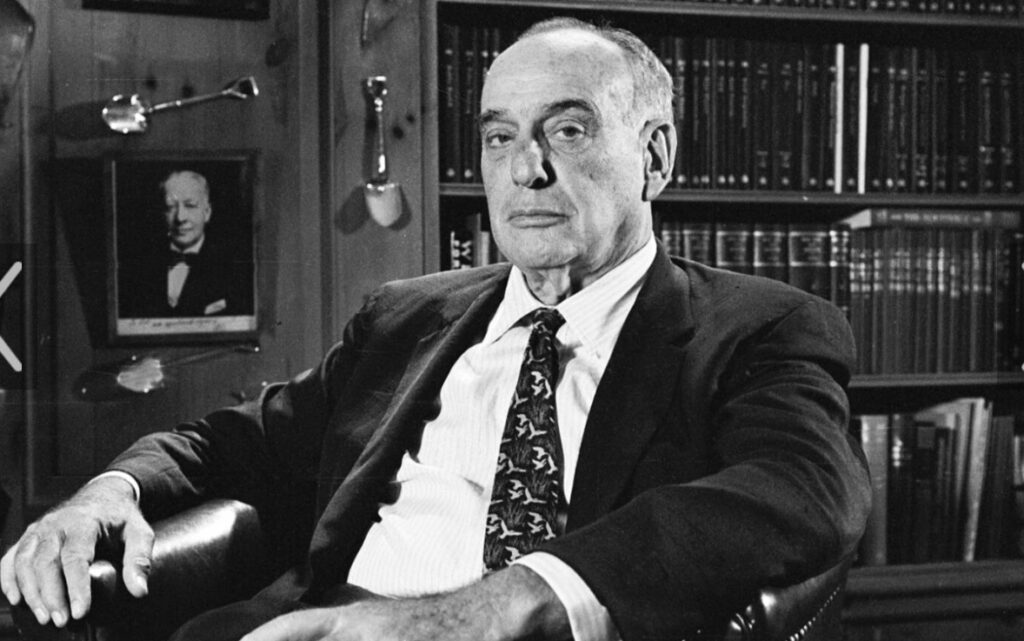
Mamdani’s announcement also spent time discussing Robert Moses.
Some viewers may have wondered why a 2026 infrastructure announcement needed a history lesson about a man whose greatest influence over New York occurred generations ago.
But the history matters.
Moses helped reshape New York around highways and automobile transportation on a scale almost impossible to comprehend today.
The construction of projects like the BQE involved enormous government power, eminent domain and the destruction or division of neighborhoods.
His legacy remains fiercely debated.
To some, Moses was the master builder who created infrastructure New York still depends upon.
To others, he represents the arrogance of unelected power and an urban-planning philosophy that sacrificed neighborhoods for highways.
Both realities are part of New York’s history.
But the most important point in 2026 is considerably simpler:
New York is still driving on infrastructure built for Robert Moses’ New York.
And modern New York is placing demands on that infrastructure that could not have been contemplated seven decades ago.
At some point, somebody has to rebuild it.
SALGRECO.COM CALLS BALLS AND STRIKES
This is where our coverage may frustrate people who believe journalism requires choosing a political jersey and never taking it off.
Some people despise Mamdani.
Some attack him because of his religion.
Some attack him because of his associations.
Others label him an antisemite.
At the same time, Mamdani has received significant political support from voters across New York’s extraordinarily diverse ethnic and religious communities—including constituencies that his critics sometimes insist would never support him.
That complexity gets lost when every story becomes an ideological purity test.
SalGreco.com isn’t interested in that game.
We call balls and strikes.
If Mamdani screws up a policy, we’ll criticize him.
If he makes a political decision we believe hurts New York City, we’ll say it.
If City Hall wastes taxpayer money, we’ll investigate it.
If the administration prioritizes political theater while New Yorkers are dealing with problems directly outside their front doors, we’ll call that out too.
We already have.
But when the mayor gets something right?
We will say that too.
When his administration advances a policy that could benefit New York City taxpayers?
Kudos.
When City Hall attempts to solve a decades-old infrastructure problem that administrations from both parties and across the ideological spectrum have failed to resolve?
Give them credit.
That isn’t an endorsement of everything Mamdani believes.
It isn’t abandoning previous criticism.
It is journalism.
WE CRITICIZED HIM. NOW WE GIVE HIM CREDIT.
There is actually something valuable about the sequence of events here.
SalGreco.com complained that New York City’s infrastructure was deteriorating while City Hall’s political conversation was being consumed by subjects like Netanyahu.
We wrote about it.
We covered it on The Sal Greco Show.
We said somebody needed to address the infrastructure.
Now the administration has come forward with a major BQE proposal.
We are not going to pretend our criticism never happened.
And we are not going to pretend the administration’s announcement doesn’t exist simply because praising Mamdani might upset people who dislike him.
The standard has to work both ways.
If you’re willing to hammer someone when they’re wrong, you should be willing to acknowledge them when they’re right.
Otherwise you’re not reporting.
You’re campaigning.
NOW COMES THE REAL TEST
The BQE plan looks promising on paper.
But New York City has a long history of promising massive projects whose costs explode, schedules slip and original ambitions become diluted somewhere between the press conference and completion.
So SalGreco.com will be watching.
Does construction actually begin in 2030?
Does approximately $4 billion remain approximately $4 billion?
Can temporary roadways keep traffic moving without destroying quality of life in the surrounding neighborhoods?
Can the city successfully rehabilitate the Triple Cantilever?
Can the project remain on schedule?
And will New Yorkers ultimately receive the additional four decades of useful infrastructure life being promised?
Those are the next stories.
For now, however, the administration deserves recognition for putting an actual plan on the table.
THAT’S JOURNALISM
Politics has become increasingly tribal.
If someone hates Mamdani, they apparently have to hate everything Mamdani does.
If someone loves Mamdani, they apparently have to defend everything Mamdani does.
That’s not how SalGreco.com operates.
We criticized him when we believed he was spending time discussing the potential arrest of Benjamin Netanyahu while New Yorkers were watching their city’s infrastructure deteriorate.
We challenged those priorities publicly.
Now his administration is focusing on exactly the kind of fundamental municipal responsibility we said deserved attention.
A roughly $4 billion rehabilitation of 1.5 miles of the city-owned BQE.
A planned 2030 construction start.
A project potentially lasting approximately 10 years.
A rehabilitation designed to give the infrastructure approximately 40 additional years of useful life.
A strategy for keeping roughly 130,000 vehicles moving every day while one of New York City’s most important highways undergoes major reconstruction.
Those are tangible objectives.
The administration now has to deliver them.
If it doesn’t, we’ll report that.
If costs explode, we’ll report that.
If the project becomes another government boondoggle, we’ll report that.
But if Mamdani’s administration succeeds in finally addressing a piece of New York infrastructure that generations of politicians talked about while the concrete continued to deteriorate?
We’ll report that too.
Criticize bad policy. Praise good policy. Follow the money. Ask the uncomfortable questions. Give credit when credit is earned.
It shouldn’t matter what religion the politician practices, what political label follows his name or whether you personally like him.
The question should be:
Did this decision benefit the people and taxpayers of New York City?
On the BQE, the Mamdani administration has put forward a plan that deserves a chance to answer that question.
Now let’s see if they build it.
That’s calling balls and strikes.
That’s journalism.